Does Ghee Have Collagen? Vitamin A, Skin, and How Much
Does ghee have collagen? No. Ghee is 99.5% fat, and USDA FoodData Central lists 0.28 g of protein in 100 g, so a teaspoon holds no collagen and none of the protein your skin makes collagen from. It does carry about 42 µg of vitamin A per 5 g teaspoon. One teaspoon a day on dal or sabzi fits a skin-friendly plate; more does not firm skin.
Does ghee have collagen?
Ghee has no collagen. Collagen is a protein, and ghee is milk fat with the protein cooked out: USDA FoodData Central lists 0.28 g of protein in 100 g of ghee, which is about 0.01 g in a teaspoon. Your skin makes its own collagen from the protein in dal, curd, milk, or eggs, with vitamin C to finish the job. Ghee supplies neither.
So why do so many pages say ghee "boosts collagen"? They point to three things in ghee: vitamin A, vitamin K2, and CLA (conjugated linoleic acid, a fat found in milk). Each is real, and each is in ghee in small amounts. Below are the amounts per teaspoon, what each one has actually been tested for, and what does more for skin that is losing its firmness. This page is for adults who eat ghee and want to know if it helps wrinkles or sagging. For puffiness and dark circles, see ghee for dark circles.
What does your skin need to make collagen?
Skin needs protein for the raw material and vitamin C to lock the collagen strands together. A 2017 review in the journal Nutrients (Pullar and colleagues) describes vitamin C as a co-factor for the two enzymes that stabilise the collagen molecule. Without enough of it, the strands your body builds are weak.
ICMR-NIN's 2024 dietary guidelines list citrus fruits, guava, amla, and tomatoes as the everyday Indian sources of vitamin C, and orange and green vegetables for vitamin A. Here is what one portion of each brings, next to a teaspoon of ghee.
One portion
Protein (g)
Vitamin C (mg)
Vitamin A (µg)
Ghee, 1 tsp (5 g)
Protein: 0 g
Vitamin C: 0 mg
Vitamin A: 42 µg
Cooked dal (lentils), 1 katori (150 g)
Protein: 13.5 g
Vitamin C: 2 mg
Vitamin A: 0 µg
Curd, 1 katori (150 g)
Protein: 5.2 g
Vitamin C: 1 mg
Vitamin A: 41 µg
Boiled egg, 1 (50 g)
Protein: 6.3 g
Vitamin C: 0 mg
Vitamin A: 75 µg
Guava, 1 small (55 g)
Protein: 1.4 g
Vitamin C: 125 mg
Vitamin A: 17 µg
Red capsicum, half (60 g)
Protein: 0.6 g
Vitamin C: 77 mg
Vitamin A: 94 µg
Lemon juice, half a lemon (24 g)
Protein: 0.1 g
Vitamin C: 9 mg
Vitamin A: 0 µg
Carrot, 1 medium (61 g)
Protein: 0.6 g
Vitamin C: 4 mg
Vitamin A: 509 µg
USDA FoodData Central values per 100 g, scaled to the portion. Vitamin A as µg RAE (retinol activity equivalents), which already counts plant carotene at its conversion rate.
The pattern is plain once it is on one screen. The dal and the egg bring the protein. A single small guava brings about 125 mg of vitamin C, and half a red capsicum about 77 mg. Half a lemon squeezed on dal, the tip people pass around for collagen, brings about 9 mg. The teaspoon of ghee brings nothing on the first two columns. What ghee does is help you absorb the fat-soluble vitamins in the vegetables it sits on, which is why the teaspoon goes on the sabzi and not in a glass of warm water. How that works is on ghee and vitamin absorption.
Is ghee a natural retinol for anti-aging?
Only in name. Ghee does contain retinol, the same vitamin A molecule sold in anti-ageing creams: USDA lists 824 µg in 100 g, about 41 µg in a teaspoon. But eaten retinol goes to your liver and is shared out to the whole body, not sent to your face, and a teaspoon is a small amount. One medium carrot gives about twelve times the vitamin A of that teaspoon.
USDA FoodData Central, SR Legacy, per 100 g scaled to the portion. Checked 27 September 2026.
| Item | Value |
|---|---|
| Carrot, 1 medium (61 g) | 509 µg |
| Red capsicum, half (60 g) | 94 µg |
| Boiled egg, 1 (50 g) | 75 µg |
| Ghee, 1 tsp (5 g) | 42 µg |
| Curd, 1 katori (150 g) | 41 µg |
| Guava, 1 small (55 g) | 17 µg |
What a retinol cream does that ghee does not
The cream is a different thing. In a 2007 trial at the University of Michigan (Kafi and colleagues, Archives of Dermatology), 36 older adults had a 0.4% retinol lotion put on one arm up to three times a week for 24 weeks. The treated arm had fewer fine wrinkles and more new collagen in skin samples than the untreated arm. A 0.4% lotion holds about 400,000 µg of retinol in 100 g, close to 500 times what the same weight of ghee holds, and it sits where the wrinkles are.
Does eating more vitamin A help skin?
Eating more vitamin A in the hope of the same result has been tested too. In a trial in Nambour, Australia (Hughes and colleagues, 2013), 903 adults took 30 mg of beta-carotene, the plant form of vitamin A, or a dummy pill for four and a half years. The beta-carotene had no overall effect on skin ageing. Thirty milligrams is the beta-carotene of roughly 3,100 teaspoons of ghee.
Eating ghee vs a retinol cream
| Factor | Ghee, 1 tsp eaten | Retinol cream on the skin | Winner |
|---|---|---|---|
| Where it acts | Digested, stored in the liver, shared out to the whole body | Sits on the skin where you apply it | Retinol cream on the skin ✓ |
| Retinol in 100 g | 824 µg (USDA) | About 400,000 µg in a 0.4% lotion | Retinol cream on the skin ✓ |
| Tested on wrinkles | No trial of ghee on wrinkles that we found | 0.4% lotion improved fine wrinkles in 24 weeks (Kafi, 2007) | Retinol cream on the skin ✓ |
| Irritation | None at a teaspoon | Dryness and peeling are common at the start | Ghee, 1 tsp eaten ✓ |
| What it is for | Food: flavour, and fat that carries vitamins from the plate | Treatment for fine lines, best chosen with a dermatologist | Tie |
Verdict: Ghee is food. If fine lines are what you want to treat, a retinol cream has the evidence, and a dermatologist can pick the strength your skin will take.
Retinol creams often sting and peel at first, so start low and ask your doctor before using one, and always if you are pregnant or planning to be. Eating ghee has none of those problems, which is also why it does none of the resurfacing.
Does the vitamin K2 or CLA in ghee help collagen?
We found no human study showing that the vitamin K2 or CLA in ghee builds collagen in skin. Both claims start from lab or bone research and jump to your face.
On vitamin K, the numbers are smaller than the claims. USDA lists 8.6 µg of vitamin K1 (phylloquinone) in 100 g of ghee, under half a microgram in a teaspoon, and gives no figure at all for vitamin K2. Pages that call ghee "one of the richest sources of K2" do not show where that number comes from. CLA is a real fat in milk, but we found no trial of CLA from ghee, or from any food, on human wrinkles.
Here is what we see in our own kitchen in Gir Somnath. In the monsoon, when the animals eat green fodder, our Gir cow ghee comes out more yellow, and "why is the colour different from last time?" is one of the questions customers ask us most on WhatsApp. A deeper yellow is the season, not a stronger skin tonic. The full vitamin and fat breakdown of a spoon is on ghee nutrition facts.
Ghee or collagen powder: which helps wrinkles more?
Neither has strong proof. Ghee has not been tested on wrinkles at all, and collagen powder's results depend on who paid for the study.
A 2021 review of 19 trials with 1,125 people (de Miranda and colleagues, International Journal of Dermatology) found that hydrolysed collagen taken for about 90 days improved skin moisture, elasticity, and wrinkles. A larger 2025 review of 23 trials with 1,474 people (Myung and Park, American Journal of Medicine) split the trials by funding. Trials funded by pharmaceutical companies found a benefit. Trials without that funding, and the higher-quality trials, found no effect on moisture, elasticity, or wrinkles. The 2025 authors concluded there is no clinical evidence to support collagen supplements for skin ageing.
Collagen powder is protein. Your gut breaks it into amino acids, the same way it breaks down the protein in dal or paneer, and the body uses them wherever it needs them. If you already eat a katori of dal and some curd every day, you are getting the raw material. A tub of powder and a spoon of ghee on top will not change that.
How much ghee a day for skin, and can too much age it?
One teaspoon a day on food is enough for skin, and 2 teaspoons is the ceiling. ICMR-NIN's 2024 dietary guidelines ask everyone to limit ghee or butter to 1 to 2 teaspoons a day, and nothing about skin changes that.
Who
Ghee a day
Why
Most adults who want better skin
1 tsp a day, on dal, sabzi, or roti
Enough to carry the vitamin A and carotene from the vegetables on the same plate.
Very dry skin, winter, or a thin diet
Up to 2 tsp a day
The top of the ICMR-NIN limit for ghee or butter. Go no higher for skin.
Watching weight, cholesterol, or already eating fried food daily
½ to 1 tsp
Cut the fried snack before you cut the teaspoon on dal.
Someone told to take 1 to 2 tbsp for glow
No
That is 3 to 6 teaspoons. More fat was linked with a more wrinkled look, not less (Cosgrove, 2007).
For adults. A teaspoon here is a level 5 ml measuring spoon, about 5 g.
More can work against you. In a study of 4,025 American women aged 40 to 74 (Cosgrove and colleagues, American Journal of Clinical Nutrition, 2007), dermatologists examined their skin and compared it with what they ate. Higher vitamin C intake went with a less wrinkled look. Every extra 17 g of fat a day, about 3½ teaspoons of ghee, went with a more wrinkled look. It was a survey of all fats, not a trial of ghee, so it cannot prove cause. It does mean the tablespoon "glow" routines have nothing behind them.
In our family each of us eats 1 to 2 teaspoons a day, on roti, dal, and khichdi, and more only in winter sweets like adadiya pak and gond. We make ghee for a living and we still measure it. The daily limit for every age is on how much ghee per day, and you can work out your home's daily ghee and oil for the whole family.
What slows skin ageing more than ghee?
Daily sunscreen has the strongest proof of anything a person can do at home. In the Nambour trial, the adults who put on sunscreen every day showed no detectable increase in skin ageing over four and a half years, and 24% less ageing than those who used it only when they felt like it.
- Sunscreen: broad-spectrum, every morning, on the face, neck, and the backs of the hands. Reapply if you are out in the sun for hours.
- Vitamin C foods: a guava, amla, capsicum, or orange each day. Higher vitamin C intake went with fewer wrinkles in the 2007 survey.
- Protein at each meal: dal, curd, paneer, milk, or eggs, for the amino acids collagen is built from.
- A retinol cream, if you want to treat fine lines: the one ingredient in this list tested for new collagen in skin. Start low, at night, and ask a dermatologist if your skin is sensitive.
- Less fried food and fewer sweets: the fat and carbohydrate loads in the 2007 survey went with a more wrinkled look.
Ghee comes after all of these. Its job is the teaspoon on the dal that makes the vegetables taste good enough to eat every day. The Ayurvedic idea of ghee as a rasayana (a food for long life), and what the research says about ghee and ageing in the body rather than the face, is on ghee for longevity.
Can you apply ghee on your face for wrinkles?
You can put ghee on dry skin, but it does not reach the layer where collagen is made. Ghee sits on top of the skin and slows water loss, so fine lines caused by dryness can look softer for the night. Lines from lost collagen stay as they are.
- Patch test first. A rice-grain amount on the jawline or inner arm for two nights. Redness, itching, or bumps mean stop.
- Use a tiny amount. A rice grain to a pea for both cheeks, pressed onto slightly damp skin at night.
- Keep it off oily and acne-prone areas. The forehead, nose, and chin of an oily face clog easily. See does ghee cause acne.
- Not on the same night as a retinol cream unless your dermatologist says so; fat on top can make the cream sting more.
- Wash it off in the morning and wear sunscreen. Ghee is not a sunscreen and should not be worn in the sun.
Washed ghee spreads more lightly on the face; how it is made is on shata dhauta ghrita. Ghee as a night seal over moisturiser is covered on ghee slugging, and home mixes with besan, honey, or milk are on ghee face packs. Stop and see a dermatologist if a patch stays red or itchy for more than a few days, or if a spot changes colour, shape, or bleeds.
An 8-week skin plate checklist
Save this, try it for eight weeks, and judge by the photos, not the mirror each morning.
- Sunscreen every morning on the face and neck, even on cloudy days and indoors near a window.
- Protein at every meal: a katori of dal, curd, paneer, or an egg.
- One vitamin C food a day: a guava, an amla, half a capsicum, or an orange.
- Orange and green vegetables for vitamin A: carrot, pumpkin, palak, methi.
- Ghee: 1 teaspoon on the dal or sabzi, never over 2 a day.
- Take a photo in the same light on day 1 and in week 8. Memory is not a fair judge.
- On the face, ghee only on dry patches, after a patch test. Stop at the first bump or itch.
- Deep lines, sagging, or dark patches: a dermatologist, not a bigger spoon.
Which ghee for a skin-friendly plate?
No ghee has been shown to firm skin better than another, so buy for taste and trust, then keep to the teaspoon. Good ghee smells of toasted milk when warmed and often sets grainy when it cools. A batch cooked too hard turns dark and bitter; one cooked too little stays cloudy and spoils fast. We keep both at home and never pack them. Varsha tastes every batch before it goes into a jar. How to check any jar is on how to identify pure ghee, and our ranking of the cow ghee on sale is best cow ghee in India.
We make and sell ghee, so weigh this with that in mind. For the daily teaspoon we would pick our own A2 Gir cow ghee: milk from grass-fed Gir cows that graze near the Gir forest, set to curd overnight, churned, and cooked in a matki on a wood chulha. It is made after you order, and a video of your jar being cooked and packed comes on WhatsApp. At ₹2,399 a litre, a 5 ml teaspoon costs about ₹12. Our Jafarabadi buffalo ghee is the richer jar for halwa and parathas. We test every month against the FSSAI limits; the steps are on how we make ghee.
The daily teaspoon on dal and sabzi
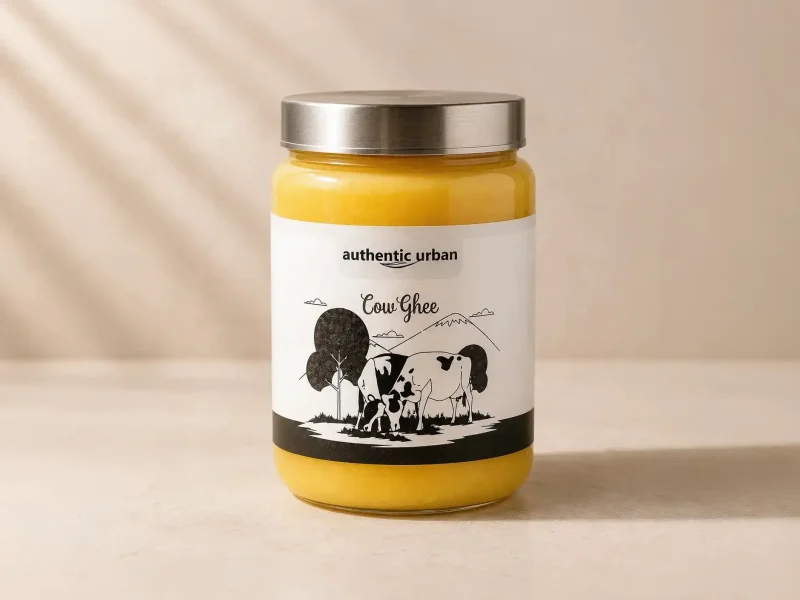 1 Litre
Winter halwa and parathas, kept small
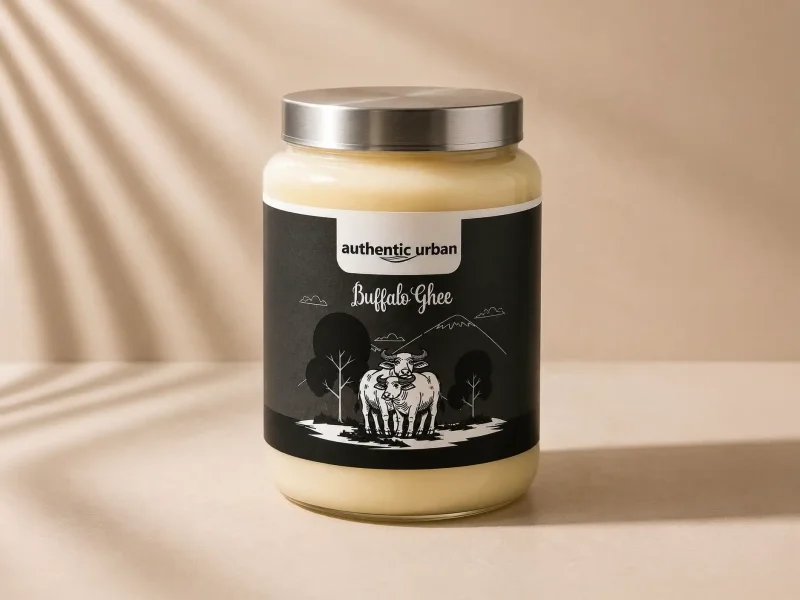 1 Litre
Each order is cooked after you place it, and the packing video is of that batch. Past order videos are on the shop.
FAQ
Is ghee good for skin tightening?
Not in any study we found. Loose skin comes from lost collagen and elastin deep in the skin, and a teaspoon of ghee brings neither, nor the protein and vitamin C your body builds them from. Ghee on dry skin can make it feel smoother and softer for a few hours because it holds water in. That is moisture, not tightening. For real sagging, a dermatologist can tell you what works for your skin.
Can vegetarians get collagen without eating collagen?
Yes. Your body makes its own collagen from the protein you eat, so it does not need collagen from food. Dal, rajma, chana, curd, paneer, and milk all supply the protein, and guava, amla, capsicum, and oranges supply the vitamin C the collagen-making enzymes need. A vegetarian thali with a katori of dal, curd, and a fruit covers both. Ghee adds taste and helps you absorb vitamins from the vegetables.
Is cow ghee or buffalo ghee better for skin?
Neither has been shown to be better for skin. Both are almost pure milk fat, with no collagen and almost no protein. Cow ghee is more yellow and lighter in taste; buffalo ghee is whiter and richer. For the daily teaspoon on dal, most people find cow ghee easier to keep small. Buffalo ghee suits halwa and parathas.
Can I mix ghee into collagen powder or coffee?
You can, and it does no harm at a teaspoon, but it does not make the powder work better. Collagen powder is protein and dissolves in liquid; ghee is fat and floats on top unless blended. The 2025 review of 23 trials found no effect of collagen powder on skin in the better-quality studies. Count that teaspoon of ghee in coffee as part of your 1 to 2 a day.
Will eating ghee for glow give me pimples?
Not for most people at a teaspoon a day. Ghee has almost none of the milk protein that the dairy and acne studies look at: USDA lists 0.28 g in 100 g. Big amounts, fried snacks, and sweets are a different story, and heavy ghee on an oily face can block pores. If you break out after starting, cut back to half a teaspoon for three weeks and watch.
Is aged or washed ghee better for wrinkles?
Neither has a human trial on wrinkles that we found. Washed ghee (shata dhauta ghrita, ghee rinsed with water up to 100 times) is lighter and creamier, so it spreads more easily on the face than plain ghee. Aged ghee (purana ghrita) is an Ayurvedic preparation kept for years, and we found no study of it on the face either. For fine lines, retinol cream and daily sunscreen have the evidence.
About the editorial team
Authentic Urban TeamBilona ghee makers, Gir Somnath, Gujarat
We are the Parmar family in Gir Somnath, Gujarat. We have made ghee here since 2016 and sold it online since 2025. We make only Bilona ghee, test it every month, and anyone is welcome to visit and watch it being made. Our Gir cows and Jafarabadi buffalo are grass-fed village animals that graze near the Gir forest, with no hormones or milk boosters. We set their milk to curd, churn it, and cook the makkhan on a wood chulha. These articles come from that kitchen and from what customers ask us on WhatsApp. We are ghee makers, not doctors.
Sources
- Butter oil, anhydrous (ghee), SR Legacy 173412: protein 0.28 g, vitamin A 840 µg RAE, retinol 824 µg, beta-carotene 193 µg, vitamin K (phylloquinone) 8.6 µg, vitamin C 0 per 100 g, USDA FoodData Central. Checked 27 Sep 2026.
- Lentils, mature seeds, cooked, boiled, SR Legacy 172421, USDA FoodData Central. Checked 27 Sep 2026.
- Yogurt, plain, whole milk, SR Legacy 171284, USDA FoodData Central. Checked 27 Sep 2026.
- Egg, whole, cooked, hard-boiled, SR Legacy 173424, USDA FoodData Central. Checked 27 Sep 2026.
- Guavas, common, raw, SR Legacy 173044, USDA FoodData Central. Checked 27 Sep 2026.
- Peppers, sweet, red, raw, SR Legacy 170108, USDA FoodData Central. Checked 27 Sep 2026.
- Lemon juice, raw, SR Legacy 167747, USDA FoodData Central. Checked 27 Sep 2026.
- Carrots, raw, SR Legacy 170393, USDA FoodData Central. Checked 27 Sep 2026.
- Dietary Guidelines for Indians, 2024 (vitamin A and vitamin C sources, PDF p. 65; limit ghee or butter to 1 to 2 teaspoons a day, PDF p. 71), ICMR-National Institute of Nutrition. Checked 27 Sep 2026.
- The Roles of Vitamin C in Skin Health (Pullar, Carr, Vissers, Nutrients, 2017), PubMed Central. Checked 27 Sep 2026.
- Dietary nutrient intakes and skin-aging appearance among middle-aged American women (Cosgrove et al., Am J Clin Nutr, 2007), PubMed. Checked 27 Sep 2026.
- Improvement of naturally aged skin with vitamin A (retinol) (Kafi et al., Arch Dermatol, 2007), PubMed. Checked 27 Sep 2026.
- Sunscreen and prevention of skin aging: a randomized trial (Hughes et al., Ann Intern Med, 2013), PubMed. Checked 27 Sep 2026.
- Effects of hydrolyzed collagen supplementation on skin aging: a systematic review and meta-analysis (de Miranda et al., Int J Dermatol, 2021), PubMed. Checked 27 Sep 2026.
- Effects of Collagen Supplements on Skin Aging: A Systematic Review and Meta-Analysis of Randomized Controlled Trials (Myung and Park, Am J Med, 2025), PubMed. Checked 27 Sep 2026.