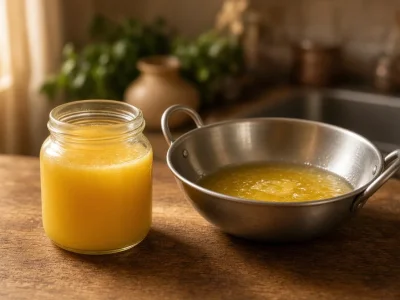
Is Ghee Heat or Cold for the Body? Cow, Buffalo, Summer
Is ghee heat or cold for the body? Cold. Ayurveda texts give both cow and buffalo ghee a cooling potency (sheeta virya), and in plain physics fat makes the least heat of any food while you digest it. When ghee seems to cause garmi, the cause is usually the amount, a fried plate, or too little water. Keep it to 1 to 2 teaspoons a day, in every season.
Is ghee heat or cold for the body?
Ghee is cold for the body in Ayurveda. The texts call its potency sheeta (cooling) and say it calms Pitta, the dosha of heat and acidity. So the answer to "ghee garam hai ya thanda" is thanda, as long as you eat a teaspoon or two with a meal and not a bowl of ghee-fried food.
The confusion comes from two places. Ghee is rich, and many people link rich food with heat. And people often eat ghee on the heaviest plates of the year: puri, halwa, ladoo. This page is for anyone who has been told to stop ghee in summer, is choosing between cow and buffalo ghee for a hot month, or felt warm after ghee and wants to know why. How much suits your body type is on ghee for Vata, Pitta, and Kapha.
What is ghee ki taseer in Ayurveda?
Ghee ki taseer is its virya, the potency Ayurveda says a food has once eaten, and for cow ghee that virya is cold. Taseer is not the temperature of the ghee in the jar, and not how many calories it has. Chilli is hot in taseer and has almost no fat; ghee is almost all fat and is cold.
A 2024 review in the Journal of Ayurveda and Integrative Medicine by Kataria and Singh went through the classical texts and set out what they say about each kind of ghee. Most are cold. Only a few, like camel ghee, are called hot. A 2019 clinical paper in the journal Ayu describes cow ghee the same way: sweet, unctuous, and cold, and calming for Vata and Pitta.
Ghee
Taseer
Doshas (texts)
What it means at home
Cow ghee
Taseer: Cold, heavy
Lowers Vata, Pitta, and Kapha
The daily spoon, all year, and the first pick in summer
Buffalo ghee
Taseer: Cold, heavy
Lowers Vata and Kapha; one text marks it as raising Pitta
Winter sweets and paratha; a smaller spoon in peak heat
Goat ghee
Taseer: Cold, light
Lowers all three
Rare in Indian shops
Camel ghee
Taseer: Hot, light
Not listed
One of the few ghees the texts call hot
Ghee in general
Taseer: Cold, heavy
Lowers Vata and Pitta, raises Kapha
Why too much feels heavy and slow
Taseer and doshas from Kataria and Singh, J Ayurveda Integr Med 2024, Table 1, which collects what the classical texts say. The last column is ours. Checked 27 September 2026.
Two words in that table explain most of what people feel. "Cold" is why ghee is given for Pitta heat. "Heavy", and the note that ghee in general raises Kapha, is why a large helping makes you slow and sleepy. That heaviness is often what people describe as ghee "not suiting" them in the heat. This is what the texts say, not a result from a trial on body temperature; nobody has run one. For the wider picture of ghee in Ayurveda, see the Ayurvedic guide to ghee.
Is buffalo ghee heat or cold for the body?
Buffalo ghee is also cold in Ayurveda, but heavier than cow ghee, and one of the texts in the 2024 review marks it as raising Pitta where cow ghee lowers it. So both are cooling, and in a hot month cow ghee is the gentler daily spoon.
In practice that means a simple split. Cow ghee goes on the everyday plate all year, and it is the one to keep in summer. Buffalo ghee, richer and firmer, does its best work in winter sweets, paratha, and halwa, when a heavy fat is what the dish wants. In May and June, if you only have buffalo ghee at home, just keep the spoon smaller. The full comparison is on cow vs buffalo ghee.
Why do some people feel hot after eating ghee?
Usually because of the amount or the food around it, not the ghee itself. Fat makes very little heat as the body digests it: 0 to 3% of its energy, against 20 to 30% for protein, according to a 2004 review by Westerterp in Nutrition & Metabolism.
Nutrient
Heat made while digesting
Fat (ghee, oil)
0 to 3%
Carbohydrate (rice, roti)
5 to 10%
Protein (dal, paneer, meat)
20 to 30%
Diet-induced thermogenesis, as a share of each nutrient's energy. Westerterp KR, Nutrition & Metabolism 2004. Checked 27 September 2026.
Modern science and the old kitchen agree here more than people expect. The NDMA's heat wave advice asks people to avoid high-protein food in extreme heat; it does not tell anyone to stop ghee. When someone feels garmi after ghee, it is almost always one of these:
What you feel
Likely cause
What to change
Burning in the chest or throat after a meal
Acid reflux. A large, fatty meal can bring it on for some people.
Change: Keep ghee to 1 teaspoon a meal, skip fried food, and do not lie down soon after eating.
Heavy, sleepy, slow after lunch
Too much for one meal. Ayurveda texts say ghee raises Kapha, the heavy dosha.
Change: Cut to 1 teaspoon and make the plate lighter: more sabzi, less rice.
Loose or oily stools
More fat than your gut can handle at once.
Change: Drop to half a teaspoon for a few days, or skip it.
Hot, thirsty, and tired on a summer afternoon
Heat and too little water. A teaspoon of ghee does not cause this.
Change: Water, buttermilk, or ORS, shade, and rest. See the heat wave notes below.
"Garmi" after pakoras, puri, or halwa
The whole plate: deep-fried or sugary food in large amounts.
Change: Judge ghee by a teaspoon on dal, not by a festival plate.
Chest burning deserves its own look, because it is the "heat" people most often blame on ghee. We go through it on ghee for acid reflux. Too much ghee in general, at any time of year, is on ghee side effects.
Can we eat ghee in summer?
Yes. One teaspoon on rice, dal, or moong khichdi at lunch suits most people through summer, and Ayurveda treats it as one of the fats that calm summer heat. What to drop in the heat is deep-fried snacks and heavy sweets, not the teaspoon.
Summer changes our kitchen too. The milk is thinner, curd sets and sours faster, and the ghee stays liquid in the jar all day. The most common summer message we get is about a jar that arrived melted. Liquid ghee in May has not turned "hot" and has not gone off; it is just warm. It will set again when the weather cools.
A summer plate that works: a moong dal khichdi finished with a teaspoon of ghee, cucumber raita with a jeera tadka in ghee, and a glass of chaas. Skip ghee and honey in equal weights, which Ayurveda warns against in any season; the safe spoon ratios are on ghee and honey in Ayurveda.
Ghee in a heat wave
Ghee does not prevent heat stroke. In a heat wave, the NDMA asks people to use ORS and homemade drinks like lassi, buttermilk, lemon water, and torani (rice water), to stay out of the sun between 12 noon and 3 pm, and to avoid alcohol, tea, coffee, and fizzy drinks. Your teaspoon of ghee on lunch can stay; it just is not part of the cooling plan.
If someone falls ill in the heat (faints, is confused, or feels very hot and weak): move them into shade, wipe them with a wet cloth, pour normal-temperature water on the head, give ORS or lemon water if they can drink, and take them to the nearest health centre at once. These are the NDMA's steps. Do not wait to see if food or home remedies help.
How much ghee should you eat in each season?
One to two teaspoons a day in every season. ICMR-NIN's 2024 dietary guidelines ask adults to limit ghee or butter to 1 to 2 teaspoons a day, and count a household teaspoon of ghee as 5 g. The season changes how you use it, not the limit.
Season
Ghee a day
How to use it
Watch for
Summer (April to June)
1 tsp, up to 2 on a light day
On rice, dal, or moong khichdi at lunch; a jeera tadka on cucumber raita
Watch for: Fried snacks and heavy sweets in the afternoon heat
Monsoon (July to September)
1 to 2 tsp
On hot dal and khichdi when digestion feels slow and damp
Watch for: Stale or street food, not the ghee
Winter (November to February)
1 to 2 tsp
On roti and dal; warm milk with turmeric at night; winter ladoo on some days
Watch for: Sweet days: a ladoo already holds ghee, so skip it elsewhere
Daily limit and 5 g teaspoon from ICMR-NIN Dietary Guidelines for Indians 2024. The seasonal uses are household practice.
Our own family eats 1 to 2 teaspoons each a day, on roti, dal, and khichdi, and more on the days winter sweets like adadiya pak and gond ladoo are made. On those days the ladoo is the ghee, so the dal goes without. The monsoon also shows up in the jar: green fodder makes our cow ghee more yellow in those months, which is colour, not a change in taseer. For your own household's number, ghee and oil together, see how much ghee per day.
If ghee is cooling, why is it eaten in winter?
Because Ayurveda says ghee carries the qualities of what it is cooked with. Ghee with dry ginger, jaggery, gond, or black pepper becomes a warming winter food, even though the ghee on its own is cold.
That is why the same jar goes into a cooling moong khichdi in May and a gond ladoo in January. Winter digestion is also stronger in Ayurveda, and winter milk is richer: more makkhan per litre and a finer grain in the jar. A warm cup of turmeric milk with ghee at night is the usual winter habit. Keep the amount the same as summer; it is the spices that change.
Ghee or oil: which is hotter?
In Ayurvedic cooking advice, mustard and sesame oil are usually called heating, and ghee and coconut oil cooling. That is why mustard oil is the classic winter massage oil in north India, and why coastal kitchens lean on coconut. For the kitchen side, smoke point, taste, and fat, see ghee vs mustard oil and ghee vs coconut oil.
Who should cut back on ghee, in any season?
Cooling or not, ghee is almost pure fat, and some people need a doctor's number instead of this page. We are ghee makers, not doctors. Ask yours before eating ghee daily if you:
- have gallstones, or pain under the right ribs after fatty meals;
- have high LDL cholesterol, heart disease, or have been told to limit saturated fat;
- have liver disease or pancreatitis, or have had your gallbladder removed;
- get acid reflux most days, even on small meals.
The longer list, with reasons, is on who should not eat ghee. Dosha labels here are household and textbook tradition, not a diagnosis. If summer heat brings fever, rashes that spread, or dizziness, see a doctor rather than changing your ghee.
Ghee in hot weather: a checklist to keep
Screenshot this for May.
- Keep ghee to 1 to 2 teaspoons (5 to 10 g) a day in every season, as ICMR-NIN advises.
- In summer, put it on rice, dal, or khichdi at lunch, not on fried food.
- Choose cow ghee for the daily spoon in hot months; save buffalo ghee for winter sweets.
- If you feel heat after ghee, check the plate and the water first, then the spoon.
- In a heat wave, drink water, buttermilk, lassi, or ORS. Ghee is not a heat remedy.
- Chest burning, loose stools, or heaviness: halve the spoon or move it to lunch.
One more check: warm a spoon and smell it. Good ghee smells of toasted milk. If yours smells sour, soapy, or waxy, the jar is the problem, not the season. Five home checks are on how to identify pure ghee.
Which ghee for hot months and cold ones?
If the Ayurveda split matters to you, keep cow ghee for the everyday plate and use buffalo ghee where a rich, heavy fat suits the dish. Either way, buy a jar you can smell and trust: it should smell of toasted milk when warm and set grainy when cool. How curd Bilona ghee is made, and why it differs from cream ghee, is on the Bilona method, and our ranking of the cow ghee on sale is best cow ghee in India.
We make and sell ghee, so weigh this with that in mind. For the summer spoon we would pick our own A2 Gir cow ghee: milk from grass-fed Gir cows near the Gir forest, set to curd overnight, churned, and cooked in a matki on a wood chulha. For winter sweets, our Jafarabadi buffalo ghee is the richer jar. Both are made after you order, with a video of your jar on WhatsApp, and we test every month against the FSSAI limits. The steps are on how we make ghee.
The daily spoon, and all of summer
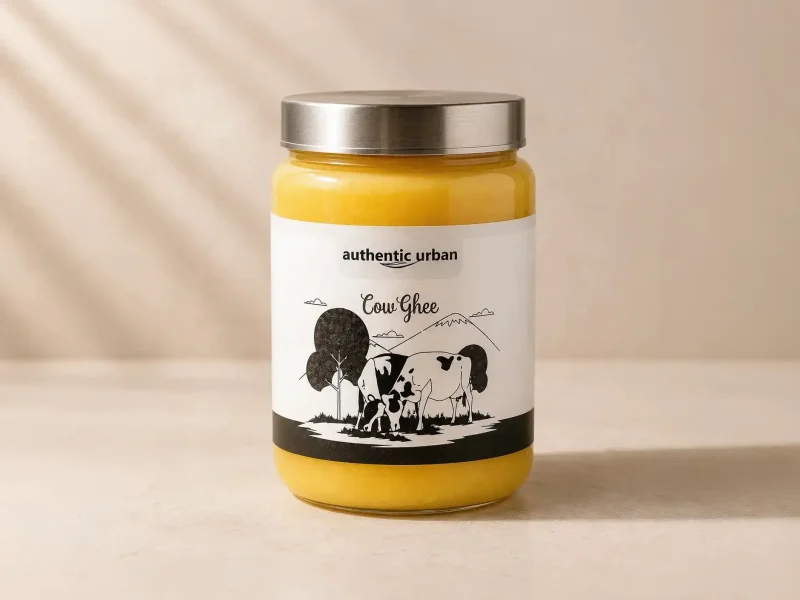 1 Litre
Winter sweets and paratha
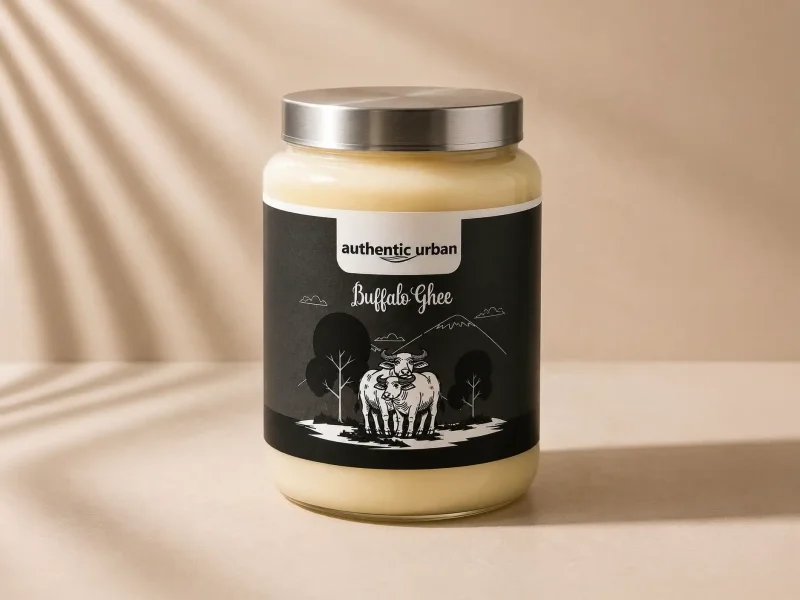 1 Litre
Each order is cooked after you place it, and the packing video is of that batch. Past order videos are on the shop.
FAQ
Is ghee with hot water heating?
No. The warm water does not change the ghee. Ayurveda still counts it as cooling in potency, and the water only melts it so it is easier to swallow. Many households take one teaspoon in warm water in the morning. Keep the water warm rather than boiling, and count that teaspoon inside the 1 to 2 teaspoons of ghee ICMR-NIN suggests for the whole day, not on top of it.
Is ghee with milk heating or cooling?
Warm milk with a teaspoon of ghee is an old night drink in Indian homes and is treated as soothing, not heating. What you add decides the feel. Cardamom or a little mishri keeps it mild for summer. Turmeric, dry ginger (saunth), and black pepper make it the winter version. Keep the ghee to one teaspoon, and skip the drink at night if you get acid reflux when you lie down.
Does ghee cause pimples in summer?
A teaspoon of ghee in food is an unlikely cause on its own. We could not find a study that tested ghee and acne. Summer pimples usually go with sweat, oily skin, and the fried and sugary food that comes with heat and festivals. If you break out, cut the fried snacks and sweets first. Ghee rubbed on the face is a different matter: on oily, acne-prone skin it can clog pores for some people.
Can children eat ghee in summer?
Yes, for children over one year, in food. Half to one teaspoon on dal, rice, khichdi, or roti gives them fat with a meal, in any season. Keep them drinking water through the day in hot weather. Do not give ghee shots or large spoons. For a baby under one year, ask your paediatrician when and how to add ghee or any fat to food.
Does A2 or Bilona ghee change whether ghee is heating?
Not in the texts. Ayurveda classifies ghee by the animal it comes from and by age, so cow ghee is cooling whether or not the label says A2. What the texts do rate highly is ghee made from curd, the Bilona way (curd churned by hand), over ghee made straight from cream, according to a 2024 review of Ayurveda literature. A2 and Bilona matter for taste and method, not for taseer.
Why does ghee melt in summer and set in winter?
It is only room temperature. Ghee is a mix of fats that melt at different points, so in May it sits liquid and in December it sets grainy. That has nothing to do with it turning hot or cold for the body, and a liquid jar in summer has not gone bad. Smell it instead: good ghee smells of toasted milk, while a sour or soapy smell means the jar is old.
About the editorial team
Authentic Urban TeamBilona ghee makers, Gir Somnath, Gujarat
We are the Parmar family in Gir Somnath, Gujarat. We have made ghee here since 2016 and sold it online since 2025. We make only Bilona ghee, test it every month, and anyone is welcome to visit and watch it being made. Our Gir cows and Jafarabadi buffalo are grass-fed village animals that graze near the Gir forest, with no hormones or milk boosters. We set their milk to curd, churn it, and cook the makkhan on a wood chulha. These articles come from that kitchen and from what customers ask us on WhatsApp. We are ghee makers, not doctors.
Sources
- Kataria D, Singh G. Health benefits of ghee: Review of Ayurveda and modern science perspectives. J Ayurveda Integr Med 2024 (Table 1, qualities and tridosha modulation of ghee types), PubMed Central. Checked 27 Sep 2026.
- Varsakiya JN et al. Efficacy of Virechana followed by Go-Ghrita (cow ghee) in the management of Ksheena Shukra (oligozoospermia): a clinical study. Ayu 2019, PubMed Central. Checked 27 Sep 2026.
- Westerterp KR. Diet induced thermogenesis. Nutrition & Metabolism 2004;1:5, PubMed Central. Checked 27 Sep 2026.
- Dietary Guidelines for Indians, 2024 (ghee or butter 1 to 2 teaspoons a day, printed p. 54; 5 g household teaspoon, printed p. 113), ICMR-National Institute of Nutrition. Checked 27 Sep 2026.
- Heat wave: Do's and Don'ts, National Disaster Management Authority (NDMA), Government of India. Checked 27 Sep 2026.