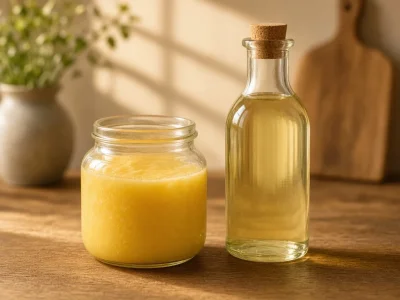
Dalda vs Ghee: What Is Dalda Made Of, Is It Healthy?
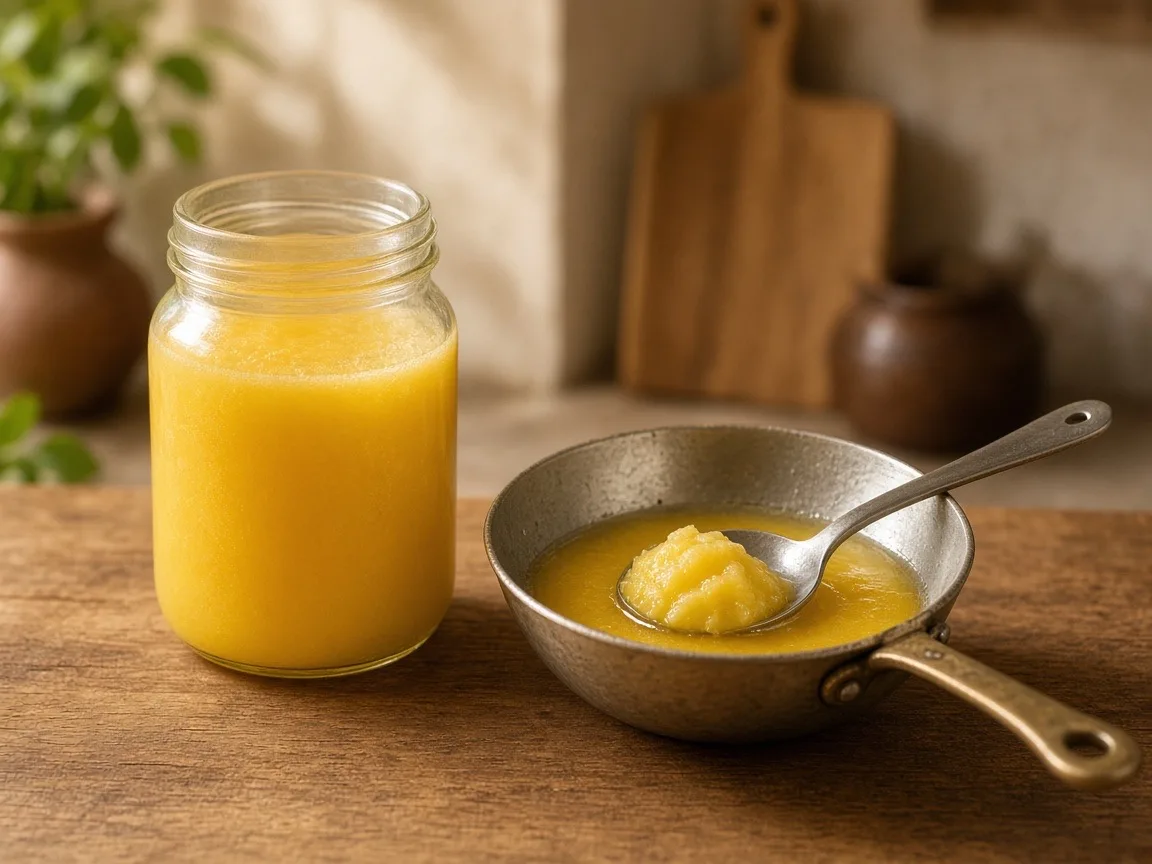
Dalda vs ghee: cook with ghee, in teaspoons, and use oil for the rest. Dalda is vanaspati, vegetable oil hardened by hydrogenation to look like ghee, and ICMR-NIN's 2024 guidelines ask you not to use it as a cooking medium because it can carry trans fat and saturated fat. Ghee is milk fat with nothing hardened or added.
Dalda vs ghee: which should you cook with?
Ghee, in small amounts, and a liquid oil for the bulk. Dalda has no job in a home kitchen that ghee or oil cannot do better. ICMR-NIN's Dietary Guidelines for Indians (2024) say trans fats are harmful and should be avoided, name vanaspati as the example, and say to limit ghee or butter to 1 to 2 teaspoons a day.
So the choice is not Dalda or a big spoon of ghee. It is a measured teaspoon of real ghee where you taste it, on dal, roti, or khichdi, and groundnut or mustard oil for the sabzi and frying. That is how our own family eats: 1 to 2 teaspoons of ghee each a day. If you are new to ghee itself, start with what is ghee.
Dalda vs ghee, side by side
Every row below comes from the two FSSAI standards: regulation 2.2.6 for vanaspati and the ghee standard in the dairy chapter (both version 01.09.2023). The law itself keeps them apart.
Factor
Ghee
Dalda (vanaspati)
What it is
Ghee: Milk fat: butter or makkhan cooked until the water leaves and the milk solids brown
Dalda: Refined vegetable oil hardened by hydrogenation (or interesterification)
Made from
Ghee: Cow or buffalo milk
Dalda: Edible vegetable oils that have an FSSAI standard
Trans fat limit in the FSSAI standard
Ghee: None set: ghee is not hydrogenated
Dalda: Not more than 2% by weight since 1 January 2022
Colour
Ghee: Its own, from the milk and the cooking
Dalda: No colour resembling ghee may be added
Flavour
Ghee: Toasted milk
Dalda: Any flavour used must be distinct from ghee
Added vitamin A
Ghee: None added
Dalda: Synthetic vitamin A, at least 25 IU per gram
Sesame oil marker (Baudouin test)
Ghee: Must test negative
Dalda: Must contain enough til oil to test positive
Plant sterol (β-sitosterol)
Ghee: Must be absent
Dalda: Present: it comes from plant oil
Catalyst left behind
Ghee: None used
Dalda: Residual nickel up to 1.5 ppm allowed
Source: FSSAI Food Products Standards, Chapter 2.2 (pp. 47-49) and Chapter 2.1 (p. 27), version 01.09.2023, checked 26 September 2026.
What is Dalda made of?
Dalda is made of refined vegetable oil that has been hydrogenated until it sets solid. Dalda is a brand, but in most Indian homes the name stands for the whole category, which FSSAI calls vanaspati.
FSSAI's standard says vanaspati may be made from any edible vegetable oil that has its own FSSAI standard, and that refined sal seed fat, if used, can be at most 10% of the oil mix. The oil is hardened by hydrogenation, or by chemical or enzymatic interesterification, with a metal catalyst; the standard allows up to 1.5 ppm of nickel to remain. ICMR-NIN's guidelines explain what the hardening does: liquid oil turns solid because its MUFA and PUFA are converted into saturated fat and trans fatty acids. To tell which oils went into a tin, read the ingredient list on the pack.
Two rules show how close to ghee it was built to sit. No colour resembling ghee may be added, and any flavour must be distinct from ghee. By law, vanaspati also gets synthetic vitamin A, at least 25 IU per gram, which is why a label can show vitamin A next to a ghee label and look similar.
Is Dalda good for health?
No. ICMR-NIN's 2024 guidelines tell Indians to avoid partially hydrogenated fats such as vanaspati as the cooking medium, because they may contain both trans fats and saturated fats, and they state that trans fatty acids raise the risk of heart disease and stroke and are more harmful than saturated fat.
The same chapter lists what trans fat does in the body: it upsets the blood lipid profile, lowers insulin sensitivity, and raises the risk of diabetes. The WHO trans fat fact sheet (January 2024) names vanaspati ghee, margarine, vegetable shortening, fried foods, and baked goods as the main sources of industrial trans fat. We are ghee makers, not doctors; if you have high cholesterol, diabetes, or heart disease, your doctor sets your fat limit. Our longer page on that is ghee for cholesterol.
Does Dalda still have trans fat after the 2022 rule?
It can, up to 2% by weight. FSSAI cut the limit for vanaspati and bakery shortening from 5% to 3% on 1 January 2021, and to 2% on 1 January 2022. Lower is better, but 2% is a cap, not zero.
Period
Cap
In 100 g
In 1 tsp
Before 2021
5%
5 g
0.25 g
From 1 January 2021
3%
3 g
0.15 g
From 1 January 2022 (today)
2%
2 g
0.1 g
Maximum trans fat allowed in vanaspati by FSSAI regulation 2.2.6. A teaspoon is 5 g, as ICMR-NIN counts it. These are ceilings; a given tin may hold less.
Put that next to WHO's ceiling for all trans fat: less than 1% of energy, which is under 2.2 g a day on a 2,000 kcal diet. At today's cap, 100 g of vanaspati may hold up to 2 g, most of a day's ceiling. The cap also only covers the tin. Loose fat and old stock at a sweet shop are harder to know.
Does ghee have trans fat too?
A little, naturally. Milk fat from cows and buffalo carries a small amount of trans fat made in the animal's stomach, not in a factory. WHO's fact sheet says both kinds are equally harmful, so the fair reason ghee is the better pick is the amount: nobody hydrogenates ghee, and a teaspoon or two a day is a small dose.
Ghee is also mostly saturated fat, which is why ICMR-NIN keeps it to 1 to 2 teaspoons. The chemistry of the two kinds of trans fat, and what the labels show, is on does ghee contain trans fat. The full label for ghee is on ghee nutrition facts.
Dalda or refined oil: which is better?
Refined oil. ICMR-NIN's 2024 guidelines say to use all extracted oils, refined or cold-pressed, in moderation, but they single out vanaspati as the one to avoid as a cooking medium. If the choice is between a tin of Dalda and a bottle of groundnut or mustard oil for frying, take the oil.
Two cautions go with the oil. Switch between oils rather than using one high omega-6 oil for years, and do not reheat frying oil again and again; the guidelines ask you to filter oil used once, use it in curry within a day or two, and not fry in it a second time. The full oil comparison is on ghee vs vegetable oil, and heat is covered in ghee for high heat cooking.
Where does Dalda still show up in Indian food?
Mostly in food you buy, not food you cook. ICMR-NIN's guidelines say vanaspati is used in place of ghee or butter in sweets, snack foods, and bakery products, and FSSAI defines bakery shortening as vanaspati meant for baking.
- Mithai. Sweets sold as "ghee" sweets and sweets made in vanaspati can look the same on the counter. Ask the shop.
- Bakery. Khari, nankhatai, puffs, and biscuits often use shortening. Packaged foods list it as hydrogenated or vegetable fat.
- Street frying. Samosa, kachori, and jalebi fat is rarely on any label.
- "Ghee" stretched with vegetable fat. How that fraud works is on how fake ghee is made in India.
How can you tell if ghee is mixed with Dalda?
Your nose catches a lot, and a lab catches the rest. The law gives the lab two easy markers. FSSAI requires vanaspati to carry enough sesame (til) oil to show colour in the Baudouin test, and requires ghee to test negative. FSSAI also requires β-sitosterol, a plant sterol, to be absent from ghee. A jar that fails either test has vegetable fat in it.
The Baudouin test uses acid, so leave it to a lab. At home, smell is the check we trust. When we cook makkhan on the chulha, it comes off the flame when the bubbling goes quiet, the solids turn golden-brown, and the whole room smells of toasted milk. Warm a spoon of any jar and that smell should come back. Slow-cooked ghee often turns grainy as it cools, too. "Is it pure, how do I check" is one of the questions we get most on WhatsApp, so we built a 2-minute purity check you can run on your own jar.
Five checks before a jar goes in your cart
Save or screenshot this list.
-
1
Read the fat on the label
Ghee or milk fat only. Walk away from "vegetable fat", "vanaspati", "hydrogenated", or "vegetable ghee".
-
2
Find the FSSAI licence
A 14-digit number you can look up on foscos.fssai.gov.in.
-
3
Do the milk maths
About 30 to 35 litres of cow milk go into 1 kg of cow ghee. A price far below that milk is a warning.
-
4
Warm one spoon
Real ghee smells of toasted milk. A flat, waxy, or packing-oil smell fails.
-
5
Ask for a lab report when in doubt
Baudouin test negative and β-sitosterol absent are the two lines that catch vegetable fat.
More kitchen checks are on how to identify pure ghee, and how to read a lab sheet is on ghee lab test reports.
What can you use instead of Dalda?
Oil for frying and the bulk of cooking, and ghee where the dish is built on the fat. This is the swap we would make for each job Dalda used to do.
Dish
Use instead
Why
Puri, pakora, bhajia, deep frying
Oil, used once
Frying needs a lot of fat. Filter it, use it in curry within a day or two, and do not fry in it again.
Halwa, sheera, ladoo, barfi
Buffalo ghee
The sweet is built on the fat's taste. Use less real ghee rather than more vanaspati.
Paratha and thepla
Buffalo ghee, or a little oil
A teaspoon of ghee on the tawa gives the flaky layers Dalda was bought for.
Nankhatai, biscuits, cake
Ghee or butter
Bakery shortening is vanaspati by FSSAI definition. Ghee creams with sugar in the same way.
Dal tadka, roti, khichdi
Gir cow ghee, 1 teaspoon
You taste this spoon, so it should be milk fat.
Sabzi and curry base
Groundnut, mustard, or another oil
This is most of the day's fat. ICMR-NIN asks you to avoid vanaspati as the cooking medium.
Ghee costs more than vanaspati, so the swap works only if you use less. Measure with a teaspoon instead of pouring from the jar; ICMR-NIN counts a teaspoon as 5 g and puts all visible fat, ghee and oil together, at 20 to 50 g a day depending on how active you are. Our page on how much ghee per day works through the numbers, and baking swaps are on ghee for baking.
Which ghee should replace the Dalda tin?
If you are cutting vanaspati out, the ghee that takes its place should be milk fat you can check: an FSSAI licence on the label, a toasted-milk smell when warm, and a price that makes sense against the milk. Our ranking of jars, and how we judged them, is on best ghee in India. For the method itself, see the Bilona ghee method.
We make both jars, so read this as our own pick. For the daily spoon on dal and roti we use our A2 Gir cow ghee: grass-fed Gir milk set to curd, churned, and cooked in a matki on the chulha after you order, about ₹14 a teaspoon at ₹2,399 a litre. For halwa, ladoo, and paratha, the jobs Dalda was bought for, Jafarabadi buffalo ghee is the one we reach for. We test every month against the FSSAI limits, including the Baudouin and β-sitosterol lines above; see how we make ghee.
Gir cow ghee: the daily teaspoon
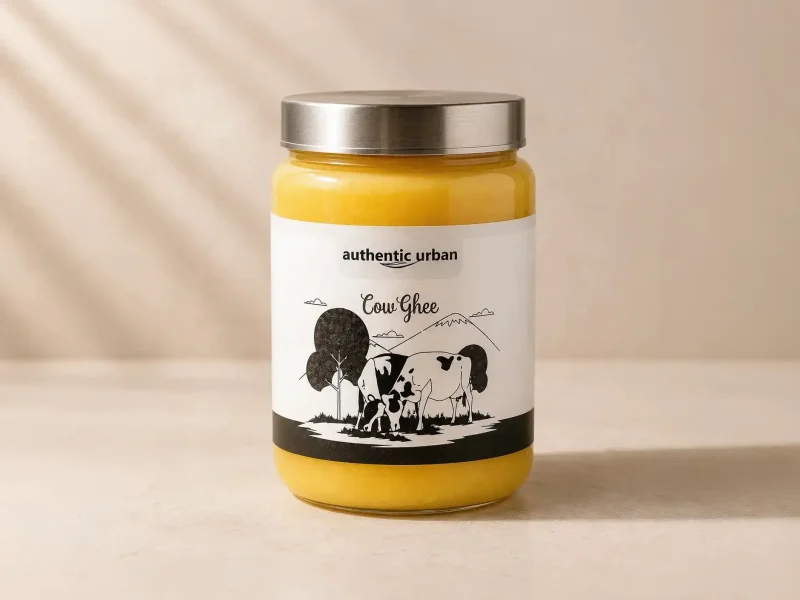 1 Litre
Buffalo ghee: sweets and paratha
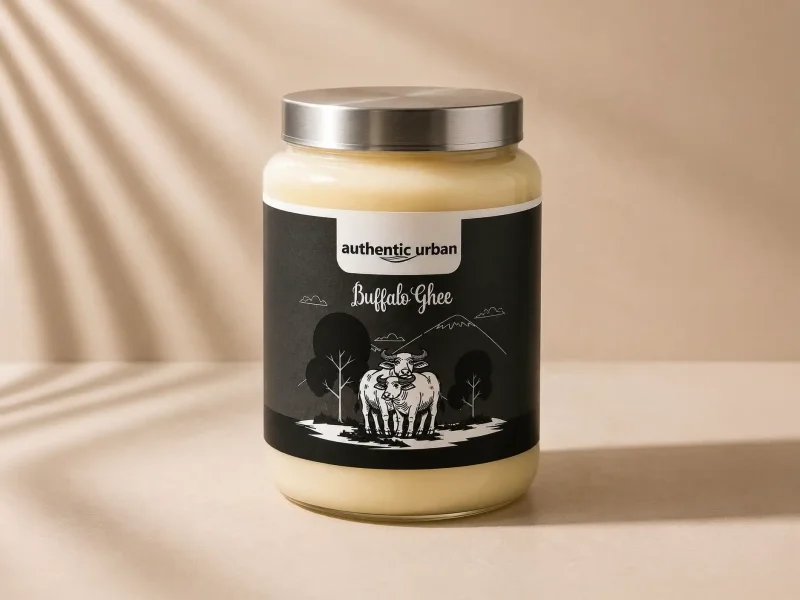 1 Litre
Each order is cooked after you place it, and the packing video is of that batch. Past order videos are on the shop.
FAQ
Is Dalda made from animal fat?
No. Dalda is vanaspati, and FSSAI defines vanaspati as refined edible vegetable oil that has been hydrogenated or interesterified. There is no milk or animal fat in it, which is also why it can never be ghee, which by the same rules must be milk fat. If a tin says vegetable fat, it is a plant product, whatever its colour.
Why is Dalda so much cheaper than ghee?
Because it starts from seed oil, not milk. In our kitchen about 30 to 35 litres of Gir cow milk make 1 kg of cow ghee, and the curd has to set, be churned, and be cooked slowly over most of two days. Vegetable oil is pressed or extracted at factory scale and hardened in hours. The price gap is the milk, and a "ghee" priced like vanaspati deserves a second look.
Is it okay to eat sweets made in Dalda sometimes?
An occasional piece of mithai is not the problem. The concern is daily use. ICMR-NIN's 2024 guidelines ask you to avoid vanaspati as the cooking medium and to limit bakery and fried snacks that may carry trans fat. If you buy sweets often, ask the shop which fat they use, and choose the ones made in ghee. At home, make them in real ghee and eat a smaller piece.
Can someone with high cholesterol switch from ghee to Dalda?
No. Swapping ghee for vanaspati trades saturated fat for a fat that ICMR-NIN's 2024 guidelines say can carry both trans fat and saturated fat, and trans fat is the more harmful of the two. For high LDL the usual advice is less of all solid fats and more liquid oils, nuts, and seeds. Your doctor or dietitian should set the daily fat limit for your own reports.
Is Dalda safe for children?
Children do not need vanaspati at all. ICMR-NIN's 2024 guidelines link trans fat to poor lipid profiles and lower insulin sensitivity, and ask families to avoid processed and bakery foods that carry it. For a child over one year, a teaspoon of real ghee on dal or rice and oil for the rest of the cooking covers the fat a meal needs. Ask your paediatrician about fat for babies under one.
Is vanaspati banned in India?
No. Vanaspati is a legal food with its own FSSAI standard, regulation 2.2.6. What changed is the trans fat cap: 5% by weight, then 3% from 1 January 2021, and 2% from 1 January 2022. Bakery shortening follows the same limits. Legal does not mean it is a good daily fat. ICMR-NIN still advises against using it as the main cooking medium.
About the editorial team
Authentic Urban TeamBilona ghee makers, Gir Somnath, Gujarat
We are the Parmar family in Gir Somnath, Gujarat. We have made ghee here since 2016 and sold it online since 2025. We make only Bilona ghee, test it every month, and anyone is welcome to visit and watch it being made. Our Gir cows and Jafarabadi buffalo are grass-fed village animals that graze near the Gir forest, with no hormones or milk boosters. We set their milk to curd, churn it, and cook the makkhan on a wood chulha. These articles come from that kitchen and from what customers ask us on WhatsApp. We are ghee makers, not doctors.
Sources
- Food Safety and Standards (Food Products Standards) Chapter 2.2: Fats, oils and fat emulsions, version 01.09.2023 (2.2.6 Vanaspati and bakery shortening, pp. 47-49), FSSAI. Checked 26 Sep 2026.
- Food Safety and Standards (Food Products Standards) Chapter 2.1: Dairy products and analogues, version 01.09.2023 (ghee standard, p. 27), FSSAI. Checked 26 Sep 2026.
- Dietary Guidelines for Indians, 2024 (Guideline 7, printed pp. 51-56), ICMR-National Institute of Nutrition. Checked 26 Sep 2026.
- Trans fat, fact sheet, 24 January 2024, World Health Organization. Checked 26 Sep 2026.