How to Identify Pure Ghee at Home: Which Tests Work
How to identify pure ghee at home: trust three checks: warm a teaspoon and smell it (toasted milk, not wax or old oil), watch it melt clear in a pan, and use FSSAI's iodine test, where any blue means starch. Then read the label. Skip the water glass test, because ghee and oil both float, and leave the hydrochloric acid test to a lab. No kitchen test can catch a careful oil blend or prove A2 or Bilona; for that you need a batch report and a maker who shows you the process.
How do you identify pure ghee at home?
Smell it warm, watch it melt, test for starch with iodine, and read the pack. Those four take about five minutes and catch a stale, burnt, badly made, flavoured, or starch-thickened jar. They will not catch refined oil, palm oil, or vanaspati mixed in with care. That needs a lab.
Most pages on this topic list seven or ten tests and give each one equal weight. Some of those tests contradict each other: one site says pure ghee floats, another says it sinks. This page sorts them by what they can actually catch, so you know which result to believe. We make ghee in Gir Somnath, Gujarat, and the smell and set checks below are the ones we use at our own kettle. If you want to know which fats get mixed in and why, read how fake ghee is made first.
Which home ghee tests work, and which do not?
Three tests are worth doing (warm smell, pan heat, and iodine), three are weak signals, and two should be dropped. Save this table; it is the short version of the whole page.
Home ghee tests: what each one catches
Test
What it can catch
What it misses
Verdict
Warm smell
Catches: Stale, rancid, burnt, or flavoured ghee
Misses: A clean oil blend with ghee flavour added
Verdict: Use it
Pan heat
Catches: Water left in (spitting, foam) and a burnt or chemical smell
Misses: Most blends made to behave like ghee
Verdict: Use it
Iodine (FSSAI method)
Catches: Starch, mashed potato, or flour added for body
Misses: Every kind of oil or fat
Verdict: Use it
Fridge set
Catches: A large share of liquid oil that stays runny in the cold
Misses: Palm oil and vanaspati, which set like ghee
Verdict: Weak
Palm melt
Catches: A waxy fat that will not melt at all
Misses: Nearly everything else; buffalo ghee melts slower anyway
Verdict: Weak
Colour and grain
Catches: Very little on its own
Misses: Dye, season, and breed all change the look
Verdict: Weak
Water glass
Catches: Nothing: ghee, oil, and vanaspati all float
Misses: Every adulterant
Verdict: Skip
Hydrochloric acid and sugar
Catches: Vanaspati or sesame oil, in a lab
Misses: Cannot tell the two apart; dyes also turn it pink
Verdict: Lab only
Iodine and acid tests: FSSAI Manual of Methods for Food Safety on Wheels (2017), pp. 29-31. Melting points: Bhavani Ramya et al. (2019). Checked 28 September 2026.
What does pure ghee smell and look like?
Warm pure ghee smells of toasted milk, the smell of milk solids browning in fat. It melts clear and golden (cow) or clear and pale (buffalo), and it goes quiet in the pan instead of spitting.
That smell is the one we cook towards. At our chulha the makkhan is cooked in a matki on a low flame, and it comes off only when three things happen together: the bubbling goes quiet, the solids at the bottom turn golden-brown, and the room smells of toasted milk. The quiet matters. It means the water in the butter has boiled away. A jar that spits hard in your pan still has water in it, and that ghee spoils early. A jar that smells flat, waxy, like old frying oil, or sweetly perfumed is the one to question. FSSAI's ghee standard says the raw material must be free from added flavour, colour, or preservative, so a ghee that smells like a sweet shop, not a kitchen, has a reason to.
Colour is a much weaker sign. Our own cow ghee turns deeper yellow in the monsoon, when the cows eat green fodder, and buffalo ghee is pale all year. Even in a lab, colour struggles: a 2022 study in the Journal of Food Science and Technology found that an instrument measuring whiteness could only pick up buffalo ghee mixed into cow ghee from about 15%. Your eyes will not do better. More on this in white ghee vs yellow ghee.
Grain is the same story. Slow-cooled ghee often forms grains, and in winter our jars set with a fine grain, while in summer the same ghee can stay liquid on the shelf. Grain tells you how the ghee cooled, not whether it is pure; see why ghee is grainy.
How do you do the iodine test for starch in ghee?
Melt a little ghee, let it cool, add 2 to 3 drops of iodine solution, and look for blue. Blue means starch is present. This is the method in FSSAI's rapid-test manual for milk products, including ghee.
- Put about 2 g of ghee (a little under half a teaspoon) in a small glass or steel bowl.
- Melt it by standing the bowl in hot water.
- Let it cool to room temperature. The manual says 25 °C, give or take 2 °C.
- Add 2 to 3 drops of iodine solution. The manual uses a 1% solution.
- Look at the colour. Blue means starch, mashed potato, or flour has been added. The brown of the iodine itself, with no blue, is a pass.
Be clear about what a pass means. Iodine reacts with starch and nothing else in this test, so it says nothing about oil, palm fat, vanaspati, or animal fat. It is still worth the two minutes, because starch is one of the few adulterants a kitchen can catch for certain. Keep the iodine away from children and do not eat the tested ghee.
Does pure ghee float or sink in water?
Pure ghee floats on water, and so does every cooking oil and vanaspati. All fats are lighter than water. That is why the water glass test cannot tell pure ghee from a blend, and why you will find one site saying pure ghee floats and another saying it sinks.
What you might see in the glass is cloudiness. That comes from water, milk solids, or an emulsifier carried in the fat, and it can happen with homemade ghee taken off the flame too early. It is a sign of a badly made jar, not proof of a fake one. The pan test shows the same thing more clearly: water in the fat makes it spit.
Is the palm test for ghee reliable?
Not very. It can flag a waxy fat that stays solid on your hand, and little else. Pure ghee melts in the low 30s °C: a 2019 study from Tamil Nadu measured cow ghee at 31.3 °C and buffalo ghee at 33.5 °C.
Two things follow. First, pure buffalo ghee melts more slowly on a palm than pure cow ghee, so the common rule "slow melt means fake" fails every pure jar of buffalo ghee, especially on a cold morning. Second, a blend built to set like ghee is built to melt like it too. If a spoonful sits on your warm palm as a stiff, waxy lump and leaves a greasy film instead of a smell, that is worth noting. Otherwise, the palm has told you nothing. Why cow and buffalo ghee behave differently is in cow vs buffalo ghee.
What about the fridge test?
Put a small bowl of melted ghee in the fridge overnight. Pure ghee sets right through. If a clear, runny, oily layer stays liquid on top, a liquid oil is probably mixed in, and in a large amount. A small share of oil will not show, and palm oil and vanaspati set solid in the cold just like ghee, which is exactly why they get used. Treat a fail as meaningful and a pass as nothing more than a pass.
Should you try the hydrochloric acid test at home?
No. The HCl test many pages suggest is a lab method. FSSAI's manual uses fuming concentrated hydrochloric acid, warns that it causes severe skin burns, and says to open it only in a fume hood.
The method mixes 5 ml of melted ghee with 5 ml of the acid and half a teaspoon of sugar, shakes it for 2 minutes, and looks for a crimson or pink acid layer. Even done properly, the manual notes that the test does not tell vanaspati from sesame oil, and that some coal tar dyes also turn it pink. The versions online, with a few drops of acid and no sugar, test even less. If you suspect vanaspati, send the jar to a lab for the Baudouin test and the β-sitosterol line; how to read what comes back is in ghee lab test report. Why vanaspati is used at all is in ghee vs vanaspati.
What should the label on pure ghee say?
It should name the product as ghee, list nothing but milk fat or cow or buffalo ghee, and carry an FSSAI licence number you can look up. Reading the pack takes thirty seconds and rules out more jars than any kitchen test.
On the pack
What pure ghee shows
Red flag
Product name
Pure ghee: Ghee, cow ghee, or buffalo ghee
Red flag: "Cooking medium", "ghee-like", "for pooja use", or a brand name with no product name
Ingredients
Pure ghee: Milk fat, cow milk fat, or nothing but the product name
Red flag: Vegetable fat, vanaspati, hydrogenated fat, flavour, colour, or preservative
FSSAI licence
Pure ghee: A 14-digit number whose name and address match the maker on the pack
Red flag: No number, a smudged number, or a name that does not match on FoSCoS
Batch and dates
Pure ghee: A batch number and a packing date you can read
Red flag: Blank, stickered over, or printed so faintly it rubs off
Price
Pure ghee: In line with the milk it takes
Red flag: A "Bilona" or "A2" jar priced like dairy ghee
Check the licence on foscos.fssai.gov.in: the name and address that come up should match the maker printed on the jar. The licence proves the business is registered, not that this batch passed a test. On price, Bilona ghee yields less per litre of milk than cream-based dairy ghee, so a jar that says Bilona and costs the same as a dairy tin deserves a second look; current prices per litre are in ghee price in India. Red flags on a seller's listing, from reviews to packing, are in ghee brands to avoid.
What can home ghee tests not tell you?
They cannot catch refined oil, palm oil, or vanaspati blended in with care, and they cannot prove A2, the breed, or the Bilona method. Those need a lab report for the fat and proof of process for the rest.
Labs look for plant sterols and check the fatty acid profile against FSSAI's ranges, because a blend can be tuned to pass the older tests. A kitchen has nothing that comes close. A2 is about a protein in milk, and ghee is at least 99.5% fat under the FSSAI standard, so the ghee itself carries almost none of it; see A2 vs A1 ghee. Curd-churned Bilona changes the smell and the grain, but a factory cream ghee can smell good too. For those claims, what counts is whether you can see the animals, the curd, and the cooking; see the Bilona method.
A five-minute ghee purity check
Run these in order on any new jar. Stop at the first clear fail.
-
1
Read the pack
Ghee (cow or buffalo) as the only ingredient, an FSSAI licence number, and no "flavour", "colour", "vegetable fat", or "cooking medium".
-
2
Smell it cold, then warm
Open the jar and smell. Then warm a teaspoon in a steel spoon over a low flame. It should smell of toasted milk, not wax, old oil, or perfume.
-
3
Watch the pan
A teaspoon in a small pan should melt clear and go quiet. Heavy spitting means water; black smoke before it turns golden means trouble.
-
4
Iodine for starch
Melted and cooled ghee, 2 to 3 drops of iodine solution. Any blue means starch. No change means no starch, nothing more.
-
5
Set it overnight
A small bowl in the fridge. It should set right through. A runny oily layer that never firms is a warning.
-
6
Ask for proof
For a costly jar: the batch lab report with Baudouin and β-sitosterol lines, and a way to see how it was made.
Prefer to answer a few questions about your jar instead? Check your jar in 2 minutes with our purity checker.
What should you do if your ghee fails a test?
Stop eating it, keep the jar sealed with its bill and batch number, and decide whether to return it, report it, or have it tested. A blue iodine result or a burnt, chemical smell is enough to stop; a weak signal alone, like colour, is not.
A starch result is clear evidence, and so is an ingredient line that lists vegetable fat on a pack sold as ghee. For anything you only suspect, a lab test settles it: any buyer in India can have food analysed under the Food Safety and Standards Act, and how that works is in getting your own ghee tested. Where to complain, and what to keep, is in what to do with fake ghee. If the jar simply smells old, it has probably been stored warm or opened with a wet spoon; see ghee storage and shelf life.
Which ghee can you check for yourself?
The jar worth buying is the one that passes your kitchen checks and still gives you proof you can follow up: a licence you can look up, a batch report, and a process you can see. How the main brands compare on price and method is in how to choose ghee.
We make both jars below, so read this as our own pick. Every jar is curd-churned Bilona, cooked in a matki on a wood chulha after you order, and you get a video of your jar being cooked and packed on WhatsApp. We test every month against the FSSAI limits, including β-sitosterol, and our FSSAI licence is on every label. Our A2 Gir cow ghee is from grass-fed Gir cow milk only; our Jafarabadi buffalo ghee is for halwa, ladoo, and paratha. Anyone is welcome to visit Gir Somnath and watch a batch; see how we make ghee.
Gir cow ghee: the daily teaspoon
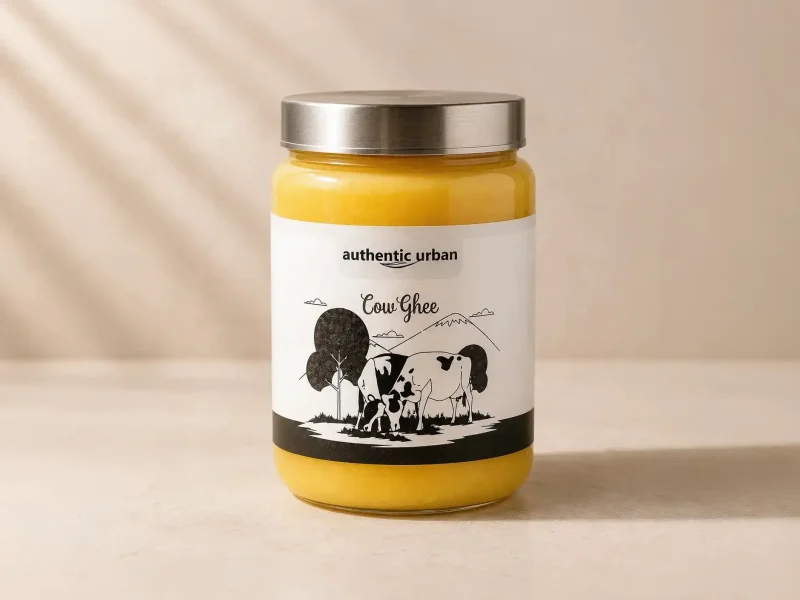 1 Litre
Buffalo ghee: sweets and paratha
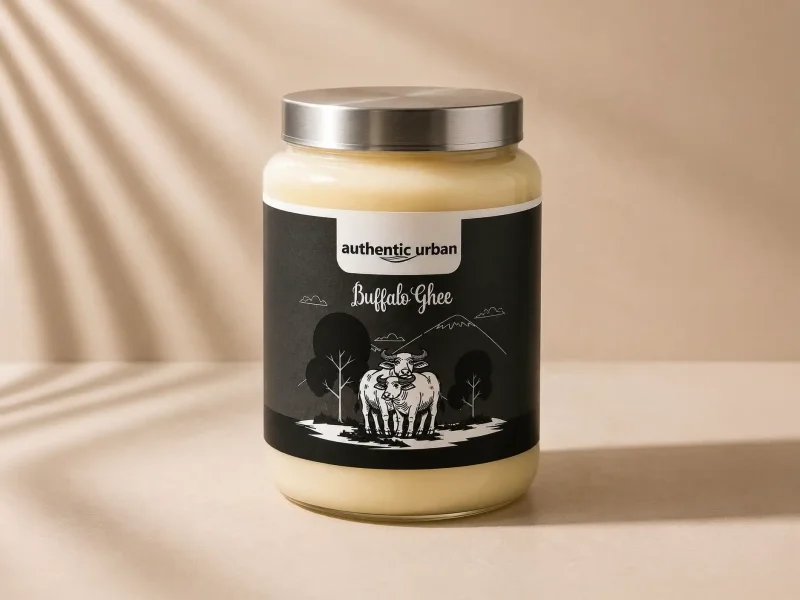 1 Litre
Each order is cooked after you place it, and the packing video is of that batch. Past order videos are on the shop.
FAQ
Which is the best pure ghee to buy in India?
We would put our own first, and we say that knowing we make it. Our Gir cow and Jafarabadi buffalo ghee is curd-churned Bilona, cooked after you order, tested every month against the FSSAI limits including β-sitosterol, and you get a video of your jar being cooked and packed. Whichever brand you choose, ask for a batch report and a way to see how the ghee is made.
Is homemade ghee always pure?
Ghee you make at home from your own malai or butter is pure in the sense that nothing was mixed in, but it can still go wrong. Taken off the flame too early, it keeps water, turns cloudy, and spoils within weeks. Taken off too late, it smells burnt and bitter. Cook until the bubbling goes quiet and the solids turn golden-brown, then strain and store it in a dry jar.
Why does my ghee smell sour or like old oil?
A sour, sharp, or old-oil smell usually means the fat has started to break down, from heat, light, water from a wet spoon, or simply age. That is spoilage, not proof of adulteration, but either way the jar is past its best. Pure ghee in a sealed jar kept away from the stove smells of toasted milk for months. Use a dry spoon every time and keep the lid shut.
Does pure ghee freeze solid in the fridge?
Yes. At fridge temperature pure ghee sets firm right through, and buffalo ghee sets harder than cow ghee. It may look grainy or smooth depending on how fast it cooled. What should not happen is a runny, oily layer that stays liquid on top after a night in the fridge. That points to a liquid oil mixed in, though small amounts will not show at all.
Is expensive ghee always purer than cheap ghee?
No. Price tells you what a jar claims to be, not what is inside it. A high price with no batch report, no licence you can check, and no way to see the making is only a high price. A very low price on a jar that says Bilona or A2 is a stronger signal, because the milk alone costs more than that. Judge on proof, then on price.
Can I test ghee by burning it with a lighter or in a diya?
You can, but it tells you little. Ghee, vegetable oil, and vanaspati all burn in a wick, and crackling mostly means there is water in the fat, which also happens with homemade ghee taken off the flame early. No FSSAI rapid test uses a flame. The warm smell test on a spoon gives you more information with less risk of a burn.
About the editorial team
Authentic Urban TeamBilona ghee makers, Gir Somnath, Gujarat
We are the Parmar family in Gir Somnath, Gujarat. We have made ghee here since 2016 and sold it online since 2025. We make only Bilona ghee, test it every month, and anyone is welcome to visit and watch it being made. Our Gir cows and Jafarabadi buffalo are grass-fed village animals that graze near the Gir forest, with no hormones or milk boosters. We set their milk to curd, churn it, and cook the makkhan on a wood chulha. These articles come from that kitchen and from what customers ask us on WhatsApp. We are ghee makers, not doctors.
Sources
- Manual of Methods for Food Safety on Wheels, 2017 (starch in milk products including ghee, pp. 29-30; vanaspati in ghee, p. 31), FSSAI. Checked 28 Sep 2026.
- Food Safety and Standards (Food Products Standards) Chapter 2.1: Dairy products and analogues, version 01.09.2023 (2.1.8 Milk fat products and ghee, description and raw material p. 26; limits p. 27), FSSAI. Checked 28 Sep 2026.
- Bhavani Ramya S., Baskaran D., Vijayarani K., Palanidorai R., Ramasamy D. A study on physico-chemical properties of Uthukuli ghee. International Journal of Current Microbiology and Applied Sciences 8(4) (2019): 2090-2099, doi:10.20546/ijcmas.2019.804.246, IJCMAS. Checked 28 Sep 2026.
- Mor S., Sharma V., Arora S., Minz P.S. Physico-chemical and color parameters to distinguish cow ghee from buffalo ghee. Journal of Food Science and Technology, 2022, Springer (open access, PMC9304484). Checked 28 Sep 2026.