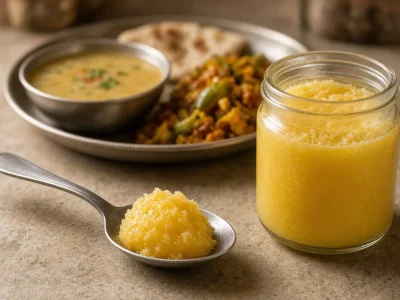
Is Ghee Healthy? The Good, the Bad, and How Much a Day
Is ghee healthy? In 1 to 2 teaspoons a day, eaten in place of other fat, yes for most healthy adults: it carries vitamin A, helps you absorb the vitamins in your vegetables, and tastes enough that a little goes far. In larger amounts, no. Ghee is about 62% saturated fat, and ICMR-NIN's 2024 guidelines say saturated fat raises LDL cholesterol. The amount decides which side you land on.
Is ghee healthy or unhealthy?
Ghee is healthy in teaspoons and unhealthy in ladles. ICMR-NIN's 2024 guidelines say to limit ghee or butter to 1 to 2 teaspoons a day, or avoid it if possible. At that amount it fits a normal Indian diet for most healthy adults. The harm comes when ghee is added on top of cooking oil, fried snacks, and sweets.
Notice the second half of that guideline. ICMR-NIN does not call ghee a health food; it allows a small amount for taste. So the fair verdict is that ghee is a good fat to enjoy in a measured spoon, not a medicine to eat more of. The answer also changes with the person. Here is how it plays out.
Who is eating it
Verdict
How much
Healthy adult, normal reports
Healthy in small amounts
1 to 2 tsp a day, on food you taste
Trying to lose weight
Fine if it replaces oil
1 tsp a day, with a spoon of oil taken out
Diabetes
Fine inside the fat budget
1 to 2 tsp; doctor decides if triglycerides are high
High LDL, heart disease, after a stent
Ask first
Your doctor sets it, and it may be none
Gallbladder pain or trouble digesting fat
Ask first
Your doctor sets it
Milk allergy
Not dairy free
An allergist decides
Babies under 1 year
Paediatrician first
No dose from us
This page gives the verdict. If you want each benefit on its own, the list is on ghee benefits, and the conditions where a doctor sets the fat are under who should not eat ghee.
What is good about ghee?
A teaspoon of ghee gives about 42 µg of vitamin A, a little butyric acid, and enough flavour that one spoon on hot dal feels like plenty. That is going by USDA FoodData Central's figures for ghee, worked out for a 5 g teaspoon. It also brings about 3 g of saturated fat, which is the other side of the same spoon.
In 1 teaspoon (5 g)
Amount
What it means
Calories
44 kcal
The same as a teaspoon of oil. Two teaspoons a day is under 5% of a 2,000 kcal day.
Saturated fat
3.1 g
The bad side. ICMR-NIN calls more than 10 g a day of visible saturated fat high; ghee alone gets there in about 3 teaspoons.
Cholesterol
13 mg
Small. The saturated fat moves blood cholesterol more than this does.
Vitamin A
42 µg
A real amount. A small raw carrot (50 g) has about ten times more.
Vitamin E
0.14 mg
Very little. Five almonds give about 1.5 mg, some ten times more.
Vitamin D
0
USDA lists none. Ghee is not a vitamin D food.
Butyric acid
0.16 g
The fat behind the gut claims. Real, but a small amount per spoon.
Worked out from USDA FoodData Central, SR Legacy, per 100 g: butter oil, anhydrous (173412); nuts, almonds (170567); carrots, raw (170393). Checked 26 September 2026.
Several pages that rank for this question call ghee an excellent source of vitamin E. The USDA numbers do not bear that out: a teaspoon has 0.14 mg, and five almonds have about ten times as much. The real strength of ghee is quieter. ICMR-NIN's 2024 guidelines note that fats carry vitamins A, D, E, and K and help you absorb them, which is why a spoon of ghee on palak or carrot sabzi is a sensible habit. Any fat does this, though, including oil.
Ghee is also nearly free of milk sugar and protein. FSSAI's standard requires ghee to be at least 99.5% milk fat, so many people who get bloated on milk manage a spoon of ghee. A milk allergy is a different matter, covered on does ghee have casein. The full label per serving is on ghee nutrition facts.
What is bad about ghee?
The bad part of ghee is its saturated fat: 61.9 g in every 100 g, per USDA. ICMR-NIN's 2024 guidelines say saturated fat raises total and LDL cholesterol, raises the risk of heart attack and stroke, and lowers insulin sensitivity. Among everyday Indian fats, only coconut oil carries more.
USDA FoodData Central, SR Legacy: butter oil, anhydrous (173412); butter, without salt (173430); oil, coconut (171412); oil, peanut (171410); oil, mustard (172337). Values rounded to the gram. Checked 26 September 2026.
| Item | Value |
|---|---|
| Coconut oil | 83 g |
| Ghee | 62 g |
| Butter (unsalted) | 51 g |
| Groundnut oil | 17 g |
| Mustard oil | 12 g |
ICMR-NIN counts saturated fat as high when more than 10 g a day comes from visible fats like ghee and butter, or when it passes 5% of the day's calories. For ghee alone, 10 g of saturated fat is about 3 teaspoons. That is the real reason the guideline stops at 2.
What happened when adults ate ghee daily in a trial
The clearest human test we found is a 2021 trial in the British Journal of Nutrition. Thirty healthy adults in Iran ate about 30 g of ghee a day for 4 weeks, and 30 g of olive oil a day for another 4 weeks, in random order. Thirty grams is roughly 6 teaspoons, three times the ICMR-NIN limit.
Measured
Ghee vs olive oil
What it means
ApoB (particles that carry LDL)
Up 0.09 g/l on ghee
A heart-risk marker went the wrong way.
Non-HDL cholesterol
Up 0.53 mmol/l (about 20 mg/dL) on ghee
Also the wrong way.
LDL cholesterol
Rose, but not by enough to be sure
Pointed the same way.
Body weight, fasting sugar, triglycerides
No difference
Ghee did not make people fatter than olive oil in 4 weeks.
Mohammadi Hosseinabadi and Nasrollahzadeh, British Journal of Nutrition, 2021. 30 adults, crossover, 4 weeks per fat, mean 30.6 g a day. Checked 26 September 2026.
The study is small and short, and it tested a large daily amount. Still, it points the same way as the guideline: a lot of ghee every day nudges heart markers up, and nothing in ghee protects against that. What it does not tell you is that a teaspoon on dal is harmful. The detail for people with a lipid report in hand is on is ghee bad for cholesterol, and for diabetes on can diabetics eat ghee.
Which ghee health claims are true?
Two of the common claims hold up, two are half true, and three are not shown in people. We checked each against USDA data, the ICMR-NIN guidelines, FSSAI's ghee standard, and the trial above.
The claim
Verdict
Why
Ghee is full of vitamins
Partly
A teaspoon has about 42 µg of vitamin A, but almost no vitamin E and no vitamin D (USDA). Vegetables, dal, and nuts carry far more.
Ghee helps you absorb vitamins from vegetables
True, for any fat
ICMR-NIN's 2024 guidelines say fats promote absorption of vitamins A, D, E, and K. A teaspoon of oil does this too.
The butyric acid in ghee heals the gut
Not shown
A teaspoon holds about 0.16 g. We found no human trial showing a kitchen spoon of ghee repairs the gut lining.
Ghee is lactose free
Nearly
FSSAI requires ghee to be at least 99.5% milk fat, so only a trace of milk sugar and protein is left. A milk allergy can still react.
Ghee raises good cholesterol and is good for the heart
Not shown
ICMR-NIN groups ghee with the saturated fats that raise LDL. A 2021 trial found ghee raised apoB and non-HDL cholesterol compared with olive oil.
Ghee burns belly fat
No
A teaspoon adds 44 kcal. We found no human trial where kitchen amounts of ghee reduced belly fat.
Ghee handles high heat better than butter
True
The milk solids that burn in butter are cooked out. That is a cooking benefit, not a health one.
The gut claim deserves a closer look because it is everywhere. Butyric acid does matter to the cells lining the colon, but a teaspoon of ghee carries only about 0.16 g of it, and most of the lab work behind the claim is in cells and animals. We go through it on ghee and butyrate. The belly-fat claim usually rests on CLA, a fatty acid in milk fat, and the amounts in a spoon are the subject of CLA in ghee.
How much ghee a day is healthy?
One to two teaspoons a day for an adult, which is 5 to 10 g. That is ICMR-NIN's 2024 limit for ghee or butter, and it sits inside a bigger budget: all visible fat, ghee and oil together, at 20 g a day for a sedentary woman and 30 g for a sedentary man, up to 40 to 50 g for heavy physical work.
So two teaspoons of ghee uses up half of a sedentary woman's fat for the day, and the rest goes to the oil in her sabzi. Count the ghee on rotis, in halwa, and in the tadka, not only the spoon on dal. You can work out your home's daily ghee and oil for each person in the family, and amounts for children, pregnancy, and other situations are on how much ghee per day.
In our own home in Gir Somnath, each of us eats 1 to 2 teaspoons a day, on roti, dal, and khichdi. We eat more only in winter sweets like adadiya pak and gond, and that is a few weeks of the year. We make ghee for a living, and that is still our daily amount. What that amount adds up to over a month, and how to keep a 30-day log, is on eating ghee daily.
Is ghee healthier than butter or oil?
Ghee is not healthier than butter in any big way, and it is less healthy than most plant oils for everyday cooking. Butter is about 16% water per USDA, so spoon for spoon it carries a little less fat and saturated fat than ghee. Ghee wins in the kitchen: it keeps without a fridge and does not burn at tadka heat the way butter's milk solids do. The side-by-side is on ghee vs butter.
Against groundnut or mustard oil, ghee has roughly four to five times the saturated fat, as the chart above shows. That is why the sensible split is oil for most of the cooking and ghee for the spoon you taste. Which fat suits which job, frying included, is on is ghee healthier than oil. Vanaspati is the one fat worse than both: ICMR-NIN says its trans fats should be avoided.
When does ghee become unhealthy?
Ghee turns unhealthy in three ways: too much of it, a bad jar, or the wrong person eating it without asking a doctor. The first is the common one. Two or three tablespoons a day, on top of the usual oil, is several times the ICMR-NIN limit.
A bad jar
A burnt or rancid jar is never a health food. At our kettle, a batch cooked too long turns dark, tastes bitter, and smells burnt. One taken off too early stays cloudy, keeps moisture, and spoils fast. Neither goes into a jar for sale; they stay for home use. At home, warm a spoon of any new jar: clean ghee smells of toasted milk. Sour, bitter, or stale means throw it out. Storage that keeps a jar fresh is on ghee storage and shelf life, and checks for a jar mixed with other fats are on how to identify pure ghee.
The wrong person, without a doctor's number
If you have high LDL, heart disease, a stent, gallbladder trouble, or a condition where your doctor has set a fat limit, ghee is not a food to judge for yourself. Ask for a daily fat number and keep ghee inside it. Never stop or change a medicine because of a food. We make ghee; we are not doctors, and this page is general information, not medical advice.
A 7-point checklist for eating ghee the healthy way
This is the routine that keeps ghee on the healthy side. Screenshot it for the kitchen.
- Measure ghee with a real 5 ml teaspoon for one week. A kadhai or ladle hides a tablespoon.
- Keep it to 1 to 2 teaspoons a day for each adult, and count the ghee on rotis and in sweets.
- Take a spoon of oil out for every spoon of ghee you add. Ghee on top of oil is where it goes wrong.
- Put the ghee where you taste it: hot dal, khichdi, roti. Use oil for most sabzi and all deep frying.
- Warm a little of every new jar. It should smell of toasted milk. Bitter, burnt, or sour means throw it out.
- Use a dry spoon and keep the lid shut, away from the stove and sunlight, so the jar stays fresh.
- High LDL, heart disease, gallbladder trouble, pregnancy, or a baby under 1: ask your doctor for your number first.
Which ghee for your daily teaspoon?
When you eat only a teaspoon or two a day, each spoon should be fresh, clean ghee. No ghee is healthier than another by label alone; A2, Bilona, and breed are about taste and how the ghee is made. What you can check is freshness and purity: the toasted-milk smell, and the grain that slow curd-churned ghee often forms as it cools. How curd Bilona (curd churned by hand) differs from cream ghee is on the Bilona method, and our ranking of the cow ghee on sale is best cow ghee in India.
We make and sell ghee, so weigh this with that in mind. For the daily spoon we would pick our own A2 Gir cow ghee: grass-fed Gir milk set to curd overnight, churned, and cooked in a matki on a wood chulha, made after you order, with a video of your jar sent on WhatsApp. At ₹2,399 a litre, a 5 ml teaspoon costs about ₹12. For the few days of halwa and paratha, our Jafarabadi buffalo ghee is the richer jar. Varsha tastes every batch before it is packed, and we test every month against the FSSAI limits; the steps are on how we make ghee.
The measured daily teaspoon
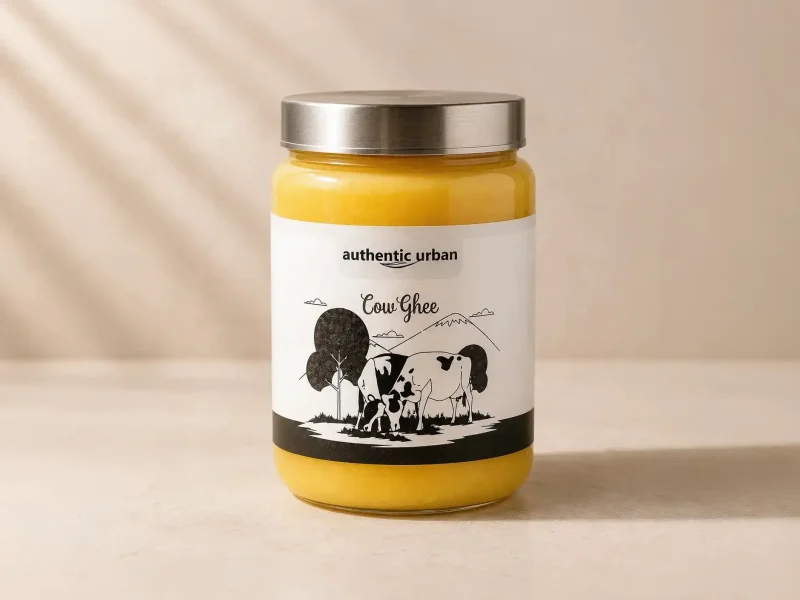 1 Litre
Sweets and paratha, on fewer days
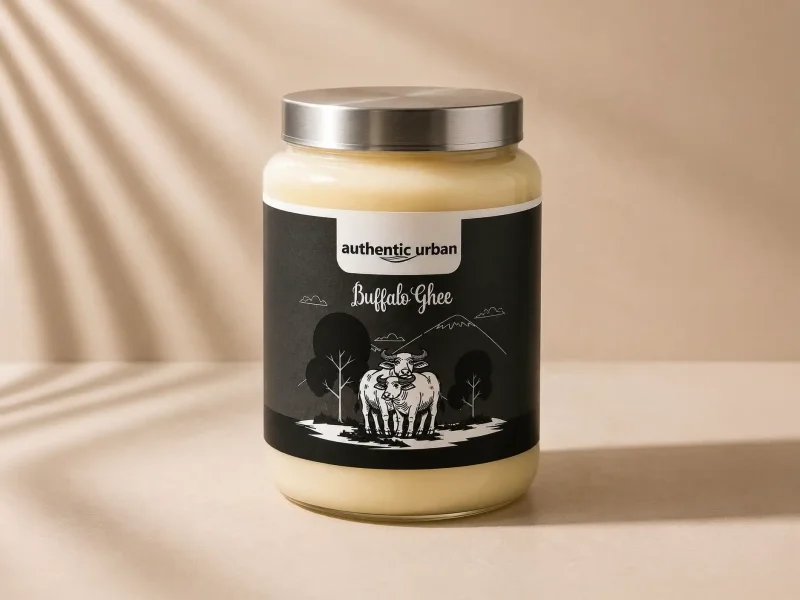 1 Litre
Each order is cooked after you place it, and the packing video is of that batch. Past order videos are on the shop.
FAQ
Is cow ghee healthier than buffalo ghee?
Not in any way your body would notice. Both are almost pure milk fat, so a teaspoon of either gives about 44 kcal and a similar load of saturated fat. Cow ghee is yellower and lighter in taste; buffalo ghee is white and richer, which suits sweets and paratha. Choose by the dish you cook, and keep the total for the day to 1 to 2 teaspoons whichever jar you open.
Is A2 ghee healthier than regular ghee?
We could not find a study showing A2 ghee is better for health than other ghee. A2 describes a milk protein, beta-casein, and ghee keeps only a trace of protein because FSSAI requires at least 99.5% milk fat. People choose A2 Bilona ghee for the breed, the taste, and the way it is made. For your health, how many spoons you eat matters far more than the label.
Is ghee healthy for weight loss?
Ghee does not burn fat. A teaspoon adds about 44 kcal, so it fits weight loss only when it replaces a fat you would have eaten anyway, such as the oil on a paratha or a fried snack. In the 2021 trial where adults ate about 30 g of ghee or olive oil a day for 4 weeks, body weight did not differ between the two fats. Total calories decide the scale.
Is it healthy to cook everything in ghee?
No. ICMR-NIN's 2024 guidelines put all visible fat, ghee and oil together, at 20 g a day for a sedentary woman and 30 g for a sedentary man, and limit ghee or butter to 1 to 2 teaspoons of that. Cooking every sabzi, dal, and roti in ghee would pass the ghee line by lunch. Use a plant oil for most cooking and keep ghee for the spoon you taste.
Is homemade ghee healthier than store-bought ghee?
Not by itself. Home ghee and a good shop jar are the same fat with the same saturated fat per spoon. Home ghee can even be worse when it is burnt, or undercooked so that moisture stays in and it spoils fast. What makes any ghee a fair food is that it is fresh, cooked properly, stored dry, and eaten in teaspoons. A rancid jar is unhealthy wherever it came from.
Is desi ghee good for health?
Desi ghee is the everyday Indian name for ghee from cow or buffalo milk, and the answer is the same as for any ghee. In 1 to 2 teaspoons a day on dal, roti, or khichdi, it is a fair part of a normal Indian diet for most healthy adults. In ladles on top of cooking oil, fried snacks, and sweets, it adds saturated fat that raises LDL cholesterol over time.
About the editorial team
Authentic Urban TeamBilona ghee makers, Gir Somnath, Gujarat
We are the Parmar family in Gir Somnath, Gujarat. We have made ghee here since 2016 and sold it online since 2025. We make only Bilona ghee, test it every month, and anyone is welcome to visit and watch it being made. Our Gir cows and Jafarabadi buffalo are grass-fed village animals that graze near the Gir forest, with no hormones or milk boosters. We set their milk to curd, churn it, and cook the makkhan on a wood chulha. These articles come from that kitchen and from what customers ask us on WhatsApp. We are ghee makers, not doctors.
Sources
- Dietary Guidelines for Indians, 2024 (Guideline 7, printed pp. 52-54; high saturated fat, printed p. 93), ICMR-National Institute of Nutrition. Checked 26 Sep 2026.
- Effects of diets rich in ghee or olive oil on cardiometabolic risk factors in healthy adults: a two-period, crossover, randomised trial (Mohammadi Hosseinabadi and Nasrollahzadeh, 2021), British Journal of Nutrition. Checked 26 Sep 2026.
- Food Safety and Standards (Food Products Standards and Food Additives) Regulations, Chapter 2.1: Dairy products and analogues, version 01.09.2023 (ghee standard, p. 27), FSSAI. Checked 26 Sep 2026.
- Butter oil, anhydrous (FDC ID 173412), SR Legacy, USDA FoodData Central. Checked 26 Sep 2026.
- Butter, without salt (FDC ID 173430), SR Legacy, USDA FoodData Central. Checked 26 Sep 2026.
- Oil, coconut (FDC ID 171412), SR Legacy, USDA FoodData Central. Checked 26 Sep 2026.
- Oil, peanut, salad or cooking (FDC ID 171410), SR Legacy, USDA FoodData Central. Checked 26 Sep 2026.
- Oil, mustard (FDC ID 172337), SR Legacy, USDA FoodData Central. Checked 26 Sep 2026.
- Nuts, almonds (FDC ID 170567), SR Legacy, USDA FoodData Central. Checked 26 Sep 2026.
- Carrots, raw (FDC ID 170393), SR Legacy, USDA FoodData Central. Checked 26 Sep 2026.