Ghee for Fatty Liver: The Controversial Truth About NAFLD and Saturated Fat
40% of Indian adults have fatty liver disease. You might be one of them. And if you've searched "can I eat ghee with fatty liver," you've likely encountered conflicting advice that's left you more confused than before. TheLiverDoc calls ghee a "super danger." Your grandmother swears by it. Nutritionists are divided. So what's the truth?
Non-Alcoholic Fatty Liver Disease (NAFLD)—now called MASLD—is India's silent epidemic. Nearly 35-40% of adults have excess fat in their liver, often without knowing it. The confusion around ghee stems from a larger debate about saturated fats, outdated nutritional guidelines, and the clash between traditional diets and modern hepatology. Understanding ghee's health effects requires looking beyond simple sound bites.
This comprehensive guide examines the latest research on ghee and fatty liver, addresses the viral TheLiverDoc controversy, compares ghee with seed oils, and provides evidence-based guidelines for safe consumption. Whether you're newly diagnosed with NAFLD, concerned about liver health, or trying to understand if ghee is healthy for your liver, you'll find science-backed answers here.
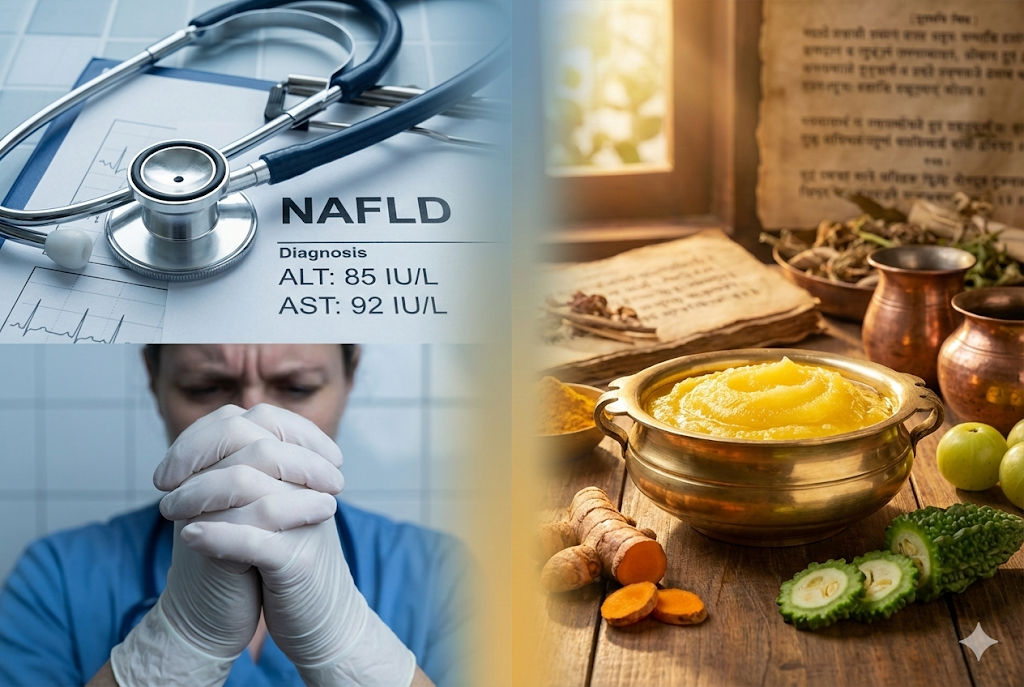
🚨 India's Fatty Liver Crisis
Understanding NAFLD: India's Silent Liver Epidemic
Before we can address whether ghee is safe for fatty liver, you need to understand what's actually happening in your liver. NAFLD (Non-Alcoholic Fatty Liver Disease)—recently renamed MASLD (Metabolic Dysfunction-Associated Steatotic Liver Disease)—occurs when more than 5% of your liver is fat.
Why NAFLD Is Exploding in India
India is experiencing a NAFLD epidemic unprecedented in scale:
- 35-40% of adults affected: Nearly half of India's urban population has fatty liver
- 35% of children showing signs: Children as young as 8 years old are being diagnosed
- Leading cause of liver transplants: Surpassing hepatitis and alcohol-related liver disease
- Linked to metabolic syndrome: 80% of NAFLD patients have obesity, diabetes, or high cholesterol
The primary drivers? High fructose consumption, refined carbohydrates, sedentary lifestyle, and yes—excessive dietary fat from ALL sources. Learn more about ghee's effect on cholesterol, which often accompanies NAFLD.
The Stages of Fatty Liver Disease
Stage 1: Simple Steatosis (Fat Accumulation)
Fat builds up in liver cells but no inflammation. Reversible with lifestyle changes. At this stage, moderate ghee (1-2 tsp/day) may be acceptable for most people.
Stage 2: NASH (Non-Alcoholic Steatohepatitis)
Fat + inflammation + liver cell damage. More serious. At this stage, ALL saturated fats including ghee should be strictly limited (consult doctor).
Stage 3-4: Fibrosis and Cirrhosis
Scarring of liver tissue. Irreversible. Ghee and all added fats should likely be avoided entirely. Medical supervision required.
The TheLiverDoc Controversy: Ghee as "Super Danger"?
In 2024, Dr. Cyriac Abby Philips, a hepatologist known as @TheLiverDoc on social media, sparked massive controversy by calling ghee a "super danger" for liver health. His viral posts recommended replacing ghee with seed oils, triggering backlash from Ayurvedic practitioners, nutritionists, and ghee advocates. So who's right?
What TheLiverDoc Actually Said
TheLiverDoc's Position:
- Ghee is 62% saturated fat, which worsens insulin resistance and promotes NAFLD
- Saturated fat causes inflammation and fat accumulation in the liver
- Seed oils rich in polyunsaturated fats are healthier alternatives
- Traditional use doesn't equal scientific validity
- Ghee contributes to India's metabolic disease epidemic
The Counter-Argument from Ayurveda and Nutrition Experts
The Defense of Ghee:
- Not all saturated fats are equal—ghee contains beneficial butyric acid and CLA
- Seed oils are high in omega-6 fatty acids that promote chronic inflammation
- Traditional ghee from grass-fed cows has anti-inflammatory properties
- The problem is refined carbs and sugar, not natural fats
- Moderation and quality matter more than complete avoidance
The Nuanced Truth: Both Sides Miss the Point
The reality is more complex than either extreme position suggests:
- TheLiverDoc is right that: Excessive saturated fat CAN worsen NAFLD, especially when paired with high-carb diets and sedentary lifestyle
- Ayurvedic practitioners are right that: Quality matters—traditional Bilona ghee from grass-fed cows is vastly different from commercial ghee; and seed oils aren't the universal solution
- What both miss: The dose makes the poison. Moderate ghee (1-2 tsp/day) in the context of a whole-food, vegetable-rich diet is different from 3+ tablespoons consumed with refined carbs
What Science Actually Says About Ghee and Liver Health
Beyond the Twitter debates, what does peer-reviewed research actually show?
🔬 Scientific Evidence on Ghee and NAFLD
Butyrate: Ghee's Liver-Healing Compound
One major difference between ghee and other saturated fats is its butyric acid (butyrate) content:
- Anti-inflammatory effects: Butyrate reduces liver inflammation by inhibiting NF-kB pathway
- Gut-liver axis support: Strengthens intestinal barrier, reducing endotoxin leakage that triggers liver inflammation
- Metabolic benefits: Improves insulin sensitivity, which is critical for NAFLD reversal
- Mitochondrial function: Enhances liver cell energy production, reducing fat accumulation
This is why some hepatologists now acknowledge that traditional ghee may have benefits that commercial ghee or other saturated fat sources lack. Learn more about butyrate's powerful health effects.
Ghee vs. Seed Oils for Fatty Liver: The Comparison
The biggest debate: Should NAFLD patients use ghee or seed oils? Let's examine the evidence:
| Factor | A2 Ghee | Refined Seed Oils |
|---|---|---|
| Omega-6 Content | Low | Very High (inflammatory) |
| Trans Fats | None | Present (heat damage) |
| Butyrate (Anti-inflammatory) | High | Zero |
| Vitamin K2 (Liver Function) | Present | Absent |
| Adulteration Risk | High (check GC report) | Moderate |
| Recommendation for NAFLD | 1-2 tsp/day (moderate, quality matters) | Avoid or minimize |
Key Insight: Neither is ideal in excessive amounts for NAFLD. The best approach: minimize ALL added fats, prioritize whole foods, and if using cooking fat, choose small amounts of ghee or extra virgin olive oil over seed oils.
Common Myths About Ghee and Fatty Liver
❌ Myth 1: "All saturated fat is equally bad for fatty liver"
Reality: Different saturated fats have different metabolic effects. Ghee's short and medium-chain fatty acids (butyric acid) behave differently than long-chain saturated fats in processed foods. Context matters—ghee with vegetables is different from ghee with refined carbs.
❌ Myth 2: "Seed oils are always healthier than ghee for NAFLD"
Reality: Industrial seed oils high in omega-6 can promote chronic low-grade inflammation that worsens NAFLD. Studies show that excessive omega-6 intake (>20g/day) increases inflammatory markers linked to liver disease. Moderate ghee may be less inflammatory.
❌ Myth 3: "Ghee will reverse fatty liver"
Reality: No single food reverses NAFLD. Ghee is not a cure. Reversal requires overall calorie deficit, reduced refined carbs, exercise, and improved insulin sensitivity. Ghee can be part of a healthy diet if used moderately.
❌ Myth 4: "I can eat unlimited ghee if it's A2 or Bilona"
Reality: Quality matters, but so does quantity. Even the purest grass-fed A2 Bilona ghee contains 9 calories per gram. Excessive intake (>3 tbsp/day) will contribute to calorie surplus and worsen NAFLD regardless of quality.
Safe Ghee Protocol for NAFLD Patients
If you have fatty liver and want to include ghee, follow this evidence-based protocol:
🩺 The NAFLD-Safe Ghee Protocol
Phase 1: Assessment (Week 1-2)
- Get baseline liver enzyme test (ALT, AST, GGT)
- Consult your hepatologist before starting
- Start with ZERO ghee to establish baseline
Phase 2: Testing Tolerance (Week 3-6)
- Introduce 1 teaspoon (5g) pure A2 ghee daily
- Use only with fiber-rich vegetables, NOT with refined carbs
- Monitor symptoms: fatigue, abdominal discomfort, digestive changes
- Retest liver enzymes at week 6
Phase 3: Moderate Use (Week 7+)
- If enzymes stable or improved: continue 1-2 tsp/day
- If enzymes worsened: reduce to zero and reassess diet
- Retest every 3 months
⛔ When to AVOID Ghee Entirely:
- Advanced liver disease or cirrhosis
- ALT/AST levels >100 U/L
- Active NASH with severe inflammation
- Gallbladder disease or bile duct issues
- Familial hypercholesterolemia
Best Type of Ghee for Liver Health
If your doctor approves ghee, quality is critical:
- Source: Grass-fed A2 cow milk (Gir, Sahiwal) for higher CLA and omega-3
- Method: Traditional Bilona method preserves beneficial compounds
- Purity: GC-tested to ensure no palm oil or vegetable fat adulteration
- Organic: Free from pesticides and antibiotics
Learn how to identify pure ghee and avoid dangerous adulterants.
See How We Make Liver-Safe, 100% Pure Ghee
For NAFLD patients, ghee quality is EVERYTHING. Watch your specific order being made with complete transparency—from grass-fed Gir cows to GC-tested purity. No adulteration, no compromises.
Every order comes with video proof of preparation using traditional Bilona method
Shop GC-Tested A2 Ghee →Frequently Asked Questions
Can I eat ghee if I have fatty liver?
If you have fatty liver disease (NAFLD/MASLD), ghee consumption should be moderated, not eliminated. Recent studies show that 1-2 teaspoons of pure A2 ghee daily does NOT worsen liver fat in healthy individuals. However, those with advanced NAFLD should limit all saturated fats. The key is QUALITY and QUANTITY: traditional Bilona ghee in small amounts may offer anti-inflammatory benefits through butyrate, while avoiding seed oils that contain pro-inflammatory omega-6. Always consult your hepatologist before dietary changes.
Does ghee increase fatty liver?
Moderate ghee consumption (1-2 teaspoons daily) does not increase fatty liver in most people, according to recent research. A 2024 study in the Indian Journal of Gastroenterology found that moderate ghee (<10g/day) did not increase liver fat. However, excessive intake (>3 tablespoons/day) combined with refined carbs CAN contribute to fat accumulation. The problem isn't ghee alone—it's total calorie excess, sugar intake, and sedentary lifestyle. Focus on overall diet quality and consult your doctor if you have existing liver disease.
What did TheLiverDoc say about ghee?
Dr. Cyriac Abby Philips (TheLiverDoc) called ghee a "super danger" due to its high saturated fat content, claiming it worsens NAFLD and increases cardiovascular risk. He recommends seed oils over ghee. However, many Ayurvedic practitioners and nutritionists disagree, citing ghee's anti-inflammatory butyrate, vitamin K2, and traditional use. The truth is nuanced: moderation matters, quality matters (grass-fed A2 vs commercial ghee), and individual health status matters. Neither extreme position—"ghee is poison" nor "ghee cures everything"—is supported by balanced scientific evidence.
Which is worse for fatty liver: ghee or vegetable oil?
The answer depends on the type and quantity. Excessive consumption of either is harmful. However, industrial seed oils (soybean, corn, sunflower) are high in omega-6 fatty acids that promote inflammation when consumed in excess, potentially worsening NAFLD. Studies show that replacing seed oils with moderate amounts of ghee may improve liver enzyme markers. Ghee's butyrate has anti-inflammatory effects on the liver. The optimal approach for NAFLD: minimize ALL added fats, prioritize whole foods, and if using cooking fat, use small amounts of ghee or extra virgin olive oil. Avoid trans fats and excessive omega-6 oils completely.
How much ghee is safe with fatty liver?
If you have fatty liver, limit ghee to 1-2 teaspoons (5-10g) per day maximum, only after consulting your hepatologist. Start with 1 teaspoon daily and monitor liver enzyme levels (ALT, AST) every 3 months. Choose pure grass-fed A2 Bilona ghee for best quality. Replace other saturated fats with ghee rather than adding it. Pair ghee with fiber-rich vegetables, not refined carbs. If you have advanced liver disease, cirrhosis, or very high ALT/AST levels (>100 U/L), you may need to avoid ghee entirely. Individual tolerance varies—always work with your doctor to determine your safe amount.
Conclusion: The Truth About Ghee and Fatty Liver
So, is ghee safe for fatty liver? The answer: It depends on quantity, quality, stage of disease, and individual factors.
For early-stage NAFLD (simple steatosis), moderate ghee consumption (1-2 tsp/day) from high-quality sources does NOT appear to worsen liver fat and may offer anti-inflammatory benefits through butyrate. However, excessive intake, poor-quality ghee, or pairing ghee with refined carbs can absolutely worsen NAFLD.
For advanced NAFLD, NASH, or cirrhosis, ghee should be strictly limited or avoided entirely under medical supervision. The TheLiverDoc controversy highlights an important truth: we need nuance, not absolutes. Ghee isn't a "super danger" for everyone, but it's also not a cure-all.
The real solution to fatty liver? Calorie control, reduced refined carbs, exercise, improved insulin sensitivity, and whole-food nutrition. If ghee fits into that plan in small amounts and your doctor approves, it can be part of a liver-healthy diet. If not, there are plenty of other healthy fats to choose from.
Choose Liver-Safe, GC-Tested Ghee
For NAFLD patients, purity isn't optional—it's essential. Our grass-fed A2 Gir Cow Ghee is GC-tested for zero adulteration, made using traditional Bilona method, and comes with video proof of preparation.
Shop Pure A2 Ghee