Butyrate in Ghee: How Much, and Does It Help Your Gut?
Butyrate in ghee is real but small: USDA FoodData Central lists 3.23 g of butyric acid per 100 g, about 0.16 g in a teaspoon. Your gut bacteria make roughly 7 to 10 g a day from the fibre in dal, grains, and vegetables, so ghee adds a small top-up, not the main supply. A teaspoon on a fibre-rich meal suits gut health; spoons of ghee to heal a leaky gut do not.
How much butyrate is in ghee?
About 3.2% of ghee by weight is butyric acid, the fat that becomes butyrate in the body. USDA FoodData Central lists 3.23 g per 100 g of butter oil (ghee), which works out to about 0.16 g (160 mg) in a 5 g teaspoon and about 0.41 g in a 12.8 g tablespoon. That teaspoon also brings 44 kcal and 3.1 g of saturated fat.
You will see other numbers online. Some health sites say ghee is only 1% butyrate; some brand pages say "up to 5%" or call ghee the richest butyrate food there is. USDA's measured figure sits between them. Among kitchen fats, milk fat is the one that carries it: USDA lists coconut oil at 0.009 g per 100 g, under a milligram in a teaspoon. The full ghee label, spoon by spoon, is on ghee nutrition facts.
USDA FoodData Central SR Legacy (ghee 173412, butter 173410, coconut oil 171412); den Besten et al. 2013, low end of 400 to 600 mmol short-chain fatty acids a day, about a fifth of it butyrate. Checked 27 September 2026.
| Item | Value |
|---|---|
| 1 tsp coconut oil (5 g) | 0 mg |
| 1 tsp butter (5 g) | 160 mg |
| 1 tsp ghee (5 g) | 160 mg |
| 2 tsp ghee, the ICMR-NIN daily limit | 320 mg |
| 1 tbsp ghee (12.8 g) | 410 mg |
| Made by gut bacteria in a day | 7,000 mg |
Portion
Butyric acid
Where the number comes from
1 tsp coconut oil (5 g)
Butyric acid: under 1 mg
USDA 171412, 0.009 g per 100 g
1 tsp butter (5 g)
Butyric acid: 160 mg
USDA 173410, 3.23 g per 100 g
1 tsp ghee (5 g)
Butyric acid: 160 mg
USDA 173412, 3.23 g per 100 g
2 tsp ghee, the ICMR-NIN daily limit
Butyric acid: 320 mg
USDA 173412 x 10 g
1 tbsp ghee (12.8 g)
Butyric acid: 410 mg
USDA 173412, tablespoon weight from USDA
Made by gut bacteria in a day
Butyric acid: about 7,000 to 10,600 mg
den Besten 2013, 400 to 600 mmol SCFAs, about a fifth butyrate
The gut bacteria row is our arithmetic: 400 to 600 mmol a day, about one fifth butyrate, at 88.1 g per mole. It is an estimate for an adult on a mixed diet, not a measured target. Checked 27 September 2026.
Butyrate in butter vs ghee
Per teaspoon they come out the same on USDA's tables: both list 3.23 g of butyric acid per 100 g, so 160 mg in 5 g of either. On paper ghee should carry a little more per gram, because it is butter with the water and milk solids taken out, and salted butter is only 81.1% fat by USDA's count. Either way the gap is a few tens of milligrams a spoon, too small to choose by. Pick between them for cooking, keeping, and taste, as set out in ghee vs butter.
Does Bilona or A2 ghee have more butyrate?
We have not seen a lab comparison that shows it, and we do not claim it for our own jar. Bilona means curd churned by hand into makkhan and then cooked; A2 is about the protein in the milk, not its fat. We make only Bilona ghee, and the reasons we do (taste, grain, the way the batch cooks) are on the Bilona method. A label that promises extra butyrate should show a fatty acid test for that batch.
Is ghee good for gut health?
A teaspoon of ghee in a fibre-rich meal fits a healthy gut, but its butyrate is not what feeds your colon. The cells lining the colon run largely on short-chain fatty acids, butyrate among them, and gut bacteria make those on the spot. A 2013 review in the Journal of Lipid Research (den Besten and colleagues) puts the output at 400 to 600 mmol a day from fermenting the carbohydrate that reaches the large gut, with about a fifth of it butyrate, and notes that 95% is taken up by the colon cells right there.
Butyrate you swallow takes a different route. A 2026 review in Digestive Diseases and Sciences on butyrate supplements notes that butyrate is absorbed fast in the stomach and the first part of the small intestine, which is why the capsules meant for the colon are coated. Ghee's butyrate comes inside ordinary fat, not a coated capsule, so most of it is likely taken up well before the colon. That is our reading of the review; no study has tracked ghee's butyrate through the gut.
So the useful jobs ghee does for digestion are plainer ones. It makes dry food easier to eat, it carries the fat-soluble vitamins in the vegetables, and it has almost no lactose left, which helps people who react to milk (the detail is on casein and whey in ghee). For passing stool, the dose and timing are on ghee for constipation.
Does ghee help leaky gut?
No trial shows that ghee repairs a leaky gut, and "leaky gut" itself is not a clear diagnosis. A 2024 review in JGH Open by Mogilevski, Maconi, and Gibson calls it a popular but poorly defined concept and warns against the simple cures that surround it. Raised gut permeability is real in conditions such as coeliac disease and inflammatory bowel disease, where the treatment is for that disease.
Be careful with test packages sold for it. The same review notes that commercial zonulin tests do not measure the zonulin molecule, and that the sugar-drink permeability test is easily thrown off by how the urine is collected and stored. A report from one of these is a weak reason to start a diet plan, and no reason at all to eat ghee by the tablespoon.
Butyrate does help the gut barrier in cell and animal studies, which is where the "ghee heals leaky gut" line starts. The step from there to a spoon of ghee is the part with no evidence: the dose is small, and it is taken up early. If you have bloating, pain, or changed stools and have been told it is leaky gut, the better route is a gastroenterologist who can test for coeliac disease, IBS, and inflammation. How ghee fits an IBS plan is on ghee for IBS.
Does ghee feed gut bacteria or improve microbiome diversity?
Not in any measured way. Gut bacteria live on the carbohydrate your small intestine cannot digest, the fibre and resistant starch in dal, rajma, whole grains, vegetables, and fruit; that is the food den Besten's review describes them fermenting. Ghee is almost pure fat with no fibre, so it gives them little to work with.
Diversity follows the variety of plants you eat, not the fat you cook them in. A week of meals with three or four dals, two grains, and a different sabzi each day does more for your gut bacteria than any jar. Ghee's part is making those meals pleasant enough to eat every day: a teaspoon on the dal, a little on the roti. If fibre makes you bloated, build it up over two or three weeks; the Ayurvedic household approach is on ghee for bloating.
Ghee vs probiotics: which helps the gut more?
They do different jobs, and for most people curd and fibre matter more than either ghee or a capsule. Ghee has no probiotics. In our kitchen the milk is set to curd overnight, 8 to 12 hours, and the curd is where the live culture is. The makkhan churned from it then cooks in a matki on a wood chulha for 45 to 90 minutes, and that heat is the point: it drives off the water so the ghee keeps. What comes out of the pot is fat, not a live food. If you want the bacteria, eat the curd or drink the chaas.
Gut tool
What it gives
What it does not
Ghee
Gives: About 160 mg of ready-made butyric acid per teaspoon, and fat that helps you absorb vitamins A, D, E, and K from the meal.
Does not: No live bacteria and no fibre. Most of its butyrate is likely taken up before the colon.
Fibre: dal, rajma, whole grains, sabzi, fruit
Gives: Food for the gut bacteria that make butyrate where the colon lining uses it.
Does not: Too much too fast can bring gas and bloating, so add it over a few weeks.
Curd and chaas
Gives: Live bacteria from the culture, in a food Indian homes already eat daily.
Does not: Not a medicine. Strains and counts vary from pot to pot.
Probiotic capsule or sachet
Gives: Named strains at a stated dose, for a specific use a doctor picks.
Does not: Strain-specific. One product does not cover every gut problem.
Ghee butyrate from USDA FoodData Central 173412; fibre fermentation from den Besten et al. 2013; early absorption from Caban et al. 2026. Checked 27 September 2026.
You can have all of them in one meal: rice, dal with a teaspoon of ghee, a sabzi, and a bowl of curd is already the combination. A probiotic capsule is worth it when a doctor names a strain for a reason, such as during or after certain antibiotic courses. Buying one because a site says ghee "works with" it adds cost and little else.
Does ghee help the gut-brain axis?
There is no study of ghee and the gut-brain axis in people, so any claim that ghee lifts mood through butyrate is a guess. The gut-brain axis is the two-way link between the gut, its bacteria, and the brain, through nerves, hormones, and immune signals. Butyrate made by gut bacteria is one of the signals researchers study, mostly in animals.
The same arithmetic applies as for the gut lining: a teaspoon of ghee adds about 160 mg, gut bacteria make many grams, and ghee's share is likely absorbed early. Pages that say ghee raises serotonin or treats anxiety or depression have no trial behind them. Regular meals with fibre, sleep, and movement are what the gut-brain research points to. Low mood, panic, or constant worry need a doctor or counsellor; what ghee can and cannot do for stress is on does ghee help anxiety and stress.
How much ghee a day for gut health?
One to two teaspoons a day in food, the same as for anyone: ICMR-NIN's 2024 dietary guidelines ask adults to limit ghee or butter to 1 to 2 teaspoons a day. That is 160 to 320 mg of butyric acid. Going to three tablespoons still gives only about 1.2 g, with about 340 kcal, so the extra spoons buy calories, not gut health.
If you have
Ghee
What helps more
Healthy gut, want gut-friendly meals
Ghee: ½ to 1 tsp on dal, khichdi, or roti; 1 to 2 tsp across the day
Helps more: A katori of dal and a sabzi at each main meal
IBS or bloating
Ghee: Start at ½ tsp with food; some people flare on any added fat
Helps more: A symptom diary for two weeks, and the plan on the IBS page
Hard stools
Ghee: 1 tsp with a meal, not a spoon on its own
Helps more: Water, fibre, and walking do more than extra ghee
Loose motions right now
Ghee: Hold extra ghee until stools settle
Helps more: ORS and plain food; a doctor if it lasts
Coeliac disease, Crohn's, or colitis
Ghee: As your gastroenterologist or dietitian sets
Helps more: Your treatment plan. Ghee is food, not part of the treatment
Gallstones, high LDL, or a doctor-set fat limit
Ghee: Ask first; stay inside the limit you were given
Helps more: The oil or fat your doctor chose
Daily limit from ICMR-NIN Dietary Guidelines for Indians 2024, printed p. 54. Checked 27 September 2026.
At home we eat 1 to 2 teaspoons each a day on roti, dal, and khichdi, and we would not go higher for the gut. Timing matters less than the meal it sits in; if you are weighing a morning spoon, read ghee on an empty stomach first. For your own household's ghee and oil, try the ghee calculator, and the daily amount by age is on how much ghee per day.
When should gut symptoms go to a doctor first?
Before any diet change, if you have blood in your stool, black stools, weight loss you cannot explain, fever, pain or loose stools that wake you at night, vomiting that keeps coming back, or trouble swallowing. These need a gastroenterologist, not a ghee trial. We make ghee; we are not doctors, and a gut problem is theirs to name and treat.
- New gut symptoms later in life, or a family history of bowel cancer: tell your doctor early rather than trying home fixes for months.
- Coeliac disease, Crohn's, or ulcerative colitis: your fat intake is part of the plan your specialist or dietitian sets.
- Gallstones or pancreas trouble: fat can set off pain; ask before adding ghee.
- High LDL or heart disease: ghee is mostly saturated fat, so stay inside your doctor's limit. Who should keep ghee low is on who should not eat ghee.
A gut-friendly plate you can keep
Screenshot this. It puts ghee where it helps the gut: on top of the fibre, not in place of it.
- Put fibre on the plate at every main meal: dal or rajma, a sabzi, and roti or rice with some whole grain.
- Add fibre slowly over two to three weeks if your meals have been low in it, and drink water with it.
- Keep curd or chaas in the day, if dairy suits you.
- Use ghee to finish the food: ½ to 1 tsp on hot dal or khichdi, 1 to 2 tsp in the whole day.
- Do not take ghee by the spoonful "for butyrate"; three tablespoons still give about 1.2 g, far less than gut bacteria make.
- Skip "leaky gut" or zonulin test packages unless a gastroenterologist orders a test.
- Keep a two-week symptom diary before you change more than one thing.
- See a doctor for blood in stool, weight loss, fever, night symptoms, or anything that lasts beyond a few weeks.
Which ghee for everyday gut-friendly meals?
No jar on the market has a tested butyrate edge over another, so choose for purity and taste. Warm a spoon: good ghee smells of toasted milk, not sour or waxy. "Is it pure, how do I check" is one of the questions we get most on WhatsApp, and the five home checks are on how to identify pure ghee. Our ranking of the cow ghee on sale is best cow ghee in India.
We make and sell ghee, so weigh this with that in mind. For the daily teaspoon we would pick our own A2 Gir cow ghee: milk from grass-fed Gir cows near the Gir forest, set to curd overnight, churned, and cooked slowly in a matki on a wood chulha in Gir Somnath. It is made after you order, and a video of your jar being cooked and packed comes on WhatsApp. For parathas and sweets, our Jafarabadi buffalo ghee is the richer jar. We test every month against the FSSAI limits; the steps, and the open invitation to watch a batch being made, are on how we make ghee.
The teaspoon on dal and khichdi
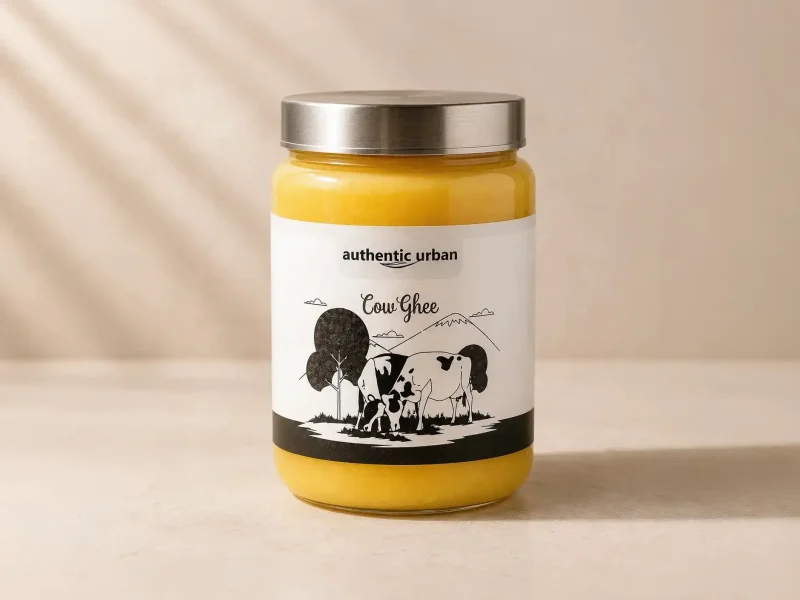 1 Litre
Paratha and winter sweets
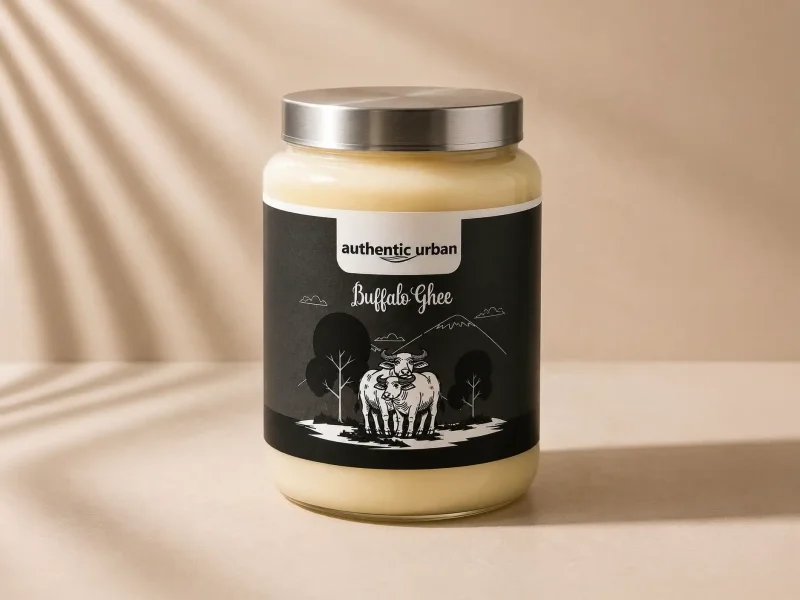 1 Litre
Each order is cooked after you place it, and the packing video is of that batch. Past order videos are on the shop.
FAQ
Kya ghee pet ke liye accha hai?
Thodi matra mein haan, khaane ke saath. Ek chammach ghee mein lagbhag 0.16 g butyric acid hota hai (USDA), jo pet ke bacteria roz fibre se banate hain uska chhota hissa hai. Isliye dal, sabzi, roti aur dahi ke saath 1 se 2 chammach roz kaafi hai (ICMR-NIN). Khoon, wajan girna ya lagatar dard ho to pehle doctor ko dikhayein.
Can I take a butyrate supplement instead of ghee?
Butyrate supplements exist as sodium butyrate and tributyrin, often in coated capsules so more of it reaches the colon. A 2026 review in Digestive Diseases and Sciences explains that plain butyrate is absorbed early in the gut, which is why coating matters. These are for a doctor to choose for a named condition. For everyday gut health, fibre-rich meals do the bigger job at no extra cost.
Is ghee in warm water on an empty stomach good for the gut?
It is a household tradition, and no trial shows it heals the gut lining or adds much butyrate. If you like it, keep it to one teaspoon in warm water and count it inside your 1 to 2 teaspoons for the day. Stop if it brings on reflux, nausea, or loose stools. People with gallstones or a fat limit should ask their doctor before starting.
Does ghee help the gut after antibiotics?
Not in any special way. Antibiotics can upset the gut bacteria for a while, and what helps them come back is food for them: fibre from dal, vegetables, and whole grains, plus curd if you eat it. Whether you need a probiotic sachet during or after the course is your doctor's call. Ghee can stay in the meal as usual, a teaspoon on the dal.
Is ghee good for a child's digestion?
A little ghee in a child's dal or khichdi is a normal Indian food and helps the meal go down, but it is not a gut treatment. For children over one, a small amount mixed into food is enough; no child needs spoons of ghee on its own. Constipation, loose stools that last, or poor weight gain need a paediatrician, not more ghee.
Can ghee cause loose stools or gas?
It can when you take more than your gut is used to, especially a spoonful on an empty stomach or several spoons in one meal. Fat speeds up the gut for some people, and those with IBS are more sensitive. Go back to ½ to 1 teaspoon inside a meal. If loose stools continue after you cut back, see a doctor rather than blaming the ghee.
About the editorial team
Authentic Urban TeamBilona ghee makers, Gir Somnath, Gujarat
We are the Parmar family in Gir Somnath, Gujarat. We have made ghee here since 2016 and sold it online since 2025. We make only Bilona ghee, test it every month, and anyone is welcome to visit and watch it being made. Our Gir cows and Jafarabadi buffalo are grass-fed village animals that graze near the Gir forest, with no hormones or milk boosters. We set their milk to curd, churn it, and cook the makkhan on a wood chulha. These articles come from that kitchen and from what customers ask us on WhatsApp. We are ghee makers, not doctors.
Sources
- Butter oil, anhydrous (FDC ID 173412), SR Legacy, USDA FoodData Central. Checked 27 Sep 2026.
- Butter, salted (FDC ID 173410), SR Legacy, USDA FoodData Central. Checked 27 Sep 2026.
- Oil, coconut (FDC ID 171412), SR Legacy, USDA FoodData Central. Checked 27 Sep 2026.
- The role of short-chain fatty acids in the interplay between diet, gut microbiota, and host energy metabolism (den Besten et al., J Lipid Res, 2013), Journal of Lipid Research, via PubMed Central. Checked 27 Sep 2026.
- Use of Sodium Butyrate and Its Microencapsulated Forms in Intestinal Diseases: Current Clinical Approach (Caban et al., Dig Dis Sci, 2026), Digestive Diseases and Sciences, via PubMed Central. Checked 27 Sep 2026.
- Recent advances in measuring the effects of diet on gastrointestinal physiology: Probing the "leaky gut" and application of real-time ultrasound (Mogilevski, Maconi, Gibson, JGH Open, 2024), JGH Open, via PubMed Central. Checked 27 Sep 2026.
- Dietary Guidelines for Indians, 2024 (Guideline 7, printed p. 54), ICMR-National Institute of Nutrition. Checked 27 Sep 2026.