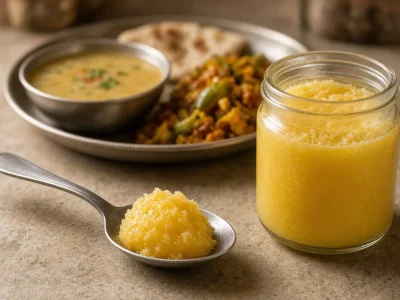
Ghee for Breastfeeding: Does It Increase Milk? How Much
Ghee for breastfeeding is safe at 1 to 2 teaspoons a day (5 to 10 g) with meals, but it does not increase breast milk. Milk supply follows how often the baby feeds. What a nursing mother needs more of, by ICMR-NIN's 2024 guidelines, is about 600 extra kcal a day from dal, milk, nuts, and grains, and most of that should not be ghee.
Does ghee increase breast milk?
No. There is no study showing that ghee makes a mother produce more breast milk, and the NHS explains supply as a supply-and-demand system: the more the baby feeds, the more milk you make. ICMR-NIN's 2024 guidelines say the same, asking for frequent feeds on demand to set up and keep the supply. Ghee helps only in a roundabout way, by helping a tired mother with little appetite eat enough.
This page is for a nursing mother in India, or the family cooking for her, who has been told to "eat more ghee for milk" and wants to know how much is sensible. We are the Parmar family in Gir Somnath, Gujarat. We make ghee; we are not doctors or lactation counsellors. "Can I give it to my baby?" is one of the questions we get most on WhatsApp, and the mother's own spoon comes up right behind it. If your milk feels low or the baby is not gaining, a doctor or lactation counsellor checks the feeding first. The first 40 days after delivery, with panjeeri, gond laddoo, and C-section food, are on ghee for postpartum recovery.
What the evidence says about "milk-making" foods
The Academy of Breastfeeding Medicine's protocol on galactogogues (foods, herbs, and medicines said to raise milk) was last revised in 2018. It finds little or no scientific evidence that any herb or food works, and it puts the first step for low supply elsewhere: feed or express more often, and make sure the milk is actually coming out, with the latch checked. The tablespoons-of-ghee advice on many pages, including an older version of this one, rests on family habit, not on any trial.
How much ghee can a breastfeeding mother eat a day?
One to two teaspoons a day, the same line ICMR-NIN's 2024 guidelines give every adult for ghee or butter. The guidelines give a breastfeeding mother about 35 g of fats and oils a day in all, 10 g more than a sedentary woman, and they ask that visible fat stay restricted while nursing, with the extra fat coming from nuts, oilseeds, beans, and fish.
So the ghee is part of the 35 g, not an extra on top of it. Here is what each common portion carries, set against the extra 600 kcal a nursing mother needs in the first six months and against the whole day's fat. Your own number, with your family's cooking oil counted in, can be worked out with our ghee and oil calculator.
Portion
Energy
Of +600 kcal
Of 35 g fat
What it means
1 teaspoon (5 g)
44 kcal
7%
14%
One spoon on dal, khichdi, or a roti. Enough for most days. Saturated fat 3.1 g.
2 teaspoons (10 g)
88 kcal
15%
29%
The top of ICMR-NIN's 1 to 2 teaspoon ghee line. Our pick while nursing. Saturated fat 6.2 g.
1 tablespoon (12.8 g)
112 kcal
19%
37%
Fine on a day it replaces the oil in a meal, not on top of it. Saturated fat 7.9 g.
2 tablespoons (25.6 g)
224 kcal
37%
73%
The old "lactation dose". Close to three quarters of the day's fat, and still no more milk. Saturated fat 15.8 g.
Energy and saturated fat from USDA FoodData Central, SR Legacy 173412 (876 kcal and 61.9 g saturated fat per 100 g). "Of +600 kcal" is the share of the extra energy ICMR-NIN gives a mother in the first six months of breastfeeding (Guideline 2); "Of 35 g fat" is the share of her day's fats and oils (Table 1.6). Teaspoon 5 g, tablespoon 12.8 g. Checked 27 September 2026.
Two teaspoons cover about 15% of the extra energy. Two tablespoons would cover more of it, but they also take nearly three quarters of the day's fat and bring 16 g of saturated fat, with almost no protein, iron, or calcium. At home our family eats 1 to 2 teaspoons each a day on roti, dal, and khichdi, and we make ghee for a living. A nursing mother does not need a different rule from ours; she needs more of everything else. The same limit for every adult is set out on how much ghee per day.
What does a breastfeeding mother need more of?
Energy and protein, mostly from ordinary food. ICMR-NIN adds 600 kcal and 13.6 g of protein a day in the first six months of breastfeeding, and 520 kcal and 10.6 g of protein in the next six. The CDC gives a lower figure, 330 to 400 extra kcal, for a mother who was already well fed. Either way, the gap is a meal and a snack, not a spoon of fat.
ICMR-NIN's balanced-diet table shows where the extra goes. This is the table to screenshot and stick on the fridge.
A day of
Woman, not nursing
Nursing, 0 to 6 months
Nursing, 7 to 12 months
Energy
~1,660 kcal
~2,245 kcal
~2,200 kcal
Protein
57 g
77 g
78 g
Milk or curd
300 ml
400 ml
400 ml
Nuts and oilseeds
30 g
40 g
40 g
Fats and oils (all of it)
25 g
35 g
35 g
Of which ghee
1 to 2 tsp
1 to 2 tsp
1 to 2 tsp
ICMR-NIN Dietary Guidelines for Indians 2024, Table 1.6: a sedentary woman of 55 kg against a breastfeeding mother. Energy and protein are what those food groups provide. The ghee row is ICMR-NIN's 1 to 2 teaspoon line for ghee or butter (Guideline 7), inside the fats and oils.
Look at what actually rises: 100 ml more milk or curd, 10 g more nuts, and more cereals and dal behind the 77 g of protein. Ghee has almost no protein (USDA lists 0.28 g per 100 g) and no iron, folate, vitamin D, or DHA, so it cannot fill any of those rows. ICMR-NIN also asks nursing mothers to keep taking the iron and folic acid tablets for the first six months. Full numbers per spoon are on ghee nutrition facts.
Does the ghee you eat change your breast milk?
It can change the fat in your milk a little for a few hours, but not the amount of milk. In a 2021 study in Maternal & Child Nutrition, nine exclusively breastfeeding mothers ate an extra 28 g of fat on one test day and an extra 66 g of sugar on another. Milk triglycerides (the main milk fat) rose within hours on both days, and more on the sugar day. The study did not measure how much milk they made.
ICMR-NIN adds the part that matters for a worried family: breast milk keeps its normal make-up even when a mother is mildly or moderately undernourished. Only severe undernutrition may cut the quality and quantity. So "thin milk" is rarely fixed by ghee.
The fat that does help the baby's brain is DHA, which ghee does not have. ICMR-NIN points nursing mothers to nuts, oilseeds, beans, and fish for the extra fat, and the NHS suggests fish twice a week, one of them oily, for mothers who eat fish. For vegetarian homes, walnuts, flaxseed, and mustard or soybean oil in the cooking are the usual stand-ins. Ghee also carries very little milk protein or lactose, which is why many mothers who find milk heavy eat it without trouble; that is explained on does ghee have casein.
What does a nursing mother's day with ghee look like?
Three meals and two or three snacks, with ghee on two of them and the extra energy coming from milk, dal, nuts, and grains. Night feeds make a mother hungry at odd hours, so it helps to keep the snacks ready and within reach.
When
On the plate
Ghee
Early morning feed
A glass of milk, a handful of almonds and walnuts, or roasted chana
Ghee: None
Breakfast
Poha, upma, or methi thepla with curd
Ghee: None, or oil in the tadka
Lunch
Two rotis, a katori of dal, sabzi, salad
Ghee: 1 tsp on the dal or roti
Evening
Fruit, a small bowl of sprouts, or one small panjeeri piece
Ghee: Counted if it is panjeeri
Dinner
Moong khichdi or dal-rice with sabzi
Ghee: 1 tsp on top
Night feed
Water beside you; milk if hungry
Ghee: None
Our kitchen example, built on the food groups in ICMR-NIN's Table 1.6 for a breastfeeding mother. Two teaspoons of ghee in the day; the other fat is oil in the cooking.
Soft moong khichdi with a teaspoon on top is the easiest dinner on a bad night; the method is on ghee khichdi. If a family member brings haldi doodh, the half-teaspoon version is on turmeric ghee golden milk. Constipation is common in the weeks after birth, and a teaspoon in warm dal can help a little alongside water and fibre; the rest is on ghee for constipation.
Do methi, panjeeri, and other lactation foods work better with ghee?
No. Ghee carries their calories, not their effect, and the effect itself is unproven. The ABM protocol lists fenugreek (methi), fennel (saunf), oats, moringa, and shatavari among the herbs used for milk, and finds little or no evidence for any of them.
Methi in a thepla or sabzi is food and fine. Concentrated methi powder or "lactation" mixes are a different matter: the ABM protocol notes rare but serious allergic reactions to fenugreek, with cross-reactions in people allergic to peanuts or chickpeas. Ask your doctor before taking any herbal mix, as ICMR-NIN asks nursing mothers to take nothing without medical advice.
Panjeeri and gond laddoo are where the ghee quietly piles up. A traditional batch is roasted in cups of ghee, so a bowl a day can hold more fat than the whole ICMR-NIN day. One small piece counts as your ghee for that meal. The recipe, with its ghee, is on panjeeri recipe.
Can the ghee you eat upset your baby?
Rarely. A teaspoon or two of ghee in your meals is very unlikely to give a breastfed baby gas or loose stools, and cutting it out on a guess only takes food off your plate. If the baby is fussy or gassy for days, the baby's doctor is the one to look for the cause.
The one real exception is cow's milk allergy. Milk protein from the mother's diet can pass into breast milk, and a baby with this allergy may need the mother to go dairy-free. NHS milk-free diet sheets for breastfeeding mothers list ghee and butter among the foods to avoid, even though ghee carries only a trace of milk protein. That decision belongs to the baby's doctor or dietitian. Do not cut out dairy on your own; do not keep ghee in if you have been told to cut it.
How do you know the baby is getting enough milk?
The NHS signs are simple: from day 5, at least 6 heavy wet nappies every 24 hours; from day 4, at least 2 soft yellow poos a day for the first few weeks; and steady weight gain after the first few days. If those are there, your milk is enough, whatever the family says about its colour. If they are not, speak to your doctor, a nurse, or a lactation counsellor that day. More ghee is not the fix.
Who should ask a doctor about ghee for breastfeeding?
Mothers whose baby has cow's milk allergy, and mothers with diabetes, high cholesterol, gallstones, or a recent C-section, should let their doctor set the ghee. For them it is often less than a teaspoon, or none. This is where your care team takes over from us.
If
Ghee
Why
Your baby has cow's milk allergy and you were told to cut out dairy
Stop ghee
NHS milk-free diet sheets for breastfeeding mothers list ghee and butter among the foods to avoid. Follow your baby's doctor or dietitian.
Gestational diabetes in pregnancy, or diabetes now
Ask the doctor
Ghee does not raise sugar by itself, but the laddoo, halwa, and extra roti it comes with do.
High cholesterol or heart disease
Doctor first
Ghee is about 62% saturated fat (USDA). Your doctor may keep it under a teaspoon.
Gallstones or gallbladder pain
Doctor first
A fatty meal can set off gallbladder pain. Keep ghee small and skip heavy sweets until you have asked.
First days after a C-section
Surgeon's steps
Follow the hospital's diet steps. The ghee can wait until you are eating normal food.
On medicines while nursing
Tell the doctor
ICMR-NIN notes that many medicines pass into breast milk. Ghee does not change that; ask before any herbal "lactation" mix.
Wanting to lose the pregnancy weight is not a reason to drop ghee altogether, but it is a reason not to add more; the maths is on ghee for weight loss. The full list of people who should go easy on ghee is on who should not eat ghee. This page is general information, not medical or lactation advice.
Which ghee is best for a breastfeeding mother?
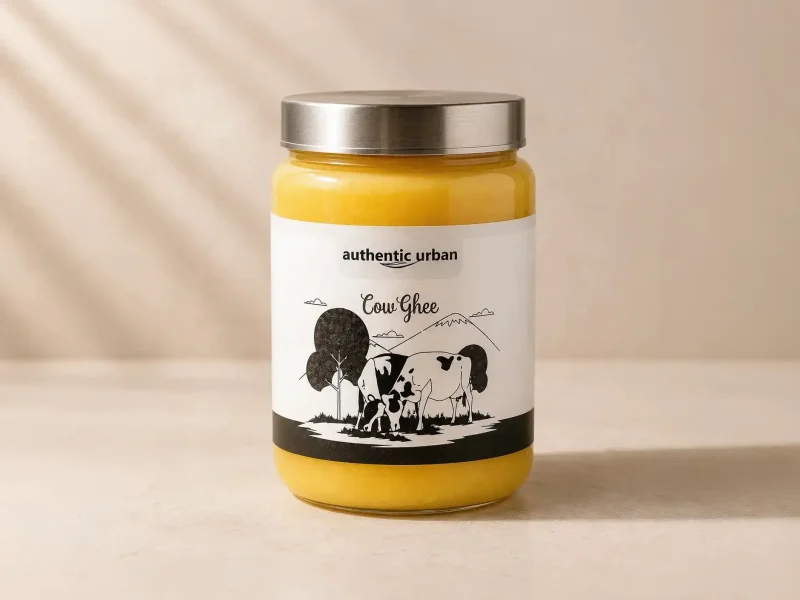
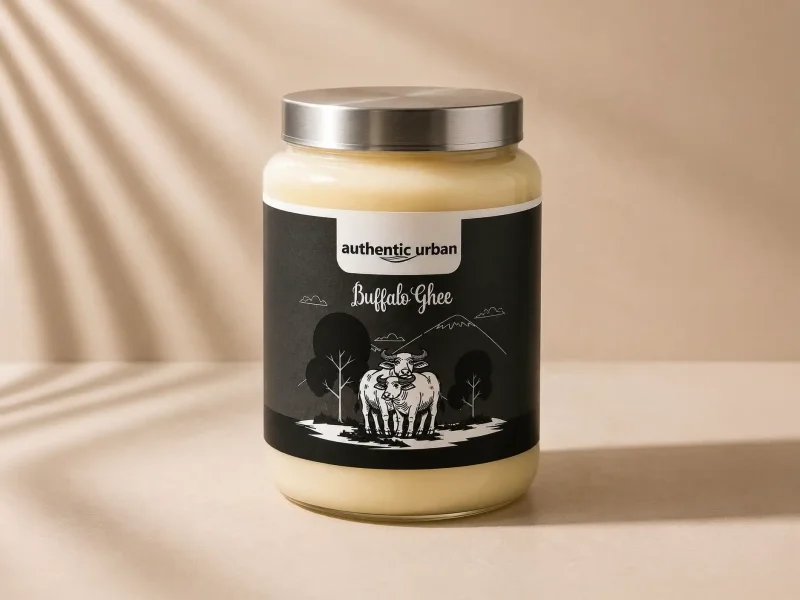
Pure cow or buffalo ghee with one ingredient on the label, an FSSAI licence number, and a clean toasted-milk smell. Nothing on a jar makes it a "lactation ghee": A2 describes the protein in the milk, and ghee keeps almost none of it. What matters is that you trust the jar enough to eat from it every day for a year.
Cow ghee is lighter and the usual choice for the daily spoon; buffalo ghee is richer and sets firmer, and suits the family's parathas and sweets. How the two compare is on best cow ghee in India, and the kitchen tests for a new jar are on how to identify pure ghee.
A new mother often notices every change in the jar, so it helps to know which changes are normal. In our kitchen, winter milk is richer and the ghee sets with a fine grain; in summer it can stay liquid in the jar; in the monsoon, green fodder turns cow ghee a deeper yellow. A batch left too long on the chulha comes out dark, bitter, and smelling burnt, and one taken off too early stays cloudy and spoils fast. Neither goes into a jar. Sour, soapy, or waxy is never normal.
Check these 7 things before adding ghee for milk
- Is the baby feeding often, whenever hungry, day and night? Supply follows how often milk is removed.
- From day 5, are there at least 6 heavy wet nappies every 24 hours (the NHS sign)? If not, call your doctor or a lactation counsellor today.
- Are you eating three meals and two snacks, with dal, milk or curd, and nuts in them? That is where the extra 600 kcal comes from.
- Is the ghee 1 to 2 teaspoons a day, with the rest of the fat as oil in the cooking?
- Are panjeeri and laddoos a piece a day, not a bowl?
- Are you drinking to thirst, with water beside you at every feed?
- Is the jar one ingredient, with an FSSAI licence number, and does it smell of toasted milk when warmed?
Which ghee for a nursing mother's plate?
At 1 to 2 teaspoons a day, a 1 litre jar lasts a nursing mother about three months, so the first year of breastfeeding needs roughly four. That makes it worth choosing one jar you trust and sticking with it. How curd Bilona (curd churned by hand) differs from cream ghee is on the Bilona method.
We make and sell ghee, so weigh this with that in mind. For the nursing teaspoon we would pick our own A2 Gir cow ghee: milk from grass-fed Gir cows with no hormone injections, set to curd overnight, churned, and cooked in a matki on a wood chulha. It is made after you order, and a video of your jar being cooked and packed comes on WhatsApp. At ₹2,399 a litre, a teaspoon costs about ₹13. For the rest of the family's cooking, our Jafarabadi buffalo ghee is the richer jar. Varsha tastes every batch before it is packed, and we test every month against the FSSAI limits; the steps are on how we make ghee.
Before the birth, the daily amount by trimester is on ghee during pregnancy, and the baby's own first ghee, from six months, is on ghee for babies.
The daily teaspoon on dal, khichdi, and roti
 1 Litre
The family's paratha, halwa, and sweets
 1 Litre
Each order is cooked after you place it, and the packing video is of that batch. Past order videos are on the shop.
FAQ
Can I lose pregnancy weight while breastfeeding and still eat ghee?
Yes. One or two teaspoons of ghee is 44 to 88 kcal, a small part of a nursing mother's day of about 2,200 kcal. Slow weight loss comes from cutting sweets, fried snacks, and second helpings of rice, not from dropping a teaspoon of ghee. Crash dieting while nursing leaves you tired. If you want a plan, a dietitian can set one that keeps your milk and energy steady.
Is ghee in warm milk at night good for a nursing mother?
A teaspoon of ghee in a glass of warm milk is fine for most nursing mothers, and it counts as one of the day's two teaspoons. The milk is the useful part here: ICMR-NIN gives a breastfeeding mother 400 ml of milk or curd a day. Keep sugar to a pinch. The glass will not make more breast milk overnight; it simply adds calories, protein, and calcium to a tired day.
Does the mother eating ghee help the baby gain weight?
Not in any way you can count on. ICMR-NIN notes that breast milk keeps its normal make-up even when the mother is mildly or moderately undernourished, so a well-fed mother eating more ghee does not make the baby heavier. A baby gains weight by feeding often and well. If weight gain worries you, the baby's doctor or a lactation counsellor checks the feeding, not the mother's ghee.
Is ghee heating for a nursing mother or the baby?
In Ayurveda, ghee is described as cooling rather than heating, which is why many families keep it in the diet after delivery. That is tradition, not a tested fact. In practice ghee in normal amounts does not cause heat, rashes, or loose stools in the baby. If the baby has a rash or stomach trouble, see the doctor rather than guessing at one food.
Should I change my ghee when my baby starts solids at six months?
Your own teaspoon stays the same. Once the baby starts solid food at six months, the family jar can also go into the baby's dal and khichdi, a little at a time, as long as it is plain ghee with nothing added. The baby's amount is separate from yours and much smaller. Breastfeeding usually carries on alongside solids, so your plate still needs the extra dal, milk, and nuts.
Is it safe to eat homemade ghee while breastfeeding?
Yes, if it is cooked well: heated until the milk solids turn golden-brown and the bubbling stops, strained, and kept in a dry jar. Undercooked ghee keeps water and can go sour quickly, so throw out any that smells sour or grows mould. Use a dry spoon every time. The same one to two teaspoons a day applies to homemade and bought ghee.
About the editorial team
Authentic Urban TeamBilona ghee makers, Gir Somnath, Gujarat
We are the Parmar family in Gir Somnath, Gujarat. We have made ghee here since 2016 and sold it online since 2025. We make only Bilona ghee, test it every month, and anyone is welcome to visit and watch it being made. Our Gir cows and Jafarabadi buffalo are grass-fed village animals that graze near the Gir forest, with no hormones or milk boosters. We set their milk to curd, churn it, and cook the makkhan on a wood chulha. These articles come from that kitchen and from what customers ask us on WhatsApp. We are ghee makers, not doctors.
Sources
- Dietary Guidelines for Indians, 2024 (Table 1.6, printed p. 11; Guideline 2, printed pp. 15 and 19; Guideline 3, printed pp. 23 and 25; Guideline 7, printed p. 54), ICMR-National Institute of Nutrition. Checked 27 Sep 2026.
- Butter oil, anhydrous (FDC ID 173412), SR Legacy, USDA FoodData Central. Checked 27 Sep 2026.
- ABM Clinical Protocol #9: Use of Galactogogues in Initiating or Augmenting Maternal Milk Production, Second Revision 2018, Academy of Breastfeeding Medicine. Checked 27 Sep 2026.
- Ward E et al. Acute changes to breast milk composition following consumption of high-fat and high-sugar meals. Maternal & Child Nutrition, 2021, Maternal & Child Nutrition (Wiley). Checked 27 Sep 2026.
- Breastfeeding: is my baby getting enough milk?, NHS. Checked 27 Sep 2026.
- Milk supply (Best Start in Life), NHS. Checked 27 Sep 2026.
- Breastfeeding and diet, NHS. Checked 27 Sep 2026.
- A milk free diet when breastfeeding, Bedfordshire and Luton Children's Nutrition and Dietetics Service, NHS. Checked 27 Sep 2026.
- Maternal Diet and Breastfeeding, CDC. Checked 27 Sep 2026.