Bilona Method: How Bilona Ghee Is Made, Step by Step
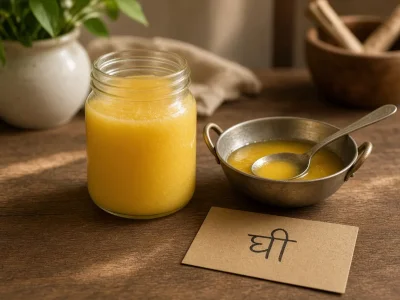
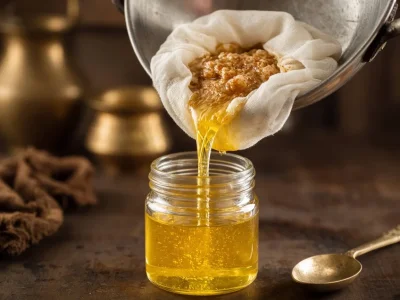
Bilona ghee is ghee made from curd, not cream. The Bilona method step by step with times, a home batch, the label words, price per litre, and checks.
22 articles
Bilona ghee is ghee made from curd, not cream. The Bilona method step by step with times, a home batch, the label words, price per litre, and checks.
Ghee in Hindi में घी ही कहते हैं। FSSAI के हिसाब से घी क्या है, कैसे बनता है, देसी, A2, बिलोना और वनस्पति का फर्क, और शुद्ध घी कैसे पहचानें।
What is A2 ghee: ghee from cows that give only A2 milk protein, such as Gir. Which breeds qualify, what the label proves, and what a litre costs.
What is ghee: milk fat cooked until the water and milk solids are gone. What FSSAI counts as ghee, how it is made, cow vs buffalo, and how to use it.
CLA in ghee: about 50 mg in a teaspoon of cow ghee, against 3,200 mg a day in weight-loss trials. What CLA does, capsule risks, and grass-fed claims.
Ghee on carnivore: allowed on most plans, not on meat-and-water ones. Saturated fat per spoon vs tallow and butter, a daily amount, and the LDL catch.
Ghee for longevity: what rasayana means in Charaka, what a 33-year butter study found, and how much ghee a day after 40 and after 60, in teaspoons.
Is ghee keto friendly? Yes, 0 g carbs. How much ghee a day on keto, ghee vs butter and coconut oil, the LDL catch, and an Indian keto day.
Why ghee tastes different from your last jar: season, feed, curd, and cooking heat change its smell and colour. What is normal, and the signs of a bad jar.
Does ghee have trans fat? Yes, about 170 to 390 mg per teaspoon, made in the animal, not a factory. What WHO and FSSAI say, labels, heat, and how much.
Ghee for nutrient absorption: why vitamins A, D, E, K and beta-carotene need fat, how much ghee per meal the studies used, and the Indian dishes to pair.
Ghee for thyroid: 1 to 2 tsp a day on meals suits most people with hypothyroidism or Hashimoto disease. It does not lower TSH. Timing with your tablet.
Can you reuse ghee after frying? Once, in a curry within a day or two, not for another fry. Why, the FSSAI throw-out signs, and reheating a melted jar.
Butyrate in ghee: USDA lists about 0.16 g per teaspoon, a small part of what gut bacteria make from fibre. What it does, leaky gut, and how much to eat.
Can diabetics eat ghee? Why ghee has no carbs but still matters for sugar, how much a day, ghee or oil, what to watch in reports, and which ghee to buy.
Does ghee have casein? Yes, a trace: about 14 mg of milk protein per teaspoon. Why ghee is not dairy free, and what that means for milk allergy.
Ghee smoke point is about 250°C, but frying in ghee works best at 160 to 180°C. How to judge the heat, ghee or oil by dish, and when to bin it.
Ghee nutrition facts from USDA: 44 kcal per teaspoon, 112 per tablespoon, 99.5% fat, vitamins A, E, K, zero carbs, and how much ICMR says to eat a day.
Ghee side effects: what too much ghee does, the ICMR-NIN daily limit in teaspoons, who should avoid ghee, and the signs that mean stop and see a doctor.
Does ghee need to be refrigerated? No. A sealed jar keeps 9 to 12 months at room temperature. How long it lasts, signs it has gone bad, how to store it.
Clarified butter vs ghee: ghee is clarified butter cooked until the milk solids brown. How each is made, FSSAI limits, taste, swaps, and which to use.
Is ghee healthy? What a teaspoon gives you and costs you, which health claims hold up, the ICMR-NIN daily limit, and when ghee turns unhealthy.