Why Is Ghee Grainy? What Danedar Means, and Is It Pure?
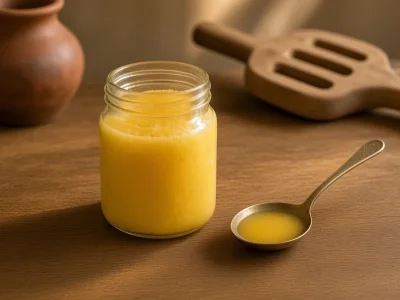
Why is ghee grainy? Because ghee is a mix of fats that melt at different temperatures. As a jar cools slowly, the fats with the highest melting point turn solid first and form small crystals, the dana in danedar, while the rest stays soft or liquid around them. Grain tells you how the ghee cooled and what fat the milk had. It does not prove the ghee is pure, and smooth ghee is not fake just for being smooth.
Why is ghee grainy?
Ghee turns grainy when its high-melting fats crystallise as it cools. Milk fat is not one fat but hundreds, and some stay solid well above room temperature. Cooled slowly, those fats gather into grains you can see and feel. Cooled fast, they form crystals too small to notice, and the ghee sets smooth.
FSSAI's standard for ghee says it in one line: ghee has an especially developed flavour and physical structure as a result of its method of manufacturing. The standard then sets limits for water, milk fat, free fatty acids, and a list of lab values, but none for grain. So grain is part of what ghee is, and not a test it has to pass.
"Why is it grainy?" is the question we get most on WhatsApp, and grainy versus smooth is one of the most common complaints, in both directions. This page is for anyone holding a jar that looks different from the last one, or from a photo. How to check the rest of the jar is on how to identify pure ghee.
What does danedar ghee mean?
Danedar means grainy, from dana, a grain. Danedar ghee is ghee that has set into small, soft grains in a little liquid fat, so a spoon comes up rough and sandy rather than smooth like butter. In many Indian homes it is the look people grew up with.
Dairy science describes it the same way. The e-PG Pathshala dairy course, published by INFLIBNET, says good ghee should have a soft, granular texture, with a large share of crystalline fat held in enough liquid fat that it can still be poured at room temperature. It puts the grain down to high-melting triglycerides, the fats that set first.
The grains are fat, not sugar and not milk solids. Rub one between two warm fingers and it melts to oil. The brown specks at the bottom of some jars are something else: toasted milk solids left from cooking the butter.
What makes ghee more grainy, or less?
Cooling speed and storage temperature decide most of it; the fat in the milk decides the rest. The same batch can come out grainy in one jar and smooth in another if one was chilled and the other left on the counter.
What changes the grain, at a glance
What changes it
More grain
Less grain, smoother
How fast it cools
More grain: Slow cooling at room temperature
Smoother: Fast chilling, straight into the fridge
Where it sits after packing
More grain: A steady room near 29°C for one to three days
Smoother: A hot shelf near the stove, or a cold fridge
Seeding
More grain: A spoon of already-grainy ghee stirred in as it cools
Smoother: No seed, and the jar filled hot and left alone in the cold
The fat in the milk
More grain: More high-melting saturated fat (palmitic acid above 35% in the 2013 study)
Smoother: More low-melting, unsaturated fat
Cow or buffalo
More grain: Buffalo ghee: much bigger grains in the INFLIBNET dairy text
Smoother: Cow ghee: finer grain
Season (our kitchen)
More grain: Winter: richer milk, fine grain that sets firm
Smoother: Summer: ghee often stays liquid in the jar
Sources: INFLIBNET e-PG Pathshala, Technology of ghee making; Rachana et al., International Journal of Dairy Technology (2013); season row from our own kitchen. Checked 27 September 2026.
The INFLIBNET text reports that ghee stored at 29°C finished granulating in three days, cow and buffalo alike, and that buffalo ghee grew grains about four times the size of cow ghee's. It also notes that seeding with previously granulated ghee helps good grain form. In a 2013 study in the International Journal of Dairy Technology, ten commercial ghee samples held at 29°C for 24 hours had grains of 0.20 to 0.33 mm, and grains made up anywhere from 1% to 40% of the ghee. Laboratory ghee made for the study reached 42%.
The same study found that samples with bigger grains had more palmitic acid (above 35% of the fat), and the poorly grained ones had less saturated fat overall. That links grain to the animal, its feed, and the season, not only to the pot. It is also why we say our ghee "cools grainy" but never promise the same grain in every jar.
Does grainy ghee mean pure ghee?
No. Grain is a good sign of slow cooling, not a purity test. Pure ghee can be smooth, and a jar with grain can still be cut with another fat. Read grain as one clue, next to smell, label, price, and a lab report.
The numbers show why. FSSAI's fatty acid table for ghee allows palmitic acid anywhere from 22% to 38% of the fat. The 2013 study tied big grains to palmitic acid above 35%. So two jars can both be legal, pure ghee, one near the bottom of that range and one near the top, and set very differently on the same shelf.
It works the other way too. The study found that blending ghee with its own high-melting fraction gave bigger grains, and blending it with the low-melting fraction gave poor grain. Grain follows how much high-melting fat is in the jar, whatever that fat is. A mixed fat that sets hard can grain, which is why the adulterants on how fake ghee is made are caught by lab lines such as the Baudouin test and β-sitosterol, not by looking at the jar. How to read those lines on a report is on ghee lab test reports.
Why is my ghee liquid on top and grainy at the bottom?
Because the room is warm enough to keep part of the fat melted. The grains are heavier than the liquid fat, so they settle and a clear oily layer sits on top. This is normal, and it is the texture the INFLIBNET text describes as good ghee: crystals held in liquid fat.
Stir the jar with a clean, dry spoon before you take some out, so each spoon gets a little of both layers. The liquid should look like clear oil. If it looks cloudy and watery instead, or beads of water sit under the fat, the ghee was not cooked long enough to drive the water off. Our own rule at the chulha is to take the matki off the flame only when the bubbling goes quiet, the solids turn golden-brown, and it smells of toasted milk. An undercooked batch is cloudy, holds moisture, and spoils fast, so we never pack it.
Why is some ghee smooth, with no grain at all?
Mostly because it was cooled fast, stirred while cooling, or kept cold. Fast cooling makes many tiny crystals instead of a few big ones, so the ghee sets into a smooth, even paste. The INFLIBNET text notes that texture can keep changing in storage depending on the temperature.
A smooth jar from a shop says nothing bad about the ghee by itself. At home, the fridge does the same thing: a grainy jar chilled overnight comes out as a hard, smooth block. A shiny slab that never grains in any season, at a price below what the milk would cost, is a reason to look closer, but the price is the real warning there, not the texture. What goes into the price of a slow jar is on why A2 Bilona ghee is expensive.
Why does my ghee look different from the last jar?
The season, and the trip. Our Gir cow ghee and Jafarabadi buffalo ghee are made the same way all year, and they still change. In winter the milk is richer, we get more makkhan per litre, and the ghee sets with a fine grain. In summer the milk fat is lower and the ghee often stays liquid in the jar.
Transit is the other half. A jar that travels through a hot week can melt fully in the box, and then it sets again in your kitchen at whatever temperature your kitchen is. A leaked or melted jar in summer is one of the complaints we hear most. If yours arrived liquid, nothing is wrong with the ghee; the next section brings the grain back.
Colour moves too. In the monsoon, green fodder makes our cow ghee more yellow, and buffalo ghee is white all year. Why colour changes, and why it is not a purity test either, is on white ghee vs yellow ghee, and cow versus buffalo for each job is on cow vs buffalo ghee.
How do you make melted ghee grainy again?
Melt it fully, then let it cool slowly on the counter for one to three days. The grain comes from slow setting at room temperature, so the job is to give the jar a second slow cool.
- Melt it gently. Stand the closed jar in a bowl of hot water until the ghee is clear all the way down. Do not put a glass jar on a flame, and do not heat until it smokes.
- Seed it, if you can. Stir in a spoon of grainy ghee from another jar as it cools. The INFLIBNET text notes seeding helps good grain form.
- Cool it slowly. Leave the covered jar on the counter, away from the stove, the window, and the fan. No fridge.
- Wait. In a room near 29°C, grain shows within a day and can take up to three days to finish. In a cold winter room it sets finer; in a hot summer room part of it may stay liquid.
- Leave it be. Every melt and reset is more heat and air for the fat. Do it once, not every week.
The same method gives grain to ghee you make at home. The full home batch, from butter or cream, is on how to make ghee at home, and the curd-churned method we use is on the Bilona method.
When is ghee texture a warning sign?
When the "grain" will not melt, when there is water, or when the smell is wrong. Grain, a liquid top layer, a smooth set, or a change with the season are all normal. Save this five-point check for any jar.
Five-point ghee texture check
Check
Normal
Act on it
1. Rub a grain between warm fingers
Normal: It melts to oil in seconds
Act on it: Hard grit that never melts: not fat. Stop using it.
2. Look at the bottom of the jar
Normal: Soft white or golden grains, maybe a few brown specks
Act on it: Beads of water, or a watery layer under the fat
3. Warm a spoon on low heat
Normal: Smells of toasted milk, melts clear
Act on it: Sour, soapy, waxy, or old-oil smell
4. Look at the surface
Normal: A clear liquid layer on top in a warm room
Act on it: Fuzzy spots of any colour: mould. Throw it out.
5. Compare jars across the year
Normal: Grain and colour shift with the season
Act on it: Always the same slab, every season, at a price below the milk it needs
Water and mould are storage problems as much as making problems: a wet spoon or a loose lid in the monsoon is enough. How long a jar keeps, and what rancid ghee smells like, is on ghee storage and shelf life. If a jar fails the smell check and you want a second opinion, you can check your jar in 2 minutes with our purity checker.
Which ghee sets with a natural grain?
Buy on method, smell, and proof, and let the grain be a bonus. A jar made slowly from curd, cooled in the jar, and kept at room temperature will usually grain; a jar with a batch report and a licence you can look up tells you far more than the texture. How the brands compare is on best ghee in India.
We make both jars below, so read this as our own pick. Every jar is curd-churned Bilona, cooked in a matki on a wood chulha after you order, and it cools grainy. You get a video of your jar being cooked and packed on WhatsApp before it ships. Our A2 Gir cow ghee is from grass-fed Gir cow milk only, for the daily spoon; our Jafarabadi buffalo ghee is for halwa, ladoo, and paratha. We test every month against the FSSAI limits, and anyone is welcome to visit and watch a batch; see how we make ghee.
Gir cow ghee: the daily teaspoon
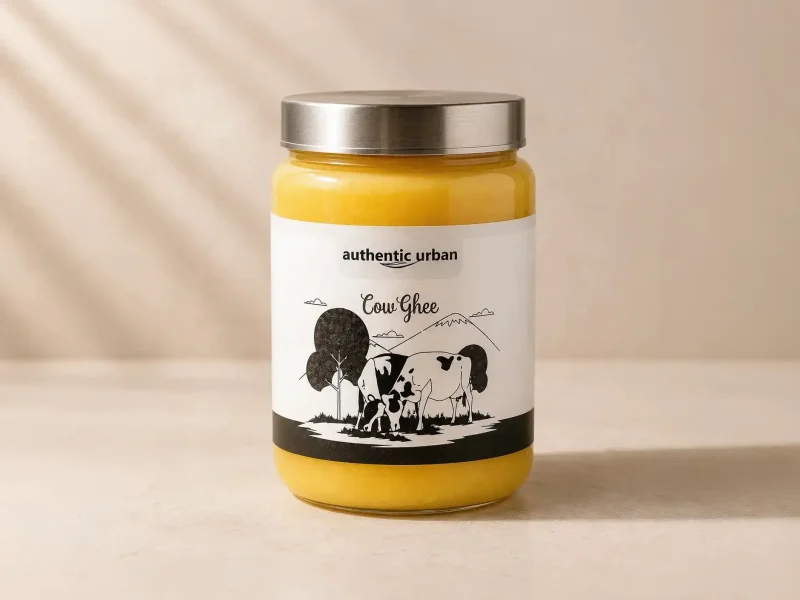 1 Litre
Buffalo ghee: sweets and paratha
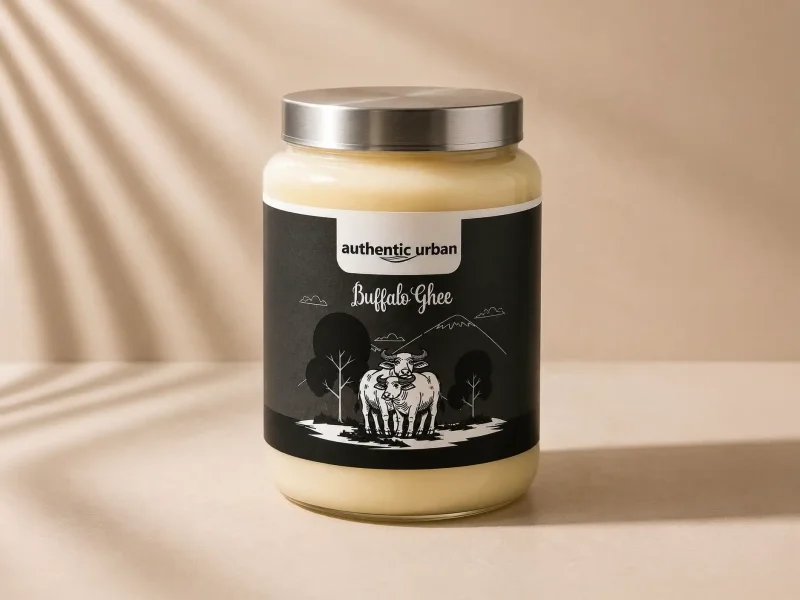 1 Litre
Each order is cooked after you place it, and the packing video is of that batch. Past order videos are on the shop.
FAQ
Are the grains in ghee sugar or milk solids?
Neither. The grains are milk fat that has turned solid, the same way coconut oil turns white in winter. They melt on a warm finger or a hot roti. The brown specks you sometimes see at the very bottom are different: those are bits of toasted milk solids from cooking the butter. A few are harmless. A thick brown layer means the ghee was not strained well.
Is grainy ghee healthier than smooth ghee?
No. Grain is the shape the fat takes as it cools, not a different fat. A teaspoon of grainy ghee and a teaspoon of the same ghee melted and set smooth have the same fat, calories, and vitamins. The grain can tell you something about how the jar was cooled and stored. It cannot tell you anything about nutrition, and it disappears the moment the ghee hits hot dal.
Should I keep grainy ghee in the fridge?
You do not need to. A sealed jar of well-made ghee keeps at room temperature, and the fridge mostly changes the texture: cold sets the fat fast into a hard, smooth block, and the big grains do not return until it warms up and sets slowly again. If your kitchen is very hot and you use the jar slowly, the fridge is fine; just scoop with a dry spoon.
Why is my homemade ghee not grainy?
Usually because it cooled too fast or too cold. A small batch poured into a steel katori and left under a fan, or put straight into the fridge, sets smooth. Pour the strained ghee into a glass jar, cover it, and leave it on the counter away from the stove for one to three days. Stirring in a spoon of grainy ghee from your last batch as it cools helps the grain start.
Can I cook with ghee that is half liquid and half grainy?
Yes. Both layers are the same ghee; the liquid part simply has more of the fats that melt at a lower temperature. Stir the jar with a dry spoon before you take some out so each spoon gets a little of both. Once it is in a hot pan or on hot rice, the difference is gone. It only matters if the liquid is watery rather than oily, or smells sour.
Does grainy ghee go bad faster?
No. Spoiling in ghee comes from water, air, light, heat, and wet spoons, not from the grain. Grain forms in the fat itself and does not let water in. What does shorten a jar's life is a wet or dirty spoon, a loose lid, or keeping it next to the stove. A grainy jar and a smooth jar from the same batch, kept the same way, last the same time.
About the editorial team
Authentic Urban TeamBilona ghee makers, Gir Somnath, Gujarat
We are the Parmar family in Gir Somnath, Gujarat. We have made ghee here since 2016 and sold it online since 2025. We make only Bilona ghee, test it every month, and anyone is welcome to visit and watch it being made. Our Gir cows and Jafarabadi buffalo are grass-fed village animals that graze near the Gir forest, with no hormones or milk boosters. We set their milk to curd, churn it, and cook the makkhan on a wood chulha. These articles come from that kitchen and from what customers ask us on WhatsApp. We are ghee makers, not doctors.
Sources
- Food Safety and Standards (Food Products Standards) Chapter 2.1: Dairy products and analogues, version 01.09.2023 (2.1.8 Milk fat products and ghee, description p. 26; limits and Table 1 fatty acids, pp. 27-28), FSSAI. Checked 27 Sep 2026.
- Rachana C.R., Nath B.S., Reshma M.V., Armughan C. Variation in grainy texture of commercial ghee in relation to laboratory ghee and its blends. International Journal of Dairy Technology 66 (2013): 90-97, doi:10.1111/j.1471-0307.2012.00872.x, Wiley (abstract). Checked 27 Sep 2026.
- Technology of ghee making: direct cream, creamery butter, continuous method (Technology of Milk and Milk Products, e-PG Pathshala), INFLIBNET Centre. Checked 27 Sep 2026.