Bilona Method: How Bilona Ghee Is Made, Step by Step
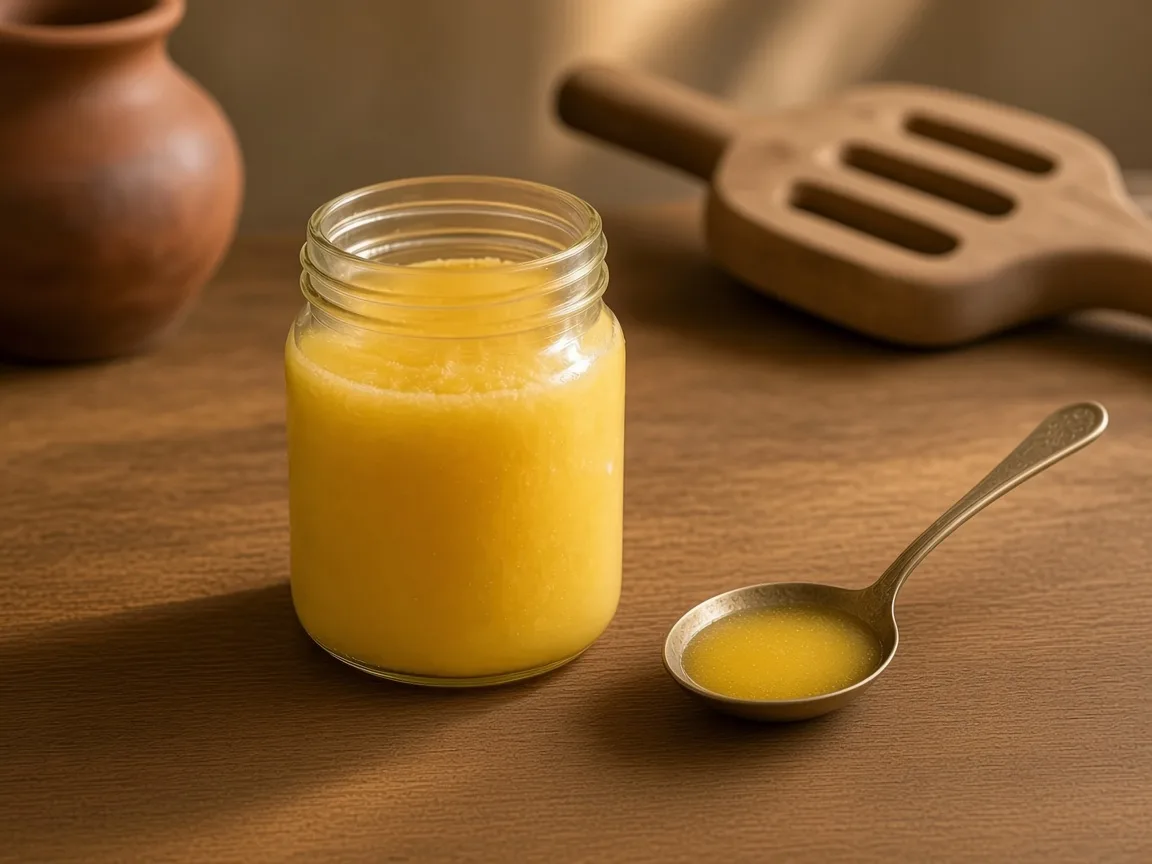
The Bilona method makes ghee from curd, not cream: whole milk is set to curd overnight, the curd is churned until the makkhan (butter) floats, and the makkhan is cooked on a low flame until the solids turn golden-brown. In our kitchen in Gir Somnath that takes the better part of two days, and 30 to 35 litres of Gir cow milk for 1 kg of ghee.
What is the Bilona method?
The Bilona method is the old village way of making ghee in four moves: milk to curd, curd to makkhan, makkhan to ghee, then strain. The name comes from the bilona, the wooden churn that beats the curd. What makes it Bilona is the curd. Butter churned from soured whole-milk curd, then cooked slowly, is Bilona ghee. Butter from fresh cream is not.
Bilona is a kitchen word, not a legal grade. FSSAI's standard for milk fat products (Chapter 2.1, version 01.09.2023) sets one set of limits for all ghee, whichever route made it, and the word Bilona does not appear in it. The standard does say that ghee has "especially developed flavour and physical structure" from the way it is made, which is exactly where the method shows. So Bilona on a label is the seller's claim about how the ghee was made, and it is only as good as the seller. What the word promises on a jar, next to A2 and organic, and what it costs, are further down this page.
How is Bilona ghee made, step by step?
Bilona ghee is made in seven steps over about two days: boil and cool the milk, set it to curd for 8 to 12 hours, churn for 30 to 45 minutes, lift the makkhan, cook it for 45 to 90 minutes, stop at the right moment, and strain. The times below are from our own kitchen, where the makkhan cooks in a clay matki on a wood chulha.
Step
Time
What happens
What goes wrong
1. Milk
Time: Morning
Whole milk is boiled and cooled until lukewarm, so the starter can work.
Goes wrong: Toned packet milk has had fat taken out, so it gives far less makkhan.
2. Curd
Time: 8 to 12 hours
A spoon of yesterday's curd sets the milk overnight. The souring builds the aroma.
Goes wrong: Too cold and it will not set; too long in summer and it turns sharp and sour.
3. Churn
Time: 30 to 45 minutes
The curd is churned until the makkhan gathers and floats on the chaas.
Goes wrong: Warm curd gives soft, greasy butter that will not gather; cool it first.
4. Lift
Time: A few minutes
The makkhan is lifted out by hand. The chaas stays behind.
Goes wrong: Chaas left in the butter makes the pan spit and the ghee cloudy.
5. Cook
Time: 45 to 90 minutes
The makkhan goes into a matki on a low flame. Water boils off and the solids sink.
Goes wrong: A high flame browns the solids before the water is out.
6. Stop
Time: A minute's window
Off the flame when the bubbling goes quiet, the solids are golden-brown, and it smells of toasted milk.
Goes wrong: Early: cloudy, spoils fast. Late: dark, bitter, smells burnt.
7. Strain and set
Time: Overnight
Strained through cloth into a dry jar, it cools grainy.
Goes wrong: A wet jar or spoon brings back the water that spoils ghee.
How hot does the makkhan get?
Hotter than boiling water, but slowly. The dairy technology course on INFLIBNET's e-PG Pathshala describes makkhan being heated to about 110 to 120°C with constant stirring to drive out practically all the moisture. On a chulha there is no dial, so we go by the pan: loud crackling while the water leaves, then the bubbling thins and goes quiet. That quiet, with golden-brown solids and a toasted-milk smell, is the stop. A batch that comes off early is cloudy, keeps moisture, and spoils fast. One left too long turns dark and bitter and smells burnt. Neither goes into a jar; both stay for home use.
What does the Bilona method change in the ghee?
The Bilona method changes the smell and taste of ghee, not its fat. The souring of the curd is what does it. The INFLIBNET course notes that desi ghee made from makkhan carries many of the aroma compounds formed while the dahi ferments.
A 2025 study in Food Chemistry: X tested this directly. Kataria and Singh made ghee three ways from the same milk: from curd butter, from fresh cream butter, and from cream that was soured first. All three were clarified the same way, at 120°C. The fatty acid profile did not differ between the three, and neither did butyric acid or CLA (conjugated linoleic acid, a fat found in milk). What did differ was the smell chemistry. The two soured routes carried more lactones, acids, ketones, and maltol, the compounds behind a rich, nutty ghee aroma.
So when someone tells you Bilona ghee tastes deeper on a roti, the study backs them. When someone tells you it has more butyrate or more CLA, it does not. The same study found the breed of cow changed the fatty acids more than the method did. Per spoon, Bilona ghee has the same calories and fat as any ghee; the numbers are on ghee nutrition facts.
Does the wooden churn matter?
Not that anyone has shown. We found no study that churns the same curd once by wooden bilona and once by machine and compares the ghee. The 2025 study points at the souring, not the tool. A wooden churn is gentle and it is how households have always done it, but a label that sells the stick rather than the curd is selling a picture.
Is Bilona ghee probiotic?
No. The good bacteria live in the curd and the chaas. The makkhan then cooks for the better part of an hour at well above the boiling point of water, and strained ghee is at least 99.5% milk fat under the FSSAI standard. The curd leaves its smell behind, not live cultures. If you want the bacteria, drink the chaas.
Bilona method vs cream method: what is different?
The Bilona method starts from soured whole-milk curd; the cream method starts from cream separated off the milk and usually skips the souring. Both end in ghee that must meet the same FSSAI limits. The difference is in the smell, the time, and the milk it takes.
Bilona method vs cream method, side by side
| Factor | Bilona method | Cream method |
|---|---|---|
| Starts from | Whole milk set to curd | Cream separated from milk |
| Souring | Yes, overnight | Usually none |
| Fatty acids, butyric acid, CLA | Same as cream route (2025 study) | Same as curd route (2025 study) |
| Aroma compounds | More lactones, acids, ketones, maltol | Fewer |
| FSSAI ghee limits | One standard for both | One standard for both |
| Milk for 1 kg | 30 to 35 L of Gir cow milk (our kitchen) | Depends on the cream, not stated here |
| Time, milk to jar | The better part of two days | Much shorter |
Verdict: Same fat, same legal standard. The curd route costs more milk and time and gives a deeper smell.
Cream ghee is still ghee when it meets the standard; it is a different jar, not a fake one. Which one to buy for which job is on Bilona ghee vs cream ghee, and the milk and labour maths behind the price is on why A2 Bilona ghee is expensive.
How to make Bilona ghee at home
To make Bilona ghee at home, set 5 litres of whole milk to curd overnight, churn it the next morning until the makkhan gathers, and cook that makkhan on a low flame until the solids brown. Expect a small jar: with whole cow milk like ours, about 140 to 170 g.
What
Amount
Note
Milk
5 litres whole milk, cow or buffalo
Full-cream milk from a dairy or a farmer; not toned packet milk.
Starter
1 to 2 tablespoons curd
Stir it into lukewarm milk, cover, and leave overnight.
Churn
Wooden madhani, or a hand blender on low
Add a cup of cold water once small butter grains show.
Pan
Heavy kadhai or clay pot
A thin pan scorches the solids before the water is out.
Cow ghee you get
About 140 to 170 g
At our rate of 30 to 35 litres of Gir cow milk per kg.
Buffalo ghee you get
About 200 to 225 g
At our rate of 22 to 25 litres of buffalo milk per kg.
Day one, evening. Boil the milk, let it cool until a finger in it feels just warm, stir in the curd, cover, and leave it somewhere undisturbed. In a cold room it needs the full 12 hours; in summer, check it after 8.
Day two, morning. Churn the set curd. Small yellow grains appear first, then they clump into makkhan. In summer the butter goes soft and refuses to gather, so add cold water or chill the pot for half an hour. Lift the makkhan out with your hands and squeeze out the chaas.
Day two, afternoon. Cook the makkhan in a heavy pan on the lowest flame, stirring now and then. Take it off when the bubbling goes quiet and the solids at the bottom are golden-brown. Strain through a thin cotton cloth into a dry jar.
Many homes do a shortcut: collect the malai from boiled milk for a week, add a spoon of curd, and churn that. It is faster and uses the fridge instead of 5 litres at once. It is a soured-cream route rather than whole-milk curd, and in the 2025 study the soured-cream ghee picked up the same kind of aroma compounds as the curd ghee. Full steps for the malai and store-butter versions, with fixes for dark or cloudy ghee, are on how to make ghee at home.
How does the season change Bilona ghee?
Because Bilona ghee starts from whole milk, the season shows in every jar: the yield, the colour, and whether it sets. This is what we see through the year in Gir Somnath.
Winter
Richer milk, more makkhan per litre, better yield, fine grain in the jar.
Summer
Lower fat in the milk. Curd sets and sours faster. The ghee stays liquid in the jar.
Monsoon
Green fodder turns cow ghee more yellow.
That is why two jars from the same kitchen can look different, and it is one of the first things people ask us on WhatsApp: why is the colour different from last time, and why is it grainy. The grain itself is explained on why ghee is grainy, and the taste shifts on why ghee tastes different each batch.
What does Bilona mean on a ghee label?
On a label, Bilona means only that the butter came from curd. Most jars that say Bilona also print three or four other words beside it, and each of those makes a different claim. Screenshot this table before you shop:
Word on the jar
What it claims
What it does not tell you
Bilona
The butter was churned out of curd, then cooked into ghee.
Not a legal grade. FSSAI does not define it, and a lab report cannot prove it.
Cultured, curd, dahi
The same claim in other words: the milk or cream was soured first.
Not a probiotic. Cooking leaves the smell of the curd, not live bacteria.
Hand-churned, wooden-churned
How the curd was churned.
No study shows the tool changes the ghee. The souring does.
A2
The milk came from cows that give A2 milk protein.
Says nothing about the method. A2 ghee can be made from cream.
Gir, Sahiwal, Jafarabadi
A named breed. The most specific claim on the jar.
Not the method. A Gir cow pack can still be cream ghee.
Desi
Usually Indian cow milk, or just "homestyle".
No breed and no method unless the page names them.
Traditional methods
Nothing you can check.
Ask what the method is, in one sentence.
Organic
Certified organic farming, if a certificate backs it.
Not the method. Selling food as organic needs certification.
A2 and Bilona are the pair most often confused. A2 is about the cow; Bilona is about the kettle. What the A2 claim means on its own is on what is A2 ghee.
How many ghee jars say Bilona?
For our September 2026 price check we read the product pages of 38 ghee packs from 25 brands. Fifteen are sold as made from curd or by the Bilona method. Thirteen say nothing at all about how they are made. Of the fifteen curd packs, nine name a breed (Gir, Sahiwal, or Jafarabadi) and six do not, and two of the six buffalo Bilona packs put "A2" in the name. The pack by pack claims are in our Ghee Claims Report. Two of our own jars are among the fifteen.
How much does Bilona ghee cost?
Bilona cow ghee costs about three times dairy cow ghee. In our Ghee Price Index for September 2026, read from each brand's own page or BigBasket on 25 and 26 September, the median curd-made cow ghee was ₹2,399 a litre. Our own Gir cow jar is one of the nine and sells at ₹2,399, which is also the median. A teaspoon is 5 ml, so a litre is 200 teaspoons.
Ghee
Checked
Median a litre
Range a litre
A teaspoon
Cow ghee sold as curd or Bilona
9 packs
Median: ₹2,399
Range: ₹1,652 to ₹3,595
A teaspoon: About ₹12
Cow ghee with no curd claim
13 packs
Median: ₹720
Range: ₹616 to ₹1,651
A teaspoon: About ₹3.60
Buffalo ghee sold as curd or Bilona
6 packs
Median: ₹1,660
Range: ₹1,279 to ₹1,999
A teaspoon: About ₹8.30
Buffalo ghee with no curd claim
6 packs
Median: ₹732
Range: ₹645 to ₹1,744
A teaspoon: About ₹3.70
The gap is mostly milk and time: 30 to 35 litres of Gir cow milk per kilo and the better part of two days, as in the steps above. That is also the quickest check on a Bilona claim: a cow ghee sold as Bilona for less than the milk inside it would cost has something wrong with the word or the price. Prices for every type of ghee are on ghee price in India.
How can you tell if ghee was really made by the Bilona method?
You cannot tell from the jar alone, so check the seller. The 2025 study found the same fatty acid profile whichever route made the ghee, which means a routine lab report can show that ghee is pure but cannot prove it was curd-churned. A home test cannot either. What you can check is below; save it for the next time you buy.
- 1. The seller says "curd" or "dahi" when you ask how it is made, in one sentence.
- 2. The milk is named: which animal, and for cow ghee, which breed.
- 3. You can see a real batch: a video of your jar, or a visit to the kitchen.
- 4. The price can pay for 30 or more litres of whole milk per kg of cow ghee.
- 5. A warm spoon smells of toasted milk, not flat butter or packing oil.
- 6. The FSSAI licence number is on the label and checks out on foscos.fssai.gov.in.
- 7. Grain alone proves nothing: in summer, real Bilona ghee can stay liquid.
Purity is a separate question from method. Home checks for vanaspati and other oils in ghee are on how to identify pure ghee. We test every month against the FSSAI limits, and anyone is welcome to visit our kitchen and watch a batch being made.
Where should you use Bilona ghee?
Use Bilona ghee where you taste it: a spoon on hot roti, dal, or khichdi, and in sweets. The extra aroma is the whole point of the method, and it is lost in a kadhai of frying oil. At home our family eats 1 to 2 teaspoons each a day on roti, dal, and khichdi, and more in winter sweets like adadiya pak and gond. For your own household's daily amount, see how much ghee per day.
Kitchen job
Use
Why
A spoon on hot roti, dal, or khichdi
Bilona cow ghee
You eat it for the smell, and the curd route is where the smell comes from.
Halwa, ladoo, paratha
Bilona buffalo ghee
Richer and firmer; it holds sweets and dough well.
Tadka for dal and sabzi
Either
A teaspoon is enough to carry the jeera.
Deep frying puri or pakora
Oil
Frying uses a lot of fat. Keep the ghee for what you taste.
Keep it dry and it keeps well. Storage, and the signs that a jar has turned, are on ghee storage and shelf life.
Which Bilona ghee should you buy?
If you are buying rather than churning, use the checklist above: a seller who says curd, a named milk, a batch you can see, and a warm spoon that smells of toasted milk. Our ranking of cow ghee jars, with prices, is on best cow ghee in India.
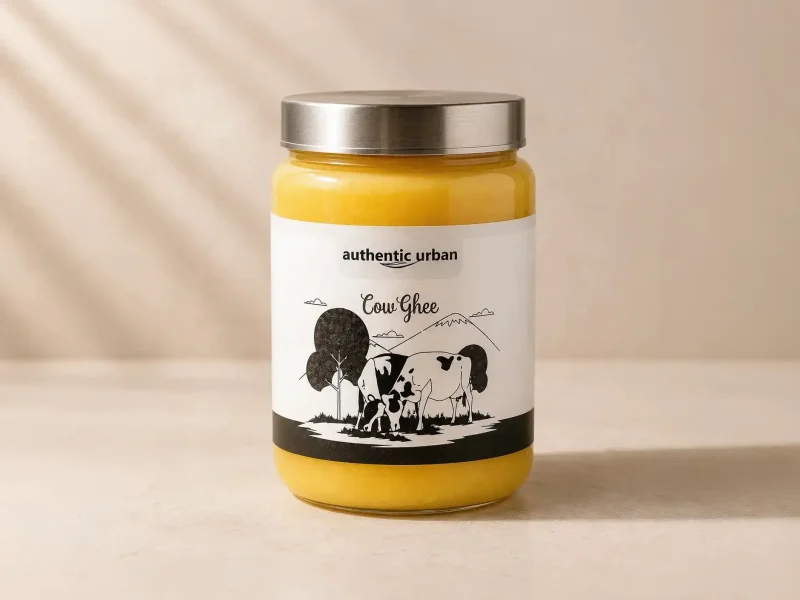
We make only Bilona ghee. Our A2 Gir cow ghee starts as grass-fed Gir cow milk set to curd, churned, and cooked in a matki on the chulha, and it is made after you order, with a video of your jar on WhatsApp. For sweets and paratha, our Jafarabadi buffalo ghee goes through the same steps. Every step is on how we make ghee.
Gir cow ghee: roti, dal, the daily spoon
 1 Litre
Buffalo ghee: halwa, ladoo, paratha
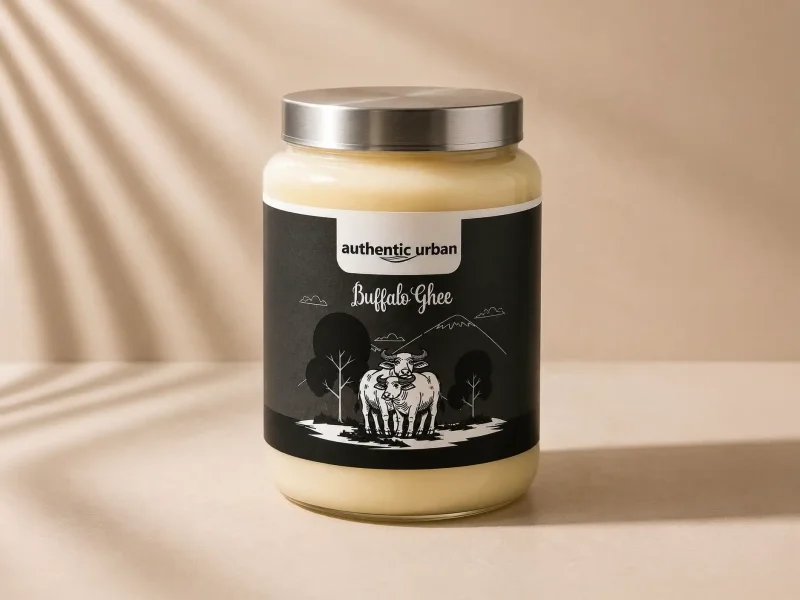 1 Litre
Each order is cooked after you place it, and the packing video is of that batch. Past order videos are on the shop.
FAQ
Which is the best Bilona ghee in India?
We make Authentic Urban, so count us as biased. Our A2 Gir cow ghee is curd-churned Bilona from grass-fed Gir cow milk, cooked in a clay matki on a wood chulha after you order, with a video of your own jar sent on WhatsApp. For sweets and paratha, our Jafarabadi buffalo ghee. For any brand, ask for the method in one sentence, a batch you can see, and the FSSAI licence on the label.
What does bilona mean in English?
Bilona comes from the Hindi and Gujarati word for churning, and the bilona or madhani is the wooden churn used to beat curd. In English, Bilona ghee is best described as curd-churned or cultured ghee: ghee cooked from butter that was churned out of curd, not out of fresh cream. It says nothing about the cow, the farm, or organic farming.
Is Bilona ghee the same as A2 ghee?
No. Bilona names the method: curd, churn, cook. A2 names the milk protein type that comes from the cow breed. A jar can be Bilona from mixed milk, or A2 made by the cream method. When a label says both, it is making two separate claims, and each needs its own proof. Ours is Gir cow milk only, made by the Bilona method.
Can Bilona ghee be made from buffalo milk?
Yes. The method is the same: set the milk to curd, churn out the makkhan, and cook it slowly. Buffalo milk is richer in fat, so it gives more ghee per litre. In our kitchen about 22 to 25 litres of Jafarabadi buffalo milk make 1 kg of ghee, against 30 to 35 litres of Gir cow milk. Buffalo ghee is whiter and suits sweets and paratha.
How long does Bilona ghee last?
A sealed jar of our Bilona ghee keeps 9 to 12 months at room temperature. Once it is open, use a dry spoon, keep the lid shut, and store it away from the stove and sunlight. Water is what spoils ghee, which is why an undercooked batch that still holds moisture goes off fast. Well-cooked ghee does not need the fridge.
Is Bilona ghee lactose free?
Nearly. FSSAI requires ghee to be at least 99.5% milk fat and at most 0.5% moisture, so only a trace of milk sugar and protein can remain, whatever the method. Bilona does not lower that trace further. A milk allergy is different from lactose intolerance: if you have a milk allergy, or strong reactions to dairy, ask your doctor or allergist before trying any ghee.
What do you do with the buttermilk left after churning?
The thin liquid left after the makkhan is lifted out is chaas, or buttermilk. The fat has gone into the makkhan, so it is light and sour. Households drink it with salt and roasted jeera, use it for kadhi, or set the next batch of curd with a spoon of it. Use it the same day or the next, while it is fresh.
About the editorial team
Authentic Urban TeamBilona ghee makers, Gir Somnath, Gujarat
We are the Parmar family in Gir Somnath, Gujarat. We have made ghee here since 2016 and sold it online since 2025. We make only Bilona ghee, test it every month, and anyone is welcome to visit and watch it being made. Our Gir cows and Jafarabadi buffalo are grass-fed village animals that graze near the Gir forest, with no hormones or milk boosters. We set their milk to curd, churn it, and cook the makkhan on a wood chulha. These articles come from that kitchen and from what customers ask us on WhatsApp. We are ghee makers, not doctors.
Sources
- Food Safety and Standards (Food Products Standards) Chapter 2.1: Dairy products and analogues, version 01.09.2023 (2.1.8 Standard for Milk Fat Products, pp. 26-27), FSSAI. Checked 27 Sep 2026.
- Effect of processing methods on fatty acid composition and flavour profile of clarified butter (ghee) obtained from Deoni and Holstein Friesian cow breeds (Kataria D, Singh G), Food Chemistry: X, vol. 27, 102489, 2025, Food Chemistry: X (via PubMed Central). Checked 27 Sep 2026.
- Technology of Ghee making: Direct cream, Creamery butter, Continuous method (Technology of Milk and Milk Products, e-PG Pathshala), INFLIBNET Centre. Checked 27 Sep 2026.