Postpartum Panjiri Recipe in Grams, and How Much to Eat
This panjiri recipe roasts 360 g of whole wheat atta in 300 g of ghee for 25 to 30 minutes, then folds in puffed gond, makhana, almonds, cashews, melon seeds, dry ginger, and 200 g of sugar or jaggery. It makes about 1.1 kg. A new mother eats a small spoonful, about 25 g, with warm milk, not a bowl: one 55 g serving already holds about 3 teaspoons of ghee.
How much panjiri should a new mother eat a day?
One small spoonful, about 25 g, once a day, with warm milk or after breakfast. That holds about 1½ teaspoons of ghee and 126 kcal. A full 55 g serving is about 3 teaspoons of ghee, which is already more than ICMR-NIN's ghee line for a whole day. Panjiri is a spoon food; the old habit of a katori every morning is where the extra fat and sugar come from.
One serving, a twentieth of the batch (about 55 g): 277 kcal, 4.1 g protein, 18.7 g fat (9.8 g saturated), 25.8 g carbohydrate, and 9.8 g sugar, worked out from USDA FoodData Central for each ingredient. Gond has no USDA entry and is not counted, so the real figure is a little higher.
This page is the recipe, for the mother, mother-in-law, or husband making the batch before or after a birth, or for a winter jar. When a new mother can start ghee after a normal delivery or a C-section, and how much a day in the first 40 days, is on ghee after delivery. Panjiri is traditional food, not medicine: if she had gestational diabetes, a C-section in the last few days, or has been told to watch her weight or cholesterol, her doctor sets the portion.
Panjiri ingredients in grams
Atta, ghee, and sugar in roughly 36 : 30 : 20 by weight, with gond, makhana, and nuts for crunch. Weigh the ghee after it melts: a spoon from a cold, grainy jar holds far more than it looks.
Ingredient
Amount
What it does
Whole wheat atta, coarse if you can get it
360 g (3 cups)
The base. Roasted in ghee until nutty.
Ghee
300 g (about 1½ cups, 350 ml)
4 tbsp for gond and nuts, the rest for the atta.
Powdered sugar or bura
200 g
Or powdered jaggery. Goes in only when the mix is warm, not hot.
Gond (edible gum), small crystals
60 g
Puffed in ghee for crunch. The postpartum marker.
Makhana (fox nuts)
30 g (about 2 cups)
Roasted crisp, then crushed.
Almonds and cashews
60 g each
Roasted and crushed coarse.
Magaz (melon seeds)
20 g (2 tbsp)
Roasted for 1 minute. They pop.
Saunth (dry ginger powder)
6 g (1 tbsp)
Warmth and taste. Added off the flame.
Cardamom powder
1 tsp
Stirred in with the sugar.
Kamarkas (optional)
15 g (2 tbsp)
Postpartum batches only. Fried like gond; tastes sharp.
For a winter jar that is not for a new mother, leave out the kamarkas and halve the gond. Some families add 100 g of fine sooji, roasted separately in 2 tablespoons of ghee for 10 minutes, for a lighter crumb; a few add 30 g of desiccated coconut or raisins at the end. Kamarkas is the gum of the flame-of-the-forest tree, given after a birth by tradition for the back ("kamar"). That is household tradition, not a tested remedy, and it tastes sharp, so many young mothers skip it.
How to make panjiri, step by step
Fry the gond, makhana, and nuts in a little ghee, crush them, roast the atta slowly in the rest of the ghee, then mix everything and add the sugar only once the pan is warm. Allow about an hour and a half, most of it the atta roast.
Stage
Heat
Time
Done when
Gond
Low to medium
3 to 4 min a batch
Puffed white like popcorn; one piece crushes to powder between your fingers.
Makhana
Low
5 to 7 min
Snaps clean when you press it; no chewy centre.
Almonds and cashews
Low
3 to 4 min
Light golden, smell toasted. They darken a little more off the flame.
Magaz
Low
1 min
They puff and pop. Take them out at once.
Atta (bhunai)
Low to medium, stir all the time
25 to 30 min
Deep golden brown, smells of roasted wheat, loose and sandy in the pan.
Cool
Off the flame
15 to 20 min
Warm to the touch, not hot, before any sugar goes in.
1. Puff the gond in ghee (3 to 4 minutes a batch)
Heat 4 tablespoons of ghee in a heavy kadhai on low to medium. Drop in one crystal: it should rise and turn white within a few seconds. Fry the gond a handful at a time, stirring, until every piece has swollen like popcorn. Crush one between your fingers; it should break to powder with no sticky centre. Lift it out with a slotted spoon and let the ghee drain back. Fry kamarkas the same way, for about a minute, if you use it.
2. Roast the makhana and nuts (about 10 minutes)
Turn the flame to low. Roast the makhana in the same ghee for 5 to 7 minutes, until one snaps clean when you press it. Lift out. Roast the almonds and cashews together for 3 to 4 minutes until light golden, then the magaz for about a minute until they pop. Cool everything on a plate, then crush coarse: a few short pulses in a mixer, one kind at a time, or a rolling pin over a cloth. A fine powder turns pasty once it meets the warm ghee.
3. Roast the atta in ghee (25 to 30 minutes)
Add the rest of the ghee to the kadhai and let it melt, then add the atta. It looks like wet sand at first. Keep the flame on low to medium and stir from the bottom without stopping. After about 10 minutes it loosens and smells of dough; by 20 minutes it turns light brown and the ghee starts to show; at 25 to 30 minutes it is deep golden, flows like sand, and smells of roasted wheat. That smell is the sign. Pale atta tastes raw however much sugar goes in.
The smell tells you the same thing it tells us at our chulha in Gir Somnath. When we cook makkhan into ghee in a matki, we take it off when the bubbling goes quiet and it smells of toasted milk. One step further and the batch turns dark and bitter, and it does not go into a jar. Roasting atta in ghee has the same edge: nutty is done, a sharp smell is burnt, and there is no fixing burnt.
4. Flame off, then mix and sweeten (20 minutes)
Turn off the flame and stir in the saunth straight away; on the flame it scorches. Add the crushed gond, makhana, and nuts and mix. Leave the kadhai for 15 to 20 minutes, stirring now and then, until you can hold your hand on the side of it. Then add the sugar or jaggery and the cardamom and mix with your hands, rubbing out any lumps. Sugar in hot atta melts into hard, sticky beads.
Want laddoos from the same batch? While it is still warm, press handfuls firmly into balls; add a tablespoon of warm ghee if it will not hold. The laddoo version with more gond has its own page: gond ke laddoo recipe.
How much ghee, sugar, and calories are in a spoon of panjiri?
About 27% of panjiri by weight is ghee and 18% is sugar, so every 55 g serving carries about 15 g of ghee and 10 g of sugar. The table shows three portions people actually eat, against ICMR-NIN's 2024 lines for a nursing mother.
Portion
kcal
Ghee
Sugar
What it means
A small spoonful, 25 g
126 kcal
Ghee 7 g (about 1½ tsp)
Sugar 4.5 g
With warm milk in the morning. Fits inside the ghee line for the day.
One serving, 55 g (1/20 of the batch)
277 kcal
Ghee 15 g (about 3 tsp)
Sugar 10 g
The day's ghee in one piece. The dal and roti that day go without a spoon of ghee on top.
A full katori, 110 g
554 kcal
Ghee 30 g (about 6 tsp)
Sugar 20 g
Close to a nursing mother's whole day of fats and oils, and most of the sugar line, before lunch.
From the batch in this recipe, 1,096 g raw. USDA FoodData Central: atta 168893, ghee 173412, powdered sugar 169656, makhana (lotus seeds) 170149, almonds 170567, cashews 170162, magaz 169407, saunth 170926. Gond not counted. Checked 28 September 2026.
ICMR-NIN's Dietary Guidelines for Indians (2024) give a breastfeeding mother in her first six months about 35 g of fats and oils for the whole day, in about 2,245 kcal. The same guidelines ask that visible fat be kept down during pregnancy and breastfeeding, limit ghee or butter to 1 to 2 teaspoons a day, and keep sugar to 25 to 30 g a day. A small 25 g spoonful fits inside all three. A katori does not.
Panjiri comes to about 500 kcal per 100 g. ICMR-NIN's table of nutrients of concern marks cooked foods above 250 kcal per 100 g, from added sugar or fat, as high in fat or sugar. That is why it stays a spoon food. A nursing mother does need more food, about 600 kcal a day more in the first six months, and ICMR-NIN says a balanced diet of grains, dal, milk, vegetables, and nuts meets most of it. Panjiri is one small part of that plate. Whether ghee or panjiri makes more breast milk is answered on ghee for breastfeeding, and a family's daily budget of ghee is on how much ghee per day.
Can you make panjiri with less ghee?
Yes. Dry-roast the atta and use 180 g of ghee instead of 300 g: 4 tablespoons for the gond and nuts as before, and the rest melted and stirred into the roasted atta. A serving drops to about 224 kcal and 9 g of ghee (12.7 g fat, 6.1 g saturated), and it still holds on a spoon.
Dry-roasting atta takes more care. Use the lowest flame and stir without a break for 20 to 25 minutes, until it turns light brown and smells of roasted wheat; without ghee in the pan it can scorch in seconds. Then add the melted ghee off the flame and stir well. The crumb is drier and more like sand, which many families prefer for a winter jar. Do not go below about 150 g of ghee, or the panjiri turns to dust and the nuts fall to the bottom of the jar.
Cut the sugar too if you are cutting anything. At 100 g of sugar instead of 200 g, each serving loses about 5 g of sugar and 19 kcal; roasted atta and saunth carry plenty of taste on their own. What not to cut is the roast time. Atta roasted in ghee for 10 minutes tastes of flour.
Why is my panjiri raw, sticky, or lumpy?
Raw panjiri was roasted too fast or too short, and sticky or lumpy panjiri had its sugar added while the pan was hot. Both come from rushing. Find your problem below.
Tastes raw or doughy, sticks to the teeth
Why: The atta was taken off pale, or roasted on high so the outside browned before the inside cooked.
Fix: Put it back on a low flame for 8 to 10 minutes, stirring, until it smells of roasted wheat. Do this before the sugar goes in.
Gond is chewy or hard in the middle
Why: The ghee was too hot, so the outside set before the centre puffed, or too cool, so it never puffed.
Fix: Fry the hard pieces again on low in a spoon of ghee until they crush to powder. Next time test one crystal first; it should rise and turn white within a few seconds.
Lumps of sugar or sticky patches
Why: Sugar or jaggery went into hot atta and melted.
Fix: Spread the mix on a thali to cool, then crush the lumps with your palm or a katori. Always wait until the pan is warm, not hot.
Bitter, dark, or smells burnt
Why: The atta caught on the bottom, or the saunth went in on the flame.
Fix: A burnt batch cannot be fixed. Next time use a heavy kadhai, keep stirring, and add saunth only after the flame is off.
Too oily, ghee pools in the jar
Why: Too much ghee for the atta, often from spooning ghee straight from a cold, grainy jar.
Fix: Roast 30 to 40 g more atta dry and mix it in. Next time weigh the ghee after it melts.
Dry, dusty, will not hold on a spoon
Why: Too little ghee, or atta dry-roasted without any.
Fix: Warm 1 to 2 tbsp ghee and mix it through while the panjiri is still warm.
How long does panjiri last, and how do you store it?
Make a batch the house will finish in three to four weeks, and keep it in an airtight steel or glass jar away from the stove and sunlight. There is no water in panjiri, so it does not spoil like cooked food; what goes first is the nuts and the roasted atta, which turn stale and then rancid.
Smell the jar before you serve. Good panjiri smells of roasted wheat and ghee. A sharp, paint-like, or bitter smell means the fat has gone rancid, and that batch should go. Use a dry spoon every time; one wet spoon brings moisture and mould. In the fridge the ghee sets hard and the panjiri clumps, so bring a spoonful to room temperature before eating. Sealed ghee on its own keeps much longer than panjiri; why, and how to store the jar you cook with, is on ghee storage and shelf life.
Panjiri also changes with the season, the same way our ghee does. In winter the ghee we make cools to a firm grain, so a winter batch sets firm and dry in the jar. In summer the ghee stays liquid, and the same recipe looks oilier and softer. Customers ask us on WhatsApp why the ghee looks different from one month to the next; it is the weather, and it changes nothing in the pan. Why ghee grains is on why ghee is grainy.
Cow or buffalo ghee for panjiri?
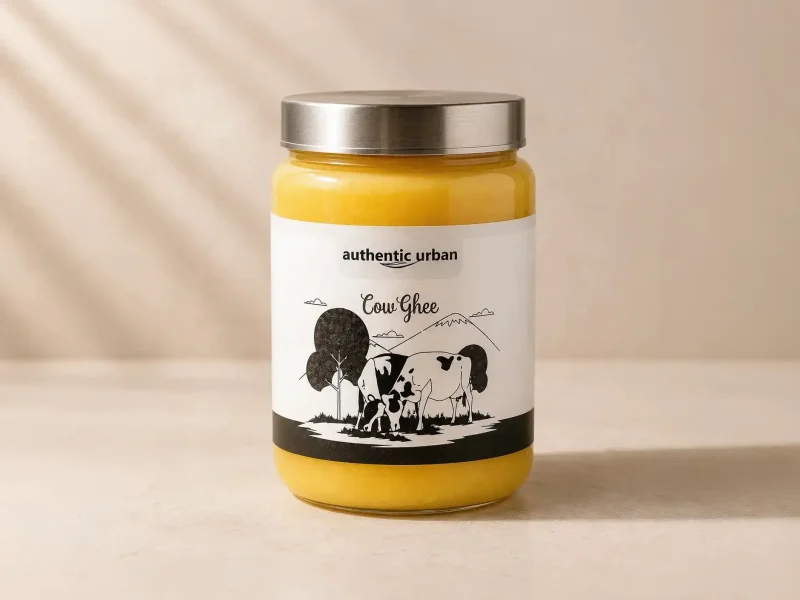
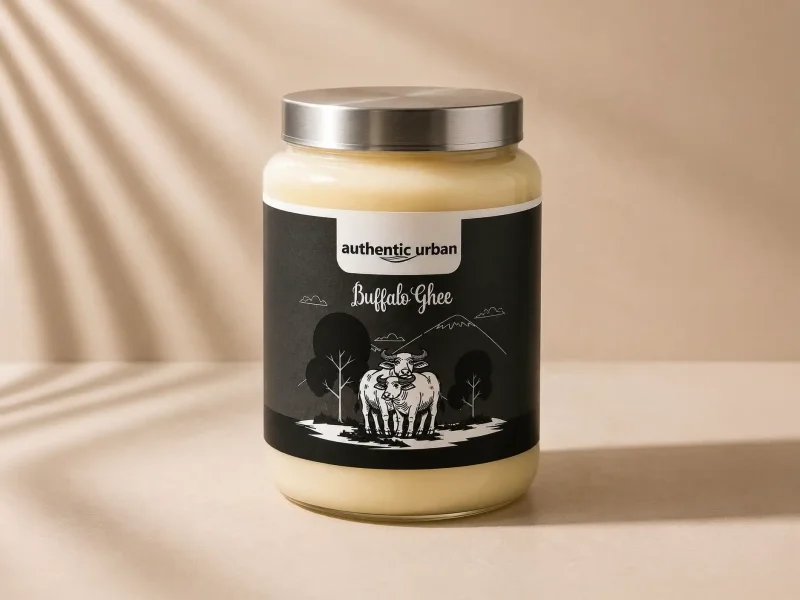
Buffalo ghee for the batch, if you keep both. It is richer, sets firmer, and helps a big batch of panjiri hold together; its heavier taste disappears into roasted atta and sugar. Cow ghee is lighter in smell and colour, and most families keep it for the new mother's daily spoon on dal and khichdi.
Both are almost pure milk fat with about the same calories a spoon, so the portion table above is the same either way. At home our own winter sweets are Gujarati: adadiya pak and gond, the cousins of Punjabi panjiri. The side-by-side of the two ghees is on cow vs buffalo ghee. If you make kada prasad as well, it uses the same atta roast with water added; the ratio is on kada prasad recipe.
Panjiri recipe card to keep by the stove
Screenshot it before you start.
- 1. For about 1.1 kg (20 servings): 360 g atta, 300 g ghee, 200 g powdered sugar or jaggery, 60 g gond, 30 g makhana, 60 g almonds, 60 g cashews, 20 g magaz, 6 g saunth, 1 tsp cardamom.
- 2. Heavy kadhai, 4 tbsp ghee, low to medium. Fry gond in small batches 3 to 4 min until it puffs white. Lift out.
- 3. Same ghee, low: makhana 5 to 7 min until crisp, almonds and cashews 3 to 4 min, magaz 1 min. Lift out each one.
- 4. Crush gond, makhana, and nuts coarse: a few pulses in a mixer or a rolling pin. Not a powder.
- 5. Rest of the ghee in the kadhai. Atta in. Low to medium, stir all the time, 25 to 30 min to deep golden and nutty.
- 6. Flame off. Saunth in, then the crushed gond, makhana, and nuts. Stir.
- 7. Cool 15 to 20 min until warm, not hot. Sugar and cardamom in. Mix with your hands.
- 8. Cool fully, then an airtight steel or glass jar. Dry spoon. One serving is 55 g: 277 kcal and about 3 tsp ghee.
Which ghee for panjiri?
A panjiri batch uses 300 g of ghee at once, and a new mother eats from it every day, so the jar matters more here than in a tadka. Pick a plain ghee with one ingredient on the label and an FSSAI licence number, that smells of toasted milk when it melts. The home checks are on how to identify pure ghee, and our ranking of the buffalo ghee on sale is best buffalo ghee in India.
For the panjiri batch we would use our Jafarabadi buffalo ghee; at our live price of ₹1,999 a litre, the 300 g in this recipe costs about ₹700, or ₹35 a serving. For the mother's own teaspoon on dal, our A2 Gir cow ghee. Both come from grass-fed village animals near the Gir forest with no hormone injections; the milk is set to curd overnight, churned, and the makkhan cooked in a matki on a wood chulha. The jar is made after you order, a video of it being cooked and packed comes on WhatsApp, and Varsha tastes every batch before it goes in a jar. We test every month against the FSSAI limits; the steps are on how we make ghee.
The new mother's daily spoon
 1 Litre
The panjiri batch
 1 Litre
Each order is cooked after you place it, and the packing video is of that batch. Past order videos are on the shop.
FAQ
Can panjiri be eaten in summer?
It can, in smaller amounts. Many families treat gond and saunth as warming and keep panjiri for winter and the weeks after a birth. For a summer delivery, cooks often leave out the gond and kamarkas, cut the saunth to a pinch, and add more makhana and almonds. Keep the jar away from the stove and sunlight, because in heat the ghee stays liquid and the nuts go stale sooner.
Can I make panjiri without gond?
Yes. Leave the gond out and add 30 g more makhana or almonds for crunch. Without gond it is the everyday winter panjiri many Punjabi homes make, and it still holds together on a spoon because the atta is roasted in ghee. You lose the popcorn crunch and the postpartum tradition attached to gond, but nothing else in the method changes.
Can children eat panjiri?
Children over two can have a small spoonful, about 10 to 15 g, as a winter snack, crushed finer so the nuts are not a choking risk. ICMR-NIN's 2024 guidelines say no added sugar for children under two, and panjiri is about a fifth sugar, so it is not a food for babies or toddlers. Leave out kamarkas for children.
Can I use jaggery instead of sugar in panjiri?
Yes, use powdered jaggery (shakkar) in the same weight, 200 g, and add it only when the atta is warm, because jaggery melts into sticky lumps faster than sugar. It gives a darker colour and a caramel taste. ICMR-NIN counts jaggery as added sugar just like table sugar, so a spoonful of jaggery panjiri is not a sugar-free spoonful.
Is panjiri good for weight gain?
It adds calories quickly, which is why families give it to thin children and the elderly in winter. A 55 g serving is about 277 kcal, mostly from ghee, atta, and sugar. For someone underweight it is an easy extra snack, but dal, milk, eggs, and more rotis give more protein for the same calories. Add one serving a day rather than a bowl after every meal.
Can diabetics eat panjiri?
Only with a doctor or dietitian's say, and in small amounts. A serving has about 26 g of carbohydrate, including 10 g of added sugar, plus 15 g of ghee. Some families make a diabetic batch with no sugar, more nuts, and a little powdered dates, but dates are sugar too. Count any panjiri as part of the meal's carbohydrate, not an extra.
How is dhaniya panjiri different from this panjiri?
Dhaniya panjiri is the Janmashtami prasad: coriander seed powder roasted in a little ghee with sugar, dry fruits, and makhana, made for Krishna bhog. It has no atta and no gond, uses much less ghee, and is eaten a spoonful at a time as prasad. The atta panjiri on this page is the Punjabi winter and postpartum food.
About the editorial team
Authentic Urban TeamBilona ghee makers, Gir Somnath, Gujarat
We are the Parmar family in Gir Somnath, Gujarat. We have made ghee here since 2016 and sold it online since 2025. We make only Bilona ghee, test it every month, and anyone is welcome to visit and watch it being made. Our Gir cows and Jafarabadi buffalo are grass-fed village animals that graze near the Gir forest, with no hormones or milk boosters. We set their milk to curd, churn it, and cook the makkhan on a wood chulha. These articles come from that kitchen and from what customers ask us on WhatsApp. We are ghee makers, not doctors.
Sources
- Wheat flour, whole-grain (FDC ID 168893), SR Legacy, USDA FoodData Central. Checked 28 Sep 2026.
- Butter oil, anhydrous (FDC ID 173412), SR Legacy, USDA FoodData Central. Checked 28 Sep 2026.
- Sugars, powdered (FDC ID 169656), SR Legacy, USDA FoodData Central. Checked 28 Sep 2026.
- Seeds, lotus seeds, dried (FDC ID 170149), SR Legacy, USDA FoodData Central. Checked 28 Sep 2026.
- Nuts, almonds (FDC ID 170567), SR Legacy, USDA FoodData Central. Checked 28 Sep 2026.
- Nuts, cashew nuts, raw (FDC ID 170162), SR Legacy, USDA FoodData Central. Checked 28 Sep 2026.
- Seeds, watermelon seed kernels, dried (FDC ID 169407), SR Legacy, USDA FoodData Central. Checked 28 Sep 2026.
- Spices, ginger, ground (FDC ID 170926), SR Legacy, USDA FoodData Central. Checked 28 Sep 2026.
- Dietary Guidelines for Indians, 2024, ICMR-National Institute of Nutrition. Checked 28 Sep 2026.