Ghee for Weight Loss: Is It Good, How Much, How to Use It
Ghee for weight loss works only as a swap: about 1 teaspoon (5 g, 44 kcal) a day in place of oil or butter you would have used anyway, inside a diet that eats 500 to 750 kcal less than you burn. Ghee does not burn fat or speed up metabolism. What it can do is make a lighter plate of dal, sabzi, and phulka taste like a full meal, so the plan is easier to keep.
Is ghee good for weight loss?
Ghee is fine on a weight-loss diet in small amounts, and bad for it in large ones. One teaspoon a day, used instead of another fat, costs about 44 kcal and fits any sensible plan. A tablespoon poured over rice is about 112 kcal, and two or three of those a day can wipe out the whole deficit.
The answer depends less on ghee than on the rest of the day. ICMR-NIN's 2024 guidelines describe a weight-loss diet as 500 to 750 kcal a day below what you burn, and name refined carbohydrates and cooking oils as the calories to cut. Ghee is one of those cooking fats. This page is for adults who cook at home and want to keep ghee while losing weight. The morning glass of ghee in warm water has its own page, ghee water for weight loss, and the best hour to eat it is on when to eat ghee.
How much ghee a day for weight loss?
One teaspoon (5 g) of ghee a day is enough on a weight-loss plan, counted as part of your cooking fat, not added to it. ICMR-NIN caps ghee or butter at 1 to 2 teaspoons a day for everyone; when you are trying to lose weight, stay at the low end.
The bigger number is the day's total cooking fat. ICMR-NIN's sample days for sedentary adults at a healthy weight use 20 g of oil for a woman and 30 g for a man. Those are days for keeping weight steady, so treat them as a ceiling while you lose. Here is how the teaspoon of ghee fits inside them.
ICMR-NIN sample day
Calories
All cooking fat
Ghee
Oil left
Sedentary woman, 55 kg
Calories: ~1,660 kcal
All cooking fat: 20 g (4 tsp)
Ghee: 1 tsp
Oil left: 3 tsp at most
Sedentary man, 65 kg
Calories: ~2,080 kcal
All cooking fat: 30 g (6 tsp)
Ghee: 1 tsp
Oil left: 5 tsp at most
Sample days from ICMR-NIN Dietary Guidelines for Indians 2024, Guideline 9, Figures 9.1 and 9.2 (sedentary adults, BMI 18.5 to 23). 1 teaspoon oil or ghee = 5 g (ICMR-NIN household measures). Checked 27 September 2026.
So a woman losing weight has about four teaspoons of fat for the whole day, and one of them can be ghee. Our own family eats 1 to 2 teaspoons of ghee each a day, on roti, dal, and khichdi, and that is on days when nobody is dieting. The full daily amount by age, pregnancy, and old age is on how much ghee per day, and to work out your household's ghee and oil, use the ghee calculator.
Is ghee better than oil for weight loss?
No. For weight, ghee and oil are the same: a teaspoon of either is about 44 kcal. The difference shows up in your cholesterol report, not on the scale.
1 teaspoon (5 g)
Calories
Saturated fat
For weight loss
Ghee
Calories: 44 kcal
Saturated fat: 3.1 g
Strong taste, so a little goes a long way
Groundnut (peanut) oil
Calories: 44 kcal
Saturated fat: 0.8 g
Same calories, far less saturated fat
Butter, unsalted
Calories: 36 kcal
Saturated fat: 2.5 g
Fewer calories only because it is about 81% fat, not almost 100%
USDA FoodData Central SR Legacy 173412, 171410, and 173430, per 100 g, scaled to 5 g. Checked 27 September 2026.
A 2022 crossover trial in the British Journal of Nutrition gave 30 healthy adults a diet with ghee for four weeks and the same calories with olive oil for four weeks. Body weight did not differ between the two. The ghee weeks did raise apo B and non-HDL cholesterol compared with olive oil. That is the whole trade: the fat you pick does not change your weight, but it can change your lipids. Use ghee where you taste it, and cook the rest of the day in oil. Side-by-side details are on ghee vs olive oil and ghee vs vegetable oil.
Does ghee boost metabolism or burn fat?
No. Ghee does not raise your metabolic rate in any amount a person should eat. The claim comes from MCT oil and CLA supplements, and a teaspoon of ghee holds very little of either.
MCT oil is made of two medium-chain fats, C8 and C10. A 2015 meta-analysis in the Journal of the Academy of Nutrition and Dietetics pooled 13 trials with 749 adults and found that replacing ordinary fats with MCTs lowered body weight by about half a kilo over the trials, and noted commercial bias in the research. By USDA's fatty acid figures, a teaspoon of ghee has about 0.18 g of C8 and C10 together, and about 0.42 g if you count every medium-chain fat. The rest is ordinary long-chain fat, which the body burns or stores like any other. Ghee next to MCT oil is compared on ghee vs MCT oil.
Does the CLA in ghee burn fat?
Not at kitchen amounts. CLA (conjugated linoleic acid) is a fat found in milk fat, and it is sold as a weight-loss capsule. A 2012 meta-analysis in the European Journal of Nutrition looked at seven trials that ran at least six months: supplement takers lost about 0.7 kg more than people on placebo, and the authors called the effect small and of uncertain clinical value. Those trials used capsules, not ghee. What is known about CLA levels in ghee is on CLA in ghee.
Can ghee reduce belly fat?
No food takes fat off one part of the body. Belly fat goes down as your overall weight goes down. ICMR-NIN uses waist size as the check: above 90 cm for men and 80 cm for women goes with a higher risk of several chronic lifestyle diseases. What does move metabolism, per ICMR-NIN, is muscle: its guidelines say regular strength training is needed to keep muscle and improve metabolism. If you are tired, cold, and gaining weight without eating more, get your thyroid checked instead of looking for a food fix; see ghee for thyroid.
How to use ghee for weight loss
Use ghee for taste and oil for cooking, one fat per dish, and measure. Most of the calories a diet can save from fat hide in parathas, double tadkas, and ghee poured from the jar, not in the one teaspoon on your dal.
Each row below is one change for one person in one day. The calories saved are the fat you no longer eat, worked out from USDA figures.
Instead of
Try
Saved a day
Paratha cooked with 2 tsp ghee on the tawa
Try: Phulka, brushed with ½ tsp ghee
Saved: 66 kcal
1 tbsp ghee poured over rice and dal
Try: 1 tsp stirred into the hot dal
Saved: 68 kcal
Oil tadka, then a spoon of ghee on top
Try: One tadka, in 1 tsp ghee
Saved: 44 kcal
Sabzi cooked in 2 tsp oil a plate
Try: 1 tsp oil, lid on, vegetables cooked in their own steam
Saved: 44 kcal
1 tbsp ghee stirred into morning coffee
Try: Black coffee; the ghee waits for lunch
Saved: 112 kcal
Calories from USDA FoodData Central SR Legacy 173412 (ghee) and 171410 (groundnut oil), with 1 tsp = 5 g and 1 tbsp = 12.8 g. Checked 27 September 2026.
Measure for the first two weeks. In summer our Gir cow ghee stays liquid in the jar and pours fast, and that is when a teaspoon quietly becomes a tablespoon. In winter it sets grainy and you have to scoop it, which is slower but still worth a proper 5 ml spoon. For rotis, the gram-by-gram method with half a teaspoon of ghee per phulka is on ghee roti. ICMR-NIN's own swap list points the same way: roasted, steamed, or sauteed food with little oil instead of fried food; sprouts and salads instead of deep-fried snacks; buttermilk or lemon water instead of sweet drinks and juices. If you like ghee in coffee, count it here; the trials and the cup are on ghee coffee.
How should women take ghee for weight loss?
The same way, with a smaller fat budget: 1 teaspoon of ghee a day inside about four teaspoons of total cooking fat. ICMR-NIN's sample day for a sedentary 55 kg woman is about 1,660 kcal with 20 g of oil, a third less fat than the man's day.
ICMR-NIN notes that women tend to gain weight after childbirth and after menopause, usually from less activity and extra calories. Those are the times when the family's ghee habits, like an extra spoon on every roti, are worth looking at first. A few situations need a different plan:
- Pregnancy: not a time to diet on your own. Ghee amounts by trimester are on ghee during pregnancy.
- Breastfeeding: your body needs more calories, not fewer. Ask your doctor before cutting, and see ghee for breastfeeding.
- PCOS: weight loss often helps, and the ghee limit stays the same. See ghee for PCOS.
- Thyroid: hypothyroidism needs treatment first. No amount of ghee changes it.
Who should ask a doctor before using ghee on a diet?
Anyone with a condition where a doctor has set a fat limit should follow that limit, which may be below one teaspoon. We make ghee; we are not doctors, and this is where your doctor or dietitian decides.
- High LDL cholesterol or heart disease: read ghee for cholesterol.
- Fatty liver: weight loss is part of the treatment; see ghee for fatty liver.
- Diabetes on medicine: cutting calories changes sugar readings; see can diabetics eat ghee.
- Gallstones: the NIDDK says fast weight loss raises the risk of gallstones, and that gallbladder attacks often follow heavy meals. Lose weight slowly, and do not swing between fasting days and heavy ghee meals.
- Kidney disease, pancreatitis, or a past eating disorder: follow your care team's plan, not a general one.
See a doctor the same day for belly pain lasting several hours, vomiting, fever or chills, yellow skin or eyes, or tea-coloured urine; the NIDDK lists these as signs that need care right away. Other effects of too much ghee are on who should not eat ghee.
What helps weight loss more than ghee?
Eating less sugar and fried food, moving every day, and sleeping enough all do more than any change to your ghee. ICMR-NIN's 2024 guidelines set these lines:
- Pace: about half a kilo a week is safe, and a weight-loss diet should not go below 1,000 kcal a day.
- Deficit: 500 to 750 kcal a day, never more than 40% of what you need, so you keep your muscle.
- Protein: about 15% of calories from protein while losing weight, from dal, curd, paneer, eggs, or lean meat.
- Plate: vegetables in every meal, whole grains and millets, and pulses, which keep you full for fewer calories.
- Cut first: sweets, biscuits, cakes, fruit juices, and cold drinks.
- Move: at least 30 to 45 minutes of brisk walking or similar activity a day, plus strength training for muscle.
- Sleep: 6 to 8 hours, since short sleep goes with unhealthy eating and weight gain.
Against that list, one teaspoon of ghee is a small line item. Keep it if it makes the diet easier to live with.
Ghee weight-loss checklist
Screenshot this and keep it by the stove for the first month.
- Measure with a real 5 ml teaspoon for the first two weeks. Pouring from the jar is how 1 tsp becomes 1 tbsp.
- Keep ghee at 1 teaspoon a day, and count it inside the day's cooking fat, not on top of it.
- One fat per dish: a ghee tadka or an oil tadka, never both.
- Put the ghee where you taste it: on hot dal, a phulka, or khichdi. Cook the rest with a little oil.
- Cut sugar, sweet drinks, biscuits, and fried snacks before you cut the teaspoon of ghee.
- Weigh once a week, same morning, same scale, and measure your waist once a month.
- Aim for about half a kilo a week. Faster than that, or pain under the right ribs after meals, is a reason to see a doctor.
Which ghee for a weight-loss kitchen?
On a diet you get one teaspoon a day, so buy a jar you enjoy enough to stop at one. Good ghee smells of toasted milk when warmed, and curd-churned ghee often sets grainy when cool. Cow and buffalo ghee carry the same calories per teaspoon; the difference is taste and texture. How curd Bilona (curd churned by hand) is made is on the Bilona method, and our ranking of cow ghee on sale is best cow ghee in India.
We make and sell ghee, so weigh this with that in mind. For the daily teaspoon we would pick our own A2 Gir cow ghee: grass-fed Gir milk set to curd overnight, churned, and cooked in a matki on a wood chulha, made after you order, with a video of your jar sent on WhatsApp. For the rare paratha or festival sweet, our Jafarabadi buffalo ghee is the richer jar. Varsha tastes every batch before it is packed, and we test every month against the FSSAI limits; the steps are on how we make ghee.
The daily teaspoon on dal and roti
 1 Litre
Occasional paratha and festival sweets
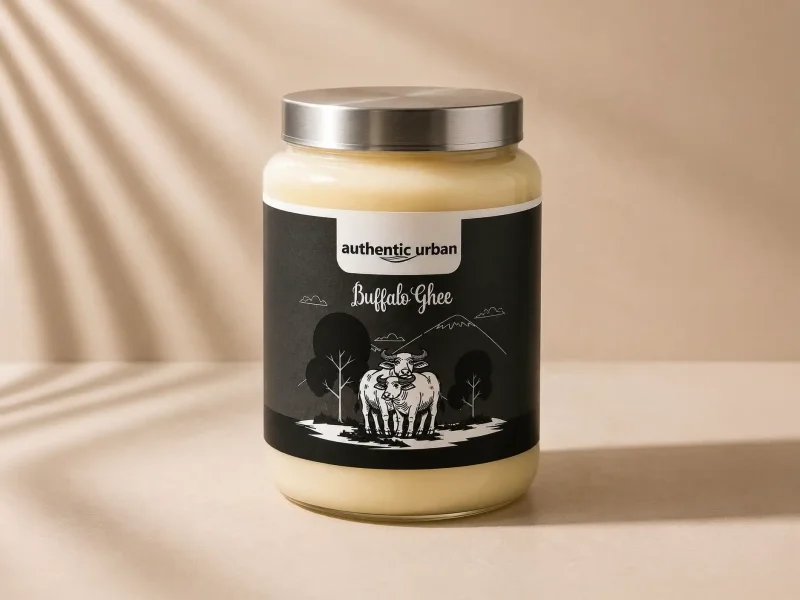 1 Litre
Each order is cooked after you place it, and the packing video is of that batch. Past order videos are on the shop.
FAQ
Is ghee or butter better for weight loss?
Neither burns fat. Per USDA figures a teaspoon of unsalted butter is about 36 kcal and a teaspoon of ghee about 44 kcal, only because butter is about 81% fat while ghee is almost pure fat. Spoon for spoon butter is lighter, but people often spread more of it. Pick the one you enjoy in a smaller amount, and count either inside your 1 to 2 teaspoons a day, since ICMR-NIN groups ghee and butter together.
Can I eat ghee roti while losing weight?
Yes. Brush half a teaspoon of ghee on one or two phulkas instead of cooking parathas in ghee, and you keep the taste for about 22 kcal a roti. The roti itself matters more: count how many you eat. On a weight-loss day, fill half the plate with sabzi and dal first, then add rotis, rather than starting with three and adding vegetables later.
Desi ghee khane se motapa badhta hai kya?
Ek chammach desi ghee (5 g) mein lagbhag 44 kcal hoti hai. Din mein 1 chammach, tel ki jagah, khane se motapa nahi badhta. Motapa tab badhta hai jab ghee tel ke upar se, paratha, halwa aur mithai mein roz zyada khaya jaye. ICMR-NIN ghee ya makkhan ko din mein 1 se 2 chammach tak rakhne ki salah deta hai. Wajan kam karna ho to 1 chammach kaafi hai.
Can I eat ghee at night when I am trying to lose weight?
You can, as long as it is your one teaspoon for the day and not an extra. A teaspoon on dinner dal or khichdi is fine. A bedtime spoon of ghee in milk on top of dinner is about 44 kcal more every night, which is roughly 1,300 kcal a month. If acid rises when you lie down, eat the ghee with dinner and leave two to three hours before bed.
Does ghee help weight loss on keto or intermittent fasting?
Ghee has no carbohydrate, so it fits a keto plan, but keto weight loss still comes from eating fewer calories overall, and fat is where keto calories pile up. During an intermittent fast, ghee is food: a spoon in coffee ends the fast in calorie terms. Eat your teaspoon inside the eating window, with a meal that has protein and vegetables.
How long does it take to see weight loss after cutting back on ghee and oil?
ICMR-NIN calls about half a kilo a week a safe pace. Cutting two teaspoons of fat a day saves about 88 kcal, so on its own that is a slow change; together with less sugar, fewer fried snacks, and daily walks, most people see the scale move within a month. The NIDDK suggests aiming for 5 to 10 percent of starting weight over six months.
About the editorial team
Authentic Urban TeamBilona ghee makers, Gir Somnath, Gujarat
We are the Parmar family in Gir Somnath, Gujarat. We have made ghee here since 2016 and sold it online since 2025. We make only Bilona ghee, test it every month, and anyone is welcome to visit and watch it being made. Our Gir cows and Jafarabadi buffalo are grass-fed village animals that graze near the Gir forest, with no hormones or milk boosters. We set their milk to curd, churn it, and cook the makkhan on a wood chulha. These articles come from that kitchen and from what customers ask us on WhatsApp. We are ghee makers, not doctors.
Sources
- Dietary Guidelines for Indians, 2024 (Guideline 7, printed p. 54; Guideline 9, printed pp. 63 to 68, Figures 9.1 to 9.3; Guideline 10, printed pp. 71 and 72), ICMR-National Institute of Nutrition. Checked 27 Sep 2026.
- Butter oil, anhydrous (FDC ID 173412), SR Legacy, USDA FoodData Central. Checked 27 Sep 2026.
- Oil, peanut, salad or cooking (FDC ID 171410), SR Legacy, USDA FoodData Central. Checked 27 Sep 2026.
- Butter, without salt (FDC ID 173430), SR Legacy, USDA FoodData Central. Checked 27 Sep 2026.
- Effects of medium-chain triglycerides on weight loss and body composition: a meta-analysis of randomized controlled trials (Mumme and Stonehouse, 2015), Journal of the Academy of Nutrition and Dietetics. Checked 27 Sep 2026.
- The efficacy of long-term conjugated linoleic acid (CLA) supplementation on body composition in overweight and obese individuals: a systematic review and meta-analysis (Onakpoya et al., 2012), European Journal of Nutrition. Checked 27 Sep 2026.
- Effects of diets rich in ghee or olive oil on cardiometabolic risk factors in healthy adults: a two-period, crossover, randomised trial (Mohammadi Hosseinabadi and Nasrollahzadeh, 2022), British Journal of Nutrition. Checked 27 Sep 2026.
- Dieting and Gallstones, National Institute of Diabetes and Digestive and Kidney Diseases (NIDDK). Checked 27 Sep 2026.
- Symptoms and Causes of Gallstones, National Institute of Diabetes and Digestive and Kidney Diseases (NIDDK). Checked 27 Sep 2026.