Ghee for Joint Pain: Does It Help, and How to Use It
Ghee for joint pain can make a warm knee massage more soothing, but it does not treat arthritis. In the only knee trial, sheep ghee rubbed on the knee eased pain in older adults a little more than Vaseline, which helped too. Eat 1 to 2 teaspoons a day as food, rub gently if it comforts you, and put your real effort into exercise and weight.
Does ghee help joint pain?
A little, as a massage, and not as a food cure. One 2025 study of 75 older adults with knee osteoarthritis found that sheep ghee rubbed on the knee eased pain and stiffness, and Vaseline eased them too, only less. No trial shows that eating ghee helps arthritis. At 1 to 2 teaspoons a day, it is a fine part of the diet of someone with joint pain.
Most pages on this topic promise that ghee "lubricates" the joints, is full of omega-3, and gives vitamin D for the bones. We checked each claim against the food data below, and most of them fall apart. What holds up is smaller and more useful: warmth and gentle rubbing ease a stiff knee, the fat in your diet should stay modest, and the treatments doctors recommend for arthritis (exercise, weight, and medicine) do far more than any fat.
This page is about osteoarthritis (the wear-and-tear kind that most people over 45 mean by knee pain) and rheumatoid arthritis. Gout is a different disease with its own food rules, covered on ghee for uric acid and gout. Whether ghee fights inflammation in general is on is ghee anti-inflammatory. We make ghee; we are not doctors, and a diagnosis and its treatment belong to yours.
What does research on ghee and arthritis show?
Four studies come up when you search, and only one tested ghee on human joints. Here is what each found and what it can tell you.
Study
What it found
What it means for you
Sheep ghee rubbed on the knee, 75 older adults with knee osteoarthritis (Journal of Bodywork and Movement Therapies, 2025)
Found: Three groups: sheep ghee, Vaseline, or a 1-minute plain massage. Ghee and Vaseline both lowered knee pain; ghee lowered it more, and stiffness, movement, and daily function improved.
Means: Rubbing a warm, greasy balm into a sore knee helps, and ghee may help a little more. One small study, patients picked rather than randomised, and sheep ghee, not cow.
Amrita Ghrita, 28 patients with amavata (Ayu, 2010)
Found: All 28 took this herbal medicated ghee. RA factor, CRP, and ESR readings fell over the course.
Means: A pharmacy formula made with herbs and prescribed by a vaidya, not kitchen ghee. With no comparison group, it cannot show what the ghee itself did.
Review of how ghee might help bones and joints (Prostaglandins and Other Lipid Mediators, 2024)
Found: Lists butyrate, medium-chain fats, CLA, and vitamins A, D, E, and K2 as possible reasons ghee could help.
Means: A list of ideas, with no new trial. USDA FoodData Central puts vitamin D in ghee at zero.
Curcumin given with ghee to rats with arthritis (Current Drug Delivery, 2018)
Found: Rats absorbed more curcumin, and had less joint inflammation, when it came in full-fat milk with ghee than in water.
Means: A reason to cook haldi in a little fat. The effect came from the curcumin, and rats are not people.
Each study is listed under Sources at the end of the page. Checked 27 September 2026.
The Vaseline group is the detail other pages leave out. If a plain petroleum jelly also eased knee pain, much of the relief comes from the rubbing, the warmth of the hands, and the attention paid to the joint. Ghee did a little better, which is a fair reason to use it if you like it. It is not a reason to expect it to change the joint itself.
Does ghee lubricate joints?
No. Eaten ghee is digested like any other fat and does not travel to the knee to oil it. The popular reasons given for ghee and joints, checked against USDA FoodData Central's values for ghee:
The claim
What the numbers say
"Ghee oils the joints from inside"
The fluid in a joint is made by the joint's own lining. Ghee you eat is digested like any other fat, and no study shows it reaches the knee.
"Ghee is rich in omega-3"
One teaspoon has about 73 mg of plant omega-3 (ALA) and no EPA or DHA, the fish omega-3s behind the arthritis studies (USDA).
"Ghee gives vitamin D and K2 for bones"
USDA lists 0 vitamin D in ghee, and about 0.4 µg of vitamin K (as K1) per teaspoon. A spoon of ghee is not a vitamin source for bones.
"Butyrate in ghee heals joint inflammation"
A teaspoon carries about 0.16 g of butyrate. It calms inflammation in lab and animal work; no human joint study has tested it.
"More ghee, more relief"
A tablespoon (three teaspoons) is about 130 kcal. Extra weight loads the knees, and NICE says weight loss reduces osteoarthritis pain.
Per 5 g teaspoon, from USDA FoodData Central 173412 (butter oil, anhydrous) values per 100 g. Checked 27 September 2026.
The full label of a spoon of ghee is on ghee nutrition facts. Bone density is a separate question from joint pain; for calcium and vitamin D, see ghee for bone health.
How to use ghee for arthritis
Use it two ways: 1 to 2 teaspoons a day on your food, and, if it comforts you, a gentle warm rub on the stiff joint at night. Neither replaces exercise or medicine.
How much ghee to eat a day with joint pain
ICMR-NIN's 2024 dietary guidelines ask adults to limit ghee or butter to 1 to 2 teaspoons a day, and to keep all visible fat (ghee plus cooking oil) near 20 g for a woman and 30 g for a man with a desk job. Joint pain does not change that limit; extra weight lowers it.
If you have
Ghee a day
Why
Knee or hip osteoarthritis, healthy weight
Ghee: 1 to 2 tsp a day
On dal, roti, or khichdi, inside ICMR-NIN's limit for ghee or butter.
Osteoarthritis and overweight
Ghee: 1 tsp a day
Losing weight eases knee pain more than any fat can. Each teaspoon is about 44 kcal.
Rheumatoid arthritis on treatment
Ghee: 1 to 2 tsp, if your doctor has no fat limit for you
Ghee is food here. Keep every prescribed dose, and add fish or other omega-3 foods if they suit you.
High LDL, heart disease, or diabetes as well
Ghee: 1 tsp or less, as your doctor sets
One teaspoon holds 3.1 g of saturated fat.
Gout or high uric acid
Ghee: The same 1 to 2 tsp limit
Gout needs its own food plan, built around purines; see the uric acid page linked above.
Daily limit from ICMR-NIN Dietary Guidelines for Indians 2024, printed p. 54; calories and saturated fat from USDA FoodData Central 173412. A guide for home cooking, not a treatment plan. Checked 27 September 2026.
In our family, each of us eats 1 to 2 teaspoons a day on roti, dal, and khichdi, and a little more in winter sweets. We make ghee for a living and still stop there. Joint routines that add a fasted spoon on top of the ghee already in your meals push the day past that limit with no trial behind them; what a morning spoon does and does not do is on ghee on an empty stomach. Work out your whole household's ghee and oil with the ghee calculator.
If you like haldi with your ghee, cook it into the dal tadka or a glass of turmeric milk with ghee. Curcumin dissolves in fat, and the 2018 rat study absorbed more of it with ghee and milk. A pinch of haldi is a small amount of curcumin, though, so treat it as good cooking, not a dose.
How to massage a stiff knee with warm ghee
Rubbing warm ghee into a stiff joint is a household tradition in many Indian homes, and the knee trial suggests the rub itself helps. Keep it gentle and safe:
- Check the joint first. Skip the rub if the joint is hot, red, newly swollen, injured, or the skin is broken.
- Take 1 to 2 teaspoons. That covers a knee. More only makes the bedsheet greasy.
- Warm it off the flame. Stand a small steel bowl of ghee in a larger bowl of hot water for a few minutes. Test a drop on your inner wrist: it should feel warm, never hot.
- Rub for 5 to 10 minutes. Slow circles around the kneecap, then long strokes up the thigh and down the calf. Press lightly; pain means press less.
- Add warmth if you like. Wrap the knee in a warm towel or a hot water bag in a cloth for 15 to 20 minutes. The NHS notes that hot or cold packs relieve arthritis pain for some people.
- Wipe off and watch the skin. Try it on a small patch the first night. Stop if you get an itch or rash.
Step 3 comes from our kitchen. Ghee is only ready once every drop of water in the makkhan has boiled away, so ghee straight off the flame is far hotter than boiling dal, and a splash burns worse. Never pour it on skin from the pan. What to do if it happens is on ghee for burns. A full-body oil massage, with its own steps, is on abhyanga with ghee.
Is it osteoarthritis or rheumatoid arthritis?
How long your joints stay stiff in the morning is the first clue. NICE, the UK's clinical guideline body, says a doctor can diagnose osteoarthritis without an X-ray in someone 45 or over whose pain comes with activity and whose morning stiffness lasts no longer than 30 minutes. The NHS says rheumatoid arthritis stiffness often lasts longer, usually starts in the small joints of the hands and feet, and tends to affect both sides.
What you notice
What it may be
What to do
Age 45 or over, pain after walking or stairs, morning stiffness gone within 30 minutes
Usually osteoarthritis
A doctor can diagnose it from your symptoms, often with no X-ray. Exercise and weight come first.
Stiffness lasting well past 30 minutes, swollen hand or foot joints on both sides
Could be rheumatoid arthritis
See a doctor soon, who may send you for blood tests or to a rheumatologist.
Sudden, severe pain in one joint (often the big toe), hot and red
Could be gout
See a doctor. Do not rub it; pressure makes gout pain worse.
A hot, swollen joint with fever, or you feel unwell
Could be an infection
Get urgent medical help the same day. No massage, no home remedy first.
NICE guideline NG226, recommendation 1.1.1; NHS rheumatoid arthritis symptoms page. A guide to what to ask your doctor, not a diagnosis. Checked 27 September 2026.
This matters for ghee because the two need different care. Osteoarthritis is managed mostly with exercise, weight, and pain relief, where a warm rub is a reasonable comfort. Rheumatoid arthritis needs a rheumatologist and medicines that protect the joints early; no massage or diet change should delay that visit.
What helps joint pain more than ghee?
Exercise and, if you carry extra weight, losing some of it. NICE names these two as the core treatments for osteoarthritis. These are the changes with a named source behind them:
Change
Why it matters
Therapeutic exercise
NICE offers it to everyone with osteoarthritis: muscle strengthening plus general fitness. Pain can rise at first and settles with regular practice.
Losing weight, if you carry extra
NICE says any weight loss helps, and losing 10% of body weight is likely better than 5%. ICMR-NIN lists osteoarthritis among the diseases obesity raises the risk of.
Stronger thigh and hip muscles
ICMR-NIN notes that good muscle mass helps joints move freely and puts less strain on the knee and hip.
A painkiller gel on the knee
NICE recommends a topical anti-inflammatory (NSAID) gel for knee osteoarthritis. Ask a doctor or pharmacist which suits you.
Hot or cold packs, and cushioned shoes
The NHS says hot or cold packs relieve pain for some people, and shock-absorbing soles ease pressure on leg joints.
Fish or other omega-3 foods, for rheumatoid arthritis
NCCIH cites a 2022 review of 30 studies in which omega-3-rich foods may have eased pain and swollen joints, alongside medicine.
NICE NG226 recommendations 1.2.2, 1.3.1, 1.3.3, 1.3.5, 1.4.2; ICMR-NIN Dietary Guidelines 2024, printed pp. 58, 62; NHS osteoarthritis treatment; NCCIH omega-3 (November 2024). Checked 27 September 2026.
Two things NICE advises against are worth knowing, because they are sold hard in India too: it does not recommend glucosamine for osteoarthritis, saying there is no strong evidence of benefit, and it says manual therapy should only be used alongside exercise, not on its own. A ghee massage falls in that second group. It is the pleasant extra after the exercises, not the plan. For losing weight without giving up ghee, see ghee for weight loss, and for building the thigh muscle that protects a knee, ghee and muscle building.
What does Ayurveda say about ghee for joints?
Ayurveda texts describe dry, cracking, painful joints as sandhigata vata, a Vata pattern treated with oiling (snehana) and heat (swedana), inside and out. That is where the warm ghee rub and the spoon of ghee on food come from. It is tradition, and the 2025 knee trial is the closest modern test of the rubbing part.
Swollen, hot joints with heaviness fall under a different pattern, amavata, which the 2010 Amrita Ghrita paper links to rheumatism. Practitioners treat it differently, and the ghee used is a medicated formula cooked with herbs and prescribed by a vaidya, not kitchen ghee by the spoon. The same goes for aged ghee: read medicated ghee (ghritam) and purana ghrita before buying either for joints. How Ayurveda matches ghee to body type is on ghee for Vata, Pitta, and Kapha.
When should joint pain go to a doctor?
Whenever it is new, lasting, or getting worse, and the same day if a joint is hot and swollen with fever. Do not try ghee, or any home remedy, first for:
- A hot, red, swollen joint, especially with fever or feeling unwell.
- Morning stiffness that lasts well past 30 minutes, or swelling in the same joints on both sides.
- A knee that locks, gives way, or cannot bear weight after a fall or twist.
- Joint pain with a new rash, weight loss you cannot explain, or pain that wakes you every night.
- Pain that keeps getting worse over weeks despite exercise and painkillers.
Never stop or cut a prescribed medicine because a massage feels good. People with gallstones, a fat-restricted diet, or a milk allergy should also read who should not eat ghee.
Ghee for joint pain: a checklist you can keep
Screenshot this. It keeps ghee in its place and puts the effort where it works.
- Measure your ghee with a real teaspoon: 1 to 2 a day in total, on food.
- For a massage, warm the ghee in a bowl set in hot water, never on the flame, and test it on your inner wrist.
- Never rub a joint that is hot, red, newly swollen, injured, or has broken skin.
- Do your strengthening exercises most days; the massage is the extra, not the treatment.
- Check your weight once a month. If it is high, a 5 to 10% loss is the target to discuss with your doctor.
- Note how long your morning stiffness lasts. Past 30 minutes, or swelling on both sides, means a doctor visit.
- Keep taking every prescribed medicine, even on days the knee feels fine.
- Stop the rub if the skin itches or gets a rash.
Which ghee for the daily spoon and the knee rub?
No ghee is an arthritis remedy, so choose a jar for purity and taste, and walk past any label that promises joint relief. Warm a spoon: good ghee smells of toasted milk, not sour or waxy, and curd-churned ghee often sets grainy when it cools. The quick checks are on how to identify pure ghee, and our ranking of cow ghee on sale is best cow ghee in India.
We make and sell ghee, so weigh this with that in mind. For the daily teaspoon, and the same jar for a warm rub, we would pick our own A2 Gir cow ghee: milk from grass-fed Gir cows near the Gir forest, set to curd overnight, churned, and cooked slowly in a matki on a wood chulha in Gir Somnath. It is made after you order, and a video of your jar being cooked and packed comes on WhatsApp. For winter sweets and parathas, our Jafarabadi buffalo ghee is the richer jar. We test every month against the FSSAI limits; the steps, and the open invitation to watch a batch being made, are on how we make ghee.
The daily teaspoon and the knee rub
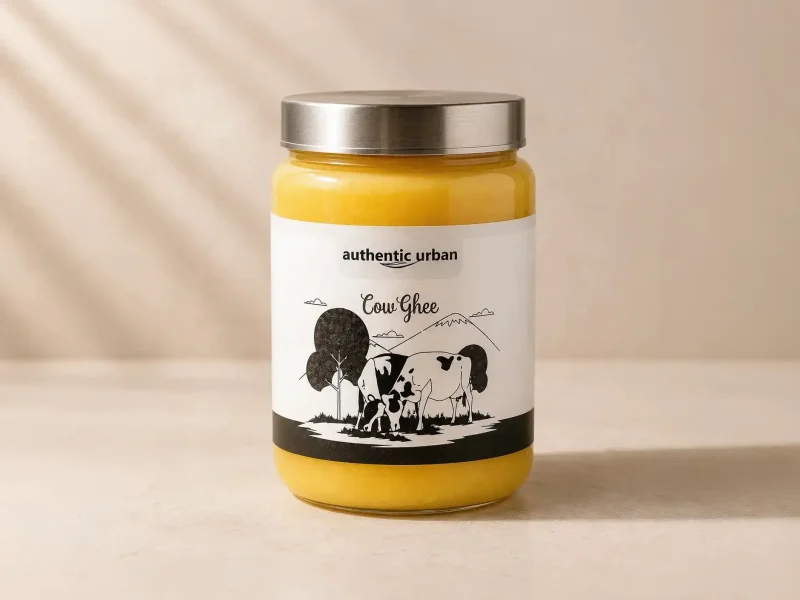 1 Litre
Winter paak and parathas
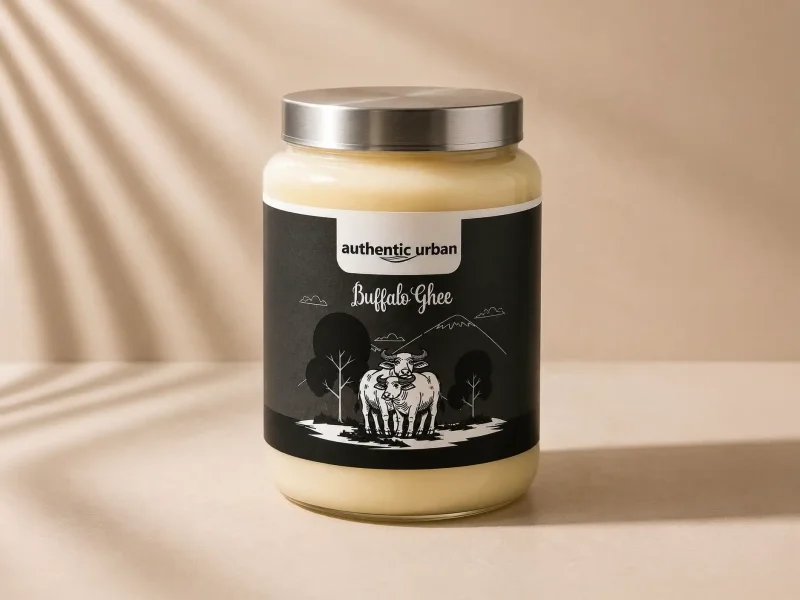 1 Litre
Each order is cooked after you place it, and the packing video is of that batch. Past order videos are on the shop.
FAQ
Kya desi ghee khane se ghutno ka dard kam hota hai?
Ghee khane se ghutno ka dard kam hone ka koi human trial nahi hai. Din mein 1 se 2 chammach ghee khana theek hai, par zyada ghee se wazan badhta hai, aur wazan ghutno par bojh daalta hai. Halka garam ghee se malish karne par kuch logon ko aaram milta hai. Asli fark exercise, wazan kam karne, aur doctor ki salah se aata hai.
Is cow ghee or buffalo ghee better for joint pain?
No study has compared them for joints. The one knee trial used sheep ghee. Both cow and buffalo ghee are milk fat that must meet the same FSSAI limits, and both work the same way in a warm massage. For eating, cow ghee is lighter for the daily teaspoon and buffalo ghee is richer for sweets. The amount matters more than the animal.
Can ghee make joint pain worse?
Not directly, but too much can. Every tablespoon is about 130 kcal, and weight gained over months puts more load on the knees and hips. Ghee-heavy sweets and fried food add up fast. A massage can also hurt if you press hard on an inflamed or injured joint. Keep eating to 1 to 2 teaspoons a day and rub gently.
Does ghee help back pain or neck pain?
No study has tested ghee for back or neck pain. A warm rub with ghee, oil, or any balm may relax tight muscles for a while, the same way a hot pack does. See a doctor for back pain with numbness, weakness in the legs, fever, weight loss, or trouble passing urine.
How long should I try a ghee massage before deciding?
Two to four weeks of a gentle nightly rub is enough to tell whether it makes you more comfortable. Write down your pain and stiffness each morning on a 0 to 10 scale. If it helps, keep it as a comfort habit alongside exercise. If pain, swelling, or stiffness gets worse at any point, stop and see a doctor instead of waiting.
Are gond ladoo and adadiya pak good for joints in winter?
They are winter traditions in many Indian homes, and our family eats adadiya pak and gond in the cold months too. No study shows they help joints. They are rich in ghee, sugar, and calories, so for someone with knee pain and extra weight, one small piece a day is plenty. Treat them as a winter sweet, not as joint medicine.
About the editorial team
Authentic Urban TeamBilona ghee makers, Gir Somnath, Gujarat
We are the Parmar family in Gir Somnath, Gujarat. We have made ghee here since 2016 and sold it online since 2025. We make only Bilona ghee, test it every month, and anyone is welcome to visit and watch it being made. Our Gir cows and Jafarabadi buffalo are grass-fed village animals that graze near the Gir forest, with no hormones or milk boosters. We set their milk to curd, churn it, and cook the makkhan on a wood chulha. These articles come from that kitchen and from what customers ask us on WhatsApp. We are ghee makers, not doctors.
Sources
- Dietary Guidelines for Indians, 2024 (printed pp. 54, 58, 62), ICMR-National Institute of Nutrition. Checked 27 Sep 2026.
- Butter oil, anhydrous (FDC ID 173412), SR Legacy, USDA FoodData Central. Checked 27 Sep 2026.
- Osteoarthritis in over 16s: diagnosis and management (NG226), Recommendations, National Institute for Health and Care Excellence (NICE). Checked 27 Sep 2026.
- Osteoarthritis: Treatment and support, NHS. Checked 27 Sep 2026.
- Rheumatoid arthritis: Symptoms, NHS. Checked 27 Sep 2026.
- Omega-3 Supplements: What You Need To Know (updated November 2024), National Center for Complementary and Integrative Health (NCCIH). Checked 27 Sep 2026.
- The effect of sheep ghee on pain, stiffness, physical function, and range of motion of the knee joint in older people with osteoarthritis of the knee (Harandi et al., 2025), Journal of Bodywork and Movement Therapies, via PubMed. Checked 27 Sep 2026.
- Management of Amavata with Amrita Ghrita: A clinical study (Lekurwale et al., 2010), Ayu, via PubMed Central. Checked 27 Sep 2026.
- From tradition to science: Possible mechanisms of ghee in supporting bone and joint health (Falahatzadeh et al., 2024), Prostaglandins and Other Lipid Mediators, via PubMed. Checked 27 Sep 2026.
- Anti Inflammatory and Anti Arthritic Activity of Different Milk Based Formulation of Curcumin in Rat Model (2018), Current Drug Delivery, via PubMed. Checked 27 Sep 2026.