Ghee for Migraine: Does It Help, and How Much to Eat?
Ghee for migraine is food, not treatment: no study we could find shows ghee, eaten or put in the nose, stops or prevents attacks. One to two teaspoons a day on a regular meal is fine. The one fat change a good trial linked to fewer headaches was more fish omega-3 and less omega-6 oil, and ghee is low in omega-6.
Does ghee help migraine?
Not directly. Ghee does not stop a migraine attack, and no trial shows it prevents them. What it can do is sit on a regular, proper meal, since the NHS lists irregular meals as a migraine trigger, and replace some high omega-6 cooking oil. Keep it to 1 to 2 teaspoons a day, the ICMR-NIN 2024 limit for ghee or butter.
This page is for adults with migraine or frequent headaches who have read that ghee, ghee drops in the nose, or Brahmi ghee can fix them. Most pages that rank for this question repeat the butyric acid and nasya claims without a single study. We make ghee for a living in Gir Somnath, so we would like those claims to be true. Below is what we could actually find, and the red flags that come before any kitchen advice.
What do studies say about ghee and migraine?
None tests ghee. Every claim we found on the top pages is tradition or a guess from other research, and the only strong study on fats and migraine changed fish and cooking oil, not ghee.
The claim
What is actually known
The butyric acid in ghee calms brain inflammation and stops migraines
We found no human study of ghee, or of butyrate from food, on migraine. A teaspoon of ghee is a small source of butyrate; most butyrate in the gut is made by bacteria from fibre in dal, vegetables, and whole grains.
Two or three drops of ghee in each nostril twice a day ease migraine
This is nasya, an Ayurveda practice. We could not find a trial of plain ghee in the nose for migraine. A 2016 Indian case report links years of sniffing ghee to lipoid pneumonia, a lung illness.
Brahmi ghee works well on migraine
Brahmi ghrita is a herbal medicine cooked in ghee and dosed by an Ayurveda doctor. We found no controlled trial of it for migraine, and a jar of plain ghee is not Brahmi ghrita.
Ghee with black pepper cures migraine
A household remedy with no study behind it that we could find. A pinch of pepper in a teaspoon of ghee is harmless food, not a treatment.
Ghee fixes the constipation that causes headaches
Constipation and headache can happen together, but the NHS does not list constipation as a migraine trigger. Fibre and water do more for constipation than ghee.
Studies show a fat change can cut headaches
One good trial did, but it was not about ghee. A 2021 BMJ trial raised fish omega-3 and cut omega-6 cooking oils; details below.
The butyrate story is the one repeated most. Where butyrate in your gut really comes from, and why a spoon of ghee is a small part of it, is on does ghee help the gut-brain axis. How herbal ghritams like Brahmi ghrita are made and dosed is on medicated ghee (ghritam).
Can changing your cooking fat help migraine?
Possibly, and this is the one place ghee fits the research. A 2021 trial in the BMJ (Ramsden and colleagues) put 182 adults with migraine on one of three diets for 16 weeks, with food supplied and a dietitian every two to three weeks.
- More fish omega-3 (EPA and DHA, to 1.5 g a day): about 2 fewer headache days a month than the usual-diet group, and 1.3 fewer headache hours a day.
- More fish omega-3 and less omega-6 (linoleic acid) from oils: about 4 fewer headache days a month, and 1.7 fewer headache hours a day.
- What changed in the kitchen: the low omega-6 group cooked with olive and macadamia oil and regular butter; the usual-diet group used corn oil blends.
So the trial supports eating fish omega-3 and cutting the oils richest in omega-6. It did not test ghee, and quality of life did not change much. Ghee has no EPA or DHA at all. What it does have is very little omega-6, as the USDA figures show:
1 teaspoon (5 g)
kcal
Saturated fat
Omega-6 (linoleic)
Ghee
kcal 44
Sat. fat 3.1 g
Omega-6 0.11 g
Sunflower oil (regular)
kcal 44
Sat. fat 0.5 g
Omega-6 3.3 g
Soybean oil
kcal 44
Sat. fat 0.8 g
Omega-6 2.6 g
Groundnut (peanut) oil
kcal 44
Sat. fat 0.8 g
Omega-6 1.6 g
Olive oil
kcal 44
Sat. fat 0.7 g
Omega-6 0.49 g
Coconut oil
kcal 45
Sat. fat 4.1 g
Omega-6 0.08 g
USDA FoodData Central, per 100 g, scaled to a 5 g teaspoon; checked 28 September 2026. USDA's ghee entry is "butter oil, anhydrous"; its sunflower entry is the regular, high-linoleic kind.
A teaspoon of regular sunflower oil carries about 30 times the omega-6 of a teaspoon of ghee. The catch is the other column: ghee has six times the saturated fat, and ICMR-NIN's guidelines cap ghee or butter at 1 to 2 teaspoons a day for that reason. The sensible swap is not "cook everything in ghee". It is: use ghee for the teaspoon on dal and roti, cook sabzi in a lower omega-6 oil such as groundnut, mustard, or olive, and cut fried snacks. Oil by oil, the numbers are on ghee vs sunflower oil, and whether ghee is inflammatory at all is on ghee for chronic inflammation. If you eat fish, the trial points to it more than to any fat.
How much ghee should you eat with migraine?
The same as anyone else: 1 to 2 teaspoons a day, on meals. ICMR-NIN's 2024 guidelines say to limit ghee or butter to that, and to keep all visible fat (oil and ghee together) to about 20 g a day for a sedentary woman and 30 g for a sedentary man. Migraine gives no reason to eat more.
Who
Ghee a day
How
Adult with occasional migraine
1 to 2 tsp a day
Spread over lunch and dinner, on dal, roti, or khichdi. The ICMR-NIN 2024 limit for ghee or butter.
Migraine that comes when meals are late
½ to 1 tsp per meal
The point is the meal on time, not the ghee. A teaspoon on breakfast poha or a paratha can make an early meal easier to eat.
Nausea during an attack
None, or ½ tsp
Plain khichdi or curd rice with little or no ghee. A rich plate is harder to keep down.
Menstrual migraine
1 to 2 tsp a day
No change around the period. The NHS lists periods as a trigger; the treatment plan is a doctor's job.
High LDL, heart disease, or on BP tablets
½ to 1 tsp, or as your doctor says
Ghee is mostly saturated fat. Some migraine preventives are also BP tablets, so ask before changing fats.
Pregnant, or a child with headaches
Normal food amounts only
New or changed headaches in pregnancy need a doctor. Children with repeated headaches need a check, not a remedy.
A teaspoon is 5 g (ICMR-NIN). A starting point for adults; your doctor's advice wins.
In our home in Gir Somnath each of us eats 1 to 2 teaspoons a day, on roti, dal, and khichdi, and more only in winter sweets like adadiya pak and gond. Nobody takes a spoon of ghee for a headache. The daily limit for the rest of the family is on how much ghee per day, and you can work out your home's daily ghee and oil person by person.
Why the meal matters more than the ghee
The NHS lists skipping meals or not eating regularly as a trigger for both migraine and everyday headaches. For many people with migraine, the useful habit is breakfast before chai and lunch before 2 pm, every day. A little ghee on poha, a paratha, or dal can make that early meal more filling. Long gaps, including all-day fasts, are worth writing in your diary if attacks follow them.
Is ghee in the nose (nasya) good for migraine?
It is an Ayurveda tradition, not a tested migraine treatment. We could not find a trial of plain ghee drops in the nose for migraine or headache. The main risk is real: oil breathed in through the nose can reach the lungs. A 2016 case report in the Indian Journal of Chest Diseases and Allied Sciences (Banka and colleagues) describes lipoid pneumonia, a slow lung illness, in a 31-year-old man after years of sniffing ghee.
If you still want to try it on a well day, the drop count, warming, and who should never do it are on ghee in the nose (nasya). Do not use it during an attack with vomiting, with a cold or blocked sinus, or on a child. It should never stand in for your migraine medicine. A gentle rub of the temples or neck with a little melted ghee is a lower-risk household habit; the comfort there comes from the massage and a quiet, dark room.
What triggers migraine, and where does food fit?
Triggers differ from person to person, and food is only one of them. The NHS lists periods, anxiety and depression, stress and tiredness, skipping meals, too much caffeine, and too little exercise as common migraine triggers, and adds dehydration and alcohol among the causes of everyday headaches. Ghee is not on either list, and we found no study that links it to headaches.
The NHS suggests a headache diary to spot your own pattern. Write the time of each attack against sleep, meals, drinks, periods, and stress for a month before you cut out a food. Headaches around periods have their own page on ghee for period cramps and PMS, and stress and poor sleep on ghee for anxiety and stress.
What helps migraine more than ghee?
Regular habits and a proper treatment plan. The NHS advice for people with migraine is plain, and none of it is a food:
- Regular meals at set times, and enough water.
- Regular sleep, and regular exercise, since too little exercise is on the NHS trigger list.
- Less caffeine and alcohol.
- During an attack: lying down in a dark, quiet room, with the painkiller or migraine medicine your doctor has advised.
- Painkillers on no more than 2 days a week, the NHS says; more often can cause medication-overuse headaches.
- Preventive medicine from a doctor if attacks are frequent or hard to manage. The NHS names beta blockers, some antidepressants, and some epilepsy medicines.
Brain nutrients that ghee lacks, like omega-3 and B12, are compared food by food on ghee for brain health.
When is a headache an emergency?
When it comes on suddenly and is extremely painful, or brings new problems with sight, speech, strength, or thinking. Those need emergency care the same day, not a home remedy.
Go to a hospital now for a sudden, extremely painful headache; loss of vision, blurred or double vision, or slurred speech; confusion or a fit; weakness or numbness on one side; or a high temperature with a stiff neck or a rash that does not fade. See a doctor soon if an attack lasts more than 3 days, aura lasts more than an hour, headaches get worse or come more than once a week, or you are pregnant or have just had a baby and the headache is new or different. These are the NHS warning signs.
Conditions where a doctor sets your fat intake, such as gallstones or pancreatitis, are listed under who should not eat ghee.
An 8-point migraine kitchen and diary checklist
Screenshot this, or stick it on the fridge for a month and bring the diary to your doctor.
- Eat three meals at regular times. The NHS lists irregular meals as a migraine trigger.
- Keep ghee to 1 to 2 teaspoons a day in total, measured with a 5 ml spoon.
- Cook everyday sabzi in a lower omega-6 oil, and use the ghee on top of dal and roti.
- Drink water through the day, more in summer.
- Keep chai and coffee to the same few cups each day, and go easy on alcohol.
- Sleep and wake at the same times, weekends included.
- Write down each attack: date, what you ate and when, sleep, period, stress, and any medicine.
- If painkillers are needed more than 2 days a week, see a doctor about prevention.
Which ghee for a migraine-friendly kitchen?
No ghee treats migraine, so the jar to buy is simply one that tastes good enough that one teaspoon feels like plenty, with nothing added. Well-made ghee smells of toasted milk when warmed and often sets grainy when cool. A batch cooked too hard turns dark and bitter and smells burnt, and we keep those at home instead of packing them. How to check any jar is on how to identify pure ghee, and our ranking of the cow ghee on sale is best cow ghee in India.
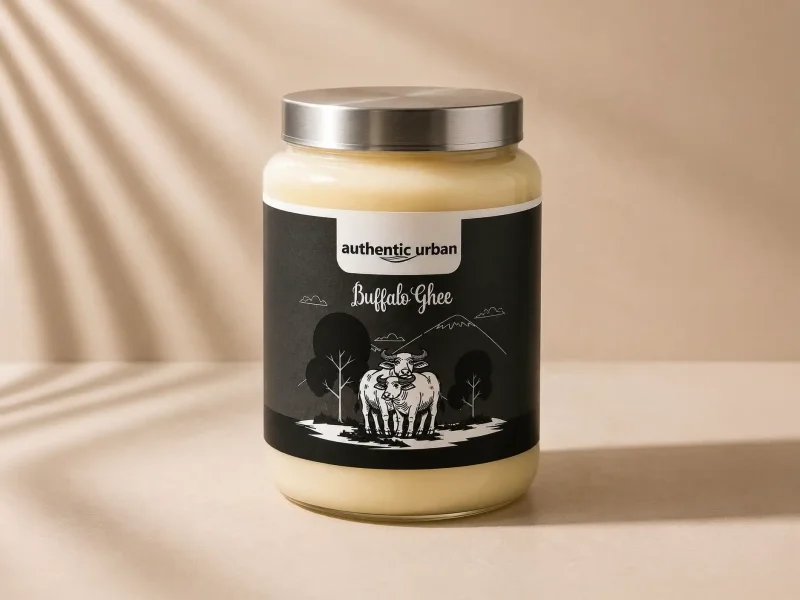
For the daily teaspoon we would pick our own A2 Gir cow ghee: grass-fed Gir milk set to curd overnight, churned, and cooked in a matki on a wood chulha, made after you order, with a video of your jar sent on WhatsApp. At ₹2,399 a litre, a 5 ml teaspoon costs about ₹12. Our Jafarabadi buffalo ghee is the richer jar for halwa and parathas. We test every month against the FSSAI limits; the steps are on how we make ghee.
The daily teaspoon on dal
 1 Litre
Winter sweets and parathas
 1 Litre
Each order is cooked after you place it, and the packing video is of that batch. Past order videos are on the shop.
FAQ
Kya ghee se sir dard theek hota hai?
Nahi, ghee sir dard ki dawai nahi hai. No study we found shows ghee stops a headache or migraine. What helps most headaches is water, a meal on time, rest, and sleep, and a teaspoon of ghee on that meal is fine. If the headache is sudden and very severe, or comes with fever, a stiff neck, or weakness, go to a hospital at once.
Does rubbing ghee on the forehead or temples help a headache?
A gentle rub of the forehead, temples, or neck can feel soothing, and ghee is a common household choice for it. The comfort comes from the massage and lying down in a quiet room, which the NHS suggests during a migraine. We found no study showing ghee on the skin does more than any other oil. Warm it only until it melts, and skip it on broken skin.
Can eating too much ghee cause a headache?
Ghee is not on the NHS list of common migraine triggers, and we found no study linking it to headaches. A very heavy, late meal of fried food and sweets can leave some people unwell the next morning, though, and that is worth noting in a diary. If your attacks follow rich meals, try keeping ghee to 1 to 2 teaspoons a day for a month and compare.
Is cow ghee or buffalo ghee better for migraine?
Neither has been studied for migraine. Both are almost pure milk fat with very little omega-6 and no fish omega-3, so the amount and the rest of the plate matter more than the animal. Cow ghee is lighter in taste, which makes one teaspoon on dal feel like enough. Buffalo ghee is richer and suits halwa and parathas, which are already the heavy dishes.
Can I take ghee with my migraine medicine?
Normal food amounts of ghee, 1 to 2 teaspoons a day on meals, do not clash with common migraine medicines that we know of. Do not stop or skip any medicine to try ghee or nasya instead. Some tablets are better taken with food, so a proper meal with a little ghee can suit them. Ask your pharmacist if you are unsure.
Is desi ghee good for a headache from gas or acidity?
A headache that comes with acidity is often about the meal: too late, too big, or too spicy. Ghee does not treat either one. Small, regular meals with a teaspoon of ghee on dal or khichdi are easier on the stomach than fried snacks. Heartburn on most days, or a headache with vomiting, is a reason to see a doctor rather than change the fat.
About the editorial team
Authentic Urban TeamBilona ghee makers, Gir Somnath, Gujarat
We are the Parmar family in Gir Somnath, Gujarat. We have made ghee here since 2016 and sold it online since 2025. We make only Bilona ghee, test it every month, and anyone is welcome to visit and watch it being made. Our Gir cows and Jafarabadi buffalo are grass-fed village animals that graze near the Gir forest, with no hormones or milk boosters. We set their milk to curd, churn it, and cook the makkhan on a wood chulha. These articles come from that kitchen and from what customers ask us on WhatsApp. We are ghee makers, not doctors.
Sources
- Butter oil, anhydrous (ghee), FDC ID 173412, USDA FoodData Central. Checked 28 Sep 2026.
- Oil, sunflower, linoleic (approx. 65%), FDC ID 171025, USDA FoodData Central. Checked 28 Sep 2026.
- Oil, soybean, salad or cooking, FDC ID 171411, USDA FoodData Central. Checked 28 Sep 2026.
- Oil, peanut, salad or cooking, FDC ID 171410, USDA FoodData Central. Checked 28 Sep 2026.
- Oil, olive, salad or cooking, FDC ID 171413, USDA FoodData Central. Checked 28 Sep 2026.
- Oil, coconut, FDC ID 171412, USDA FoodData Central. Checked 28 Sep 2026.
- Dietary Guidelines for Indians, 2024 (limit ghee or butter to 1 to 2 teaspoons a day, visible fat limits, PDF p. 71), ICMR-National Institute of Nutrition. Checked 28 Sep 2026.
- Dietary alteration of n-3 and n-6 fatty acids for headache reduction in adults with migraine: randomized controlled trial (Ramsden CE et al.), BMJ 2021;374:n1448, BMJ. Checked 28 Sep 2026.
- Lipoid Pneumonia After Prolonged Inhalation of Clarified Butter Made from the Milk of a Buffalo or Cow (Ghee) (Banka R, Deshpande RB, Udwadia ZF), 2016, Indian Journal of Chest Diseases and Allied Sciences. Checked 28 Sep 2026.
- Migraine, NHS. Checked 28 Sep 2026.
- Headaches, NHS. Checked 28 Sep 2026.