Turmeric Milk With Ghee: Golden Milk Recipe and How Much
Turmeric milk with ghee takes ½ teaspoon of haldi, a pinch of black pepper, and 1 level teaspoon of ghee for one 240 ml cup of milk. Bloom the haldi in the ghee on a low flame for 30 to 45 seconds, add the milk, and simmer 3 to 5 minutes. The cup comes to about 191 kcal before any sweetener, by USDA figures.
How do you make turmeric milk with ghee?
Melt 1 teaspoon of ghee on a low flame, stir ½ teaspoon of haldi into it for 30 to 45 seconds, add a pinch of black pepper and a cup of milk, and simmer 3 to 5 minutes. Strain, let it cool a little, then sweeten. That is haldi doodh as most Indian homes make it, and what cafés sell as golden milk.
Ingredients (1 cup)
- 240 ml whole milk (1 cup, 244 g)
- 1 level tsp ghee (about 4 g)
- ½ tsp ground haldi (about 1.5 g)
- 1 pinch freshly ground black pepper
- Optional: a pinch of dry ginger (sonth), 2 crushed green cardamom, or a small piece of cinnamon
- Jaggery or honey to taste, added off the flame
Steps
- 1. Put the ghee in a small, heavy pan on a low flame. When it runs clear, add the haldi.
- 2. Stir for 30 to 45 seconds. The ghee foams and smells warm and earthy. Take it off the flame if the powder starts to darken.
- 3. Add the pepper and any whole spices, then pour in the milk. It hisses; that is fine. Whisk for 20 seconds.
- 4. Bring it just to a simmer and keep it on low for 3 to 5 minutes, stirring every minute so it does not catch or boil over.
- 5. Pour through a tea strainer into a cup. Wait until you can sip it, then stir in jaggery or honey.
One cup (240 ml whole milk, 1 teaspoon ghee, ½ teaspoon haldi): about 191 kcal, 7.8 g protein, 12.2 g fat, and 12.7 g carbohydrate, all of the sugar from the milk itself, worked out from USDA FoodData Central. For toned milk or a child's cup, use ½ teaspoon of ghee; the method stays the same. If milk sits badly with you, the lactose is in the milk, not the ghee, which we explain on A2 ghee and lactose intolerance.
Which spices go in, and which stay out?
Dry ginger (sonth), green cardamom, and cinnamon all simmer well with the milk. A few strands of kesar go in at the end. Fresh ginger is where cups go wrong: grated into hot milk, it can split it. If you want fresh ginger, boil it in 2 tablespoons of water first, strain, and add that water to the finished cup. Nutmeg is for a small pinch only. Jaggery also goes in off the flame, because a sour or old piece can curdle milk that is still simmering.
Why add ghee and black pepper to turmeric milk?
Ghee gives the haldi a fat to cook in, and pepper is there because of one study on how the body takes up curcumin, turmeric's yellow compound. Curcumin dissolves in fat and barely in water, so blooming haldi in ghee before the milk goes in cooks out the raw taste and spreads the colour through the cup instead of leaving grit at the bottom.
The pepper claim needs more care. Almost every golden milk page says black pepper raises curcumin absorption by 2000%. That figure is real, but it comes from a 1998 study by Shoba and colleagues in Planta Medica, in which healthy volunteers took 2 g of pure curcumin with 20 mg of piperine, the active compound of pepper, as an extract. With curcumin alone their blood levels were very low or not measurable; with piperine, the study measured a 2000% rise in bioavailability. Nobody has run that test on a cup of haldi doodh.
Turmeric in the cup
Curcumin, roughly
¼ tsp haldi (0.75 g)
about 24 mg
½ tsp haldi (1.5 g), this recipe
about 47 mg
1 tsp haldi (3 g)
about 94 mg
Dose in the 1998 pepper study
2,000 mg pure curcumin, with 20 mg piperine extract
Worked out from USDA FoodData Central 172231 (1 tsp ground turmeric = 3 g) and Tayyem and colleagues, Nutrition and Cancer, 2006, who tested 28 turmeric and curry powders and found pure turmeric powder averaged 3.14% curcumin by weight. Brands vary. Study dose from Shoba and colleagues, Planta Medica, 1998. Checked 27 September 2026.
So your cup holds roughly 47 mg of curcumin, about one-fortieth of the study dose, and a kitchen pinch of pepper is not a measured 20 mg of piperine. Pepper and ghee are sensible because that is how turmeric is cooked in Indian food anyway, in a tadka, never raw. They do not turn a cup of milk into a supplement. The US National Center for Complementary and Integrative Health (NCCIH) says in its 2025 turmeric page that there is not enough evidence to conclude turmeric or curcumin helps any health condition, which is why we write about this as a warm drink, not a treatment. What ghee itself can and cannot do for inflammation is on ghee for inflammation.
How much ghee and turmeric should go in one cup?
One level teaspoon of ghee and ½ teaspoon of haldi per 240 ml cup. More ghee does not make the drink work harder; it adds calories and leaves an oily film. More haldi makes the cup bitter and gritty. The table shows what each version of the cup adds up to.
One 240 ml cup of whole milk
kcal
Fat
Saturated fat
Milk and ½ tsp haldi, no ghee
154 kcal
Fat 8.0 g
Saturated fat 4.6 g
With ½ tsp ghee (children, weight watchers)
172 kcal
Fat 10.1 g
Saturated fat 5.9 g
With 1 tsp ghee (this recipe)
191 kcal
Fat 12.2 g
Saturated fat 7.2 g
With 1 tsp ghee and 1 tsp honey
212 kcal
Fat 12.2 g
Saturated fat 7.2 g
With 1 tbsp ghee (some online recipes)
266 kcal
Fat 20.7 g
Saturated fat 12.5 g
Worked out from USDA FoodData Central 171265 (whole milk, 244 g a cup), 173412 (butter oil, 4.27 g a teaspoon), 172231 (ground turmeric), and 169640 (honey, 7 g a teaspoon), checked 27 September 2026. Toned milk brings every row down.
The teaspoon in the cup counts toward the day. ICMR-NIN's 2024 dietary guidelines suggest limiting ghee or butter to 1 to 2 teaspoons a day. At home our own 1 to 2 teaspoons each go on roti, dal, and khichdi, so a nightly cup with a full teaspoon means taking one off the dinner plate. To see the whole day for your family, use our ghee calculator, and for the reasons behind that limit, read how much ghee per day.
Measuring the teaspoon in winter and summer
In our kitchen in Gir Somnath, ghee stays liquid in the jar through summer, and in winter the richer milk gives ghee that sets to a fine grain. A heaped spoon of set ghee can be nearly two level ones, so scrape it flat against the rim. The grain is normal, and why ghee is grainy is one of the first things customers ask us on WhatsApp. The colour of the cup comes from the haldi, not the ghee, though our cow ghee does turn more yellow in the monsoon, when the cows eat green fodder.
When is the best time to drink turmeric milk with ghee?
Most families drink it in the evening, 1 to 2 hours before bed, and on cold or sick days. If you get heartburn at night, drink it earlier in the evening rather than just before you lie down.
Whether the ghee in the cup helps sleep, and what studies on milk at bedtime show, is on ghee for sleep. Morning or night for ghee in general is covered on when to eat ghee, and the cold-day version with honey and khichdi is on ghee for cough and cold. If reflux is already a problem, see ghee for acid reflux before making this a nightly cup.
Why is my golden milk bitter, gritty, or oily?
Usually the flame under the ghee, or too much of something. Find the problem below.
Bitter or burnt taste
The haldi scorched in the ghee. Ghee heats fast in a small pan.
Fix: Low flame, 30 to 45 seconds, off the moment it foams and smells of haldi. If the powder turns brown, start again.
Gritty, sandy last sip
Turmeric does not dissolve; it settles.
Fix: Bloom it in the ghee first, whisk after the milk goes in, and pour through a tea strainer. A little sediment is normal.
Oil floating on top
More ghee than the milk can hold, or no whisking.
Fix: Keep to 1 level teaspoon. Whisk or froth for 20 to 30 seconds, and stir before each sip.
Milk split or curdled
Fresh ginger juice or a sour spoon of jaggery hit hot milk.
Fix: Use a pinch of dry ginger (sonth) instead of fresh, and stir jaggery in off the flame once the cup has cooled a little.
Tastes of raw powder
Haldi went straight into the milk, or the simmer was too short.
Fix: Bloom in ghee, then simmer 3 to 5 minutes on low. Old turmeric tastes dull and dusty; a fresh pack smells earthy and bright.
If the cup tastes burnt or sour even on a low flame, smell the ghee straight from the jar. At the chulha, a batch cooked too long turns dark and bitter and smells burnt, and one taken off too early stays cloudy and sours fast. We keep both back from jars, but both reach kitchens, and plain milk shows them more than a dal does. The checks are on how to identify pure ghee.
Can you make golden paste with ghee ahead of time?
Yes. Cook the haldi, pepper, and ghee together without water and you have a spoonable base for a week of cups. Water is what makes most golden paste recipes spoil, so leave it out.
-
1. Weigh it out
7 tsp ghee, 3½ tsp haldi, and ½ tsp black pepper makes seven cups at this page's ratio.
-
2. Cook on low
Melt the ghee, stir in the haldi and pepper, and keep stirring for 1 to 2 minutes until it smells cooked, not raw. It must not brown.
-
3. Cool and jar
Cool completely, then spoon into a clean, dry glass jar. It sets firm in the fridge.
-
4. Use a dry spoon
Keep it in the fridge and use it within a week. A wet spoon brings in water and mould.
-
5. Make the cup
Stir 1½ level teaspoons of paste into 240 ml of hot milk and simmer 2 to 3 minutes. That is 1 tsp ghee and ½ tsp haldi.
A made cup is best drunk fresh. If you must keep one, put it in the fridge within 2 hours and reheat it once, gently in a pan, stirring so the ghee goes back into the milk. The jar of ghee itself needs no fridge; how to keep it is on ghee storage and shelf life.
Who should skip turmeric milk or ask a doctor first?
A cup with ½ teaspoon of haldi is a food amount, and most adults drink it without trouble. The warnings on official health pages are mostly about turmeric and curcumin supplements, not a spoon of haldi in milk, but a few people should check first.
- Anyone taking turmeric or curcumin capsules as well. NCCIH warns that highly bioavailable curcumin products, often sold with piperine, have been linked to liver damage in some people. Stop and see a doctor if you notice tiredness, nausea, poor appetite, dark urine, or yellow eyes.
- Pregnancy. NCCIH says turmeric supplements may be unsafe in pregnancy. A cup of haldi doodh is food, but ask your doctor before taking more than food amounts; ghee in pregnancy is on ghee during pregnancy.
- People on regular medicines. NCCIH advises anyone who takes medicine to talk to their doctor before using any herbal product, because some herbs and medicines interact. Tell your doctor about the nightly cup, and about any turmeric capsules.
- People told to watch saturated fat for cholesterol or the liver. Use toned milk and ½ teaspoon of ghee, and count it in the day; see ghee for cholesterol.
Turmeric can also upset the stomach: NCCIH lists nausea, acid reflux, and diarrhoea among the possible side effects of turmeric taken by mouth. If a nightly cup does that to you, drop the pepper first, then halve the haldi.
Turmeric milk with ghee: a recipe card to keep
Screenshot this and keep it by the stove.
- 1. 240 ml whole milk, ½ tsp haldi (1.5 g), 1 pinch black pepper, 1 level tsp ghee (about 4 g).
- 2. Ghee and haldi in a small pan on a low flame, 30 to 45 seconds. Foamy and fragrant, never brown.
- 3. Pepper in, then the milk. Whisk 20 seconds.
- 4. Simmer 3 to 5 minutes on low. Do not let it boil over.
- 5. Strain, cool until you can sip it, then sweeten.
- 6. About 191 kcal before sugar or honey. That teaspoon is half to all of a day's ghee.
- 7. Evening cup: 1 to 2 hours before bed, not on the pillow.
- 8. Pregnant, or on regular medicines: food amounts only, no turmeric capsules on top, and tell your doctor.
Which ghee for turmeric milk?
For a cup that tastes of milk and haldi, use a plain cow ghee with nothing added that smells of toasted milk when it melts. A cup of milk hides nothing: a burnt or sour jar shows up on the first sip. Buffalo ghee works, but it is richer and whiter and better kept for gond ladoo and halwa. Our ranking of the cow ghee on sale, with prices, is best cow ghee in India.
We make and sell ghee, so weigh this with that in mind. For haldi doodh we would use our A2 Gir cow ghee, and keep our Jafarabadi buffalo ghee for winter sweets. Both come from grass-fed village animals near the Gir forest; the milk is set to curd overnight, churned, and the makkhan cooked in a matki on a wood chulha. The jar is made after you order, a video of it being cooked and packed comes on WhatsApp, and Varsha tastes every batch before it goes in a jar. We test every month against the FSSAI limits; the steps are on how we make ghee.
The nightly haldi doodh
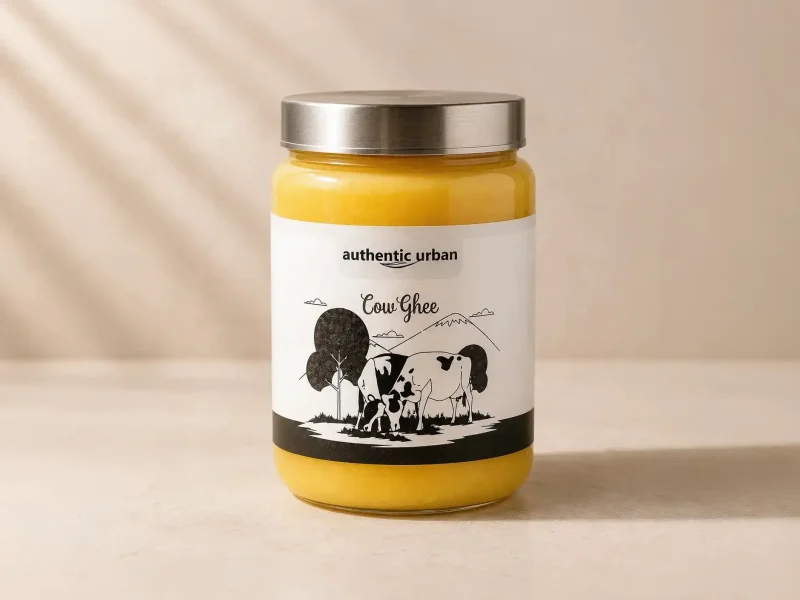 1 Litre
Winter sweets, not the cup
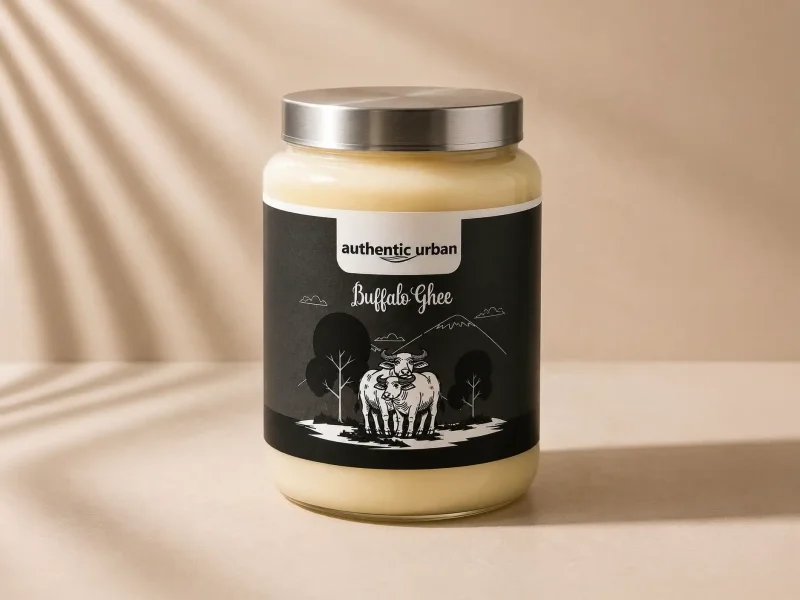 1 Litre
Each order is cooked after you place it, and the packing video is of that batch. Past order videos are on the shop.
FAQ
Haldi doodh me ghee dal sakte hai?
Haan. Ek cup garam doodh mein ½ chammach haldi, chutki bhar kali mirch, aur 1 chammach ghee kaafi hai. Pehle ghee mein haldi 30 se 45 second dheemi aanch par bhuno, phir doodh daalo aur 3 se 5 minute pakao. ICMR-NIN ke 2024 guidelines din bhar ka ghee 1 se 2 chammach tak rakhne ko kehte hain, isliye baaki khane ka ghee bhi gino.
Can I drink turmeric milk with ghee every day?
Yes, one cup a day in food amounts is a normal Indian habit. What to watch is the ghee, not the haldi: one teaspoon in the cup is half to all of the 1 to 2 teaspoons a day ICMR-NIN's 2024 guidelines suggest for ghee or butter. If you drink it daily, cut a teaspoon from dal or roti, or use ½ teaspoon in the cup.
Is cow ghee or buffalo ghee better for golden milk?
Cow ghee is the usual pick. It is lighter and more yellow, and the cup tastes of haldi and milk rather than of fat. Buffalo ghee works too but is richer and whiter, and suits winter sweets better. Both are almost pure milk fat, about 37 kcal a teaspoon by USDA figures, so the animal changes taste more than nutrition.
Can children drink turmeric milk with ghee?
Children over one year can have a small cup of warm milk with a pinch of haldi and ¼ to ½ teaspoon of ghee, if milk suits them. Skip the pepper for small children, keep sugar low, and give it warm, not hot. Do not give honey to babies under one. Turmeric capsules or extracts are not for children unless their doctor prescribes them.
Is turmeric milk with ghee good for weight loss?
It is not a weight loss drink. By USDA figures a cup of whole milk with 1 teaspoon of ghee and ½ teaspoon of haldi is about 191 kcal, and a teaspoon of honey takes it to about 212. If you are cutting calories, use toned milk, ½ teaspoon of ghee, and no sugar, and count the cup as a snack.
Can I use coconut oil instead of ghee in golden milk?
Yes, for a dairy-free cup made with almond, oat, or coconut milk, 1 teaspoon of coconut oil does the same job as ghee: it gives the haldi a fat to bloom in. Plant milks carry less fat than whole milk, so do not skip it. The taste changes more than the method. Ghee gives a toasted milk flavour; coconut oil tastes of coconut.
About the editorial team
Authentic Urban TeamBilona ghee makers, Gir Somnath, Gujarat
We are the Parmar family in Gir Somnath, Gujarat. We have made ghee here since 2016 and sold it online since 2025. We make only Bilona ghee, test it every month, and anyone is welcome to visit and watch it being made. Our Gir cows and Jafarabadi buffalo are grass-fed village animals that graze near the Gir forest, with no hormones or milk boosters. We set their milk to curd, churn it, and cook the makkhan on a wood chulha. These articles come from that kitchen and from what customers ask us on WhatsApp. We are ghee makers, not doctors.
Sources
- Milk, whole, 3.25% milkfat, with added vitamin D (FDC ID 171265), SR Legacy, USDA FoodData Central. Checked 27 Sep 2026.
- Butter oil, anhydrous (FDC ID 173412), SR Legacy, USDA FoodData Central. Checked 27 Sep 2026.
- Spices, turmeric, ground (FDC ID 172231), SR Legacy, USDA FoodData Central. Checked 27 Sep 2026.
- Honey (FDC ID 169640), SR Legacy, USDA FoodData Central. Checked 27 Sep 2026.
- Influence of piperine on the pharmacokinetics of curcumin in animals and human volunteers (Shoba G et al.), Planta Medica, 1998, PubMed. Checked 27 Sep 2026.
- Curcumin content of turmeric and curry powders (Tayyem RF et al.), Nutrition and Cancer, 2006, PubMed. Checked 27 Sep 2026.
- Turmeric (updated April 2025), National Center for Complementary and Integrative Health (NIH). Checked 27 Sep 2026.
- Dietary Guidelines for Indians, 2024 (Guideline 7, printed p. 54), ICMR-National Institute of Nutrition. Checked 27 Sep 2026.