Ghee for Puja and Havan: Which Ghee, How Much per Diya
Ghee for puja is plain cow ghee that is also fit to eat. One to two teaspoons (5 to 10 g) fills a diya, and a havan takes about 5 g for every teaspoon ahuti, so 108 ahutis need roughly 540 g. Avoid packs printed with a black cross inside a square: FSSAI uses that mark for ghee for diya that is not meant for eating, so it cannot go into prasad.
Which ghee is best for puja?
The best ghee for puja is pure cow ghee from a food jar: the same ghee you would put on your child's dal. Many priests and families ask for cow ghee (gau ghrita) for the havan and the altar diya. A food jar matters because puja ghee rarely stays in the lamp. It goes into panchamrit, tilak, the sheera for prasad, and back into the kitchen.
Nothing in a text we can point you to asks for a particular brand, breed, or method. What tradition asks for is purity, and in a shop that comes down to three things you can check: it is ghee and nothing else, it is fresh, and it is meant to be eaten. Buffalo ghee is used for the everyday lamp in plenty of homes; whether it suits your havan is your priest's call, and how the two differ in the kitchen is on cow vs buffalo ghee.
What to leave on the shelf: vanaspati (hydrogenated vegetable fat) sold beside ghee, anything labelled "ghee flavour" or a blend, and any jar that smells sour or waxy. Why vanaspati is not ghee, down to the FSSAI rules, is on Dalda vs ghee. This page is for home puja, festival lamps, and a family havan. For a wedding, where the ghee runs into kilos, see ghee for Indian weddings.
What does the black cross mark on pooja ghee mean?
A black cross inside a square on a pack means the product is not meant for eating. FSSAI's labelling rules (regulation 5(15), in the compendium dated 3 April 2025) say every retail pack of "food material" that is not for human consumption must carry this symbol, and they name "Ghee for diya" and "Oil for Pooja" as examples.
So a cheap "pooja ghee" or "diya ghee" pack with the cross is telling you what it is for: the lamp, and only the lamp. It should not go into prasad, panchamrit, charnamrit, tilak paste, or the kada prasad at the gurdwara, and it should not be moved into the kitchen jar when the puja is over. If you want one jar for both the altar and the kitchen, buy ghee sold as food.
Ghee sold as food has to meet the FSSAI ghee standard (Chapter 2.1, version of 1 September 2023, p. 27): at least 99.5% milk fat, at most 0.5% moisture, free fatty acids at most 2.0%, a negative Baudouin test (which catches til oil), and no β-sitosterol (a plant sterol that shows up when vegetable fat is mixed in). Those limits are what "pure" means on paper. Home checks that go with them are on how to identify pure ghee.
How much ghee do you need for a diya?
A small clay or brass diya takes 1 to 2 teaspoons of ghee, which is 5 to 10 g (ICMR-NIN's 2024 guidelines count a teaspoon of ghee as 5 g). Fill it to just below the rim so the wick base sits in ghee. The table below turns that into a month's jar.
Lamp
Ghee per filling
What it adds up to
One small clay diya, once a day
1 tsp (5 g)
about 150 g a month
Brass diya, morning and evening
1 tsp each time (10 g a day)
about 300 g a month
Panch mukhi diya (5 wicks) for aarti
2 to 3 tsp (10 to 15 g)
depends on how often
Diwali: 21 small diyas for one evening
1 tsp each (105 g)
about 525 g over five evenings
Akhand jyoti for nine nights
Top up as it burns
measure your own lamp (steps below)
Worked from 5 g a teaspoon. Diyas differ in size, so weigh one filling of yours once and scale the table.
How to light a ghee diya so it burns steady
- Start dry. Wipe a brass diya; let a new clay diya dry fully after washing. Any water under the ghee will crackle and spit once it heats.
- Warm the ghee if it has set. Stand the jar in a bowl of warm water, then spoon it in with a dry spoon.
- Seat the wick. A cotton phool batti lies flat; a long batti rests with one end in the ghee and the tip just above the rim.
- Let the wick drink. Wait a minute so the cotton soaks through before you light it, or it chars and smokes.
- Trim, do not drown. A tall flame smokes; pull the wick back. A flame that shrinks needs a little more wick drawn out with a clean pin.
- Place it safely. On a brass plate or tray, away from curtains, dupattas, marigold garlands, and paper, and never where a child or pet can knock it.
The crackle has a kitchen reason. We cook makkhan on a wood chulha in a matki for 45 to 90 minutes, and the ghee is only ready once the water in the makkhan has boiled away and the bubbling goes quiet. A batch taken off too early stays cloudy and keeps moisture. It spoils fast, so we never pack one. In a diya, that hidden water is what pops. If your lamp spits even in a dry diya, the ghee itself is the problem.
Akhand jyoti: for a lamp that must not go out for nine nights, measure your own burn once. Weigh the lamp full, light it, weigh it again after four hours, and you know your grams per hour. Keep it in a glass or brass chimney on a tray, and have one person in charge of topping up. Never leave it burning in a closed room with no one at home.
How much ghee is needed for a havan?
Count the ahutis your priest plans, multiply by the spoon, and add a little for the samagri and the lamp. At one teaspoon (5 g) of ghee per ahuti, 108 ahutis need about 540 g. A priest using a bigger sruva (the havan ladle) will pour more per ahuti, so ask the spoon size when you ask the count.
Ahutis
Ghee at 1 tsp each
What to buy
11 ahutis
55 g
A 250 ml jar covers it with plenty left
21 ahutis
105 g
A 250 ml jar
51 ahutis
255 g
A 500 ml jar
108 ahutis
540 g
A 1 L jar (samagri and diya need some too)
1,008 ahutis
about 5 kg
Bulk; plan it with your priest
Grams worked from ICMR-NIN's 5 g teaspoon. The ghee mixed into samagri and the lamp beside the kund come on top.
Three things push the number up. Many priests stir ghee into the samagri (the herb, grain, and resin mix) before offering it, and that ghee is not counted in the ahutis. A fire of dry mango or peepal wood needs a little ghee to catch and stay bright. And a family havan often runs longer than planned. Keep one extra 250 ml jar unopened on the day; it goes back to the kitchen if it is not needed.
Ghee for the kund should be liquid, so it pours clean from the spoon and does not drop in lumps. Grainy ghee that has set in a cool room is normal, and it is the question customers send us most on WhatsApp; warm the jar in water before the havan. Why it sets that way is on why ghee is grainy.
Is a ghee diya better than an oil diya?
A ghee diya is the lamp many families keep for the altar and aarti, and a til oil diya is a normal, accepted everyday lamp. Which one your home lights where is custom, not a rule we can settle for you. The practical differences are smell, smoke, and cost.
Lamp fuel
Where it is used
What to watch
Cow ghee
The lamp many families and priests ask for at the altar and for aarti
Must be dry and fresh, or it crackles and smells
Til (sesame) oil
The everyday lamp in many homes, and the usual oil for Shani and Hanuman lamps
Use a cold-pressed bottle that smells of sesame, not a stale one
Mustard oil
Common for doorstep and outdoor diyas, especially in the north and east
Sharp smoke; keep it outdoors or near an open window
Kerosene or paraffin
Not a puja fuel
The most soot of the lamp fuels studied (see below); keep it out of the puja room
On smoke, there is one small study. A 2025 paper in the Interdisciplinary Journal of Yagya Research burned kerosene, four vegetable oils (mustard, peanut, coconut, castor), and cow and buffalo ghee in lamps, and looked at what the soot was made of. Kerosene soot carried the most of the aromatic compounds linked to harm; ghee soot carried less than the oils. It looked at what the soot contains, not how much of it fills a room, and it comes from a single lab. Read it as "ghee is not the worst lamp fuel", not as "ghee smoke is safe".
Does burning ghee in a havan purify the air?
One study found fewer airborne bacteria after havan smoke, but it tested wood and herb samagri, not ghee, and it did not measure whether the smoke is good to breathe. That is the fair summary of the claim you will see on posters and forwards.
The study is Nautiyal and colleagues, Journal of Ethnopharmacology, 2007. They burned wood with havan samagri for an hour in a closed room and counted bacteria in the air. Counts fell by over 94% within 60 minutes, and the effect held for up to 24 hours in the closed room. That tells you the smoke killed or settled airborne bacteria in that room. It does not say ghee did it, and it does not say the room was healthier to sit in.
The other side is well known. Asthma + Lung UK says candles and incense release fine particles when they burn, that scientists have found incense can release more particles than cigarettes, and that wood fires do the same. It advises burning them in large, well-aired rooms with the windows open. A havan is a small wood fire with incense-like herbs on it. So keep the fire as small as the ritual allows, do it in a courtyard, terrace, or a hall with windows open, and let anyone with asthma sit back from the kund. The asthma side in detail is on is ghee smoke bad for asthma.
Which ghee for prasad, panchamrit, and tilak?
Anything that is eaten or touches skin needs food-grade ghee, never a black-cross pack. That covers panchamrit and charnamrit, the sheera or halwa offered as bhog, ladoos, and the ghee in tilak paste.
For the gurdwara-style atta halwa, the proportions and the bhuna time are on kada prasad, and Krishna's makhan mishri, panjiri, and panchamrit are on Janmashtami prasad recipes. Prasad is eaten in small bites, but a festival week of sweets adds up; the everyday limit is on how much ghee per day.
Colour is not a purity test here. Cow ghee turns more yellow in the monsoon, when the animals eat green fodder, and paler in the dry months. "Why is the colour different from last time" is one of the questions we are asked most, and the answer is almost always the season.
A checklist for puja ghee
Screenshot this before Diwali, a katha, or a griha pravesh havan.
- Cow ghee for the havan and the altar diya, unless your priest or family custom says otherwise.
- No black cross in a square on the pack if the same jar will touch prasad, panchamrit, or tilak.
- The label says ghee, with an FSSAI licence number; not "vanaspati", "ghee flavour", or a blend.
- It smells of toasted milk when warmed. Sour, soapy, or waxy means the jar has gone off.
- Grainy when cool and a different yellow from last time are both normal.
- A dry spoon, a dry diya, and a dry wick. Water is what makes a ghee lamp crackle.
- Havan grams worked out from the ahuti count, plus one extra small jar on the day.
- A window open, a brass plate under every lamp, and no diya left alone near cloth.
If a jar you already own smells off or burns badly, you can check your jar in 2 minutes, and how long an open jar stays good is on does ghee go bad.
Which ghee to keep for puja and prasad?
Keep one food jar that serves the altar and the kitchen: cow ghee, nothing added, that smells of toasted milk when warmed and sets grainy when cool. Slow curd-churned ghee (Bilona) is the old household way; how it differs from cream ghee is on the Bilona method, and our ranking of the cow ghee on sale is best cow ghee in India.
We make and sell ghee in Gir Somnath, Gujarat, so weigh this with that in mind. For the diya, the havan, and prasad we would use our own A2 Gir cow ghee: milk from grass-fed Gir cows, set to curd overnight, churned, and cooked in a matki on a wood chulha, made after you order, with a video of your jar sent on WhatsApp. It is food ghee, so what is left after the puja goes straight into the dal. If your family makes prasad sweets with buffalo ghee, our Jafarabadi buffalo ghee is the richer jar. We test every month against the FSSAI limits, and anyone is welcome to visit and watch; the steps are on how we make ghee.
Diya, havan, panchamrit, and prasad
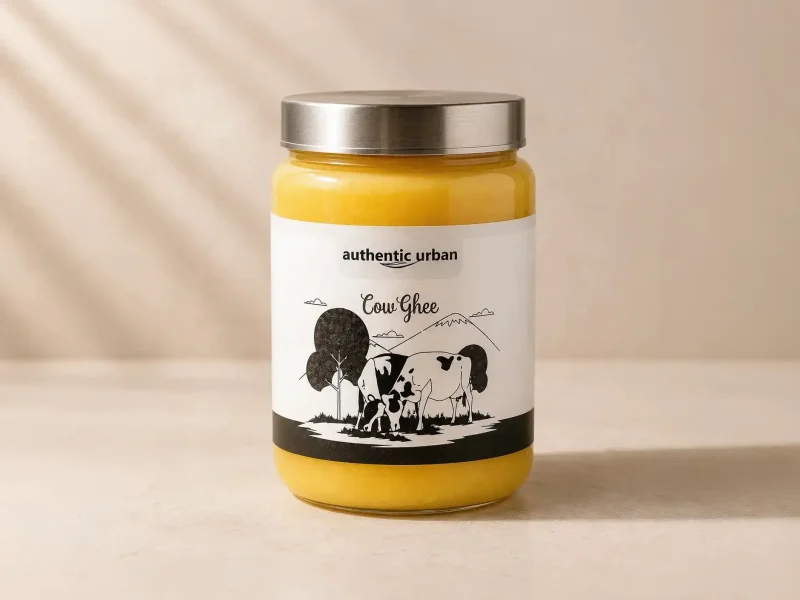 1 Litre
Prasad sweets, if your family uses buffalo ghee
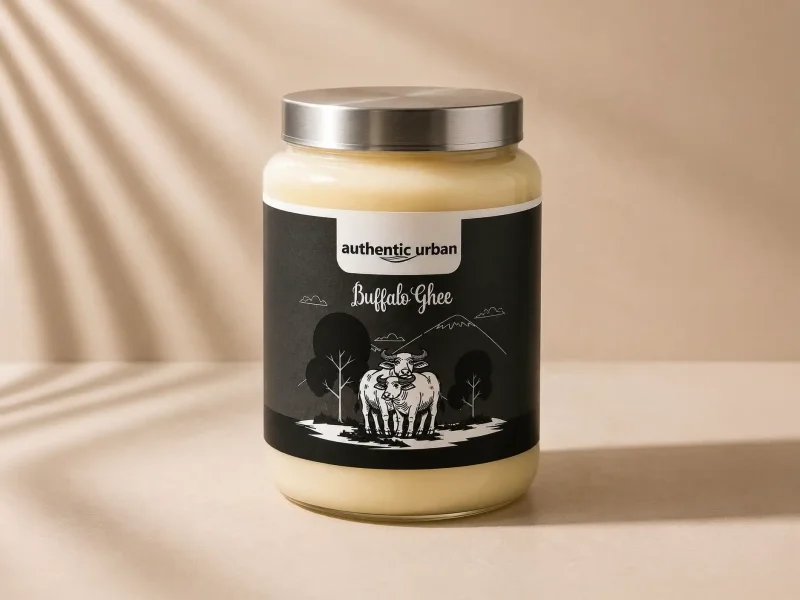 1 Litre
Each order is cooked after you place it, and the packing video is of that batch. Past order videos are on the shop.
FAQ
Can I use buffalo ghee for puja?
Many homes do, especially for the everyday lamp, and no food rule stops it. For the havan and for offerings, many priests and families ask for cow ghee (gau ghrita), so check with the person leading your puja before you buy. Buffalo ghee is whiter and sets firmer. If your family uses it for prasad sweets like sheera or ladoo, that is a kitchen choice, not a ritual rule.
Can I eat ghee that was kept for the diya?
If it came out of a normal food jar that stayed clean, yes: it is still food, so use a dry spoon and keep the lid on. Ghee left in a lit diya is different. It has been heated for hours and holds soot and wick fibre, so let it burn out or throw it away. Never eat ghee from a pack printed with a black cross inside a square.
Why does my ghee diya sputter or go out?
Sputtering almost always means water: a damp clay diya, a wet wick, or ghee that holds moisture. Dry a new clay diya well before the first use, keep wicks in a closed box, and fill with a dry spoon. A flame that shrinks and dies usually means the wick is too short or has sunk into the ghee; pull a little more out with a clean pin.
Can I mix ghee and oil in one diya?
You can, and a mixed lamp burns fine, but most families keep them apart: ghee in one diya, til or mustard oil in another. That way the lamp your tradition asks to be pure ghee, usually the one before the deity, stays pure ghee. What matters more than the mix is that each fat is fresh, with no sour or stale smell.
Is homemade ghee good for puja?
Yes, if it was cooked until all the water was gone. Undercooked homemade ghee looks cloudy, turns sour sooner, and crackles in a diya because of the water left in it. Cook the makkhan on a low flame until the bubbling goes quiet and the solids turn golden-brown, strain it through a clean cloth into a dry jar, and let it cool before the lid goes on.
How long does puja ghee keep on the shelf?
Our sealed jars keep 9 to 12 months at room temperature. Once a jar is open, use a dry spoon, keep the lid shut, and store it away from the lamp, the stove, and sunlight. A jar parked on the puja shelf beside a burning diya warms up every day and goes stale sooner. Smell it before a big puja: sour or paint-like means replace it.
About the editorial team
Authentic Urban TeamBilona ghee makers, Gir Somnath, Gujarat
We are the Parmar family in Gir Somnath, Gujarat. We have made ghee here since 2016 and sold it online since 2025. We make only Bilona ghee, test it every month, and anyone is welcome to visit and watch it being made. Our Gir cows and Jafarabadi buffalo are grass-fed village animals that graze near the Gir forest, with no hormones or milk boosters. We set their milk to curd, churn it, and cook the makkhan on a wood chulha. These articles come from that kitchen and from what customers ask us on WhatsApp. We are ghee makers, not doctors.
Sources
- Food Safety and Standards (Labelling and Display) Regulations, compendium Version VII (03.04.2025), regulation 5(15), p. 19: "Ghee for diya" not meant for human consumption carries a black cross in a square, FSSAI. Checked 27 Sep 2026.
- Food Safety and Standards (Food Products Standards) compendium, Chapter 2.1: Dairy products and analogues, version 1 (01.09.2023), ghee standard, p. 27, FSSAI. Checked 27 Sep 2026.
- Dietary Guidelines for Indians, 2024 (household measures: a teaspoon of oil or ghee is 5 g), ICMR-National Institute of Nutrition. Checked 27 Sep 2026.
- Nautiyal CS, Chauhan PS, Nene YL. Medicinal smoke reduces airborne bacteria. Journal of Ethnopharmacology 2007;114(3):446-51, Europe PMC. Checked 27 Sep 2026.
- Jangir R, Rathore K, Kumar K, Kumar D. Comparative physicochemical characterization of particulate matter emitted from diya. Interdisciplinary Journal of Yagya Research 2025;8(2), Interdisciplinary Journal of Yagya Research. Checked 27 Sep 2026.
- Air pollution and allergies at home (candles, incense, wood fires), Asthma + Lung UK. Checked 27 Sep 2026.