Ghee in Ayurveda: What the Texts Say and How to Use It
Ghee in Ayurveda is the best of all fats: the Charaka Samhita ranks it above sesame oil because it carries the herbs cooked into it, and says it calms Vata and Pitta. For everyday eating that means 1 to 2 teaspoons a day on warm food, the same limit ICMR-NIN sets. Large doses, medicated ghee, and drops in the nose or eyes are treatments for a vaidya, not the kitchen.
What is the role of ghee in Ayurveda?
Ayurveda treats ghee as food, as a carrier for herbs, and as a medicine base. The Charaka Samhita calls it the best of the four fats and says it calms Vata and Pitta, nourishes the body, and suits the old, the young, and the weak. For a healthy adult, its role at home is a teaspoon or two on warm meals.
Most pages on this topic list twenty benefits and stop there. We make ghee for a living, and we would rather show you where each claim comes from. The table below puts Charaka's own verses on ghee (Sutra Sthana 13, the chapter on fats) beside what modern research can and cannot say about them. It is for readers who grew up hearing that ghee is good for everything, and want to know which parts to act on.
Verse
What Charaka says
What research says
13.13
Charaka: Ghee is the best of the four fats (ghee, sesame oil, muscle fat, marrow), because it takes on the qualities of what it is cooked with and keeps its own.
Research: Ghee is almost pure fat, and fat carries fat-soluble plant compounds. That is why Ayurvedic pharmacies cook herbs into ghee. Each herbal ghee has to be tested on its own.
13.14-15
Charaka: Ghee calms Vata and Pitta and is good for rasa, shukra, and ojas. It eases burning, softens the body, and improves voice and complexion.
Research: Dosha and ojas have no lab measure, so these have not been tested as written. No human trial shows that eating ghee improves voice or skin.
13.18
Charaka: Ghee is best taken in sharad (autumn), at a time that is neither very hot nor cold.
Research: Seasonal advice. No study has compared ghee eaten in different seasons.
13.41-43
Charaka: Ghee is for people of Vata-Pitta nature, the elderly, children, the thin and weak, the wounded, and those who want eyesight, memory, and strength.
Research: Ghee gives 9 kcal a gram (ICMR-NIN), so it helps the thin and the old eat more energy in a small spoon. Memory and eyesight gains from plain ghee are not shown in trials.
13.53-56
Charaka: Oiling therapy is not for people with excess Kapha and body fat, indigestion, pregnancy, or great weakness.
Research: Here the texts and modern advice point the same way: ICMR-NIN counts ghee as saturated fat and caps it at 1 to 2 teaspoons a day.
Verses from the English translation of the Charaka Samhita, Sutra Sthana 13 (Snehadhyaya), on Charaka Samhita Online, shortened. Energy figure from ICMR-NIN Dietary Guidelines for Indians 2024. Checked 28 September 2026.
Why does Ayurveda rank ghee above oil?
Because ghee takes on the qualities of whatever it is cooked with and keeps its own. Charaka names four main fats (ghee, sesame oil, muscle fat, and bone marrow) and puts ghee first for this one reason, called samskara (verse 13).
In a pharmacy, that is the whole basis of medicated ghee. Herbs are boiled in water, and the decoction and a herb paste are cooked into ghee until the water is gone and the fat-soluble parts of the herb stay in the ghee. The ratios, the heat, and the signs that it is done are set out on medicated ghee (ghritam). The same idea explains a kitchen habit: jeera, hing, and curry leaves go into hot ghee first, so their flavour is in the fat before the dal goes in.
We see why the done point matters every time we cook. Makkhan in our matki bubbles hard at first, then goes quiet when the water has boiled off, and the milk solids turn golden-brown with a toasted-milk smell. Taken off too early, the ghee is cloudy and spoils. Left too long, it turns dark and bitter. Neither goes in a jar. A pharmacy cooking herbs into ghee is watching for the same signs.
How is ghee used in Ayurveda: food, carrier, medicine, or therapy?
In five ways, and only two of them belong in a home kitchen without advice. The table shows each use, the amount, and who should be in charge.
Use
What it is
Amount
Where
Food
Ghee on dal, roti, khichdi, rice, and in the tadka
Amount: 1 to 2 tsp a day in total
Where: Home
Carrier (anupana)
A little ghee taken with an herbal powder or tablet, so the herb goes down with fat
Amount: Small, as the vaidya says
Where: Home, only on a vaidya's advice
Medicated ghee (ghrita)
Herbs cooked into ghee by a pharmacy: Brahmi, Triphala, Ashwagandha ghrita
Amount: Set by the vaidya
Where: Bought licensed, prescribed
Snehapana
Drinking plain or medicated ghee in rising doses for a few days before Panchakarma
Amount: Far above a food spoon
Where: Clinic only, supervised
On the body
Massage (abhyanga), drops in the nose (nasya), ghee pooled over the eyes (netra basti)
Amount: Drops to a small cup
Where: Massage at home; nose and eyes with a trained practitioner first
Food is the use this blog is about. The body uses have their own pages, each with its steps and its risks: ghee massage (abhyanga), ghee in the nose (nasya), where oil reaching the lungs is a real risk, and netra basti for the eyes. These are household and clinic traditions; at home, our own ghee is for eating.
How much ghee should you eat a day in Ayurveda?
For daily food, 1 to 2 teaspoons (5 to 10 g) in total, the same as ICMR-NIN's 2024 limit for ghee or butter. The large amounts in Ayurveda books are therapy doses, and they are given for a few days under supervision, not eaten every day.
Snehapana: the large doses in the books
Charaka measures a therapy dose of ghee by how long it takes to digest: the smallest in about 6 hours, the middle in 12, and the largest in a full day and night (verses 29 to 30). That is snehapana, the drinking of ghee before Panchakarma cleansing, and Ayurvedic clinics give it with a set diet and a physician watching for trouble. It has nothing to do with the spoon on your dal. Home "ghee cleanse" plans borrow the name without the supervision; why that is a bad idea is on the 3-day ghee detox.
ICMR-NIN counts fat at 9 kcal a gram and a household teaspoon at 5 g, so each teaspoon of ghee is about 45 kcal. At home we each eat 1 to 2 teaspoons a day on roti, dal, and khichdi, and a little more in winter when adadiya pak and gond sweets come out. That count includes the tadka. Dosha changes which meal the spoon goes on more than the amount: Vata, Pitta, and Kapha amounts are on ghee for Vata, Pitta, and Kapha, and the general rules for children and older people on how much ghee per day.
Which ghee does Ayurveda prefer: cow, buffalo, or old?
Cow ghee. A 2024 review in the Journal of Ayurveda and Integrative Medicine by Kataria and Singh gathered what the classical texts say about each kind of ghee, and cow ghee is the one listed as lowering all three doshas. Buffalo ghee is heavier and is said to raise Pitta.
Ghee
Nature in the texts
Doshas
In a kitchen
Cow ghee
Sweet, heavy, cooling
Lowers Vata, Pitta, and Kapha
The daily spoon
Buffalo ghee
Heavier
Lowers Vata and Kapha, raises Pitta
Winter sweets and parathas
Ghee in general
Heavy, oily
Lowers Vata and Pitta, raises Kapha
Keep Kapha types to a small spoon
Old ghee (purana ghrita)
Aged for years, used as medicine
Lowers all three
Not a jar left too long at home
From Kataria and Singh, J Ayurveda Integr Med 2024, Table 1, which summarises the classical texts. Tradition, not trial results. Checked 28 September 2026.
"Cow or buffalo for me?" is one of the questions we get most on WhatsApp. Our answer follows the table: cow ghee for the daily spoon, buffalo for winter sweets and parathas. Taste, fat, and cooking are compared on cow vs buffalo ghee. Old ghee in the texts means ghee aged for years and used as medicine; what ageing does to it in a lab is on purana ghrita.
Is ghee sattvic, and what does that mean for the jar you buy?
Yes. In the yoga and Ayurveda idea of three food qualities, cow ghee is counted as sattvic: calm, clean, and fit for offerings. That is a statement about how the ghee is made and eaten, not a nutrient on a label.
The texts assume ghee made from butter, from cows eating what they should, and cooked with care. A jar made from cream in a factory is still ghee under FSSAI rules, but it is not what those verses describe. If the Ayurvedic side matters to you, the questions to ask are simple: which animal, fed how, and was the butter churned from curd? How curd Bilona (curd churned by hand into butter, then cooked) differs from cream ghee is on the Bilona method. Ghee for the diya and havan is its own question, answered on ghee for puja and havan.
When is the best time and season for ghee in Ayurveda?
Charaka names sharad, the autumn after the monsoon, as the season for ghee, taken at a time of day that is neither very hot nor cold (verse 18). Day to day, the texts favour ghee with warm meals, when digestion is strongest, over a spoon on its own.
We see the seasons in the ghee itself. In winter the milk is richer, there is more makkhan per litre, and the ghee sets with a fine grain. In summer it stays liquid in the jar, and in the monsoon green fodder turns cow ghee more yellow. The amount stays the same all year; what changes is the meal it goes on. Summer and winter use are on is ghee heat or cold for the body, and the best hour of the day on when to eat ghee.
What has modern research tested about ghee?
Mostly heart risk, not the Ayurvedic claims. Kataria and Singh's 2024 review notes that modern studies of ghee have focused on cardiovascular risk, that human results there are mixed, and that the benefits described in Ayurvedic texts have been largely overlooked by research.
So there are two kinds of evidence on this page. The verses tell you what Ayurveda observed and taught for centuries. Nutrition science tells you what ghee is: nearly all fat, 9 kcal a gram, and counted by ICMR-NIN with butter as saturated fat, which is why it is capped more tightly than oil. Neither has shown that a spoon of ghee builds ojas or prevents disease. Where they agree is on the amount: generous for the thin and the old, small for heavy bodies and weak digestion.
Who should not take ghee therapies?
Charaka himself keeps oiling therapy away from people with excess Kapha and body fat, indigestion, pregnancy, and great weakness (verses 53 to 56). Today's list adds anyone whose doctor watches their fat intake.
- High LDL cholesterol, heart disease, or a past heart attack or stroke.
- Gallstones or a past gallbladder attack, where a fatty meal can bring on pain.
- Diabetes, fatty liver, or kidney disease on a prescribed diet.
- Pregnancy: food amounts are fine, but no snehapana, cleanse, or medicated ghee without your obstetrician knowing.
- Indigestion, great thirst, or no appetite, which Charaka lists among the times not to give oiling therapy.
The full list, with reasons, is on who should not eat ghee. Ayurveda on this page is tradition and supervised practice. It does not replace a diagnosis, and ghee does not treat any illness.
Before you follow Ayurvedic ghee advice: 6 checks
Save this for the next time a relative, a yoga class, or a reel tells you what ghee will do.
1. Is it food or treatment?
A spoon on your meal is food. Anything called ghrita, snehapana, a cleanse, or drops in the nose or eyes is treatment, and needs a vaidya.
2. Does the amount fit 1 to 2 teaspoons?
Daily advice in tablespoons is more than the ICMR-NIN limit for ghee or butter. The texts' large doses are for supervised therapy, not every day.
3. Does it promise a cure?
The texts describe; they do not prove. Advice that says ghee cures a disease is selling something.
4. Do you have a condition?
High cholesterol, gallstones, diabetes, fatty liver, or pregnancy: your doctor's number comes first, and dosha only chooses the meal.
5. Are you on medicine?
Tell your doctor about Ayurvedic medicines and your vaidya about prescription ones. Never stop a prescribed drug for ghee.
6. Is the ghee well made?
The texts assume cow ghee made carefully from butter. Warm, it should smell of toasted milk, not burnt, sour, or of nothing.
Which ghee for Ayurvedic daily use?
For the Ayurvedic spoon, buy the ghee the verses describe: cow ghee, made from butter, cooked until the bubbling goes quiet. Warm, it should smell of toasted milk; cooled, it should grain. Our ranking of the cow ghee on sale is best cow ghee in India.
We make and sell ghee, so weigh this with that in mind. For daily use we would pick our own A2 Gir cow ghee: milk from grass-fed Gir cows near the Gir forest, set to curd overnight, churned, and cooked in a matki on a wood chulha in Gir Somnath. For winter sweets, our Jafarabadi buffalo ghee is the richer jar. Both are made after you order, with a video of your jar on WhatsApp, and we test every month against the FSSAI limits. The steps are on how we make ghee.
The daily spoon the texts favour
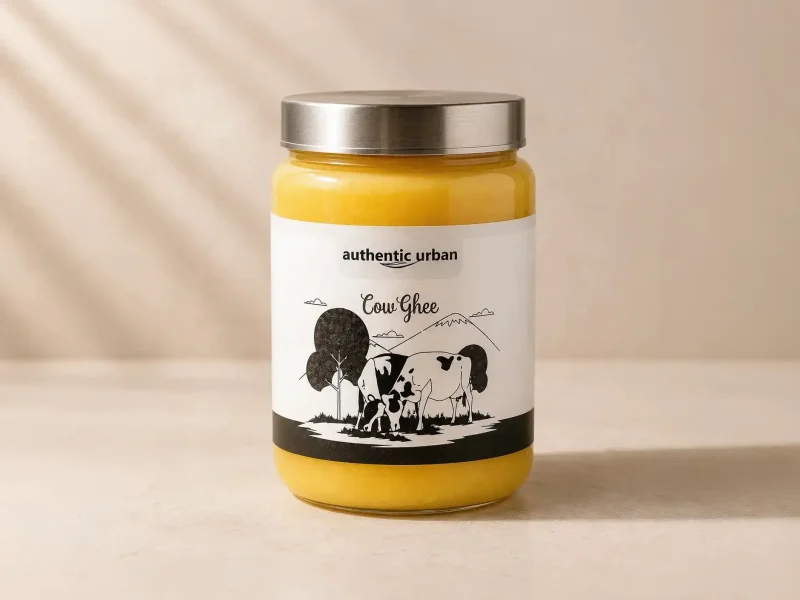 1 Litre
Winter sweets and parathas
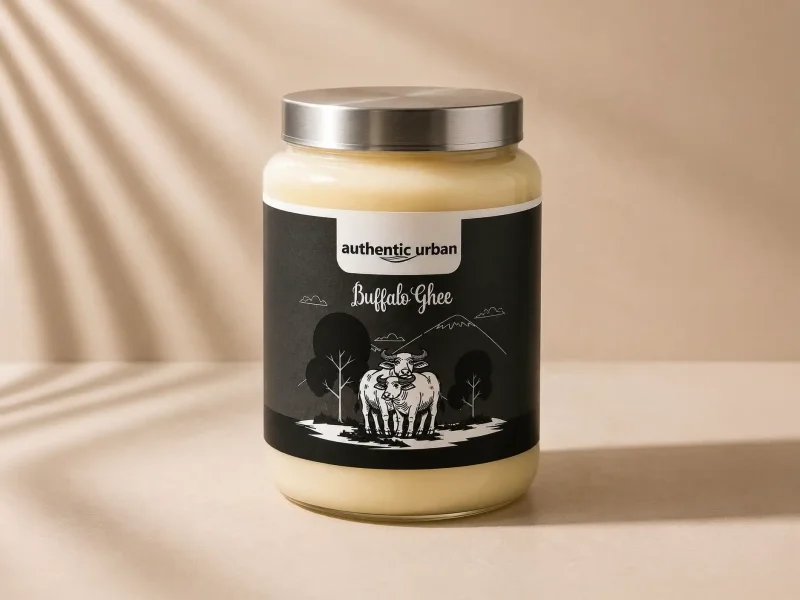 1 Litre
Each order is cooked after you place it, and the packing video is of that batch. Past order videos are on the shop.
FAQ
Is desi ghee the same as ghrita in Ayurveda?
Yes. Ghrita (ghrta) is the Sanskrit word for ghee: butter cooked until its water is gone. When a text says ghrita on its own, it means plain ghee, and cow ghee unless it names another animal. A name like Brahmi ghrita or Triphala ghrita is different. That is a medicine made by cooking herbs into ghee, and it is taken on a vaidya's advice, not spooned on dal.
Does ghee increase ojas?
The Charaka Samhita says ghee is good for ojas, the Ayurvedic idea of the body's essence and strength (Sutra Sthana 13, verse 14). Ojas has no modern test or blood marker, so no study can say whether ghee raises it. In practice, families read it as ghee helping a thin, tired, or recovering person eat well. That fits: a teaspoon adds about 45 kcal to a meal.
Can I take ghee with my Ayurvedic medicine?
Only if your vaidya says so. Ghee is a classic carrier (anupana) for some herbal powders, and the vaidya decides which medicine goes with ghee, which with honey or warm water, and how much. Do not add extra ghee on your own. If you also take prescription medicines, for diabetes, blood pressure, or blood thinning, tell your doctor about every Ayurvedic product you use.
Does Ayurveda say ghee improves memory?
Yes. Charaka lists people who want memory and intelligence among those who should take ghee (Sutra Sthana 13, verses 41 to 43), and Brahmi ghrita is a classic memory formula. That is tradition. No human trial shows that plain kitchen ghee improves memory. For a child's studies or an older parent's memory, regular meals, sleep, and a doctor's check matter far more than extra ghee.
Can children eat ghee according to Ayurveda?
The Charaka Samhita names children among those ghee suits. For children over one year, a teaspoon on dal, khichdi, or roti fits that tradition and a normal diet. The amount follows age and the family's total fat, not dosha. For babies under one, ask your paediatrician when to add fat and how much. Never give ghee drops in a baby's nose, eyes, or ears.
Is it Ayurvedic to cook everything in ghee?
No. The texts rank ghee as the best fat, but they also keep it away from people with excess Kapha, body fat, or weak digestion. ICMR-NIN's 2024 guidelines cap ghee or butter at 1 to 2 teaspoons a day. So cook most food in oil and use ghee where you taste it: on hot roti, on dal, in a final tadka, or in a festival sweet.
About the editorial team
Authentic Urban TeamBilona ghee makers, Gir Somnath, Gujarat
We are the Parmar family in Gir Somnath, Gujarat. We have made ghee here since 2016 and sold it online since 2025. We make only Bilona ghee, test it every month, and anyone is welcome to visit and watch it being made. Our Gir cows and Jafarabadi buffalo are grass-fed village animals that graze near the Gir forest, with no hormones or milk boosters. We set their milk to curd, churn it, and cook the makkhan on a wood chulha. These articles come from that kitchen and from what customers ask us on WhatsApp. We are ghee makers, not doctors.
Sources
- Charaka Samhita, Sutra Sthana 13 (Snehadhyaya), verses 13, 14-15, 18, 29-30, 41-43 and 53-56: the best fat, qualities of ghee, season, three dose sizes, who should and should not take ghee, English translation, Charaka Samhita Online. Checked 28 Sep 2026.
- Kataria D, Singh G. Health benefits of ghee: Review of Ayurveda and modern science perspectives. J Ayurveda Integr Med 2024;15(1):100819 (Table 1, qualities and dosha effects of ghee types; research focus on heart risk), PubMed Central. Checked 28 Sep 2026.
- Dietary Guidelines for Indians, 2024 (fats give 9 kcal a gram, printed p. 9; limit ghee or butter to 1 to 2 teaspoons a day, p. 54; teaspoon 5 g, p. 111), ICMR-National Institute of Nutrition. Checked 28 Sep 2026.