Ghee in Indian Weddings: How Much to Buy, Ritual by Ritual
Ghee in Indian weddings goes into the havan, the diyas, the prasad, and the sweets, so work it out by count, not by guest list. Each teaspoon ahuti takes about 5 g, each diya 5 to 10 g, and each sweet the grams in its recipe. In our worked two-day wedding, the rituals need about 1.7 kg and the sweets about 2.2 kg: roughly 4.4 litres in all.
How much ghee do you need for an Indian wedding?
Add up four counts: havan ahutis at about 5 g each, diya fillings at 5 to 10 g, aartis at 10 to 15 g, and the ghee in every sweet the family makes. A two-day Hindu wedding with two 108-ahuti havans, 51 diyas for two evenings, halwa prasad, and 200 ladoos comes to about 3.8 kg, or 4.4 litres.
Guest count moves this number less than you would think. A havan for 50 guests and a havan for 500 take the same ghee, because the priest offers the same ahutis. What grows with guests is the prasad and the sweets. So the ritual ghee comes from the priest's plan, and the kitchen ghee comes from the halwai's recipe. Ask both before you order anything.
The grams come from a household teaspoon, which ICMR-NIN's 2024 dietary guidelines count as 5 g. The spoon, the diya, and the ghee in a ladoo are worked out on our recipe pages and in the table below. For a single home puja or a griha pravesh havan, the smaller tables on ghee for puja and havan are all you need.
Where does ghee go in a Hindu wedding?
Ghee goes into the sacred fire, the lamps, the offerings, and the food. The exact list depends on your region, community, and priest, so treat this as the list to check against, not a rule.
- Ganesh puja and graha shanti. Many families hold a puja, often with a havan, a day or two before the wedding. In many Gujarati homes this comes with the mandap muhurat.
- The vivah havan. The couple take the pheras around Agni, the fire, which stands witness to the vows. The priest and the couple offer ghee into the fire as ahutis through the ceremony, and puffed rice (laja) in the laja homa.
- Diyas and aarti. Lamps at the mandap, the entrance, and the home, and a panch mukhi diya for each aarti.
- Tilak and the kalash. A few spoons, mixed into tilak paste or used at the puja plate.
- Prasad and bhog. Halwa or sheera offered after the havan, and panchamrit at the puja.
- The wedding sweets. Ladoos for the family boxes, mohanthal, halwa at the meal. This is usually the biggest line.
Sikh, South Indian, and Bengali weddings
Other traditions differ. A Sikh Anand Karaj has no fire; the ghee goes into the kada prasad served at the gurdwara. South Indian weddings hold a homam with ghee, and many Bengali weddings a yagna. Whatever your tradition, the counting method below works the same way.
How far does one litre of ghee go?
One litre of ghee weighs about 865 g, which covers about 170 teaspoon ahutis or 144 besan ladoos. Ghee is lighter than water: USDA FoodData Central lists a tablespoon of butter oil (ghee) at 12.8 g, which works out to about 865 g a litre. So a seller quoting "per kg" is selling about 1.16 litres, and a 5 L jar holds about 4.3 kg.
Use
Ghee each
One litre covers
One havan ahuti (a teaspoon)
5 g
about 170 ahutis
One small diya, one filling
5 to 10 g (1 to 2 tsp)
85 to 170 fillings
Panch mukhi aarti diya
10 to 15 g
58 to 86 aartis
Halwa prasad, one hand portion (kada prasad ratio)
6.4 g
about 135 portions
Besan ladoo, one piece
6 g
about 144 ladoos
Suji halwa (sheera), one full bowl
17 g
about 50 bowls
Teaspoon: ICMR-NIN 2024 (5 g). Litre weight: USDA FoodData Central (12.8 g a tablespoon). Sweets: our recipe pages, classic ghee level.
The sweet rows come from our own recipes. The halwa row uses the gurdwara ratio of equal cups of atta, ghee, and sugar, which puts 205 g of ghee into a batch of 32 hand portions. The ladoo row is the classic besan ladoo, 120 g of ghee for 20 ladoos, and the sheera row is a full bowl of suji ka halwa. Your halwai's recipe may use more or less; ask for the grams per batch and redo the row.
Two things the table leaves out. Many priests stir ghee into the samagri before offering it, and a wood fire needs some ghee to catch, so add a spare jar to the havan line. And deep-frying is a different sum: a kadhai of puris or boondi needs a pan full of fat, most of which is never eaten. For wedding-scale frying, the caterer's oil is the sensible fat; why ghee is costly to fry in is on ghee for deep frying.
What does a two-day wedding need, line by line?
Here is one worked example: about 1.7 kg for the rituals and 2.2 kg for the sweets, or about 4.4 litres in all. The counts are ones a family might get from its priest and halwai; swap in yours.
Line
Ghee
Day 1: Ganesh puja and graha shanti havan, 108 ahutis
540 g
Day 2: vivah havan around the pheras, 108 ahutis
540 g
51 diyas at the mandap and gate, two evenings
510 g
Four aartis with a panch mukhi diya
60 g
Tilak, kalash, and small uses
25 g
Rituals total
1,675 g (about 1.9 L)
Halwa prasad after the havan, 150 hand portions
960 g
Besan ladoos for the family boxes, 200 pieces
1,200 g
Sweets total
2,160 g (about 2.5 L)
Ahutis and diyas at 5 g, aarti at 15 g, halwa at 6.4 g a hand portion, ladoos at 6 g each. Total 3,835 g, about 4.4 L.
In jars, that is a 2 L jar for the rituals with a 250 ml jar kept sealed as the spare, and a 2 L plus a 500 ml jar for the sweets. Keeping the ritual ghee in its own jar means the havan never waits on the kitchen, and the kitchen never borrows from the havan.
The ahuti count is the number that swings most. Some priests offer far fewer than 108 in the vivah havan, some more, and a priest with a bigger sruva (the havan ladle) pours more than a teaspoon each time. One phone call with the priest settles it.
Which ghee for the wedding havan, and which for the kitchen?
Use food-grade cow ghee for the havan, the diyas, and the prasad, and whichever ghee your family cooks with for the sweets. Many priests and families ask for cow ghee (gau ghrita) at the fire. Whether buffalo ghee suits your havan is your priest's call; for sweets it is a kitchen choice, and the difference is on cow vs buffalo ghee.
Food-grade matters more at a wedding than at a daily puja, because the same jar ends up everywhere: the havan, the prasad the guests eat, the tilak on the couple's foreheads. Cheap "pooja ghee" or "diya ghee" packs often carry a black cross inside a square. FSSAI's labelling rules (regulation 5(15), compendium of 3 April 2025) require that mark on food material not meant for eating, and name "Ghee for diya" as an example. A pack with the cross can light a lamp and nothing else.
Buying several kilos at once is when a bad jar costs the most. The label should say ghee with an FSSAI licence number, not vanaspati or a blend, and it should smell of toasted milk when warmed. The full set of home checks is on how to identify pure ghee.
When should you order wedding ghee, and how do you store it?
Order three to four weeks before the first function, so there is time to open a jar, check it, and replace it if needed. Sealed ghee keeps 9 to 12 months at room temperature, so ordering early costs nothing in freshness.
Weather decides what the ghee looks like when it arrives. In summer our ghee stays liquid in the jar, and a jar that melted or leaked on the way is one complaint we hear in hot months; keep jars upright and the lids tight. In a cool room in winter it sets grainy, and customers ask us on WhatsApp whether that is normal. It is: winter milk is richer and the ghee sets in a fine grain. For the havan, stand the jar in a pan of warm water an hour before, so it pours clean from the spoon. Why ghee sets that way is on why ghee is grainy.
At the venue, give the ghee a shelf of its own, away from the cooking range and out of the sun. Open one jar at a time with a dry spoon. Water from a wet spoon is what makes ghee crackle in a diya and turn sour in the jar. What to do with the rest after the wedding, and how long an opened jar lasts, is on does ghee go bad.
Is a wedding havan safe in a banquet hall?
It can be, if the fire is kept small and the hall is aired. A havan is a wood fire with ghee and herbs on it, and its smoke is still smoke, whatever the posters say about purifying the air.
Ask the venue about its fire rules before you plan the havan: some halls allow only a small kund, some ask for it outdoors or on a terrace. Keep a bucket of sand nearby, open the doors and windows, keep diyas on brass plates away from marigold garlands, dupattas, and draped cloth, and seat elders with asthma or heart trouble back from the kund. What the air-purifying study actually tested is on does havan purify the air, and smoke as an asthma trigger is on is ghee smoke bad for asthma.
Is wedding food too much ghee for guests?
One full bowl of kada prasad holds about 26 g of ghee, which is two and a half to five times the daily limit of 1 to 2 teaspoons (5 to 10 g) in ICMR-NIN's 2024 guidelines. A hand portion of the same halwa holds about 6 g, inside the limit.
For a few days of celebration that is a food choice, not a worry, for most guests. It matters for elders with diabetes, heart disease, or high cholesterol who eat at every function for three days. Serve prasad as a hand portion rather than a bowl, keep a plain dal and roti on the menu, and let them skip seconds without comment. The everyday amount is on how much ghee per day.
A wedding ghee checklist
Screenshot this and send it to whoever is buying the puja samagri.
- Get the ahuti count, the spoon size, and the number of havans from your priest, in writing.
- Count diyas and evenings, and ask the decorator whether the diyas are real or electric.
- Ask the halwai how many grams of ghee go into each sweet, and whether frying is in ghee or oil.
- Buy food-grade ghee for everything. No pack with a black cross inside a square.
- Cow ghee for the havan and the altar diya, unless your priest or family custom says otherwise.
- One sealed jar per job, labelled: havan, diyas, prasad, kitchen. Plus one spare jar unopened.
- Warm set ghee in a pan of water before the havan, so it pours from the spoon.
- Name one person to carry the havan jar and a dry spoon, and keep it away from the kund.
If a jar that arrives smells off or crackles in a test diya, you can check your jar in 2 minutes while there is still time to replace it.
Which ghee to order for a wedding?
For a wedding, buy food ghee in jars sized to each job: cow ghee that smells of toasted milk when warmed and sets grainy when cool, with nothing added. Slow curd-churned ghee (Bilona) is the old household way; how it differs from cream ghee is on the Bilona method, and our ranking of the cow ghee on sale is best cow ghee in India.
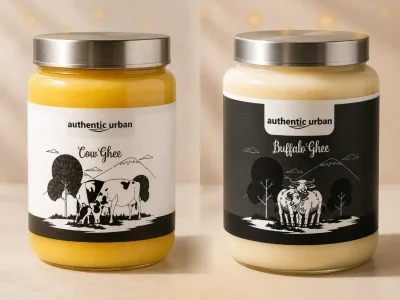
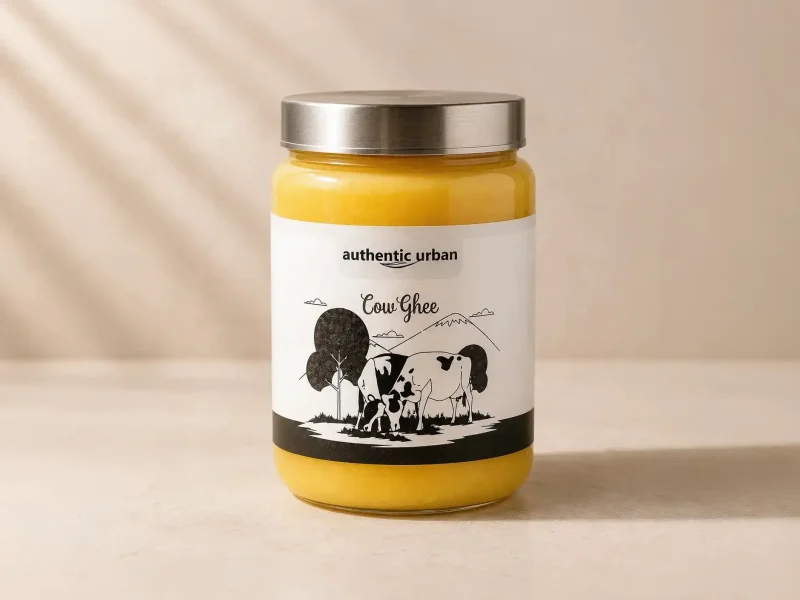
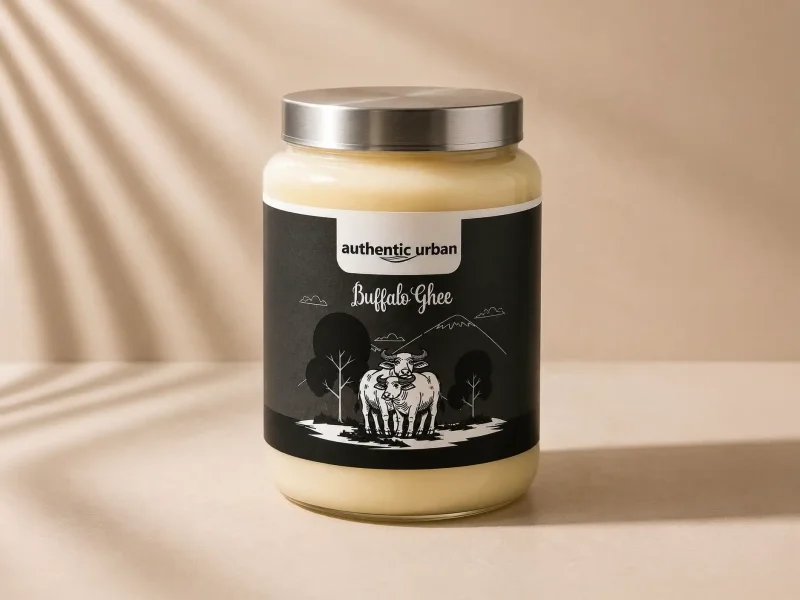
We make and sell ghee in Gir Somnath, Gujarat, so weigh this with that in mind. For the havan, the diyas, and the prasad we would use our own A2 Gir cow ghee: milk from grass-fed Gir cows, set to curd overnight, churned, and cooked in a matki on a wood chulha. For the wedding sweets, our Jafarabadi buffalo ghee is the richer jar. Jars come in 250 ml, 500 ml, 1 L, 2 L, and 5 L, so the worked example above is four jars. Each jar is cooked after you order, and a video of your jar being cooked and packed comes on WhatsApp, so order early. We test every month against the FSSAI limits, and anyone is welcome to visit and watch; the steps are on how we make ghee.
Havan, diyas, tilak, and prasad
 1 Litre
Wedding sweets, halwa, and ladoos
 1 Litre
Each order is cooked after you place it, and the packing video is of that batch. Past order videos are on the shop.
FAQ
Does the pandit bring ghee in the samagri kit?
Some do, and many kits hold only a small pack, enough for a short puja, not a wedding havan. Ask the pandit what the kit contains and how much ghee it has, then buy the rest yourself. Read the label on any kit pack: if it carries a black cross inside a square, FSSAI rules mark it as not for eating, so keep it away from prasad and tilak.
Can we give ghee jars as wedding return gifts?
Yes, and small 250 ml jars travel best. Order them with the rest, keep them sealed, and hand them out upright in a box, because in summer the ghee turns liquid and a loose lid will leak. A sealed jar keeps 9 to 12 months at room temperature, so guests can open it well after the wedding. Add a card saying it is ghee to eat, not puja ghee.
Can buffalo ghee be used in the wedding havan?
Many priests and families ask for cow ghee (gau ghrita) for the fire and the altar diya, so ask your priest before you buy. Buffalo ghee is fine for the sweets and the kitchen, where it gives a richer, firmer set. If your family already makes wedding halwa and ladoos with buffalo ghee, keep doing that, and buy a separate cow ghee jar only for the havan and the diyas.
What do we do with ghee left over after the wedding?
Sealed jars go straight back to the kitchen and keep 9 to 12 months. An opened jar that was handled with dry spoons is still food; move it to the kitchen and use it within a few months. Ghee that sat in the sruva bowl beside the fire, or in a lit diya, has been heated for hours and holds ash and soot, so let it burn in lamps and do not eat it.
Is a big tin cheaper than jars for a wedding?
A tin can cost less per kilo, but a wedding opens it on day one and handles it with many spoons for three days, and whatever is left comes home as one opened tin. Several sealed jars cost a little more and keep the leftover sealed. For the havan and prasad, which need food-grade ghee you trust, jars sized to each job waste less.
How do we check bulk ghee is pure before the wedding?
Open one jar as soon as it arrives. Warm a spoon of it: it should smell of toasted milk, not sour, soapy, or waxy. Check the label says ghee with an FSSAI licence number, not vanaspati or a blend. Grainy texture and a colour different from your last jar are both normal. Light one diya with it; ghee that crackles holds water. Any doubt, you still have time to replace it.
About the editorial team
Authentic Urban TeamBilona ghee makers, Gir Somnath, Gujarat
We are the Parmar family in Gir Somnath, Gujarat. We have made ghee here since 2016 and sold it online since 2025. We make only Bilona ghee, test it every month, and anyone is welcome to visit and watch it being made. Our Gir cows and Jafarabadi buffalo are grass-fed village animals that graze near the Gir forest, with no hormones or milk boosters. We set their milk to curd, churn it, and cook the makkhan on a wood chulha. These articles come from that kitchen and from what customers ask us on WhatsApp. We are ghee makers, not doctors.
Sources
- Dietary Guidelines for Indians, 2024 (Annexure I household measures: a teaspoon is 5 g; guideline on limiting ghee or butter to 1 to 2 teaspoons a day), ICMR-National Institute of Nutrition. Checked 29 Sep 2026.
- FoodData Central, SR Legacy 173412: Butter oil, anhydrous (portion weights: 1 tbsp 12.8 g, 1 cup 205 g), USDA Agricultural Research Service. Checked 29 Sep 2026.
- Food Safety and Standards (Labelling and Display) Regulations, compendium Version VII (03.04.2025), regulation 5(15), p. 19: "Ghee for diya" not meant for human consumption carries a black cross in a square, FSSAI. Checked 29 Sep 2026.