Ghee for Dandruff: When It Helps and How to Apply It
Ghee for dandruff helps one kind of flake: the fine, white, dusty kind from a dry, tight scalp. One or two teaspoons of warm ghee, massaged into the scalp for a few minutes and washed out within an hour, once or twice a week, can ease that dryness and itch. For oily, yellow flakes it is the wrong fix: that dandruff is driven by a yeast that feeds on fat, and a dandruff shampoo works better.
Does ghee help dandruff?
Ghee helps a dry scalp, not true dandruff. If your flakes are small and white and your scalp feels tight after washing, a little warm ghee before a wash can soften the skin and ease the itch. If the flakes are oily and yellowish, with redness at the hairline or behind the ears, ghee can make it worse, and a dandruff shampoo is the fix.
Most pages that recommend ghee for dandruff call it "antifungal" and promise flakes gone in two weeks. None of them cites a study, and we could not find a single trial of ghee on a scalp. What does exist is clear advice from the NHS and the American Academy of Dermatology (AAD) on dandruff, and good lab work on the yeast behind it. We use those below, so you can tell which kind of flake you have before you reach for the jar.
This page is about flakes and itch. Hair fall is on ghee for hair, and a full champi massage with hair mask recipes is on ghee hair mask and champi.
Is it dry scalp or dandruff?
Look at the flakes: fine, white, and dry points to a dry scalp; bigger, oily, and yellowish points to dandruff. The AAD lists ten common reasons a scalp itches, and several look alike at first. Find your row before you oil anything.
What it is
What you notice
Where ghee fits
What does more
Dry scalp
Small, fine white flakes, a tight scalp after washing, worse in winter or after a harsh shampoo
Good fit. A little warm ghee before washing softens the skin and the flakes.
A milder shampoo, lukewarm water, less frequent hot oil and hair dryer
Dandruff (yeast)
Larger, oily, yellowish flakes; itch; redness at the hairline, eyebrows, or behind the ears
Poor fit. Extra fat on the scalp can feed the yeast behind it.
A dandruff shampoo for at least 4 weeks
Reaction to a hair product
An itchy rash on the scalp and wherever the product touched, often after a new dye
No fit. Ghee does not settle an allergy.
Stop the product. See a doctor if the rash is strong.
Scalp psoriasis
Thick, raised, silvery scales, often past the hairline, sometimes on elbows or knees too
Can soften scale before a wash; does not treat the cause.
A dermatologist and the treatment they prescribe
Lice or ringworm
Itch with tiny eggs on hair near the root, or round scaly patches with broken hair
No fit.
Lice treatment, or a doctor for ringworm
Causes from the AAD's scalp itch page and the NHS dandruff page, checked 28 September 2026.
Plenty of people have both: a scalp that dries out in winter and a touch of dandruff that flares at the same time. The NHS says cold weather and stress can make dandruff worse, which is why winter often brings more flakes. If you cannot tell, treat it as dandruff first. A shampoo for 4 weeks does no harm to a dry scalp, while oil on true dandruff can set you back. Psoriasis on the scalp is its own condition, covered on ghee for psoriasis, and eczema elsewhere on the body on ghee for eczema.
Can oiling make dandruff worse?
It can, for true dandruff. The yeast behind dandruff, Malassezia, lives on fat, and ghee is almost pure fat. Oiling the scalp for a dry-skin problem makes sense. Oiling it for a yeast problem feeds the yeast.
Two papers explain why. When scientists read the genome of Malassezia globosa, one of the dandruff yeasts, they found it has no gene to make its own fatty acids, so it depends on fats from the skin, and it carries many enzymes (lipases) to break those fats down (Xu and colleagues, PNAS, 2007). An earlier study (DeAngelis and colleagues, Journal of Investigative Dermatology Symposium Proceedings, 2005) showed that dandruff is driven by what the yeast leaves behind: it splits the triglycerides in scalp oil and frees fatty acids, oleic acid among them, that irritate the scalp and cause flaking in people who are sensitive to them.
Ghee is triglycerides too. Nobody has tested ghee on a dandruff scalp, so we cannot say how much it feeds the yeast. But the reasoning is plain enough to act on: if your flakes are oily and yellow, do not add more fat. The 2005 paper also notes that zinc pyrithione, a common dandruff shampoo ingredient, kills the yeast, and fewer yeast means fewer of those fatty acids, less flaking, and less itch. It is also why the old habit of leaving hair oil in for two or three days between washes can make dandruff worse, not better.
How to apply ghee on the scalp for a dry, itchy scalp
Warm 1 to 2 teaspoons, massage it into the skin through partings for 3 to 5 minutes, leave it 30 to 60 minutes, and wash it out. Once or twice a week, on wash days only.
1. Patch test
Rub a few drops of ghee behind one ear and leave it overnight. Skip ghee if it itches, reddens, or spots.
2. Warm, not hot
Take 1 to 2 teaspoons into a small steel bowl and stand it in warm water until it melts. Test a drop on your wrist.
3. Part the hair
Make 6 to 8 partings with a comb, so the ghee reaches the skin, not only the hair.
4. Fingertips on the scalp
Dab it along each parting and massage with the pads of your fingers for 3 to 5 minutes. No nails: scratching makes a dry scalp worse.
5. Leave 30 to 60 minutes
Before a wash, not instead of one. Overnight is not needed and leaves more fat on the skin.
6. Wash it out
Shampoo on dry hair first, work it in, then add water and rinse. A second wash if the scalp still feels coated.
7. Once or twice a week
Only on wash days. Stop after 2 weeks if the flakes are no better, or at once if they turn greasier or the itch grows.
Warm it in a bowl over warm water, never in a pan on the flame. At our kettle, ghee is only ready once all the water in the makkhan has boiled off, so hot ghee runs far hotter than boiling water. A splash burns worse than a splash of dal, and a scalp has no time to pull away.
The scalp needs less than you think. One to two teaspoons covers the skin of most heads; the lengths do not need any for this job. If your hair is long and dry as well, that is a hair mask, and the recipes and timings for it are on ghee hair mask and champi. Whether rubbing ghee in does anything for hair growth is checked on does applying ghee help hair.
What the ghee should be like
Use ghee you would eat, from a clean jar. At our kettle in Gir Somnath, a batch taken off the flame too early stays cloudy, keeps water, and spoils fast, and one cooked too long turns dark and smells burnt. Neither goes in a jar. Warm a little on the back of your hand: good ghee melts clear and smells of toasted milk. Sour or soapy ghee has gone off; how that happens is on does ghee go bad.
Dry-scalp season is also the season our ghee sets in fine grains, because winter milk is richer. Grain is not a fault, as why ghee is grainy explains; it just needs a minute longer in warm water. Take what you need into the bowl with a dry spoon, so oily fingers never go back into the kitchen jar.
What can you mix with ghee for dandruff?
Start with plain ghee, so you know what your scalp is reacting to if it does. Most home mixes add a risk and no proven benefit.
Mix
Verdict
Why
Plain ghee
Start here
One ingredient, so if the scalp reacts you know the cause.
Ghee with aloe vera gel
Fine for a dry, itchy scalp
Lighter and easier to wash out. Patch test the aloe too.
Ghee with coconut oil
Fine
Thinner and spreads further; still fat, so same caution for greasy flakes.
Ghee with curd
Messy, no benefit shown
Sours fast on a warm scalp and is hard to rinse out of thick hair.
Ghee with lemon juice
Skip
Stings on a scratched or cracked scalp, and leaves the skin drier.
Ghee with tea tree or neem oil
Only with care
Strong oils can irritate. A drop or two at most, patch test first, never on children.
Lemon comes up in almost every ghee and dandruff recipe online. We found no test showing it kills the dandruff yeast, and acid on a scalp you have been scratching stings and dries it further. Tea tree and neem oils are strong enough to cause a rash on their own; if you use them at all, a drop or two in the ghee is plenty. How ghee and coconut oil compare as fats is on ghee vs coconut oil.
Which dandruff shampoo works, and can you use ghee with it?
A shampoo with ketoconazole, zinc pyrithione, selenium sulfide, salicylic acid, or coal tar is the tested treatment for dandruff. You can still use ghee on a dry scalp on other wash days, as long as the flakes are not the oily kind.
How long. The NHS says to use an anti-dandruff shampoo for up to 4 weeks to see if it works, and to try another type if it does not.
How to use it. The AAD says to lather it on the scalp, not just the hair, and that some need 5 to 10 minutes on the scalp before rinsing. If one shampoo stops working, alternate it with one that has a different active ingredient.
How often. For fine, straight, or oily hair, the AAD suggests a dandruff shampoo twice a week, with ordinary washes in between. For coarse, curly, or coily hair, about once a week if the scalp tolerates it. Coal tar shampoos can make the scalp more sensitive to the sun, so cover your head outdoors.
With ghee. Keep them on different days. A ghee pre-wash right before a medicated shampoo coats the scalp and gets in the shampoo's way. A simple week for someone with both a dry scalp and mild dandruff: dandruff shampoo on Monday and Thursday, and on a third wash day, ghee for 30 minutes before a mild shampoo. If the flakes get oilier, drop the ghee. We are ghee makers, not doctors, and a pharmacist can help you choose between the shampoos.
When should you see a doctor for dandruff?
See a doctor if the flakes are still there after 4 weeks of an anti-dandruff shampoo, or sooner for a red, swollen scalp or patches beyond it. The NHS says dandruff is not harmful and you cannot catch it, but these signs can mean a different condition.
Sign
What to do
Still flaking after 4 weeks of an anti-dandruff shampoo
See a doctor. The NHS gives this as the point to get checked.
Scalp red or swollen, or the dandruff is bad
See a doctor.
Flaky, itchy patches on the face, ears, chest, or elsewhere
See a doctor. This can be seborrhoeic dermatitis, eczema, or psoriasis.
Thick silvery scales, bleeding, pus, or hair falling out in patches
Stop all oils, ghee included, and see a dermatologist.
Itchy rash after a new dye or shampoo
Stop the product, as the AAD advises, and see a doctor if the rash spreads or swells.
Stop the ghee at once if the itch grows, the scalp turns red, or small bumps appear along the hairline; fat left on the forehead can bring out pimples there, as does ghee cause acne explains. For a baby with thick yellow crusts on the head (cradle cap), follow the oil advice on ghee for baby massage and ask your paediatrician.
A 4-week dry scalp and dandruff checklist
Four weeks is the NHS test period for a dandruff shampoo, so judge ghee over the same stretch. Screenshot the list if it helps.
- Look at your flakes in daylight: fine and white, or oily and yellow?
- Dry and white: patch test ghee behind one ear first.
- Warm 1 to 2 teaspoons, part the hair, fingertips on the skin, 3 to 5 minutes.
- Wash out within an hour, shampoo on dry hair first.
- Once or twice a week, on wash days only.
- Oily and yellow: skip the ghee and use a dandruff shampoo twice a week for 4 weeks.
- Leave the shampoo on the scalp 5 to 10 minutes before rinsing.
- Stop ghee at once if flakes turn greasier or the itch grows.
- Still flaking at week 4: see a doctor.
Which ghee for the scalp and the plate?
For a scalp, freshness matters more than the label: plain ghee with nothing added, that melts clear and smells of toasted milk. Five ways to check a jar at home are on how to identify pure ghee.
We make and sell ghee, so weigh this with that in mind. For the small bowl on wash day and the teaspoon on dal, we would pick our own A2 Gir cow ghee: milk from grass-fed Gir cows, set to curd overnight, churned, and cooked in a matki on a wood chulha, made after you order, with a video of your jar sent on WhatsApp. It is softer than buffalo ghee and washes out more easily. Our Jafarabadi buffalo ghee is the richer jar for paratha and sweets. We test every month against the FSSAI limits; the steps are on how we make ghee. Our ranking of the cow ghee on sale is on best cow ghee in India.
The dry scalp and the daily teaspoon
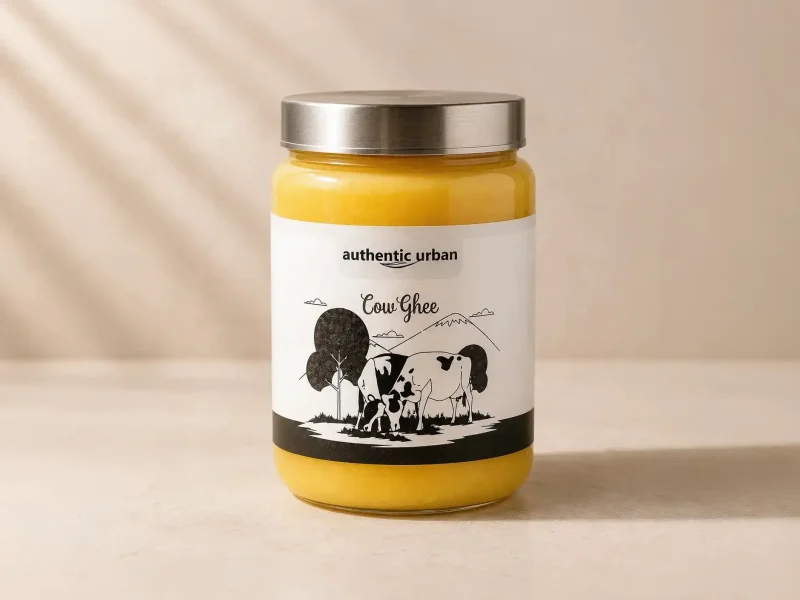 1 Litre
Paratha and halwa
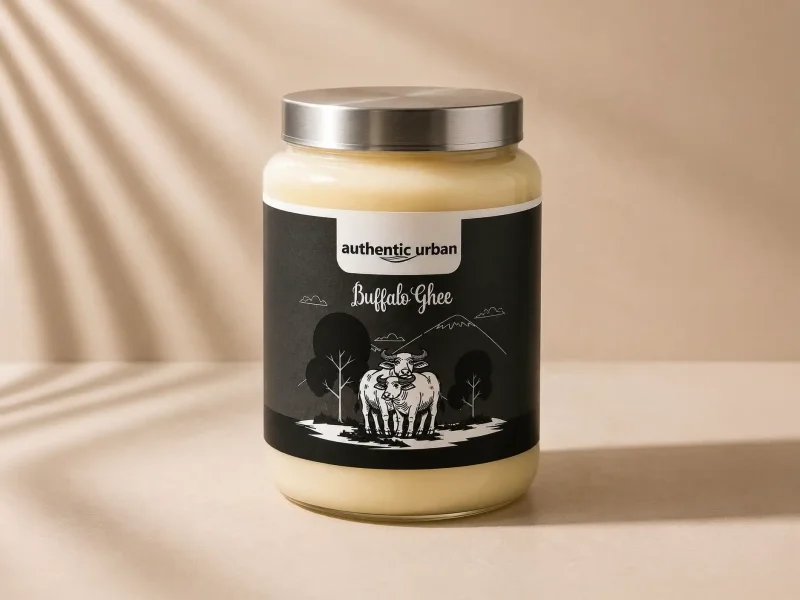 1 Litre
Each order is cooked after you place it, and the packing video is of that batch. Past order videos are on the shop.
FAQ
Can I leave ghee on my scalp overnight for dandruff?
You can, but it does not add much for a dry scalp and adds risk for dandruff. After an hour the skin has taken what it will, and the rest sits on the scalp and the pillow. If the flakes are the oily, yellow kind, a night of fat gives the yeast more to feed on. Keep it to 30 to 60 minutes before a wash, and save overnight for a very dry winter scalp.
Is ghee or coconut oil better for a dry scalp?
Neither has a trial on adult dandruff, so pick by feel. Coconut oil is lighter, spreads further, and washes out more easily. Ghee is richer and suits a very dry, tight scalp in winter. The NHS names coconut oil, or a moisturiser, for loosening a baby's cradle cap, and says not to use olive oil there. For greasy flakes, the answer is neither: use a dandruff shampoo.
Does eating ghee cause or cure dandruff?
Neither, as far as any study shows. Dandruff comes from a yeast that lives on everyone's scalp, the oil your own scalp makes, and how sensitive your skin is to them. The NHS says stress and cold weather can make it worse. A teaspoon or two of ghee on dal does not change that. Eating more ghee to fix a flaky scalp only adds calories.
Is dandruff caused by dirty hair, and can it spread?
No to both. The NHS says dandruff is not caused by poor hygiene, is not harmful, and you cannot catch it. Washing does help, because it clears the flakes and the scalp oil the yeast lives on. That is why people with dandruff often do better washing more often, not less, and why leaving oil on for days between washes can make it worse.
Can I put ghee on my child's itchy scalp?
First check for lice: an itchy scalp in a school child is often lice, and oil will not treat it. Look for tiny eggs stuck to hairs near the root. If the scalp is only dry, a few drops of warm ghee before a wash is fine after a patch test. Leave out lemon and essential oils. For a baby with cradle cap, the NHS suggests coconut oil or a moisturiser.
My scalp started itching after hair dye. Will ghee help?
Probably not. An itchy rash after dye is often a reaction to the dye, and the AAD names PPD, found in dark hair dyes, as a common cause. The AAD says you must stop using the product causing the reaction, and oil does not stop an allergy. Stop the dye and see a doctor if the rash spreads, blisters, or swells. Do a patch test before any new dye.
About the editorial team
Authentic Urban TeamBilona ghee makers, Gir Somnath, Gujarat
We are the Parmar family in Gir Somnath, Gujarat. We have made ghee here since 2016 and sold it online since 2025. We make only Bilona ghee, test it every month, and anyone is welcome to visit and watch it being made. Our Gir cows and Jafarabadi buffalo are grass-fed village animals that graze near the Gir forest, with no hormones or milk boosters. We set their milk to curd, churn it, and cook the makkhan on a wood chulha. These articles come from that kitchen and from what customers ask us on WhatsApp. We are ghee makers, not doctors.
Sources
- Dandruff, NHS. Checked 28 Sep 2026.
- How to treat dandruff, American Academy of Dermatology. Checked 28 Sep 2026.
- 10 reasons your scalp itches and how to get relief, American Academy of Dermatology. Checked 28 Sep 2026.
- Dandruff-associated Malassezia genomes reveal convergent and divergent virulence traits shared with plant and human fungal pathogens (Xu et al., PNAS, 2007), Europe PMC. Checked 28 Sep 2026.
- Three etiologic facets of dandruff and seborrheic dermatitis: Malassezia fungi, sebaceous lipids, and individual sensitivity (DeAngelis et al., J Investig Dermatol Symp Proc, 2005), Europe PMC. Checked 28 Sep 2026.
- Cradle cap, NHS. Checked 28 Sep 2026.