Ghee Hair Mask at Home: 6 Recipes and Champi Steps
A ghee hair mask is 1 teaspoon to 3 tablespoons of warm ghee, depending on hair length, massaged into the scalp for 5 to 10 minutes (the champi), smoothed down to the ends, left for 1 to 2 hours, and washed out with shampoo put on before any water. Once a week softens dry, rough hair and cuts breakage. It will not make hair grow faster.
How do you make a ghee hair mask?
Warm the ghee in a bowl over hot water until it is clear and skin-warm. Part dry hair and trace each parting with it. Massage the scalp with your fingertips for 5 to 10 minutes. Smooth the rest onto the ends, cover, wait 1 to 2 hours, and shampoo twice. Plain ghee is the whole recipe; the add-ins below change the feel, not the method.
This page is the how-to: amounts, the massage, six mixes, and getting it out again. It suits dry, rough, frizzy, or curly hair best. Fine hair and oily scalps can use it too, with less on the roots. Whether ghee can stop hair fall is a different question, answered cause by cause on ghee for hair. For flakes and itch, read ghee for dandruff first, because oiling the wrong kind of dandruff makes it worse.
How much ghee do you need for a hair mask?
Far less than most people pour: one tablespoon covers chin-to-shoulder hair, and only waist-length or very thick hair needs three. The scalp itself never needs more than a tablespoon. Most greasy, won't-wash-out masks are simply too much ghee.
Hair length
Scalp
Total
Note
Short (above the ears) or a crop
Scalp: 1 tsp
Total: 1 to 2 tsp
Scalp only. The hair is too short to need a coat.
Chin to shoulder length
Scalp: 2 tsp
Total: 1 tbsp (3 tsp)
The usual first mask. Start here if unsure.
Shoulder to mid-back
Scalp: 2 tsp
Total: 2 tbsp
Most of the extra goes on the last 10 cm, the driest part.
Waist length, or very thick or curly
Scalp: 1 tbsp
Total: 3 tbsp
Warm it in two batches so the second half does not set in the bowl.
1 tbsp = 3 tsp, about 15 ml. Start at the low end; you can add more next week, but you cannot take it out.
Season changes how the ghee behaves in the bowl. In winter the milk is richer and our ghee sets in fine grains; in summer it stays liquid in the jar. So a winter mask needs a few extra minutes in the warm water, and it thickens again on the fingers as you work. That grain is normal, as why ghee is grainy explains, and it melts out completely.
How do you do a champi with ghee, step by step?
A champi is the scalp massage itself: fingertips pressing and moving the skin, not oil poured on top. The word is old. English took "shampoo" from the Hindi champo, "press, knead", in 1762, when it meant a massage; it came to mean washing hair only by 1860, according to the Online Etymology Dictionary.
1. Warm the ghee
Spoon it into a small steel bowl with a dry spoon and stand the bowl in a larger bowl of hot tap water for 3 to 5 minutes. It should be clear and only skin-warm. Check a drop on the inside of your wrist.
2. Start with dry hair
Comb out knots first. Ghee spreads over dry hair; on wet hair it sits in beads on top of the water.
3. Part and apply to the scalp
Part down the middle, then every 2 to 3 cm from the hairline to the nape. Dip two fingertips and trace each parting in a thin line. Do the temples, behind the ears, and the nape, which people miss.
4. The champi: 5 to 10 minutes
Pads of the fingers, never nails. Press and move the skin in small circles instead of sliding over it, working from the front to the crown to the nape. Then spread the fingers and lift the scalp gently toward the crown. Finish with light tapping all over.
5. Coat the lengths
Rub what is left between your palms and smooth it down the hair, most of it on the ends. Oily roots? Stop the coat 5 cm from the scalp.
6. Cover and wait
Twist the hair into a loose bun and put on a shower cap or an old cotton dupatta. Leave it 30 minutes to 2 hours (see the recipe table for mixes).
7. Wash it out
Shampoo first, water second. The full method is below.
Warming ghee safely
Never warm it in a pan on the flame. At our kettle in Gir Somnath, ghee is ready only once every drop of water in the makkhan has boiled away, which means hot ghee runs far hotter than boiling water. A splash of it burns worse than a splash of dal, and a scalp has no time to pull back. A bowl standing in hot tap water cannot overheat. If you use a microwave, 10 seconds at a time, stir, and check on your wrist.
Smell it while it warms. Good ghee smells of toasted milk. Sour, soapy, or stale ghee has gone off, and that smell stays in hair through two washes. How ghee goes off is on does ghee go bad. Spoon what you need into the bowl with a dry spoon, so oily fingers never go back into the kitchen jar.
How hard should the massage be?
Firm enough that the skin moves under your fingers, never so hard that it hurts or hair comes away in your hand. Scrubbing with nails pulls out hairs that were already loose, and it looks like hair fall. The one small study on scalp massage, published in Eplasty in 2016, used 4 minutes a day with a device, not fingers and not oil, so 5 to 10 minutes is plenty. The whole-body version of this massage is abhyanga with ghee.
Which ghee hair mask recipes are worth trying?
Six mixes cover almost every home recipe: plain ghee, and ghee with coconut oil, curd, egg, amla, or aloe. Do two plain masks first, so you know how your hair takes ghee and washes clean, before adding anything. Then change one thing at a time.
Mask
Mix (medium length)
Good for
Leave on
Watch for
Plain ghee
1 to 3 tbsp warm ghee, by length
Good for: Dry, rough ends; the first two masks
Leave on: 1 to 2 hours
The simplest wash-out. Start here so you learn how your hair takes ghee.
Ghee and coconut oil
1 tbsp ghee + 1 tbsp coconut oil
Good for: Hair that frays and breaks when combed
Leave on: 1 to 2 hours
Coconut oil is the oil with the hair-protein study behind it (below). Melts at room heat in summer, sets in winter.
Ghee and curd
1 tbsp ghee + 3 tbsp plain curd, at room temperature
Good for: Frizz, and a thicker paste that stays on the ends
Leave on: 30 to 45 minutes
Cold curd sets the ghee into lumps. Rinse well: sour curd left in hair smells.
Ghee and egg
1 tbsp ghee + 1 whole egg, whisked
Good for: Dull, limp hair
Leave on: 20 to 30 minutes
Rinse with cool water first; hot water cooks the egg into bits in the hair. Wash the bowl and your hands with soap.
Ghee and amla powder
1 tbsp ghee + 1 tbsp amla powder + warm water to a paste
Good for: Scalp-first masks, often used before a head bath
Leave on: 30 to 45 minutes
Gritty. Takes a second shampoo and a good rinse. Can dry the ends: keep it on the scalp.
Ghee and aloe vera gel
1 tbsp ghee + 2 tbsp clear aloe gel
Good for: A tight, dry scalp in summer
Leave on: 30 minutes
Use only the clear gel from the leaf, not the yellow sap near the skin. Patch test it; aloe itself can irritate.
Mix everything warm or at room temperature. Ghee sets the moment it meets cold curd, aloe straight from the fridge, or a cold egg, and you end up with waxy lumps in the hair. Leave out lemon juice, raw onion, and undiluted essential oils; they are the usual cause of a stinging scalp after a home mask. For grey hair, the curry leaf ghee oil and its patch test are on ghee for premature greying.
How long should you leave ghee in your hair? Can it stay overnight?
One to two hours is enough for plain ghee; mixes with curd, egg, amla, or aloe come out after 20 to 45 minutes. Longer does not soak in further. The coat is on the hair within minutes, and extra hours mostly give it time to rub off on the pillow.
Overnight is fine for plain ghee on dry, thick, or curly hair if you can wash it properly in the morning. Put on a shower cap or tie an old cotton cloth over it and cover the pillow. Skip overnight masks if your scalp is oily, if you get forehead pimples, or if you have fine hair that goes flat. Never leave curd, egg, or aloe on overnight: they sour and smell.
Once a week is the rhythm for most hair. Very dry or curly hair can take two a week for a month. Daily masks do nothing extra except build up on the scalp.
How do you wash ghee out of your hair?
Put shampoo on the oiled scalp before any water. Ghee is fat, and water just slides over it; shampoo worked into dry, oily hair grips the fat first, and then water carries both away.
- Rub a coin-sized amount of mild shampoo between your palms and work it into the scalp, section by section, with no water yet. Add a few drops of water only once it starts to lather.
- Rinse with lukewarm water, not hot. For an egg mask, rinse with cool water first, then shampoo.
- Shampoo a second time, lightly. The American Academy of Dermatology (AAD) advises putting shampoo on the scalp, not the lengths, and letting it run through the rest as you rinse. That is enough for the ends.
- Condition the ends, or the full length if your hair is dry or curly, as the AAD suggests. After a ghee mask, fine hair may not need it.
- Wrap your hair in a towel to soak up water instead of rubbing, and let it air dry. The AAD lists rubbing wet hair and heat tools among the habits that damage hair.
If the roots still feel heavy the next day, you used too much ghee or only one wash. Use half next time. Do not blow-dry, straighten, or curl hair that still has ghee in it; hot fat on a hot iron can scorch hair.
Ghee or coconut oil for a hair mask?
Coconut oil has the better evidence; ghee has none of its own. In a 2003 study in the Journal of Cosmetic Science, coconut oil was the only one of three oils (with sunflower and mineral oil) that cut the protein hair loses when washed and combed, on both damaged and undamaged hair. The authors put it down to lauric acid, a small fat that can get inside the hair shaft.
Ghee was not tested, and it has far less lauric acid than coconut oil (the numbers are on does applying ghee help hair). So treat ghee as a coat, like a rich conditioner: it smooths the surface, cuts friction when you comb, and keeps dry ends from snapping. That is why the half-and-half mix in the recipe table is a fair choice for hair that breaks. Coconut oil also washes out a little more easily on fine hair; ghee feels richer on thick, dry hair.
What can a ghee hair mask do, and what can it not?
It can make dry hair feel softer and tangle less, and it can make a tight, dry scalp more comfortable. It cannot grow new hair, stop hair fall from the root, turn grey hair black, or treat an infection.
Many pages on ghee for hair promise thicker hair in weeks. We could not find a single trial of ghee on human hair. The nearest thing, the 2016 Eplasty massage study, gave nine healthy men 4 minutes of scalp massage a day with a device for 24 weeks. Their strands got slightly thicker, from 0.085 mm to 0.092 mm. It had no comparison group and no oil. It hints that rubbing the scalp does something; it says nothing about ghee.
If hair is coming out in clumps, thinning at the parting, or falling after an illness, delivery, or crash diet, a mask will not reach the cause. The causes and when to see a doctor are on when to see a doctor for hair fall.
Who should skip a ghee hair mask?
Skip it on a scalp that is broken, weeping, or infected, and patch test first if you have never put ghee or the add-in on your skin.
- Patch test first. The AAD's method: a coin-sized spot inside the elbow or under the arm, twice a day for 7 to 10 days. Redness, itching, or swelling means wash it off and do not use it. At the very least, test a new mix for a full day before a first mask.
- Oily, yellow flakes or red patches at the hairline. That can be seborrhoeic dermatitis or psoriasis, and oil can make it worse. See a dermatologist.
- Sores, cuts, boils, or a scalp that hurts to touch. Leave it alone and get it checked.
- Forehead or back pimples after oiling. Keep the ghee off the hairline, wash it out the same day, or stop. Why this happens is on can ghee in your hair cause forehead pimples.
- A known milk allergy. Ghee is nearly all fat, but traces of milk protein can remain. Ask your doctor before using it on skin.
- Babies and small children. Their scalp is not an adult scalp. Cradle cap and a child's itchy scalp are covered on the dandruff page; keep masks for adults.
A ghee hair mask checklist for wash day
Ten lines to screenshot and keep by the mirror.
- Patch test the mix on the inside of your elbow first, twice a day for 7 to 10 days, or at least for one full day before a first mask.
- Measure by length: 1 tsp for short hair, up to 3 tbsp for waist-length or thick hair.
- Warm the ghee in a bowl over hot water, never in a pan on the flame. Wrist check before it touches your head.
- Start on dry, combed hair. Part every 2 to 3 cm.
- Champi 5 to 10 minutes with the pads of your fingers. No nails, no tugging.
- Most of the coat goes on the ends. Oily roots stay light.
- Leave plain ghee 1 to 2 hours; curd, egg, amla, or aloe mixes 20 to 45 minutes.
- Shampoo onto the oiled scalp before any water, then rinse, then a second, gentler wash.
- Pat dry with a towel, no rubbing, and no blow-dryer or straightener on hair with ghee still in it.
- Once a week is plenty. Stop for itching, redness, bumps, or forehead pimples.
Which ghee for a hair mask and the plate?
For hair, freshness matters more than any label: plain ghee with nothing added, that melts clear and smells of toasted milk. A batch cooked too long at our kettle turns dark and smells burnt; one taken off too early stays cloudy, keeps water, and spoils fast. Neither goes in a jar, and neither belongs in your hair. Five ways to check a jar at home are on how to identify pure ghee.
We make and sell ghee, so weigh this with that in mind. For the small bowl on wash day and the teaspoon on dal, we would pick our own A2 Gir cow ghee: milk from grass-fed Gir cows, set to curd overnight, churned, and cooked in a matki on a wood chulha, made after you order, with a video of your jar sent on WhatsApp. It is softer than buffalo ghee and washes out more easily. Our Jafarabadi buffalo ghee is the richer jar for paratha and sweets. We test every month against the FSSAI limits; the steps are on how we make ghee. Our ranking of the cow ghee on sale is on best cow ghee in India.
The hair mask and the daily teaspoon
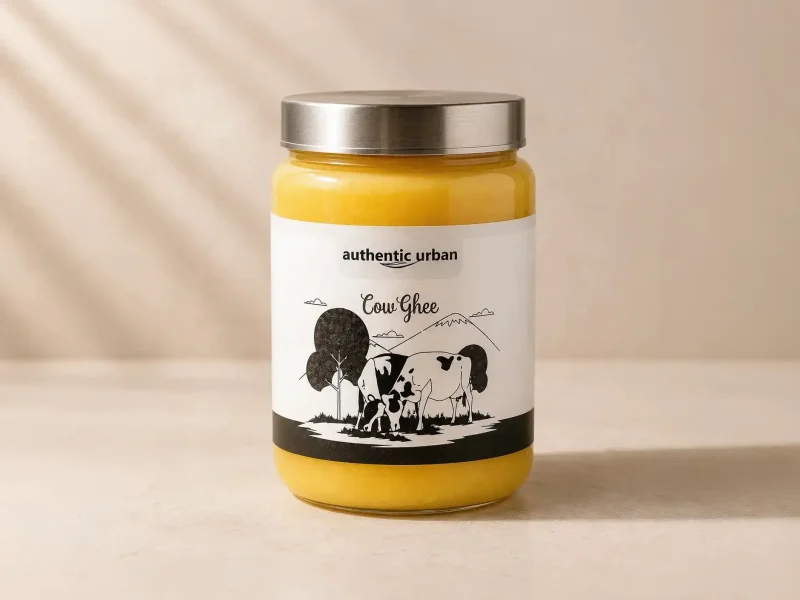 1 Litre
Paratha and halwa
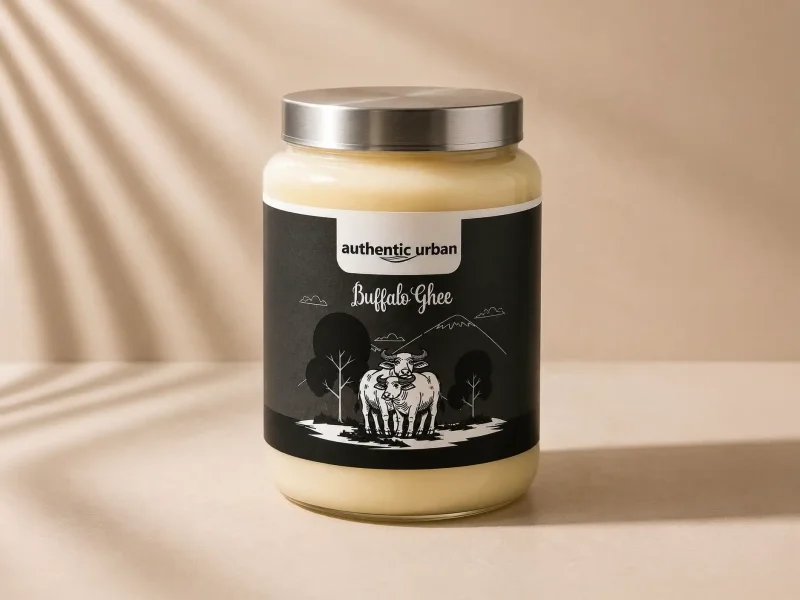 1 Litre
Each order is cooked after you place it, and the packing video is of that batch. Past order videos are on the shop.
FAQ
Is cow ghee or buffalo ghee better for a hair mask?
Cow ghee is easier. It is softer, melts at a lower warmth, and washes out with less shampoo, which matters on fine hair or an oily scalp. Buffalo ghee is firmer and richer, so it sits heavier on the hair and sets faster in the bowl in winter. For very thick, dry, or curly hair, some people like that weight. For a first mask, use cow ghee.
Can I keep leftover ghee hair mask for next time?
Throw away any mix with curd, egg, or aloe gel once you are done; they spoil at room temperature within hours and will smell. Plain warmed ghee left in the bowl can be kept in a small separate cup for next week, but never pour it back into the kitchen jar. Fingers that have touched hair and scalp carry water and skin into it, and that jar will go off faster.
Is a ghee hair mask safe during pregnancy?
Plain ghee on the hair and scalp is a food fat, and there is no known reason to avoid it in pregnancy. Skin can react more easily in pregnancy, so patch test even a mix you used before, keep the ghee only skin-warm, and leave out essential oils unless your doctor has said they are fine. See your doctor for any scalp rash, sores, or sudden heavy hair shedding.
Can men use a ghee hair mask, and can it go on a beard?
Yes. The steps are the same; short hair just needs a teaspoon or two on the scalp and no coat on the lengths. On a beard, use a few drops only, rubbed between the palms first, and wash it out the same day. Heavy fat under a beard can trap sweat and cause bumps. Whether ghee can help a patchy beard grow is a separate question, with a much shorter answer.
When will I see results from a ghee hair mask?
The feel changes after the first wash: softer, smoother ends that tangle less. That is the coat, and it fades over a few washes, which is why the mask is weekly. Less breakage when you comb shows up over four to eight weeks of weekly masks. More hair, faster growth, or darker hair is not something a mask can do; those depend on the cause, not on what you put on top.
Can I do a ghee hair mask the day before an event?
Do it two days before if you can, not the night before. The first wash after a mask can leave hair a little heavy or flat at the roots, especially fine hair, and the second normal wash brings the lift back. If it has to be the day before, keep the ghee to the ends, skip the scalp, and use two shampoos. Never style hair with a hot tool while ghee is still in it.
About the editorial team
Authentic Urban TeamBilona ghee makers, Gir Somnath, Gujarat
We are the Parmar family in Gir Somnath, Gujarat. We have made ghee here since 2016 and sold it online since 2025. We make only Bilona ghee, test it every month, and anyone is welcome to visit and watch it being made. Our Gir cows and Jafarabadi buffalo are grass-fed village animals that graze near the Gir forest, with no hormones or milk boosters. We set their milk to curd, churn it, and cook the makkhan on a wood chulha. These articles come from that kitchen and from what customers ask us on WhatsApp. We are ghee makers, not doctors.
Sources
- shampoo (v.), Online Etymology Dictionary, Etymonline. Checked 28 Sep 2026.
- Effect of mineral oil, sunflower oil, and coconut oil on prevention of hair damage (Rele and Mohile, J Cosmet Sci, 2003), Europe PMC. Checked 28 Sep 2026.
- Standardized scalp massage results in increased hair thickness by inducing stretching forces to dermal papilla cells in the subcutaneous tissue (Koyama et al., Eplasty, 2016), Europe PMC. Checked 28 Sep 2026.
- Tips for healthy hair, American Academy of Dermatology. Checked 28 Sep 2026.
- 10 hair care habits that can damage your hair, American Academy of Dermatology. Checked 28 Sep 2026.
- How to test skin care products, American Academy of Dermatology. Checked 28 Sep 2026.