Ghee for Hair: Does It Stop Hair Fall and Help Growth?
Ghee for hair helps with one kind of hair fall only: dry hair that snaps when you comb it. Warm ghee on the scalp and ends once a week softens the hair so less of it breaks. It does not stop hair falling from the root, and eating more ghee does not grow hair, because a teaspoon has almost no protein, iron, or zinc. No study has tested ghee on hair.
Is ghee good for hair?
Yes, for dry hair and a dry scalp, used on the outside once a week and washed out well. It coats the hair so it tangles and snaps less. It is not a hair fall treatment: it does nothing for shedding after illness, low iron, thyroid trouble, or baldness that runs in the family. Judge it after 12 weeks.
Most pages on ghee for hair say it "nourishes the follicles", "stops hair fall", and makes hair grow faster. None of them cite a trial, because there is none on ghee. What does exist is a small study on scalp massage, a study on coconut oil and hair protein, and dermatology advice on why hair falls. We use those below, together with what a spoon of ghee actually contains, so you can decide whether it is worth a Sunday morning.
This page is about hair fall and growth. Flakes and itch are on ghee for dandruff, and grey hair is on ghee for premature greying.
Can ghee stop hair fall? It depends on why it is falling
Ghee can reduce hair breaking; it cannot stop hair falling from the root. Look at what is on your comb. A full hair with a small white bulb at one end came out from the root. A short piece with no bulb broke. Then find your row below.
Cause
What you notice
Where ghee fits
What does more
Shedding after fever, delivery, surgery, stress, or a crash diet
Lots of full-length hairs on the comb and drain, all over the head, starting a few months after the event
None on the shedding itself. It settles on its own once the body recovers.
Time, enough food and protein, and a doctor if it runs past 6 to 9 months
Low iron (anaemia)
Thinning all over, with tiredness, breathlessness, or pale nails and gums
None. A teaspoon of ghee has no iron.
A blood test, then iron-rich food or tablets as the doctor advises
Thyroid, PCOS, or a new medicine
Thinning with weight change, irregular periods, acne, or after starting a tablet
None. Oil cannot change hormones.
A doctor, blood tests, and treating the cause
Pattern hair loss (runs in the family)
Receding temples or a thin crown in men; a widening parting in women
None. No oil has been shown to stop it.
A dermatologist; treatments such as minoxidil work only while used
Patchy loss (alopecia areata)
Smooth, round, coin-sized bald patches
None
A dermatologist, soon
Breakage from dryness, heat, colour, or tight styles
Short broken pieces, split ends, rough lengths; hair snaps rather than falls from the root
This is where it helps. A coat of fat before washing softens the hair so it snaps less when combed.
Less heat, looser plaits, a wide-tooth comb
Dry, flaky scalp
Fine white flakes and tightness after washing
Can soften a dry scalp. Greasy yellow flakes are a different problem.
The right shampoo for the type of dandruff
Only one row out of seven is a job for ghee. That is why so many people oil every week and still see the same hair in the drain. If yours is the anaemia or thyroid row, what ghee can and cannot do there is on ghee for anaemia and ghee for thyroid, but the blood test comes before either.
How much hair fall is normal?
Losing 50 to 100 hairs a day is normal, according to both the American Academy of Dermatology and the NHS. On wash day, and after a champi, you see more at once because loose hairs come out together.
The AAD separates two things that both look like "hair fall". Shedding (telogen effluvium) is more hair letting go than usual after a shock to the body: a high fever, childbirth, surgery, heavy stress, losing a lot of weight fast, or stopping birth control pills. It usually shows up a few months after the event and stops once the body settles. After childbirth it peaks around four months, and hair tends to be back to normal fullness within six to nine months. Hair loss is when something stops hair from growing: family pattern baldness, the immune system, some medicines, tight hairstyles, and harsh hair treatments.
Shedding is where most home remedies get their reputation. The hair would have settled anyway, and whatever oil was in use at month six gets the credit. Counting on one wash day each week, instead of every morning, gives you a number you can compare.
Does eating ghee help hair growth?
Not by itself. Hair is made of protein, and it needs iron and zinc to grow. A teaspoon of ghee has almost none of the three. An egg or a katori of dal gives far more.
Food, portion
Protein
Iron
Zinc
Vitamin A
kcal
Ghee, 1 tsp (5 g)
Protein: 0.01 g
Iron: 0 mg
Zinc: 0 mg
Vitamin A: 42 µg
Energy: 44 kcal
Boiled egg, 1 (50 g)
Protein: 6.3 g
Iron: 0.6 mg
Zinc: 0.5 mg
Vitamin A: 75 µg
Energy: 78 kcal
Cooked lentils (dal), 1 katori (150 g)
Protein: 13.5 g
Iron: 5.0 mg
Zinc: 1.9 mg
Vitamin A: 0 µg
Energy: 174 kcal
Worked out from USDA FoodData Central values per 100 g (butter oil, anhydrous; egg, hard-boiled; lentils, cooked), checked 27 September 2026.
The vitamins in ghee are real but small. USDA FoodData Central lists 840 µg of vitamin A and 2.8 mg of vitamin E in 100 g of ghee, so a teaspoon gives about 42 µg and 0.14 mg. A 2019 review of vitamins and hair loss in Dermatology and Therapy found that neither vitamin E nor biotin supplements are supported for common hair loss, and that too much vitamin A can itself cause hair loss. So "eat more ghee for the vitamins" does not hold up on either side: the amounts are small, and pushing vitamin A higher is not the answer.
Where ghee does belong is in a meal that already has the protein and iron. A teaspoon on dal, or on a roti eaten with sabzi, makes the plate something you want to finish, and it helps you take up the vitamin A in green vegetables. At home we each eat 1 to 2 teaspoons a day, on roti, dal, and khichdi, and a little more in winter sweets. That is the amount we would keep to; how much suits your family is on how much ghee per day, and the full label of a spoon is on ghee nutrition facts.
For many Indian women, the missing piece is iron, not fat. In the National Family Health Survey 2019 to 2021 (NFHS-5), 57% of women aged 15 to 49 were anaemic, up from 53% in the survey before, as a 2024 analysis in BMC Public Health reports. If your hair fall comes with tiredness, that blood test is worth more than any jar.
Does applying ghee on hair help growth?
Applying ghee does not make hair grow faster. The massage may help a little; the ghee mostly softens and coats.
The massage. In a 2016 study in Eplasty, nine healthy Japanese men used a scalp massage device for 4 minutes a day for 24 weeks. Their hair got slightly thicker, from 0.085 mm to 0.092 mm per strand. No oil was used, the group was tiny, and there was no comparison group. It is a hint that rubbing the scalp does something, not proof, and it says nothing about the fat on your fingers.
The oil. The best-known hair oil study, published in the Journal of Cosmetic Science in 2003, compared coconut, sunflower, and mineral oil. Only coconut oil reduced the protein hair loses when it is washed and combed, on both undamaged and damaged hair. The authors put it down to lauric acid, a small fat that can get inside the hair shaft. Sunflower and mineral oil did not help at all. Ghee was not tested.
Oil
Lauric acid per 100 g
Tested for hair protein loss?
Coconut oil
Lauric acid: 41.8 g
Yes. Cut protein loss from both undamaged and damaged hair, used before and after washing.
Ghee
Lauric acid: 2.8 g
Not tested. Mostly longer fats, so it most likely sits on the hair as a coat.
Sunflower oil
Lauric acid: Almost none
Yes. Did not reduce protein loss.
Mineral oil (many light hair oils)
Lauric acid: None
Yes. Did not reduce protein loss.
Lauric acid (12:0) from USDA FoodData Central: coconut oil 41.8 g and butter oil (ghee) 2.79 g per 100 g. Test results from Rele and Mohile, 2003.
Coconut oil has about 15 times the lauric acid of ghee. Most of ghee is longer fats, the kind the study found stay outside the hair. That makes ghee a coat, like a rich conditioner: it smooths the surface, cuts friction when you comb, and keeps dry ends from snapping. For dry, rough hair that breaks, that is a real use. For hair falling from the root, it is the wrong tool. If you want the protein effect as well, mixing ghee with coconut oil is a fair choice.
How to apply ghee on hair for hair fall
Once a week, warm 1 to 3 tablespoons of ghee, rub it into the scalp for 5 to 10 minutes, run the rest through the ends, leave it 1 to 2 hours, and shampoo twice.
1. Patch test
A little warm ghee behind the ear, left overnight. Skip it if the skin itches or bumps.
2. Warm a small amount
About 1 tbsp for short hair, 2 tbsp for shoulder length, 3 tbsp for long hair. Melt it until just warm, never hot.
3. Scalp, then lengths
Part the hair, rub the ghee into the scalp with fingertips for 5 to 10 minutes, then run what is left through the ends.
4. Leave 1 to 2 hours
Overnight only if your scalp is dry, under a cotton cloth so the pillow stays clean.
5. Wash twice
Mild shampoo, lukewarm water, two rounds. Hair should feel clean, not coated.
6. Once a week
Twice for very dry hair. More often only builds up on the scalp.
Rub gently with the pads of your fingers. Scrubbing hard with nails pulls out hairs that were already loose and looks like more hair fall. The full champi technique, and mask recipes with curd, egg, or amla, are on ghee hair mask and champi. Do not blow-dry or straighten hair with ghee still in it; hot fat on hair can scorch it.
What the ghee should be like
Use ghee you would eat, from a clean jar. At our kettle in Gir Somnath, a batch cooked too long turns dark, bitter, and smells burnt, and one taken off too early stays cloudy and keeps water, so it spoils fast. We do not jar either. Test your own: warm a little on the back of your hand. It should melt clear and smell of toasted milk. Sour or soapy means old, and that smell will stay in your hair. How ghee goes off is on does ghee go bad.
Winter ghee sets in fine grains and summer ghee stays liquid in the jar, so in winter you will need to warm it longer. Grain is not a fault; why it happens is on why ghee is grainy. Spoon what you need into a small bowl with a dry spoon, so hands and hair never go back into the kitchen jar.
When should you see a doctor for hair fall?
See a doctor if you have bald patches, heavy hair fall for more than 2 to 3 months, or hair fall with other symptoms. We are ghee makers, not doctors; the NHS simply says to see one if you are worried about your hair loss.
Sign
What to do
Round, smooth bald patches
See a dermatologist. This is not a hair oil problem.
Handfuls of hair every day for more than 2 to 3 months
See a doctor to find the cause: shedding, iron, or thyroid.
Hair fall with tiredness, weight change, or irregular periods
Ask for blood tests (iron, thyroid). Take the report to the doctor, not to the oil shelf.
Red, sore, scaly, or pus-filled scalp
Stop all oils and see a dermatologist.
Hair fall that began after a new medicine
Tell the doctor who prescribed it. Do not stop the medicine on your own.
Pimples on the forehead or scalp after oiling
Stop for 2 weeks and wash out better. Keep ghee off the hairline.
For pattern baldness, the NHS names finasteride and minoxidil as the main treatments, and notes that they do not work for everyone and only work for as long as they are used. Even the tested options have that limit, which is why no oil should be sold to you as a cure. If hair fall came with irregular periods or acne, read ghee and PCOS after you have seen the doctor. Pimples along the hairline after oiling are covered on does ghee cause acne.
A 12-week ghee for hair checklist
Hair grows slowly, so give it 12 weeks, then compare the photos. Screenshot the list if it helps.
- Count hair on wash day only, from the comb and drain, same day each week.
- Match your hair fall to a row in the cause table before buying anything.
- Blood test for iron and thyroid if the hair fall comes with tiredness or period changes.
- Protein at every meal: dal, egg, paneer, curd, or chana.
- Keep eating ghee in normal amounts. Do not add extra "for hair".
- Warm ghee on the scalp once a week, if the scalp or ends are dry. Wash twice.
- Stop at once for pimples, itching, or a red scalp.
- Take a photo of your parting in daylight on day 1 and in week 12.
Which ghee to use on hair and on the plate?
For hair, the jar matters less than the freshness: plain ghee, nothing added, that melts clear and smells of toasted milk. Five checks for a pure jar are on how to identify pure ghee, and how curd Bilona (curd churned by hand) differs from cream ghee is on the Bilona method.
We make and sell ghee, so weigh this with that in mind. For the teaspoon on dal and the small bowl for your hair, we would pick our own A2 Gir cow ghee: milk from grass-fed Gir cows, set to curd overnight, churned, and cooked in a matki on a wood chulha, made after you order, with a video of your jar sent on WhatsApp. It is softer and washes out easily. Our Jafarabadi buffalo ghee is the richer jar for paratha and sweets. We test every month against the FSSAI limits; the steps are on how we make ghee. Our ranking of the cow ghee on sale is on best cow ghee in India.
The weekly champi and the daily teaspoon
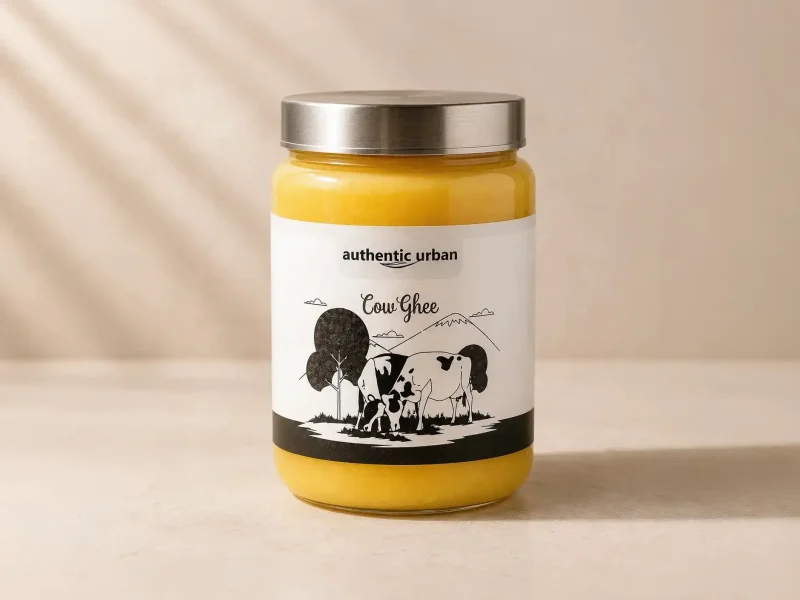 1 Litre
Paratha, halwa, and very dry, thick hair
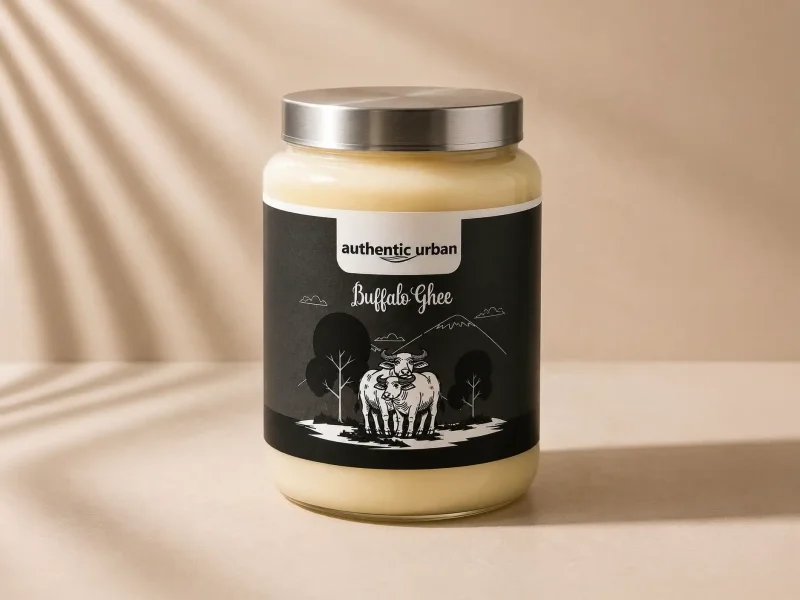 1 Litre
Each order is cooked after you place it, and the packing video is of that batch. Past order videos are on the shop.
FAQ
Can I mix ghee with coconut oil, amla, or bhringraj for hair?
You can, and mixing with coconut oil makes sense, because coconut oil is the one hair oil tested and shown to cut protein loss from hair. Half and half, warmed, is easy to spread. Amla and bhringraj oils are traditional; no good trial shows they regrow hair. Patch test any mix behind the ear first, and keep essential oils out of it if your scalp is sensitive.
Is cow ghee or buffalo ghee better for hair?
Cow ghee is easier on hair. It is softer, melts faster on warm fingers, and washes out more easily. Buffalo ghee sets firmer and feels heavier, so it takes more shampoo to rinse and suits very dry, thick hair better than fine hair. Both are almost pure milk fat, so neither feeds the root more than the other. The freshness of the jar matters more than the animal.
Will ghee on my hair cause pimples on the forehead?
It can. Any fat that runs from the hairline onto the forehead can block pores, and people with oily or acne-prone skin get this more often. Keep ghee off the front hairline, tie your hair back while it sits, and wash your face after rinsing your hair. If small pimples appear along the hairline, stop oiling for two weeks and use less when you start again.
Does ghee help hair fall after delivery?
Not the shedding itself. Hair fall after childbirth is a normal shedding phase: the American Academy of Dermatology says it peaks around four months after delivery and hair usually returns to normal fullness within six to nine months. A weekly ghee champi can make dry ends feel softer in that time. If hair is still falling heavily after a year, or you feel very tired, ask for an iron and thyroid test.
Can I put ghee on my child's hair?
A small amount of warm ghee on a dry scalp is a common household practice and is usually fine for older children, washed out the same day. Patch test first. Do not use it on a scalp with sores, heavy scaling, or round bald patches; those need a doctor. For babies under one year, ask your paediatrician before putting anything on the scalp beyond what they already advise.
Does ghee make hair smell or attract dust?
Fresh ghee smells of toasted milk while it is on the hair, and the smell goes with a proper wash. Old ghee smells sour or soapy, and that smell can stay. Left on the hair for a day or longer, any fat collects dust and feels sticky, which some people mistake for more hair fall. Wash out within a few hours, or the next morning after an overnight treatment.
About the editorial team
Authentic Urban TeamBilona ghee makers, Gir Somnath, Gujarat
We are the Parmar family in Gir Somnath, Gujarat. We have made ghee here since 2016 and sold it online since 2025. We make only Bilona ghee, test it every month, and anyone is welcome to visit and watch it being made. Our Gir cows and Jafarabadi buffalo are grass-fed village animals that graze near the Gir forest, with no hormones or milk boosters. We set their milk to curd, churn it, and cook the makkhan on a wood chulha. These articles come from that kitchen and from what customers ask us on WhatsApp. We are ghee makers, not doctors.
Sources
- Do you have hair loss or hair shedding?, American Academy of Dermatology. Checked 27 Sep 2026.
- Hair loss, NHS. Checked 27 Sep 2026.
- Standardized scalp massage results in increased hair thickness by inducing stretching forces to dermal papilla cells in the subcutaneous tissue (Koyama et al., Eplasty, 2016), Europe PMC. Checked 27 Sep 2026.
- Effect of mineral oil, sunflower oil, and coconut oil on prevention of hair damage (Rele and Mohile, J Cosmet Sci, 2003), Europe PMC. Checked 27 Sep 2026.
- The role of vitamins and minerals in hair loss: a review (Almohanna et al., Dermatol Ther, 2019), Europe PMC. Checked 27 Sep 2026.
- Prevalence and determinants of anaemia among women of reproductive age in Aspirational Districts of India: an analysis of NFHS 4 and NFHS 5 data (BMC Public Health, 2024), BMC Public Health. Checked 27 Sep 2026.
- Butter oil, anhydrous (FDC ID 173412), SR Legacy, USDA FoodData Central. Checked 27 Sep 2026.
- Oil, coconut (FDC ID 171412), SR Legacy, USDA FoodData Central. Checked 27 Sep 2026.
- Egg, whole, cooked, hard-boiled (FDC ID 173424), SR Legacy, USDA FoodData Central. Checked 27 Sep 2026.
- Lentils, mature seeds, cooked, boiled, without salt (FDC ID 172421), SR Legacy, USDA FoodData Central. Checked 27 Sep 2026.