How Much Ghee Per Day? Teaspoons by Age, With Oil Counted
How much ghee per day: 1 to 2 teaspoons (5 to 10 g) for most healthy adults, which is what ICMR-NIN's 2024 dietary guidelines advise. That ghee sits inside one daily budget for all oil and ghee together: 20 g for a sedentary woman, 30 g for a sedentary man, and less for children and people over 60. Every spoon of ghee takes a spoon of oil out.
How much ghee per day should you eat?
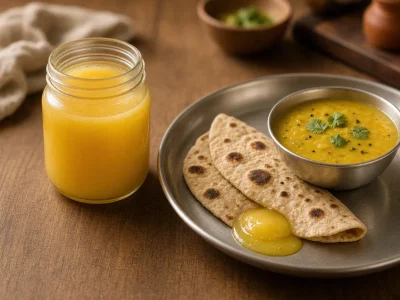
Eat 1 to 2 teaspoons of ghee a day, 5 to 10 g, counting every spoon: on roti, in dal, and in sweets. ICMR-NIN's 2024 guidelines put it plainly: limit ghee or butter to 1 to 2 teaspoons a day. The same guidelines cap all visible fat, oil and ghee together, at 20 to 50 g a day depending on how active you are.
So the real answer has two numbers. One is the ghee line, which is the same for almost everyone. The other is your whole fat budget, which changes with age, sex, and work, and decides how much oil is left after the ghee. Most pages on this question skip the second number, and that is where Indian kitchens go over: a good spoon of ghee on the roti, and the full usual oil in the sabzi as well. This page is for the person planning a family's food, with a table for each member of the house. If you already eat ghee daily and want to know if you are over, read ghee side effects too.
How much ghee and oil a day, by age and activity?
Every person in the table below gets 1 to 2 teaspoons of ghee, and the rest of their fat budget as oil. The fat budget is ICMR-NIN's number; the ghee range is ours, kept inside ICMR-NIN's line. One teaspoon is 5 g, the measure ICMR-NIN uses.
Who
All fat a day
Ghee
Oil
Child, 1 to 3 years
20 g (4 tsp)
1 to 2 tsp
2 to 3 tsp
Child, 4 to 6 years
20 g (4 tsp)
1 to 2 tsp
2 to 3 tsp
Child, 7 to 9 years
25 g (5 tsp)
1 to 2 tsp
3 to 4 tsp
Girl, 10 to 12 years
30 g (6 tsp)
1 to 2 tsp
4 to 5 tsp
Boy, 10 to 12 years
35 g (7 tsp)
1 to 2 tsp
5 to 6 tsp
Girl, 13 to 18 years
40 g (8 tsp)
1 to 2 tsp
6 to 7 tsp
Boy, 13 to 15 years
45 g (9 tsp)
1 to 2 tsp
7 to 8 tsp
Boy, 16 to 18 years
55 g (11 tsp)
1 to 2 tsp
9 to 10 tsp
Woman, sedentary
20 g (4 tsp)
1 to 2 tsp
2 to 3 tsp
Woman, moderate work
30 g (6 tsp)
1 to 2 tsp
4 to 5 tsp
Woman, heavy work
40 g (8 tsp)
1 to 2 tsp
6 to 7 tsp
Man, sedentary
30 g (6 tsp)
1 to 2 tsp
4 to 5 tsp
Man, moderate work
40 g (8 tsp)
1 to 2 tsp
6 to 7 tsp
Man, heavy work
50 g (10 tsp)
2 tsp
8 tsp
Pregnant woman
30 g (6 tsp)
1 to 2 tsp
4 to 5 tsp
Breastfeeding mother
35 g (7 tsp)
1 to 2 tsp
5 to 6 tsp
Woman over 60
15 g (3 tsp)
1 tsp
2 tsp
Man over 60
20 g (4 tsp)
1 to 2 tsp
2 to 3 tsp
All fat a day: ICMR-NIN Dietary Guidelines for Indians 2024, adults from p. 54, children, teens, pregnancy, breastfeeding, and women over 60 from Table 1.6 (p. 11), men over 60 from Table 16.1 (p. 102). Sedentary means desk or home work with little walking. Oil is what is left after the ghee. Checked 27 September 2026.
ICMR-NIN Dietary Guidelines for Indians 2024, p. 54, Table 1.6 (p. 11), and Table 16.1 (p. 102).
| Item | Value |
|---|---|
| Child, 1 to 6 years | 20 g |
| Child, 7 to 9 years | 25 g |
| Girl, 13 to 18 years | 40 g |
| Boy, 16 to 18 years | 55 g |
| Woman, sedentary | 20 g |
| Man, sedentary | 30 g |
| Man, heavy work | 50 g |
| Pregnant woman | 30 g |
| Woman over 60 | 15 g |
| Ghee inside any of these (2 tsp) | 10 g (ICMR-NIN ghee limit) |
Two things stand out. The ghee line barely moves, while the oil changes a lot: a teenage boy's day has room for 9 to 10 teaspoons of oil, a woman over 60 only 2. And the smallest budgets belong to the people families most often push ghee on: small children, elders, and sedentary women at home. To add up your own household, use our ghee calculator: enter who eats at home and it works out the day's ghee and oil for the house.
How many grams and calories is a teaspoon of ghee?
A level teaspoon of ghee is about 5 g and 44 kcal, with about 3.1 g of saturated fat, going by USDA FoodData Central's figures for ghee (876 kcal and 61.9 g saturated fat per 100 g). Here is how the usual portions compare.
Portion
Energy
Sat. fat
What it means
½ teaspoon (2.5 g)
22 kcal
1.5 g
A start for someone new to ghee, or a small child's dal.
1 teaspoon (5 g)
44 kcal
3.1 g
The bottom of the ICMR-NIN ghee line. One roti or one bowl of dal.
2 teaspoons (10 g)
88 kcal
6.2 g
The top of the ICMR-NIN ghee line for a whole day.
1 tablespoon (12.8 g)
112 kcal
7.9 g
Already past 2 teaspoons. Fine only on a day it replaces oil.
2 tablespoons (25.6 g)
224 kcal
15.8 g
More than a sedentary woman's fat budget for all oil and ghee (20 g).
Energy and saturated fat from USDA FoodData Central, SR Legacy 173412 (butter oil, anhydrous), worked out for each portion. Teaspoon 5 g (ICMR-NIN), tablespoon 12.8 g (USDA). Checked 27 September 2026.
The spoon in your cutlery drawer is not a measuring teaspoon. A heaped steel chamach, or ghee poured straight from a warm jar, is often two or three times the amount. Measure with a proper 5 ml spoon for a week, then look at what a teaspoon is on your own roti. The full label, vitamins included, is on ghee calories and nutrition facts.
Is 1 to 2 tablespoons of ghee a day too much?
Yes, for most people. One tablespoon is 12.8 g, already past the 10 g top of the ICMR-NIN ghee line, and two tablespoons (25.6 g) is more than a sedentary woman's budget for all her oil and ghee together.
Many pages, including an older version of this one, told active adults to eat 1 to 2 tablespoons a day. We changed it because the guideline says teaspoons, and because tablespoons of ghee on top of normal cooking oil is how weight and LDL creep up. A man doing heavy physical work has a 50 g fat budget, so a tablespoon of ghee fits his day if his oil comes down to match. For a desk worker it does not. Why ghee is kept low at all comes down to saturated fat: a teaspoon has about 3.1 g, while a teaspoon of sunflower or mustard oil has far less, as our ghee vs vegetable oil table shows.
Why should you count ghee and oil together?
Because the body does not keep two budgets. ICMR-NIN counts cooking oil, vanaspati, butter, and ghee as one group it calls visible fat, and caps the whole group, not each fat on its own.
Take a sedentary woman with a 20 g day, which is 4 teaspoons. If 2 go on her roti and dal as ghee, only 2 are left for the sabzi and the tadka. Most home tadkas use more than that. That is why the fix is to move the ghee to the table and make the tadka lighter, not to add ghee and keep cooking the same way. ICMR-NIN also says that for a 2,000 kcal day, 27 to 30 g of visible fat is enough.
How do you spread 2 teaspoons of ghee across the day?
Put most of it on hot food at the table, where you taste it, and cook in oil. Here is a normal vegetarian day for a sedentary adult, with the ghee and oil it uses.
Meal
Ghee
Where it goes
Oil
Breakfast
Ghee: ½ tsp
On one roti or thepla, or stirred into poha or upma after cooking.
Oil: None, if the roti is dry-cooked
Lunch
Ghee: 1 tsp
On hot dal or khichdi at the table, not in the tadka.
Oil: 1 to 2 tsp in the sabzi
Dinner
Ghee: ½ tsp
On the last roti, or in dal.
Oil: 1 tsp in the sabzi
Snack or tea
Ghee: 0
Skip ghee here. Fried namkeen and biscuits already carry fat.
Oil: Counts if fried
That day uses 2 teaspoons of ghee and 2 to 3 of oil: 20 to 25 g in all, right for a sedentary man and at the top for a sedentary woman, who would drop the dinner ghee or a teaspoon of oil. Which meal suits ghee best, and ghee at night, is on when to eat ghee.
At home in Gir Somnath, our family eats 1 to 2 teaspoons each a day, on roti, dal, and khichdi. We eat more only in winter, in sweets like adadiya pak and gond, and that is a few weeks, not the year. We make ghee for a living, and that is still our daily amount. A month of that routine, and what a 4-week ghee trial found, is on eating ghee daily for 30 days.
How much ghee a day for weight loss or weight gain?
For weight loss, stay at 1 teaspoon a day and cut the oil to your budget; for weight gain, stay at 1 to 2 teaspoons and get the extra calories from more food, not more ghee.
Ghee does not burn fat. It is 44 kcal a teaspoon, and in a weight-loss plan it earns its place only by replacing oil or butter you would have eaten anyway; the plate is on ghee for weight loss. For gaining weight, extra tablespoons of ghee add calories without the protein a thin body needs. Milk, dal, eggs, peanuts, and one more small meal do more; see ghee for weight gain.
How much ghee for children, pregnancy, and people over 60?
Children over one year, pregnant women, and breastfeeding mothers all fit inside 1 to 2 teaspoons a day; people over 60 have the smallest fat budgets, so 1 teaspoon is usually enough.
Children
A child of 1 to 6 years has a 20 g fat day, the same as a sedentary woman, spread over a much smaller plate. A teaspoon of ghee on dal rice or khichdi at one or two meals is plenty, with the family tadka counted as the rest. How to split it by meal, and when a third teaspoon fits, is on ghee for toddlers. Babies of 7 to 12 months get 10 g of fat a day in ICMR-NIN's table; their plan is on ghee for babies, and a baby under one gets ghee only when the paediatrician agrees.
Pregnancy and breastfeeding
ICMR-NIN's table gives a pregnant woman 30 g of oil and ghee a day and a breastfeeding mother 35 g, and asks that the extra fat come from nuts, oilseeds, beans, and fish rather than more visible fat. Ghee stays at 1 to 2 teaspoons; the extra laddoos are not part of the plan. Trimester by trimester, it is on ghee during pregnancy.
Over 60
ICMR-NIN's diet for a 55 kg woman over 60 has 15 g of fats and oils a day, 3 teaspoons in all. The diet for a 65 kg man over 60 has 20 g (Table 1.6 gives 25 g). With 1 teaspoon of ghee, that leaves 2 to 3 teaspoons of oil for everything else. Elders are also the most likely to have high LDL, diabetes, or heart trouble, and then the doctor's number replaces this one.
When should you eat less than 1 teaspoon of ghee a day?
When a doctor has asked you to cut fat, or you have high LDL, heart disease, gallbladder pain after meals, pancreatitis, or serious liver or kidney disease. Then the number comes from your doctor or dietitian, and it can be less than a teaspoon or none.
We are ghee makers, not doctors, and this page is for healthy people. The full list of who should avoid ghee or ask first is on who should not eat ghee. With a lipid report in hand, read ghee for cholesterol; with diabetes, can diabetics eat ghee.
Daily ghee checklist
Screenshot this and keep it by the stove.
- Your day's ghee is 1 to 2 teaspoons (5 to 10 g), for most healthy adults, children over 1, and pregnant women.
- Count ghee and oil as one budget: 20 g a day for a sedentary woman, 30 g for a sedentary man.
- Use a measuring teaspoon for one week. After that your eye knows the amount.
- Put ghee on hot food at the table. Cook the tadka in oil.
- A day with paratha or halwa is a day with less oil, not extra fat.
- Over 60, or with high LDL, heart, liver, gallbladder, or kidney disease: ask your doctor for your number.
- Babies under 1 year: the paediatrician decides.
Which ghee for the daily teaspoon?
At 1 to 2 teaspoons a day, the ghee should taste of something. Warm a little on a spoon before you trust a jar: it should smell of toasted milk, and slow curd-churned ghee often sets grainy when cool. How curd Bilona (curd churned by hand) differs from cream ghee is on the Bilona method, and our ranking of the cow ghee on sale is best cow ghee in India.
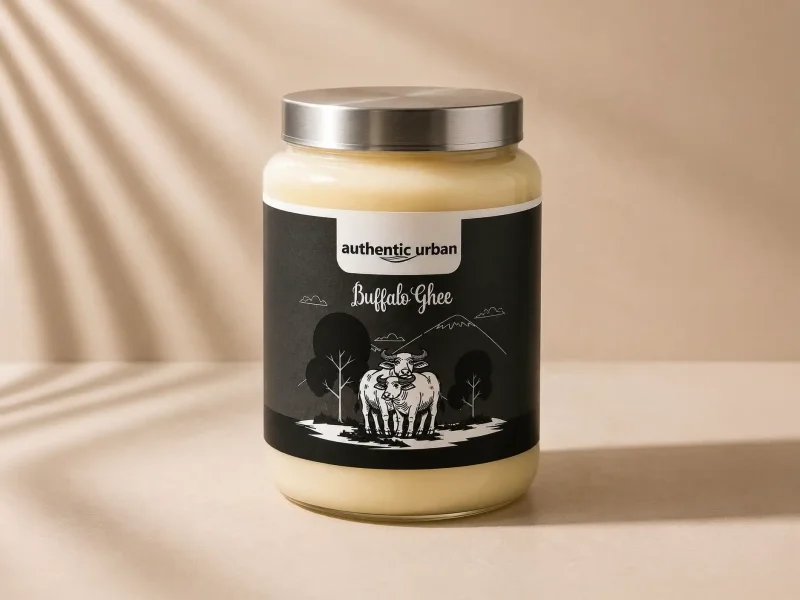
We make and sell ghee, so weigh this with that in mind. For the daily teaspoon we would pick our own A2 Gir cow ghee: grass-fed Gir milk set to curd overnight, churned, and cooked in a matki on a wood chulha, made after you order, with a video of your jar sent on WhatsApp. At ₹2,399 a litre, a 5 ml teaspoon costs about ₹12. For paratha and sweets, our Jafarabadi buffalo ghee is the richer jar. Varsha tastes every batch before it is packed, and we test every month against the FSSAI limits; the steps are on how we make ghee.
The daily teaspoon on dal and roti
 1 Litre
Paratha days and winter sweets
 1 Litre
Each order is cooked after you place it, and the packing video is of that batch. Past order videos are on the shop.
FAQ
Roz kitna ghee khana chahiye?
Most healthy adults should eat 1 to 2 chammach (teaspoons) of ghee a day, about 5 to 10 grams. That is ICMR-NIN's 2024 advice, and it counts all the ghee in the day: on roti, in dal, in sweets. Kids over one year can take about the same, spread over meals. If you cook in oil too, keep the total fat for the day inside your budget.
Is 1 tablespoon of ghee a day too much?
For most people it is a little over the line. One tablespoon is about 12.8 g, per USDA, while ICMR-NIN advises 1 to 2 teaspoons (5 to 10 g) of ghee a day. A tablespoon is fine on a day when it replaces the oil you would have used, such as a paratha breakfast with dry sabzi. Every day on top of normal oil, it adds up to extra fat and calories.
How much ghee does a family of four use in a month?
At 2 teaspoons a person a day, four people eat 40 g of ghee a day, or about 1.2 kg in 30 days. At 1 teaspoon each, it is about 600 g. Festival sweets and winter pak come on top, so many homes buy a little more in those months. If a 1 kg jar is gone in two weeks for four people, the family is eating well past the guideline.
Should I eat more ghee in winter?
Not every day. The daily line stays 1 to 2 teaspoons all year. In our home the extra ghee in winter goes into sweets like adadiya pak and gond, and those are a few weeks, not the whole season. If you eat a piece of pak or a ladoo made with ghee, count that ghee and use a little less on roti that day.
Is the daily amount different for cow and buffalo ghee?
No. Both are almost pure milk fat, so a teaspoon of either carries about the same calories and a similar amount of saturated fat. The ICMR-NIN line of 1 to 2 teaspoons does not change with the animal. Buffalo ghee is richer and sets firmer, so it suits paratha and sweets; cow ghee is lighter for the daily spoon on dal and roti.
Can I eat all my daily ghee at once?
You can, but it sits better spread over meals. Two teaspoons on one plate of dal rice is fine for most people. A full day's ghee on an empty stomach, or in one heavy dinner, gives some people nausea or acid in the throat. Half a teaspoon at breakfast and one at lunch, with a little at dinner, is easier on digestion.
About the editorial team
Authentic Urban TeamBilona ghee makers, Gir Somnath, Gujarat
We are the Parmar family in Gir Somnath, Gujarat. We have made ghee here since 2016 and sold it online since 2025. We make only Bilona ghee, test it every month, and anyone is welcome to visit and watch it being made. Our Gir cows and Jafarabadi buffalo are grass-fed village animals that graze near the Gir forest, with no hormones or milk boosters. We set their milk to curd, churn it, and cook the makkhan on a wood chulha. These articles come from that kitchen and from what customers ask us on WhatsApp. We are ghee makers, not doctors.
Sources
- Dietary Guidelines for Indians, 2024 (Guideline 7, printed p. 54; Table 1.6, printed p. 11; Tables 16.1 and 16.2, printed p. 102), ICMR-National Institute of Nutrition. Checked 27 Sep 2026.
- Butter oil, anhydrous (FDC ID 173412), SR Legacy, USDA FoodData Central. Checked 27 Sep 2026.