Ghee Benefits: 8 That Hold Up, and How Much to Eat
Ghee benefits are real but modest: 1 to 2 teaspoons a day helps you absorb the vitamins in your vegetables, adds a little vitamin A, suits people who cannot take milk, and makes a plain meal filling. Claims that ghee is rich in vitamin D, burns fat, or protects the heart do not hold up against USDA data and ICMR-NIN's 2024 guidelines.
What are the benefits of ghee?
Ghee helps your body absorb vitamins A, D, E, and K from the meal, carries some vitamin A of its own, is almost free of milk sugar, gives dense energy, and keeps a plain meal satisfying. Those benefits come from a teaspoon or two a day. More ghee does not add more benefit; it adds saturated fat.
The limit comes from ICMR-NIN's 2024 dietary guidelines, which say to keep ghee or butter to 1 to 2 teaspoons a day, or avoid it if possible. So the useful question is where that spoon does the most good. This page lists each benefit with the dish it belongs on. If you want the yes-or-no verdict on whether ghee is good for you, with the saturated fat worked out, read is ghee healthy. The same list in Hindi is on ghee khane ke fayde.
Ghee benefits list: what each one means on your plate
Eight benefits hold up when you check them against the numbers. Each row says what the benefit really is and how to eat ghee to get it. Screenshot it for the kitchen.
The benefit
What it really is
How to eat it
1. Helps you absorb vitamins from the meal
ICMR-NIN's 2024 guidelines say dietary fat carries vitamins A, D, E, and K and the carotenes in vegetables, and helps them absorb. Any fat does this; ghee is the tasty one.
1 tsp on palak, gajar, or methi sabzi, or on hot dal.
2. Some vitamin A of its own
About 42 µg in a 5 g teaspoon (USDA). Real, but a small raw carrot gives about ten times more.
Counts as a bonus on roti, never as your vitamin A source.
3. Almost no milk sugar or milk protein
FSSAI requires ghee to be at least 99.5% milk fat, so many people who bloat on milk manage a spoon of ghee. A milk allergy can still react.
1 tsp on khichdi or rice for someone who avoids milk.
4. Dense energy when someone needs it
About 44 kcal a teaspoon. Useful for a thin child over 1, an underweight adult, a recovering patient, or heavy farm work.
An extra tsp on dal-rice, inside the day's fat budget.
5. Makes a plain meal filling
ICMR-NIN notes that fat gives a feeling of fullness and delays the onset of hunger. A spoon turns dal-roti into a meal people finish.
Put the spoon where you taste it, not in the frying.
6. Tadka that does not burn
The milk solids that burn in butter are cooked out of ghee, so jeera and hing bloom without black specks.
1 tsp for a family tadka on dal. Fry in oil.
7. Keeps without a fridge
FSSAI allows ghee at most 0.5% moisture. With almost no water, a well-cooked jar stays fresh for months on the shelf.
Dry spoon, lid shut, away from the stove.
8. Softens dry lips and heels
Used on the skin as a household tradition. It is a plain fat that seals in moisture, like any balm.
A thin layer at night after a patch test.
Per 5 g teaspoon, worked out from USDA FoodData Central (butter oil, anhydrous, 173412; carrots, raw, 170393). Guidelines from ICMR-NIN 2024 and FSSAI's ghee standard. Checked 27 September 2026.
The benefit that matters most: vitamins from vegetables
Of the eight, the first does the most for an Indian plate. Carrots, palak, methi, and pumpkin carry carotenes that the body turns into vitamin A, and they need some fat in the same meal to absorb well. A teaspoon of ghee on the sabzi does that job. So does a teaspoon of oil, which is why the benefit comes from having a little fat on the vegetables, not from ghee alone. How much fat you need for this, and which vegetables gain most, is on ghee and nutrient absorption.
Benefit 3 is the one people with a sensitive stomach notice. Churning and slow cooking leave ghee almost pure milk fat, so the lactose that upsets them in milk and chai is nearly gone. The amounts per serving, ghee against milk, curd, and paneer, are on is ghee lactose free. The full label of a spoon, from calories to cholesterol, is on ghee nutrition facts.
Why ghee keeps without a fridge
Benefit 7 is one we see every day at the kettle in Gir Somnath. Ghee is ready only once the water in the makkhan has boiled away: the bubbling goes quiet, the milk solids turn golden-brown, and it smells of toasted milk. An undercooked batch stays cloudy, keeps moisture, and spoils fast, so it never goes in a jar. A properly cooked, sealed jar keeps 9 to 12 months at room temperature. Once it is open, a dry spoon and a shut lid matter more than the fridge. Why jars sometimes turn sour, and how to store them, is on how long ghee lasts.
Which ghee benefits are overstated?
Seven benefits repeated on most pages that rank for this search do not hold up. Several lists call ghee rich in vitamin D and K2, a source of omega-3, a fat burner, and good for the heart. We checked each against USDA's figures for ghee and ICMR-NIN's guidelines.
The claim
What the numbers say
Rich in vitamin D
USDA lists ghee at 0 µg of vitamin D. Sunlight and fortified foods are where vitamin D comes from.
Rich in vitamin K2 for bones
USDA lists 8.6 µg of vitamin K per 100 g, all as K1, and no K2 value. A teaspoon holds under half a microgram.
A source of omega-3
All the polyunsaturated fat in a teaspoon, omega-3 and omega-6 together, comes to about 0.18 g. Walnuts, flaxseed, mustard oil, and fish carry the omega-3.
Its MCTs burn fat
The medium-chain fats (C8 and C10) come to about 0.18 g a teaspoon, next to 44 kcal of total fat. No trial shows kitchen amounts of ghee burning fat.
Good for the heart, raises HDL
ICMR-NIN groups ghee with the saturated fats that raise total and LDL cholesterol. It credits a healthy diet and exercise, not ghee, with raising HDL.
Heals the gut lining
A teaspoon holds about 0.16 g of butyric acid. The gut-lining work is in cells and animals, not people eating a spoon of ghee.
Boosts immunity
No trial shows it. Ghee helps absorb the vitamins in the vegetables it goes on, and those vitamins do the work.
Per 5 g teaspoon from USDA FoodData Central 173412. ICMR-NIN Dietary Guidelines for Indians 2024, printed p. 52. Checked 27 September 2026.
The heart claim matters most because it changes how much people eat. If ghee raised good cholesterol, more would be better; ICMR-NIN says the opposite about saturated fat. The detail, with what to watch in a lipid report, is on is ghee bad for cholesterol. The fat-burning claim, CLA and MCTs included, is taken apart on ghee for weight loss. The gut claim is on ghee and butyrate.
A customer question we get on WhatsApp belongs here too: why is the colour different from last time? In the monsoon, green fodder turns cow ghee a deeper yellow. People read that colour as extra vitamins. We have never tested our ghee for vitamin content, so we make no claim for it, and a colour is not a lab result.
How much ghee a day do you need for the benefits?
One to two teaspoons a day, 5 to 10 g, gets you every benefit in the list above. That is ICMR-NIN's limit for ghee or butter, and it sits inside a bigger budget for all visible fat: 20 g a day for a sedentary woman, 30 g for a sedentary man, and up to 40 to 50 g for heavy physical work.
Where you put the spoon matters more than how big it is. One teaspoon on the sabzi with the most vegetables, one on hot dal or khichdi, and oil for everything else. In our own home each of us eats 1 to 2 teaspoons a day, on roti, dal, and khichdi, and more only in winter when adadiya pak and gond come out. Those sweets are where the day's ghee quietly doubles, so count them. You can work out your home's daily ghee and oil, and the amounts by age and situation are on how much ghee per day. What a daily spoon adds up to over a month is on eating ghee daily.
Ghee benefits for women: what changes by life stage
For women, ghee brings the same benefits as for anyone, inside a smaller fat budget. ICMR-NIN sets 20 g of visible fat a day for a sedentary woman against 30 g for a man, so the same two teaspoons take a bigger share of her day. Claims that ghee balances hormones or nourishes the uterus are tradition, not tested.
Life stage
Ghee a day
Why
Everyday, desk job
1 to 2 tsp
ICMR-NIN sets 20 g of visible fat a day for a sedentary woman, oil and ghee together. Two teaspoons of ghee is half of it.
Periods and cramps
1 to 2 tsp
Warm, regular meals help many women feel better; no trial shows ghee eases cramps. Severe pain is for a doctor.
PCOS
1 tsp, in place of oil
Weight and insulin matter most in PCOS, so ghee replaces a fat, never adds to one.
Pregnancy
Your doctor's number
ICMR-NIN says to restrict visible fat in pregnancy and lean on nuts, oilseeds, and beans instead.
After delivery and breastfeeding
Your doctor's number
The same ICMR-NIN advice applies while breastfeeding. Heavy ghee panjiri adds calories fast.
Menopause
1 tsp
LDL often rises after menopause, and bones need calcium and vitamin D that ghee does not carry.
Adults. Fat amounts and the pregnancy and breastfeeding advice from ICMR-NIN's 2024 guidelines, printed p. 54. Your doctor's plan comes first.
Each stage has its own page: ghee for period cramps, ghee for PCOS, ghee during pregnancy, ghee after delivery, and ghee for menopause.
Ghee benefits for children, men, and older parents
Children over 1 gain the most from benefit 4: a small stomach needs dense energy, and a little ghee on dal-rice or khichdi adds it without extra bulk. Babies under 1 are a paediatrician's decision, not ours. The amounts by age for toddlers are on ghee for toddlers.
Men get no extra benefit from ghee; they get a bigger fat budget, 30 g a day when sedentary. The testosterone and stamina claims are checked on ghee benefits for men. For older parents with a small appetite, a teaspoon on soft khichdi helps an otherwise plain meal go down, and a parent on heart or diabetes medicine should ask the doctor for a number first.
Cow, buffalo, or A2 ghee: which has more benefits?
None has meaningfully more benefit per spoon. Cow ghee and buffalo ghee are both almost pure milk fat, with about 44 kcal a teaspoon and a similar load of saturated fat. Choose by the dish, not the health claim.
Cow ghee is yellower and lighter, which suits the daily spoon on dal and roti. Buffalo ghee is whiter and richer, which suits halwa, ladoo, and paratha. A2 describes a protein in the milk, beta-casein, and ghee keeps only a trace of milk protein, so the A2 label says more about the breed and the method than about a health effect. The side by side is on cow vs buffalo ghee, and the protein science on A2 vs A1 ghee.
Ghee benefits for skin and hair
On the skin, ghee works as a plain moisturiser: a thin layer seals in water on dry lips, cracked heels, and rough elbows. Eating ghee has not been shown to make skin glow or hair grow. On oily or acne-prone skin it can feel heavy, so keep it to the dry patches.
Before using ghee on the face, dab a little on the inside of the arm and wait a day. Stop if you see redness, bumps, or itching, and see a doctor for any rash that spreads, weeps, or does not settle. Household ways to use it are on ghee for lips and ghee for skin and hair.
Ghee benefits and side effects: when to cut back
The benefits stop and the side effects start once ghee goes past 2 teaspoons a day on top of normal cooking oil. The usual results are weight gain over months and a rising LDL cholesterol, because every extra teaspoon adds about 3 g of saturated fat.
Ask a doctor for your own number first if you have high LDL, heart disease, a stent, gallbladder trouble, fatty liver, or a milk allergy, or if you are pregnant. A jar that smells sour, bitter, or burnt should go in the bin whatever its benefits were meant to be. The full list is on who should not eat ghee.
Which ghee to buy for the benefits?
Every benefit on this page depends on the jar being ghee: milk fat, cooked properly, and fresh. Good ghee smells of toasted milk when warmed and often sets grainy when cool. How to check any jar at home is on how to identify pure ghee, and our ranking of the cow ghee on sale is best cow ghee in India.
We make and sell ghee, so weigh this with that in mind. For the daily spoon we would pick our own A2 Gir cow ghee: grass-fed Gir cow milk set to curd overnight, churned, and cooked slowly in a matki, made after you order, with a video of that jar sent on WhatsApp. For sweets and parathas, our Jafarabadi buffalo ghee is the richer jar. Varsha tastes every batch before it is packed, and we test every month against the FSSAI limits; the steps are on how we make ghee.
The daily spoon on dal and sabzi
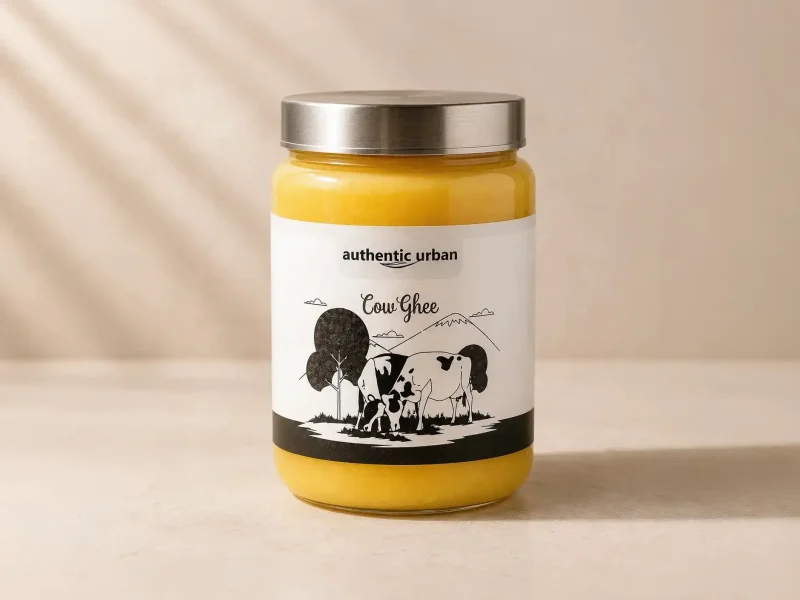 1 Litre
Halwa, ladoo, and paratha
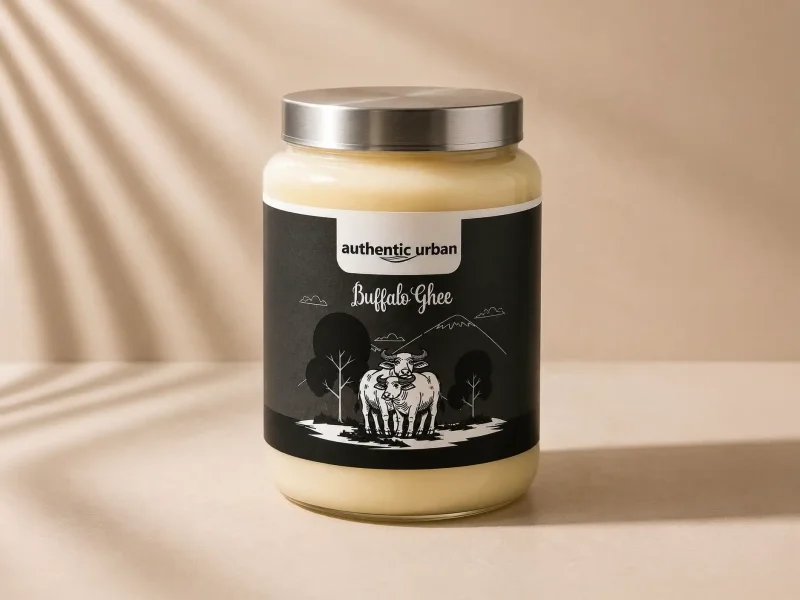 1 Litre
Each order is cooked after you place it, and the packing video is of that batch. Past order videos are on the shop.
FAQ
What are the benefits of ghee with warm water on an empty stomach?
We found no trial of ghee in warm water on an empty stomach. The drink is a household habit, and some people find it helps them pass stool in the morning. The benefits listed for it online, such as detox, weight loss, and glowing skin, are not shown. If you try it, keep to one teaspoon and count it in the day's 1 to 2 teaspoon limit. Stop if it causes loose motions or acidity.
Is ghee with milk at night good for you?
A teaspoon of ghee in warm milk at bedtime is a common home habit, and for a thin child or an underweight adult it adds about 44 kcal of easy energy. There is no trial showing it improves sleep or joints. For an adult watching weight or cholesterol, it is one more place the day's ghee hides, so count it with the ghee on roti and dal.
Does heating ghee destroy its benefits?
Not at tadka heat. Ghee is already cooked until its water is gone, and its fat, vitamin A, and flavour hold up in a short tadka. What spoils ghee is smoking it hard or frying in the same ghee again and again. For deep frying, use oil, and do not keep reusing it. Keep ghee for the finishing spoon and the tadka, where you taste it.
Can ghee replace cooking oil completely?
Not if you want the benefits without the harm. ICMR-NIN's 2024 guidelines cap ghee or butter at 1 to 2 teaspoons a day, inside a total of 20 to 50 g of visible fat depending on activity. Cooking every dish in ghee would pass that line by lunch. Use a plant oil such as groundnut or mustard for most cooking, and keep ghee for the spoon on top.
Is ghee good for the brain?
The brain is mostly fat, which is why ghee is often called brain food, but no human trial shows that eating ghee improves memory or focus. Ayurveda texts describe ghee as good for the mind, and that is tradition, not a test. What the brain needs from food is a balanced diet with enough omega-3 from walnuts, flaxseed, or fish. A teaspoon of ghee can be part of that plate.
Do benefits of ghee show up in blood tests?
Not the ones on this page. Absorbing vitamins from vegetables, feeling full, and tolerating ghee better than milk are not things a routine test measures. What a lipid test can show is the cost of too much ghee: LDL cholesterol creeping up. If you have eaten more than 2 teaspoons a day for months, a lipid profile at your next check-up tells you whether to cut back.
About the editorial team
Authentic Urban TeamBilona ghee makers, Gir Somnath, Gujarat
We are the Parmar family in Gir Somnath, Gujarat. We have made ghee here since 2016 and sold it online since 2025. We make only Bilona ghee, test it every month, and anyone is welcome to visit and watch it being made. Our Gir cows and Jafarabadi buffalo are grass-fed village animals that graze near the Gir forest, with no hormones or milk boosters. We set their milk to curd, churn it, and cook the makkhan on a wood chulha. These articles come from that kitchen and from what customers ask us on WhatsApp. We are ghee makers, not doctors.
Sources
- Dietary Guidelines for Indians, 2024 (fats and fat-soluble vitamins, printed p. 9; Guideline 7, printed pp. 52-54), ICMR-National Institute of Nutrition. Checked 27 Sep 2026.
- Butter oil, anhydrous (FDC ID 173412), SR Legacy, USDA FoodData Central. Checked 27 Sep 2026.
- Carrots, raw (FDC ID 170393), SR Legacy, USDA FoodData Central. Checked 27 Sep 2026.
- Food Safety and Standards (Food Products Standards and Food Additives) Regulations, Chapter 2.1: Dairy products and analogues, version 01.09.2023 (ghee standard, p. 27), FSSAI. Checked 27 Sep 2026.