Eggs With Ghee: Omelette, Scrambled, Fried and How Much
Eggs with ghee need less ghee than most recipes say: 1 level teaspoon (about 4 g) cooks a 2-egg omelette, scramble, or bhurji for one, and 1½ teaspoons is enough for crisp fried eggs. Keep the flame at medium or lower. That teaspoon adds about 37 kcal to the plate, by USDA figures.
How much ghee do you need for eggs?
One level teaspoon of ghee (about 4 g) for every 2 eggs. That coats a 20 cm pan, keeps a scramble soft, and browns an omelette. Crisp fried eggs you baste take 1½ teaspoons, and a 4-egg bhurji for two takes 2. Pick your style in the card below; the flame, time, and "done" sign are what matter more than the amount.
Style (2 eggs)
Ghee
Flame and time
Done when
Masala omelette
Ghee: 1 tsp (4 g)
Medium, then low, 3 to 4 min
Top just set, underside golden. Fold and slide out.
Soft scrambled eggs
Ghee: 1 tsp (4 g)
Low to medium-low, 3 to 4 min
Soft, shiny curds with no liquid egg left in the pan.
Fried eggs, crisp edges
Ghee: 1½ tsp (6 g)
Medium-high, then medium, 2 to 3 min
Brown, lacy edges. Whites set right up to the yolk.
Fried eggs, soft whites
Ghee: 1 tsp (4 g)
Low, lid on, 4 to 5 min
No brown at all. Whites set, yolk as firm as you like.
Egg bhurji (4 eggs, serves 2)
Ghee: 2 tsp (8 g)
Medium for the masala, low for the eggs, 8 to 10 min
Small dry-looking curds coated in masala.
Boiled eggs, ghee on top
Ghee: ½ tsp (2 g), melted
None for the ghee, Pour on while warm
Salt, pepper, and a pinch of jeera powder.
Amounts are level teaspoons. Pan: 20 cm (8 inch) for 2 eggs, 24 cm for 4.
Many egg pages, including the old version of this one, say 1 to 2 teaspoons of ghee per egg. For two eggs that is up to 4 teaspoons, about 150 kcal of ghee on one plate. ICMR-NIN's 2024 dietary guidelines suggest limiting ghee or butter to 1 to 2 teaspoons for the whole day. Two eggs cannot soak up 4 teaspoons anyway; the rest pools on the plate. At home our own 1 to 2 teaspoons a day go on roti, dal, and khichdi, so a teaspoon in the egg pan is most of a day's ghee, not a side note. To plan your family's ghee and oil across the day, use our ghee calculator.
Measuring a teaspoon when the ghee is set
A teaspoon is only a teaspoon if it is level. In our kitchen in Gir Somnath, ghee stays liquid in the jar through summer, and in winter the richer milk gives ghee that cools to a fine grain. A heaped spoon of set, grainy ghee can hold nearly twice a level one. Scrape it flat against the rim, or melt it in the pan first and judge by eye: a teaspoon of melted ghee just covers the base of a 20 cm pan in a thin film. The grain itself is normal, and why ghee is grainy is the question we get most on WhatsApp.
How do you make a ghee omelette?
Beat 2 eggs with the masala, pour them into 1 teaspoon of hot ghee on a medium flame, set the underside for about 2 minutes, then fold on a low flame. This is the Indian masala omelette most homes make with bread or paratha.
Ingredients (1 omelette)
- 2 large eggs (about 100 g)
- 1 tsp ghee (about 4 g)
- 1 small onion, finely chopped (about 30 g)
- 1 green chilli, finely chopped
- 1 tbsp chopped coriander
- 1 small tomato, seeds removed, chopped (optional, about 20 g)
- ¼ tsp salt, a pinch of haldi, a pinch of red chilli powder
Steps
- 1. Beat everything except the ghee for 30 seconds, until the egg is one colour and a little frothy.
- 2. Heat a 20 cm pan on medium for 1 minute. Add the ghee and swirl; it should run thin and shimmer, not smoke.
- 3. Pour in the eggs and spread the onion evenly with the spatula. Leave it for 60 to 90 seconds.
- 4. Lift an edge and tilt the pan so raw egg runs underneath. Do this twice.
- 5. When the underside is golden and the top only looks damp, turn the flame to low and fold in half.
- 6. Give it 30 seconds more, then slide it onto the plate.
Seed the tomato, or the juice leaks and the omelette steams instead of browning. For a plain French-style omelette, leave out the masala, keep the flame at medium-low the whole time, and fold while the centre is still soft. For a full breakfast, roll the omelette inside a ghee paratha and you have a street-style egg roll; skip extra ghee on the paratha and the plate stays at about 2 teaspoons.
How do you make scrambled eggs with ghee?
Melt 1 teaspoon of ghee on a low flame, pour in 2 beaten eggs, and fold them slowly for 3 to 4 minutes until no liquid egg is left but the curds still shine. Low heat is the whole trick; ghee's high smoke point does not help a scramble at all.
-
1. Beat
Fork-beat 2 eggs for about 20 seconds, until no streaks of white remain. Salt now or at the end; salt at the end if your eggs weep.
-
2. Melt the ghee low
Non-stick: pan and ghee go on together, low to medium-low. Steel or iron: heat the pan 1 minute first. The ghee should run clear, never smoke.
-
3. Wait 20 seconds
Pour in the eggs and do nothing until the edges begin to set.
-
4. Fold, do not stir
Push the set egg from the edge to the centre every 10 seconds. Large, slow folds make soft curds; fast stirring makes small dry ones.
-
5. Off the flame early
At 2 to 3 minutes, when no liquid egg is left and the curds look shiny, take the pan off. It keeps cooking for a few seconds.
One plate (2 large eggs, 1 teaspoon ghee): about 180 kcal, 12.6 g protein, and 13.8 g fat, worked out from USDA FoodData Central. Serve with a soft chapati or toast. A soft, glossy scramble still has no runny egg in it. For children, older family, and pregnant women, keep folding until the curds are firm (see the safety section below).
How do you fry eggs in ghee?
For crisp, lacy edges, fry 2 eggs in 1½ teaspoons of ghee on a medium-high flame for 2 to 3 minutes and spoon the hot ghee over the whites. For soft whites with no brown, use 1 teaspoon on a low flame with a lid for 4 to 5 minutes. This is where ghee earns its place over butter, because the crisp version needs heat that burns butter.
Crisp edges (sunny side up)
- 1. Heat 1½ tsp ghee on medium-high until it shimmers.
- 2. Crack each egg into a katori first, then slide it in. The edges bubble at once.
- 3. After 1 minute, turn the flame to medium. Tilt the pan and spoon the ghee over the white near the yolk, where it sets last.
- 4. At 2 to 3 minutes the edges are brown and the white is set up to the yolk. Salt and pepper on the plate.
Soft whites, firm yolk
- 1. Melt 1 tsp ghee on a low flame.
- 2. Slide in the eggs and add 1 tbsp water beside them, not on them.
- 3. Lid on for 4 to 5 minutes. The steam sets the top.
- 4. Lift the lid when the yolk is covered by a thin white film and firm to a light touch. No flipping, no brown.
Blue-grey smoke means the pan is too hot for eggs, even for the crisp style. Frying heat for puri and pakora is a different job; how hot ghee can go and when to use oil instead are on ghee smoke point.
How do you make egg bhurji in ghee?
For 4 eggs (serves 2), 2 teaspoons of ghee is enough: bloom the jeera, cook the onion and tomato into a soft masala on medium, then add the beaten eggs on low and scramble into small curds. Old recipes, including ours, called for 2 tablespoons. That is six teaspoons, three times what the pan needs.
Ingredients (serves 2)
- 4 large eggs (about 200 g), beaten with ¼ tsp salt
- 2 tsp ghee (about 8 g)
- ½ tsp jeera
- 1 medium onion, finely chopped (about 80 g)
- 1 medium tomato, chopped (about 80 g)
- 1 to 2 green chillies, ½ tsp grated ginger
- ¼ tsp haldi, ½ tsp red chilli powder, ¼ tsp garam masala or pav bhaji masala
- 2 tbsp chopped coriander
Steps
- 1. Heat the ghee on medium. Add jeera; it should sizzle and brown in about 10 seconds.
- 2. Add onion, chilli, and ginger. Cook 3 to 4 minutes until the onion is soft and light gold.
- 3. Add tomato and the powders. Cook 2 to 3 minutes until the tomato breaks down and the ghee shows at the edges.
- 4. Turn the flame to low. Pour in the eggs, wait 20 seconds, then scramble and break into small curds for 2 to 3 minutes.
- 5. When no liquid egg is left, add the garam masala and coriander, and take it off the flame.
The same bloom-then-masala start is a tadka, the base of most Indian ghee cooking, which we cover on cooking with ghee. If you want the bhurji to taste of ghee, keep back ½ teaspoon of the 2 and stir it in at the end instead of adding more.
Is ghee better than butter or oil for eggs?
For fried eggs and omelettes, yes: ghee takes medium-high heat without the browning and bitter smell butter gets. For a soft scramble on a low flame, butter works as well, and the choice is taste. Oil is fine for any of them if you want no dairy taste at all.
In the egg pan
Ghee
Butter
Smoke point
Ghee: 220 to 240°C (428 to 464°F)
Butter: 140 to 180°C (284 to 356°F)
What burns first
Ghee: Almost nothing left to burn: 0.28 g protein per 100 g
Butter: Milk solids and water: 0.85 g protein, 16.2 g water per 100 g
Per teaspoon
Ghee: About 37 kcal, 2.6 g saturated fat
Butter: About 34 kcal, 2.4 g saturated fat
Best for
Ghee: Crisp fried eggs, omelette, bhurji, anything on medium-high
Butter: Soft scramble on a low flame
Taste
Ghee: Toasted, nutty
Butter: Milky and sweet; turns bitter if it browns too far
Smoke points: Kumar and Jadhav, Frontiers in Food Science and Technology, 2026, Table 2. Protein, water, calories, and saturated fat: USDA FoodData Central 173412 (butter oil) and 173430 (unsalted butter). Checked 26 September 2026.
Two claims on other egg pages need correcting. The "ghee smokes at 485°F" figure is quoted everywhere without a source; the 2026 Frontiers review puts ghee at 220 to 240°C (428 to 464°F) in its comparison table, and about 250°C in its text. Either way, an egg pan never needs to go near it. And ghee is not cholesterol-free: USDA lists 256 mg per 100 g, about 11 mg in a teaspoon. That is small next to the egg itself, which USDA puts at about 186 mg for one large egg. What cholesterol and saturated fat mean for your own report is on is ghee bad for cholesterol, and the full ghee and butter comparison beyond eggs is on ghee vs butter.
How many calories in eggs cooked in ghee?
Two large eggs cooked in 1 teaspoon of ghee come to about 180 kcal, 13.8 g fat, and 5.8 g saturated fat, by USDA FoodData Central figures. The eggs do not change between rows below; the ghee spoon does.
Plate
kcal
Fat
Saturated fat
2 boiled eggs, no ghee
143 kcal
Fat 9.5 g
Saturated fat 3.1 g
2 eggs + ½ tsp ghee
162 kcal
Fat 11.6 g
Saturated fat 4.4 g
2 eggs + 1 tsp ghee (this page)
180 kcal
Fat 13.8 g
Saturated fat 5.8 g
2 eggs + 2 tsp ghee
218 kcal
Fat 18.0 g
Saturated fat 8.4 g
2 eggs + 4 tsp ghee ("2 tsp per egg")
293 kcal
Fat 26.5 g
Saturated fat 13.7 g
Worked out from USDA FoodData Central 171287 (raw whole egg, 50 g a large egg) and 173412 (butter oil, 4.27 g a teaspoon), checked 26 September 2026. Frying loses water, not calories, so the numbers hold for cooked eggs. Onion, tomato, and bread are extra.
The jump from the highlighted row to the last one is 113 kcal and 8 g of saturated fat, with nothing gained in the pan. For a day's picture, ICMR-NIN's 2024 guidelines put visible fat (all cooking oil and ghee together) at 20 to 50 g a day depending on activity, and ghee or butter at 1 to 2 teaspoons of that. If you are eating eggs to build muscle or gain weight, add an egg rather than more ghee; the protein comes from the egg. Our pages on ghee for muscle building and how many calories in ghee go further.
Why do eggs stick, turn rubbery, or taste bitter?
Almost always the flame or the timing, not the amount of ghee. Find your problem below.
Eggs stick to a steel or iron pan
The pan went in cold, or the eggs were moved too soon.
Fix: Heat the dry pan 1 minute first, then the ghee. Leave the egg alone for 60 to 90 seconds; it lets go on its own once set.
Scrambled eggs turn rubbery and watery
Too high a flame, or cooked past the shiny stage.
Fix: Low flame, slow folds, and off the heat the moment no liquid egg is left. Salt at the end if water keeps seeping out.
Omelette tears when you fold it
Too many eggs for the pan, or folded too late.
Fix: 2 eggs in a 20 cm (8 inch) pan. Fold while the top still looks damp; it finishes on the plate.
Eggs taste bitter or smell burnt
The ghee smoked, or the jar itself is overcooked.
Fix: Blue-grey smoke means start again with fresh ghee on a lower flame. If the ghee smells burnt straight from the jar, the jar is the problem.
Greasy plate with ghee pooling
More ghee than the eggs can take up.
Fix: Measure 1 level teaspoon. Two eggs cannot absorb 4 teaspoons, so the rest ends up on the plate.
The bitter egg is worth a second look. At the chulha, a batch of ghee cooked too long turns dark and bitter and smells burnt, and one taken off too early stays cloudy, holds moisture, and turns sour fast. We never pack either, but both reach kitchens, and a plain egg shows them more than a masala dish does. If the ghee smells off before it touches the pan, run the checks on how to identify pure ghee.
Are runny eggs safe, and how long do cooked eggs keep?
For most healthy adults a soft scramble or runny yolk is a personal choice, but the US FDA's egg advice is to cook eggs until yolk and white are firm, and it says scrambled eggs should not be runny. The FDA names children, older adults, pregnant women, and people with weakened immunity, including people with diabetes, as the groups at greater risk of severe illness.
So in a mixed family, cook the child's and grandparent's eggs to firm and let the rest choose. Ghee does not change this either way. For a toddler's plate, the ghee amount and the rest of the day's fat are on ghee for toddlers.
Leftovers: the FDA says never leave cooked eggs out for more than 2 hours, or 1 hour above 90°F (32°C), which covers most Indian summer afternoons. Refrigerated, a cooked egg dish should be used within 3 to 4 days. For a tiffin, bhurji keeps better than an omelette; pack it cold with an ice pack in summer and do not leave the box in a hot bag till lunch. Reheat gently in a pan, with no extra ghee needed, since the ghee already in the bhurji melts back out. Fried eggs do not reheat well; make them fresh.
Eggs with ghee: a checklist for the pan
Screenshot this and keep it by the stove.
- 1. 1 level teaspoon of ghee for 2 eggs. 1½ for crisp fried eggs, 2 for a 4-egg bhurji.
- 2. Medium flame at most. If the ghee smokes blue-grey, the pan is too hot for eggs.
- 3. Heat the pan before the ghee on steel or iron; non-stick can start cold.
- 4. Leave eggs alone for the first 60 seconds. They release when they are ready.
- 5. Children, older family, pregnant women: yolk and white firm, no runny scramble.
- 6. Cooked eggs: in the fridge within 2 hours, eaten within 3 to 4 days.
- 7. Smell the ghee before it goes in. Toasted milk is right; burnt or sour is not.
Which ghee for eggs?
For eggs, buy a plain jar with nothing added that smells of toasted milk when it melts. A plain scramble shows off a good jar and gives away a bad one faster than any dal. Cow ghee is lighter and yellower, which suits a plain omelette; buffalo ghee is richer and whiter and holds its own with onion, tomato, and masala. Our ranking of the cow ghee on sale, with prices, is best cow ghee in India.
We make and sell ghee, so weigh this with that in mind. For the morning omelette or scramble we would use our A2 Gir cow ghee; for bhurji rolled into a paratha, our Jafarabadi buffalo ghee. Both come from grass-fed village animals near the Gir forest, are set to curd overnight, churned, and cooked in a matki on a wood chulha. The jar is made after you order, with a video of it being cooked and packed sent on WhatsApp, and Varsha tastes every batch before it goes in a jar. We test every month against the FSSAI limits; the steps are on how we make ghee.
Omelette, scramble, fried eggs
 1 Litre
Egg bhurji and egg paratha rolls
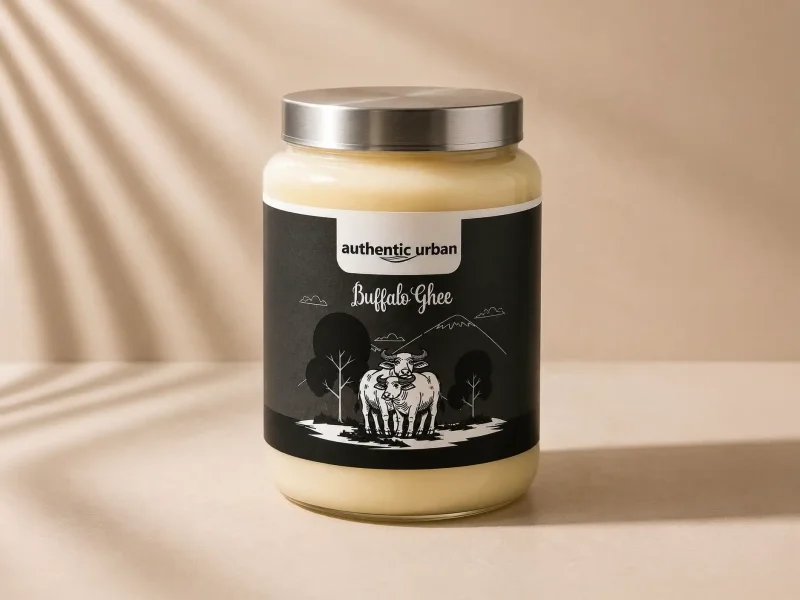 1 Litre
Each order is cooked after you place it, and the packing video is of that batch. Past order videos are on the shop.
FAQ
Can we eat egg and ghee together?
Yes. Eggs cooked in ghee are an everyday Indian breakfast, from masala omelette to anda bhurji with paratha. We could not find any ICMR-NIN or FSSAI guidance that warns against the pair. The real limit is quantity: ICMR-NIN's 2024 guidelines suggest keeping ghee or butter to 1 to 2 teaspoons a day, so one teaspoon in the egg pan is half to all of that.
Can I give my child eggs cooked in ghee?
Yes, once your child's doctor says eggs are fine for them. Use ½ teaspoon of ghee for one egg and cook it until the yolk and white are both firm. The US FDA lists children among the people at higher risk of serious illness from undercooked eggs, and says scrambled eggs should not be runny. Skip the green chilli and go easy on salt for small children.
Are eggs with ghee good for weight gain?
They help, but add an egg before you add more ghee. By USDA figures, one large egg brings about 72 kcal and 6.3 g of protein, while a teaspoon of ghee brings about 37 kcal and almost no protein. Three eggs with 1 teaspoon of ghee, rolled into a ghee paratha, is a steadier gain breakfast than two eggs swimming in 4 teaspoons.
Are eggs cooked in ghee okay for weight loss?
Yes, if you watch the spoon. Two boiled eggs are about 143 kcal by USDA figures. With ½ teaspoon of ghee poured over they come to about 162 kcal, and with the "2 teaspoons per egg" some recipes use, about 293 kcal. Cook on non-stick with ½ teaspoon, fill the plate with onion, tomato, and spinach, and count the rest of the day's ghee.
Can I put ghee on boiled eggs?
Yes. Halve two warm boiled eggs and pour ½ teaspoon of melted ghee over them with salt, black pepper, and a pinch of roasted jeera powder or chaat masala. Warm the ghee in a small tadka pan only until it melts. You can also bloom a few mustard seeds and curry leaves in that ½ teaspoon first for a South Indian style egg.
Can I use ghee for egg curry?
Yes. For anda curry for four (6 eggs), 1 tablespoon of ghee is enough for the whole pot: bloom jeera and bay leaf, cook onion and ginger-garlic until golden, then tomato and masala until the ghee shows at the edges. Add water, then the boiled eggs, and simmer 5 minutes. Shallow-frying the boiled eggs first takes another teaspoon; the curry works without it.
About the editorial team
Authentic Urban TeamBilona ghee makers, Gir Somnath, Gujarat
We are the Parmar family in Gir Somnath, Gujarat. We have made ghee here since 2016 and sold it online since 2025. We make only Bilona ghee, test it every month, and anyone is welcome to visit and watch it being made. Our Gir cows and Jafarabadi buffalo are grass-fed village animals that graze near the Gir forest, with no hormones or milk boosters. We set their milk to curd, churn it, and cook the makkhan on a wood chulha. These articles come from that kitchen and from what customers ask us on WhatsApp. We are ghee makers, not doctors.
Sources
- Egg, whole, raw, fresh (FDC ID 171287), SR Legacy, USDA FoodData Central. Checked 26 Sep 2026.
- Butter oil, anhydrous (FDC ID 173412), SR Legacy, USDA FoodData Central. Checked 26 Sep 2026.
- Butter, without salt (FDC ID 173430), SR Legacy, USDA FoodData Central. Checked 26 Sep 2026.
- Understanding the techno-functionality of ghee as a cooking medium (Kumar D, Jadhav HB), Frontiers in Food Science and Technology, 2026 (Table 2, smoke points), Frontiers. Checked 26 Sep 2026.
- What You Need to Know About Egg Safety, US Food and Drug Administration. Checked 26 Sep 2026.
- Dietary Guidelines for Indians, 2024 (Guideline 7, printed p. 54), ICMR-National Institute of Nutrition. Checked 26 Sep 2026.