Gulab Jamun Recipe: Soft Khoya Jamuns Fried in Ghee
This gulab jamun recipe makes about 20 soft jamuns from 200 g of soft khoya and just 25 g of maida. Roll smooth balls, fry them in ghee on a low flame for 8 to 10 minutes until deep golden, and soak them in warm syrup that is sticky but short of one string for at least 2 hours.
How do you make soft gulab jamun at home?
Use soft khoya with very little maida, about 8 parts to 1, and press the dough together without kneading. Fry the balls on a low flame so they take 8 to 10 minutes to brown, then put them straight into warm, sticky syrup for 2 hours. A soft jamun comes down to those five numbers, and a hard one almost always misses one of them.
Dough
200 g khoya : 25 g maida
About 8 parts khoya to 1 part maida. More maida is the most common reason for a hard jamun.
Ghee heat
A pinch of dough sinks, then rises slowly
If it pops up at once with a loud sizzle, the crust will brown before the centre cooks.
Frying time
8 to 10 minutes a batch
Faster than 6 minutes means the ghee is too hot and the core stays raw and hard.
Syrup
Sticky between two fingers, no string
A one-string syrup is too thick to soak in, and the jamuns shrink and wrinkle.
Soak
At least 2 hours in warm syrup
They should double in size and sink. Pale in the middle means they need longer.
This page is the khoya gulab jamun fried in ghee, the way a halwai makes it. If you are making a whole Diwali tray, the other two syrup sweets fried in the same kadhai are desi ghee jalebi and motichoor ladoo.
Gulab jamun recipe: ingredients and steps
Make the syrup before you touch the khoya, so it is warm and waiting when the first batch comes out of the ghee. The whole recipe takes about an hour of work and 2 hours of soaking.
Ingredients (about 20 jamuns)
Jamuns
- 200 g soft khoya (dhap or chikna), grated
- 25 g maida (3 level tbsp)
- A pinch of baking soda (about ⅛ tsp)
- 1 to 2 tbsp milk, only if the dough is dry
- About 500 ml ghee for frying, in a small deep kadhai
Syrup
- 300 g sugar (1½ cups)
- 360 ml water (1½ cups)
- 4 green elaichi, crushed
- ½ tsp lemon juice, 1 tsp rose water, a few saffron strands
Steps
- 1. Syrup. Sugar, water, and elaichi in a wide pan. Once the sugar melts, boil 5 to 6 minutes until sticky between two fingers, with no string. Add lemon, rose water, and saffron. Keep warm.
- 2. Dough. Grate the khoya. Rub in the maida and soda with your fingertips for a minute. Add milk a teaspoon at a time and press into a soft dough. Do not knead.
- 3. Balls. Divide into 20 (about 11 g each). Grease your palms with ghee and roll each one smooth, with no cracks or lines. Cover with a damp cloth.
- 4. Ghee. Heat on medium, then turn to low. Drop in a pinch of dough: it should sink and rise slowly with small bubbles.
- 5. Fry. 6 to 8 balls at a time. Swirl the ghee over them; do not push them. 8 to 10 minutes to an even deep golden brown.
- 6. Soak. Rest 1 to 2 minutes, then into the warm syrup. Soak at least 2 hours, until they double and sink.
The balls look small, about the size of a large grape. They double in the syrup, so a ball rolled to the size you want to serve comes out too big to eat in two bites. Keep all 20 the same size so each batch browns at the same pace.
Which khoya is best for gulab jamun?
Soft, moist khoya, sold as dhap or chikna khoya, and in many sweet shops simply as "gulab jamun khoya". FSSAI's 2020 guidance note on milk products describes three kinds: dhap khoa, granular with a slightly soft body; pindi khoa, smooth, compact, and finely grained; and danedar khoa, with big brown grains. Dhap makes the softest jamun.
Dhap or chikna khoya
Soft, moist, slightly sticky. FSSAI describes dhap khoa as granular with a slightly soft body.
Maida: 25 g (3 level tbsp) for 200 g. Little or no milk.
The one to buy. Many sweet shops sell it as "gulab jamun khoya".
Pindi or batti khoya
Firm block, smooth, very fine grain, drier.
Maida: 25 g for 200 g, plus 2 to 3 tbsp milk. Grate it and rest the dough 10 minutes.
Works if grated fine and softened with milk. Crumbly dough means it needs more milk, not more maida.
Danedar khoya
Big brown grains, made for kalakand and milk cake.
Maida: Not recommended.
The large grains make a coarse jamun that cracks in the ghee.
Milk powder dough
Full-fat milk powder, maida, ghee, and milk, mixed on the day.
Maida: 100 g milk powder, 25 g maida, 1 tbsp ghee, pinch of soda, 3 to 4 tbsp milk.
Lighter and softer, less milky. A good choice when fresh khoya is hard to find.
Khoya types as described in FSSAI's Guidance Note on Safety and Quality of Traditional Milk Products (2020), p. 5. Checked 28 September 2026.
The same FSSAI note says cow milk khoa is pale yellow with a moist surface, and buffalo milk khoa is white with a slightly greasy one. Both make good jamuns; buffalo khoya gives a whiter, richer crumb. Whatever you buy, smell it. Fresh khoya smells of boiled milk. A sour or cheesy smell means it is old, and it will taste that way through the syrup.
The one change that ruins more jamuns than any other is extra maida. Maida only holds the ball together. When a dry khoya makes the dough crumble, the fix is milk, a teaspoon at a time, not more flour.
How hot should the ghee be for gulab jamun?
Low: cooler than for puri or pakora. Drop a pinch of dough into the ghee. It should sink to the bottom and float up slowly, trailing fine bubbles. If it shoots up at once and the ghee roars, the jamuns will brown in 3 minutes with a raw, hard centre. If it sits on the bottom with no bubbles, wait a minute.
Minutes
What you see
What to do
First minute
Balls sink, then lift off the bottom slowly with a ring of fine bubbles.
Do: Do not poke them. Swirl the ghee gently with a spoon so it rolls over the tops.
2 to 5 minutes
They float, swell a little, and turn pale cream to light gold.
Do: Keep the flame low. Turn them by swirling the ghee, not by pushing with the ladle.
6 to 10 minutes
Even deep golden brown all over, the colour of a dark walnut shell on the darkest side.
Do: Lift them out when evenly brown. Rest 1 to 2 minutes, then into the syrup.
Too fast
Brown in 3 or 4 minutes, sizzling hard, dark patches.
Do: Ghee too hot. Take the kadhai off the flame for a minute before the next batch.
Use a small, deep kadhai rather than a wide one. The balls need enough ghee to float free, and a narrow pan gets that depth from about 500 ml. Each batch cools the ghee, so give it a minute to come back and repeat the dough test before the next lot.
Low and slow is how we make the ghee itself. At our chulha in Gir Somnath, the makkhan cooks in a matki on a low flame for 45 to 90 minutes, and it comes off when the bubbling goes quiet and the milk solids turn golden-brown. Jamuns are milk solids too, and they reward the same patience. One warning from that kitchen: ghee is only ready once all its water has boiled off, so hot ghee is far hotter than boiling dal, and a splash burns worse. Slide the balls in from a spoon held close to the surface; never drop them from a height. How ghee behaves at frying heat is on ghee for deep frying.
How thick should the sugar syrup be, and how long do you soak?
Sticky but short of one string. Cool a drop on a spoon, touch it between thumb and finger, and pull apart: it should feel tacky and not form a thread. For 300 g of sugar in 360 ml of water, that takes 5 to 6 minutes of boiling after the sugar dissolves.
Many recipes ask for one-string syrup. That thickness suits jalebi, which is dipped for seconds, but a jamun has to drink syrup into its centre for hours. In a thick syrup the outside takes up sugar faster than the inside can, and the jamuns shrink and wrinkle. The lemon juice stops the syrup from crystallising as it sits.
Temperature matters as much as thickness. Hot jamuns go into warm syrup, warm enough that you can keep a finger in it for a second. Boiling syrup softens the crust so they break; cold syrup barely soaks in. Leave them at least 2 hours. They are ready when they have doubled, sunk, and a cut one is the same colour right through. Overnight is fine and makes them softer still.
Why are my gulab jamuns hard, cracked, or dissolving?
Usually the maida, the kneading, or the heat of the ghee. Find the problem you see below.
Hard or dense in the middle
Too much maida, the dough kneaded like roti dough, or ghee so hot the crust set before the centre cooked.
Fix: Keep maida at 25 g for 200 g khoya. Only press the dough together. Fry low for 8 to 10 minutes. Already made: simmer them in the syrup on the lowest flame for 5 to 8 minutes.
Cracks on the balls, or they split in the ghee
Dry dough, or balls rolled with pressure so the surface tears.
Fix: Add milk a teaspoon at a time until the dough is soft. Grease your palms with ghee and roll with light pressure until the surface has no lines.
Dissolving or breaking up in the ghee
Too little maida for a soft khoya, too much soda, or ghee too cool.
Fix: Fry one test ball first. If it spreads, knead in 1 tsp more maida. Keep soda to a pinch.
Raw and pale inside after soaking
Fried too fast on high heat.
Fix: Next batch, lower the flame and give it the full 8 to 10 minutes.
Shrunk and wrinkled in the syrup
The syrup was boiled to one string or more, or the jamuns went in cold.
Fix: Stir 3 to 4 tbsp hot water into the syrup, warm it, and put the jamuns back.
Soggy, falling apart in the syrup
Syrup boiling hot when they went in, or too much soda in the dough.
Fix: Let the syrup cool to warm (you can hold a finger in it) before the jamuns go in.
Greasy, with ghee on the syrup
Ghee too cool, so the balls sat and soaked, or they were not drained.
Fix: Keep the dough test in mind between batches. Lift, hold over the kadhai for a few seconds, then into the syrup.
Fry one test ball before the first batch. It costs you one jamun and tells you whether the dough holds, whether it cracks, and whether the ghee is at the right heat, while you can still fix all three.
What does a good gulab jamun look like?
Soft, thin crust, spongy inside, soaked through with no hard core. FSSAI's 2020 guidance note on milk products gives a quality check for gulab jamun, and it doubles as a checklist for your own batch or a box from the sweet shop. Cut one open to check.
- ✓ Crust: soft and thin, light to yellowish brown, the same colour all round.
- ✓ Shape: round or oval, smooth and glossy, no cracks.
- ✓ Inside: soft and spongy, a fine grain, no lump or hard core in the centre.
- ✓ Syrup: soaked right through, with no pale, dry ring in the middle when you cut one.
- ✓ Taste: fresh milk aroma, moderately sweet, no doughy or floury feel.
Adapted from the gulab jamun row of the quality check in FSSAI's Guidance Note on Safety and Quality of Traditional Milk Products (2020), p. 5.
Should you fry gulab jamun in ghee or oil?
Ghee, if you want the taste of a sweet shop jamun. The crust is fried milk solids, and frying them in ghee adds a toasted-milk flavour that stays through the syrup. Oil fries them just as well, but the jamun tastes of khoya and sugar and little else. Many homes fry in oil with a few spoons of ghee added; it helps a little.
Use a ghee that smells of toasted milk when it melts, not of nothing, and not sour. A flat or waxy smell in the kadhai shows up in every jamun. The home checks are on how to identify pure ghee.
How much ghee, and what does it cost?
About 500 ml fills a small, deep kadhai. Only a little of it goes into the jamuns; most comes back out. At our prices that is:
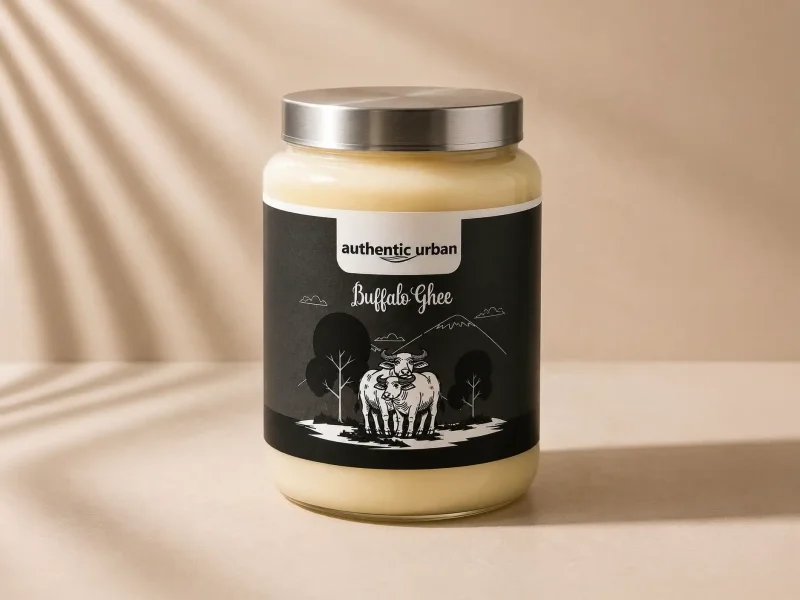
Buffalo ghee (₹1,999 a litre)
About ₹1,000 for 500 ml
Our pick for gulab jamun: the richer, rounder taste halwai sweets have.
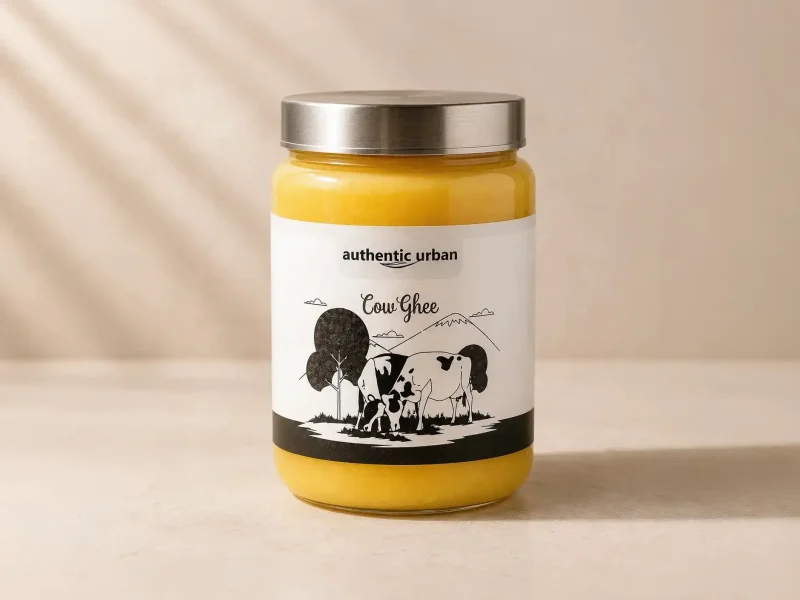
Cow ghee (₹2,399 a litre)
About ₹1,200 for 500 ml
A lighter jamun with a sharper toasted-milk smell.
So plan the leftover. ICMR-NIN's 2024 dietary guidelines say fat once used for frying should be filtered and can go into a curry, but should not be used for frying again. After jamuns, strain the ghee through a fine cloth while warm and use it for the next halwa, sheera, or dal within a day or two. It carries a little sugar and khoya, which darken fast on a second fry. The full rule is on what to do with leftover frying ghee.
Cow or buffalo ghee?
Buffalo ghee is our pick for gulab jamun. It has the full, rounded taste halwai sweets are known for, and it costs about ₹400 a litre less, which counts when half a litre goes into the kadhai. Cow ghee gives a slightly lighter jamun with a sharper toasted smell. The two are compared side by side on cow vs buffalo ghee. If your jar has set grainy in winter, that is normal and melts away in the kadhai; the reason is on why ghee is grainy.
How do you make milk powder, kala jamun, or stuffed gulab jamun?
All three use the method above. Only the dough, the frying colour, or the centre changes.
Milk powder gulab jamun
Mix 100 g full-fat milk powder, 25 g maida, and a pinch of soda. Rub in 1 tbsp melted ghee, then add 3 to 4 tbsp warm milk a spoon at a time until it just comes together. It will look too soft; rest it 5 minutes and it firms up. Roll 14 to 16 small balls. They brown faster than khoya, so keep the flame at its lowest and expect 6 to 8 minutes. Low-fat milk powder gives dry, tight jamuns.
Kala jamun
Knead 1 tbsp powdered sugar into the khoya dough. The sugar caramelises in the ghee and turns the crust near black. Fry a minute or two longer on the same low flame; black should come from sugar, not from a flame that is too high. Kala jamun is firmer and holds its shape on a plate, so it is often rolled in desiccated coconut instead of served in syrup.
Stuffed gulab jamun
Flatten each ball in your palm, put in a pinch of chopped pistachio, cardamom, and a strand of saffron, or a few crystals of mishri, and close it into a smooth ball. Keep the filling small. A big filling leaves a thin wall that cracks in the ghee. Seal with light pressure and check for lines before frying.
For another sweet that is fried in ghee and eaten soaked, see malpua with rabdi.
How many calories are in a gulab jamun?
It depends on how much ghee and syrup your jamuns take up, and we could not find a study we could open that measures that for a home jamun, so we will not print a made-up number. What is fixed: ICMR-NIN's 2024 guidelines count 9 kcal for every gram of fat and 4 kcal for every gram of carbohydrate, including sugar.
What you can know is the ceiling on sugar. This batch of syrup holds 300 g of sugar across 20 jamuns, so no jamun can carry more than 15 g, and in practice it is less, because a good part of the syrup is always left in the bowl. The same guidelines say limiting sugar to 25 g a day is better for health and suggest limiting ghee or butter to 1 to 2 teaspoons a day. Two jamuns at a festival fit inside a day with little else sweet; a bowl after every meal does not. On a sweets day, go easy on ghee at the other meals. How the daily ghee budget works is on how much ghee per day, and with diabetes, the syrup matters more than the ghee; read can diabetics eat ghee and go by what your doctor or dietitian has set.
How long do gulab jamuns keep?
A few days, not weeks. FSSAI's 2020 guidance note on milk products says sweets made with milk have a short shelf life of 1 to 4 days and are more prone to microbial growth. Keep home jamuns covered, in their syrup, and in the fridge after the first day, or on the first day itself in hot weather. Finish them within 3 to 4 days.
In the fridge the syrup thickens and the jamuns firm up. Warm the bowl on a low flame or in the microwave in short bursts until the syrup loosens and the jamuns are soft again. Use a dry spoon every time you take some out. Throw the batch away if the syrup turns frothy or smells sour. The ghee jar itself does not need the fridge; that is on ghee storage and shelf life.
Gulab jamun: a recipe card to keep
Screenshot this before you start. Once the ghee is hot, you will not want to scroll with khoya on your hands.
- 1. For about 20 jamuns: 200 g soft khoya, 25 g maida (3 level tbsp), a pinch of baking soda, 1 to 2 tbsp milk. Ghee for frying: about 500 ml.
- 2. Syrup first: 300 g sugar, 360 ml water, 4 crushed elaichi. Boil 5 to 6 minutes after the sugar melts, until sticky between two fingers, no string. Add ½ tsp lemon juice, 1 tsp rose water, saffron. Keep warm.
- 3. Grate the khoya. Rub in the maida and soda. Add milk a spoon at a time and press into a soft dough. Do not knead.
- 4. Divide into 20 balls (about 11 g each). Roll between ghee-greased palms until smooth, with no cracks.
- 5. Ghee in a small, deep kadhai on medium, then low. A pinch of dough should sink, then rise slowly.
- 6. Fry 6 to 8 balls at a time, 8 to 10 minutes, swirling the ghee, until evenly deep golden brown.
- 7. Rest 1 to 2 minutes. Into warm, not boiling, syrup. Soak at least 2 hours. They double in size.
- 8. After frying: filter the ghee and use it for halwa or dal within a day or two. Do not fry in it again.
Which ghee for gulab jamun?
Half a litre of ghee goes in the kadhai, so it is worth picking one you would also eat on a roti: plain ghee, nothing added, that smells of toasted milk when it melts. For halwai sweets, buffalo ghee gives the richer taste; our ranking of what is on sale, with prices, is best buffalo ghee in India.
For gulab jamun we would use our Jafarabadi buffalo ghee, and our A2 Gir cow ghee if your family likes a lighter sweet. Both come from grass-fed village animals near the Gir forest. The milk is set to curd overnight, churned by hand (Bilona), and the makkhan cooked in a matki on a wood chulha. Each jar is made after you order, a video of it being cooked and packed comes on WhatsApp, and Varsha tastes every batch before it goes in a jar. We test every month against the FSSAI limits; the steps are on how we make ghee.
A lighter jamun, and the daily spoon
 1 Litre
Gulab jamun and fried sweets
 1 Litre
Each order is cooked after you place it, and the packing video is of that batch. Past order videos are on the shop.
FAQ
Gulab jamun kaise banate hain?
200 gram naram khoya ko kaddukas karo, usme 25 gram maida aur chutki bhar soda milao, aur thoda doodh daal kar bina gunde naram aata bana lo. 20 chikni goliyan banao. Ghee ko dheemi aanch par garam karo aur goliyon ko 8 se 10 minute tak gehra sunehra hone tak talo. Garam chashni mein daal kar kam se kam 2 ghante bhigne do.
Can I make gulab jamun from a ready mix?
Yes. Ready mixes are mostly milk powder, maida, and a raising agent, so they behave like the milk powder dough on this page. Add the milk or water slowly, because too much makes a sticky dough that spreads in the ghee. Rest the dough 5 minutes, roll smooth balls, and fry low and slow in ghee exactly as for khoya. The syrup and soak are the same.
Should I use baking soda or baking powder in gulab jamun?
Either works in a small amount. A pinch of baking soda, about ⅛ teaspoon for 200 g of khoya, is the traditional choice and gives a softer, more open crumb. Baking powder is milder and easier to get right, so use ¼ teaspoon if you are nervous. Too much of either makes jamuns puff up in the ghee, then break or turn soggy in the syrup.
Can I make gulab jamun a day ahead for a party?
Yes, and they are often better for it. Fry and soak them the day before, let them cool in the syrup, cover the bowl, and keep it in the fridge. On the day, warm the whole bowl gently on a low flame or in the microwave, so the syrup loosens and the jamuns turn soft again. Serve warm or at room temperature. Frying on the day is only needed for the crispest crust.
Can I give gulab jamun to my baby or toddler?
Not before age two. ICMR-NIN's 2024 dietary guidelines say no added sugar for children under two years old, and a gulab jamun sits in sugar syrup for hours. For an older child, half a small jamun at a festival is a treat, not a snack. Cut it into small pieces, as a whole round jamun is a size that can block a young child's airway.
How do I make gulab jamun for 40 or 50 people?
Plan two jamuns a person, so 100 jamuns means five times this recipe: 1 kg khoya, 125 g maida, 1.5 kg sugar, and 1.8 litres of water for the syrup. The ghee does not multiply; fry in batches and top it up from the jar when the level drops. Make the dough in two lots so it does not dry out while you roll, and keep the rolled balls under a damp cloth.
About the editorial team
Authentic Urban TeamBilona ghee makers, Gir Somnath, Gujarat
We are the Parmar family in Gir Somnath, Gujarat. We have made ghee here since 2016 and sold it online since 2025. We make only Bilona ghee, test it every month, and anyone is welcome to visit and watch it being made. Our Gir cows and Jafarabadi buffalo are grass-fed village animals that graze near the Gir forest, with no hormones or milk boosters. We set their milk to curd, churn it, and cook the makkhan on a wood chulha. These articles come from that kitchen and from what customers ask us on WhatsApp. We are ghee makers, not doctors.
Sources
- Guidance Note on Safety and Quality of Traditional Milk Products (quality check for khoa and gulab jamun, p. 5; shelf life of milk sweets, p. 2), 24 February 2020, FSSAI. Checked 28 Sep 2026.
- Dietary Guidelines for Indians, 2024 (energy per gram of fat and carbohydrate; ghee limit and used frying fat, Guideline 7; added sugar; children under two), ICMR-National Institute of Nutrition. Checked 28 Sep 2026.