Mysore Pak Recipe with Ghee: Soft or Porous, in Grams
For this Mysore pak recipe, boil 200 g sugar with 100 ml water to one-string syrup, whisk in 100 g besan, then stir in 250 g of hot ghee a few spoons at a time on a low flame until the mix froths and leaves the sides of the pan. Pour it into a tin and let it set. Stop at the first froth for soft ghee Mysore pak; cook a few minutes more for the porous kind.
Mysore pak recipe: how much besan, sugar, and ghee?
By weight, Mysore pak is 1 part besan, 2 parts sugar, and 2 to 2½ parts ghee: 100 g besan, 200 g sugar, and 200 to 250 g ghee for a 20-piece tin. Cups vary so much that grams are the only way to repeat a good batch. A cup of besan weighs about 92 g and a cup of ghee about 205 g, so "1 cup of each" gives you more than twice as much ghee as besan by weight.
Ingredients (20 pieces)
- 100 g besan (gram flour), about 1 cup, sifted twice
- 200 g sugar, 1 cup
- 100 ml water
- 250 g ghee (about 1¼ cups) for soft, or 200 g (about 1 cup) for porous
- ¼ tsp cardamom powder (optional)
Equipment: a heavy kadhai 22 to 26 cm across, a small pan to keep the ghee hot, a whisk, a flat wooden spatula, and an 18 to 20 cm (7 to 8 inch) square tin, greased.
Steps
- 1. Grease the tin and keep it next to the stove. Melt the ghee in the small pan and leave it on the lowest flame.
- 2. Whisk the sifted besan with 4 tbsp of the hot ghee into a smooth paste. This stops lumps when it meets the syrup.
- 3. Put the sugar and water in the kadhai on medium. Stir until the sugar dissolves, then let it boil without stirring for 4 to 6 minutes, to one string.
- 4. Turn the flame to low. Add the besan paste in three lots, whisking each one smooth before the next.
- 5. Switch to the spatula. Pour in 2 to 3 tbsp of hot ghee, stir hard until it hisses and soaks in, then add the next lot. Keep going for 8 to 10 minutes.
- 6. The mix turns lighter, frothy, and glossy, and starts to pull away from the sides. For soft Mysore pak, pour now.
- 7. For porous Mysore pak, keep stirring 3 to 5 minutes more, until it puffs up into a honeycomb and leaves the pan as one mass.
- 8. Pour into the tin in one go. Do not press it flat. Mark the pieces after 10 minutes and cut through after an hour.
One piece of soft ghee Mysore pak: about 168 kcal, 12.8 g fat (7.8 g saturated), 12.9 g carbohydrate, 10 g sugar, and 1.2 g protein, worked out from USDA FoodData Central for besan, sugar, and ghee, with the batch cut into 20. The porous version, made with 200 g ghee, is about 146 kcal a piece.
Be careful at step 5. Hot ghee going into bubbling sugar and besan spits, and ghee is much hotter than anything water-based on the stove. We see it every day at the chulha in Gir Somnath: ghee is ready only once all the water in the makkhan has boiled away, so a splash of hot ghee burns worse than a splash of boiling dal. Pour it close to the pan, down the side, with a long-handled ladle, and keep children away from the kadhai for these ten minutes.
Soft ghee Mysore pak or porous Mysore pak: what changes?
The two are the same batter with a different stop point. Soft ghee Mysore pak (the melt-in-the-mouth kind sold in Chennai sweet shops) takes more ghee and comes off the flame at the first froth. The older porous Mysore pak takes a little less ghee and cooks a few minutes longer, until the froth sets into a honeycomb.
Soft ghee Mysore pak
- Ghee
- 250 g (about 1¼ cups)
- Syrup
- Just one string
- Stop when
- The mix turns light, frothy, and glossy and just starts to leave the sides. About 8 to 10 minutes after the besan goes in.
- You get
- Fudge-soft, melts on the tongue, sheen of ghee on top. Cut after it sets.
- Per piece
- 168 kcal, ghee 12.5 g, about 3 tsp
Porous traditional Mysore pak
- Ghee
- 200 g (about 1 cup)
- Syrup
- One to one and a half strings
- Stop when
- Keep stirring 3 to 5 minutes past the froth, until it puffs into a honeycomb, darkens a shade, and leaves the pan as one mass.
- You get
- Firm and crumbly, with holes you can see and a brown streak through the middle.
- Per piece
- 146 kcal, ghee 10 g, about 2⅓ tsp
Per piece, one twentieth of the batch, counting all the ghee. USDA FoodData Central: besan 174288, sugar 169655, ghee 173412. Checked 28 September 2026.
If you are new to it, make the soft one first. It forgives a syrup that is a little short, and the stop point is easy to see. The porous kind asks you to keep stirring past the moment it looks done, which is where most home batches go hard. Whichever you make, the besan needs the same slow, low flame; our besan ladoo uses the same flour roasted in ghee without syrup, if you want a gentler sweet to start with.
How do you check one-string syrup for Mysore pak?
Take a drop of syrup on a spoon, let it cool for a few seconds, and press it between your thumb and first finger. Pull them apart: one thread that stretches and breaks is one string. If it just feels wet and sticky, boil another 30 seconds and test again.
With 200 g sugar and 100 ml water, it usually takes 4 to 6 minutes of boiling on medium. The bubbles tell you it is close: at first they are thin and quick, then they turn thick, slow, and glossy. Test every 30 seconds from there. Two strings, or a thread that will not break, is too far for soft Mysore pak; it will set hard. If that happens, take the pan off the heat, add 2 tbsp of water, stir, and bring it back to one string.
Not happy testing with your fingers? Drop a little syrup into a bowl of cold water. At one string it spreads into a soft thread that you cannot gather into a ball.
Why is my Mysore pak hard, crumbly, or oily?
Hard Mysore pak is almost always syrup past one string or cooking too long after the froth; crumbly pak is too little ghee or cutting it hot. Find your batch below.
Hard, brittle, like a biscuit
Syrup went past one string, or the mix was cooked long after the froth.
Fix: Test the syrup every 30 seconds once it bubbles thickly. Pour the moment the mix leaves the sides. A hard batch is still good crumbled over warm milk or ice cream.
Crumbly, falls apart when cut
Too little ghee for the besan, or it was cut while too hot.
Fix: Keep going with the ghee until the mix stops soaking it up and starts to shine. Let the tray sit 10 minutes before the first cut, and cut again only when it has fully set.
Soft, sticky, will not set
Syrup short of one string, or poured off the flame too early.
Fix: Scrape it back into the pan and cook on low 2 to 4 minutes more, stirring, until it froths and leaves the sides. Then pour again.
Oily, sitting in a pool of ghee
More ghee than the besan could hold, or cooked well past the stop point so the fat split out.
Fix: Tilt the tray once it is warm, not hot, and pour the loose ghee into a katori. Use it in dal or halwa within a few days.
Tastes of raw besan
The flame was too high, so the outside browned before the besan cooked through.
Fix: Cook on low to medium-low only. The smell should change from raw and beany to warm and nutty before you pour.
Lumps and white specks
Besan not sifted, or tipped into the syrup in one go.
Fix: Sift the besan twice. Add it in three lots and whisk each lot smooth before the next.
A burnt batch cannot be saved. If the mix turns dark brown all through and smells bitter, the besan has scorched, and no amount of cardamom hides it. We know that smell from ghee-making: a batch of ghee left too long on the chulha goes dark and bitter in the same way, and it never goes in a jar. Throw the Mysore pak out and start again on a lower flame.
Why does Mysore pak need so much ghee?
The ghee does three jobs at once: it cooks the besan, it makes the froth that turns into the soft crumb or the honeycomb, and it keeps each piece soft after it cools. Cut it much below 200 g for 100 g besan and you get a dry, dense slab.
Each spoon of hot ghee that hits the thick besan and syrup boils off a little moisture and traps air, which is why the mix hisses and rises. That is also why the ghee must be hot: cold ghee sits on top in a greasy layer instead of sinking in. Ghee copes with this long stirring because its own water and milk solids were cooked out when it was made; the heat side of it is on ghee smoke point.
Butter does not work here. Its water spits in the hot syrup and its milk solids brown into specks before the besan is done; the full difference is on ghee vs butter. Some sweet shops replace part of the ghee with oil, which keeps the pak softer for longer and costs less, but it tastes of besan and sugar rather than ghee. If you want to try it, swap no more than a quarter of the ghee for a neutral oil. For which other dishes are worth ghee, see cooking with ghee.
How many calories are in one piece of Mysore pak?
One piece of home-made soft Mysore pak, a twentieth of this batch, has about 168 kcal, with 12.5 g of ghee (about 3 teaspoons) and 10 g of sugar in it. A porous piece is about 146 kcal with 10 g of ghee. Shop pieces vary in size, so weigh one if you want to know yours.
That puts one piece at or over a whole day's ghee. ICMR-NIN's 2024 dietary guidelines suggest limiting ghee or butter to 1 to 2 teaspoons a day, and say limiting sugar to 25 g a day is better for health. One soft piece is about 3 teaspoons of ghee and 40% of that sugar. It is a festival sweet, and it is fine as one: one piece after a meal, and a lighter hand with ghee on the dal that day. At home in Gir Somnath we eat 1 to 2 teaspoons of ghee each on an ordinary day, and more only in winter sweets like adadiya pak and gond, Gujarat's own ghee-heavy treats. The day-by-day budget is on how much ghee per day, and calories by the spoon are on ghee nutrition facts.
Anyone with diabetes should count the sugar first: each piece carries 10 g of it, whatever ghee it is made with. What a doctor or dietitian has set for you comes before this recipe, and the detail on fat and blood sugar is on can diabetics eat ghee.
How much does the ghee in a batch of Mysore pak cost?
The ghee is the costly part: about ₹460 to ₹690 for one 20-piece tin, depending on the ghee and the style. Besan and sugar add far less. Here is the ghee alone at our own live prices for 1 litre (₹1,999 buffalo, ₹2,399 cow, September 2026).
One batch
Buffalo ghee
Cow ghee
Per piece
Soft (250 g ghee, about 290 ml)
Buffalo ghee: ₹577
Cow ghee: ₹692
Per piece: ₹29 to ₹35
Porous (200 g ghee, about 230 ml)
Buffalo ghee: ₹461
Cow ghee: ₹554
Per piece: ₹23 to ₹28
Grams to millilitres from USDA FoodData Central (1 cup of ghee = 205 g). Prices checked 25 September 2026 on our shop; they change, so check the product page.
That is why sweet-shop Mysore pak made with pure ghee is priced well above the ordinary kind, and why some shops cut it with oil. Making it at home lets you choose the ghee.
Cow or buffalo ghee for Mysore pak?
Buffalo ghee is our pick for Mysore pak: it is richer and whiter, costs less for the 200 to 250 g a batch needs, and gives the full, heavy ghee taste a mithai should have. Cow ghee gives a lighter, more yellow pak with a sharper toasted-milk smell; use it if that is how your family likes it.
Both are almost pure milk fat, so the calories are about the same. The one practical difference comes from the season, not the animal. In winter our ghee cools to a fine grain in the jar, in summer it stays liquid; people ask us on WhatsApp every winter why their jar has turned grainy. For Mysore pak it does not matter, because all of it goes into the small pan and melts. Just weigh it after melting, not by scooping grainy ghee into a cup. Why the grain forms is on why ghee is grainy, and the side-by-side is on cow vs buffalo ghee.
How long does Mysore pak last?
Home-made Mysore pak keeps about a week in a closed steel or glass box at room temperature, and two to three weeks in the fridge. Let it cool completely before you close the box, or steam collects and softens the pieces.
Put a sheet of butter paper between layers so the pieces do not stick. Fridge-cold Mysore pak is hard, so take out what you need 20 minutes before serving. In humid weather keep the box away from the stove. Throw it out if it smells stale or sour or tastes like old oil; the ghee in it goes rancid with time like any fat. For gifting, make it one or two days ahead: the pieces firm up and cut more cleanly the next day. The ghee that drains into the tin can be reused; the rules for heated ghee are on reusing ghee. For a second sweet in the same Diwali box, our kaju katli keeps about as long.
Mysore pak: a recipe card to keep
Screenshot this before you light the stove; once the syrup is at one string there is no time to scroll.
- 1. Makes 20 pieces: 100 g besan (about 1 cup), 200 g sugar (1 cup), 100 ml water, 250 g ghee for soft or 200 g for porous, ¼ tsp cardamom (optional).
- 2. Grease an 18 to 20 cm (7 to 8 inch) square tin. Sift the besan twice.
- 3. Melt the ghee in a small pan and keep it hot on the lowest flame.
- 4. Whisk the besan with 4 tbsp of the hot ghee to a smooth paste.
- 5. Sugar and water in a heavy kadhai on medium. Boil to one string: a cooled drop pulls into a single thread between finger and thumb.
- 6. Flame to low. Add the besan paste in three lots, whisking each smooth.
- 7. Pour in hot ghee 2 to 3 tbsp at a time, stirring hard. Wait until it hisses and soaks in before the next lot.
- 8. Soft: pour when it is frothy, glossy, and just leaves the sides. Porous: 3 to 5 minutes more, until it puffs into a honeycomb.
- 9. Pour into the tin. Do not press. Mark pieces after 10 minutes, cut through after 1 hour. About 168 kcal a piece (soft).
Which ghee for Mysore pak?
In Mysore pak the ghee is most of what you taste, so a jar that smells flat, waxy, or stale shows up in every piece. Melt a spoon before you start: good ghee smells of toasted milk and nothing else. The home checks are on how to identify pure ghee, and our ranking of the buffalo ghee on sale is best buffalo ghee in India.
We make and sell ghee, so weigh this with that in mind. For Mysore pak we would use our Jafarabadi buffalo ghee, and our A2 Gir cow ghee if you like a lighter pak. Both come from grass-fed village animals near the Gir forest; the milk is set to curd overnight, churned by hand (Bilona), and the makkhan cooked in a matki on a wood chulha. The jar is made after you order, a video of it being cooked and packed comes on WhatsApp, and Varsha tastes every batch before it goes in a jar. We test every month against the FSSAI limits; the steps are on how we make ghee.
A lighter, yellow Mysore pak
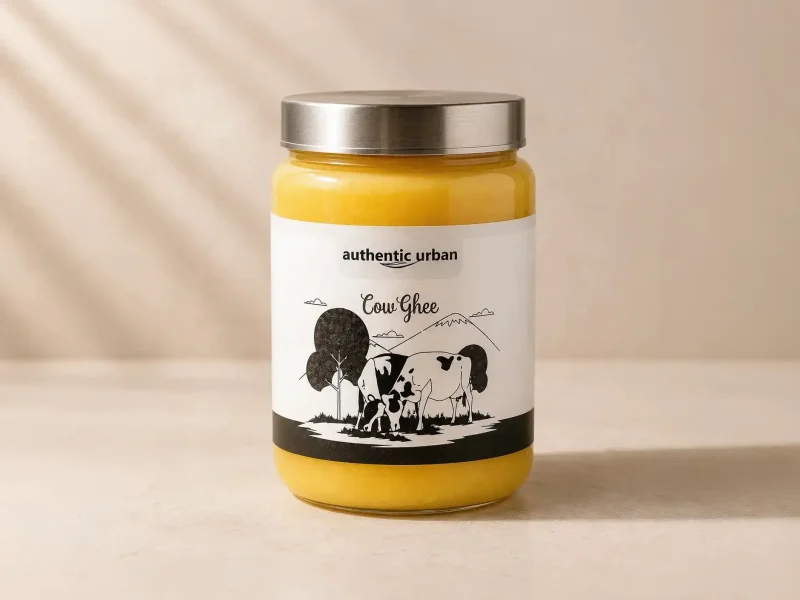 1 Litre
Rich sweet-shop Mysore pak
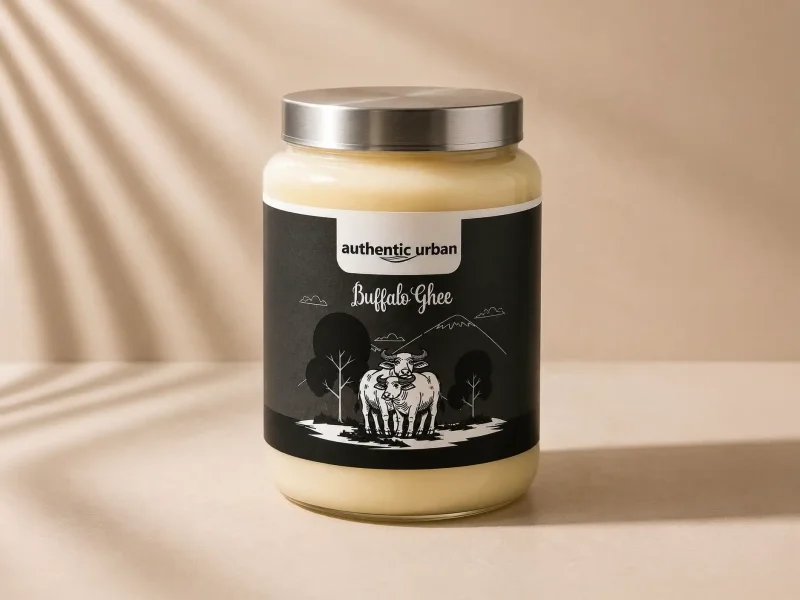 1 Litre
Each order is cooked after you place it, and the packing video is of that batch. Past order videos are on the shop.
FAQ
Can I make Mysore pak with jaggery instead of sugar?
You can, but it will not set the same way. Jaggery does not give a clean one-string syrup, so the pak comes out softer, darker, and more like a fudge, with a caramel taste. Grate 200 g of jaggery, melt it in the water, strain it, then boil it a minute or two past where you would stop for sugar. Expect it to crumble more when cut.
Which pan is best for making Mysore pak?
A heavy-bottomed kadhai or a thick non-stick pan, 22 to 26 cm across, with room for the mix to froth up to twice its height. A thin steel pan scorches the besan at the bottom before the rest cooks. Use a whisk for the besan and a flat wooden spatula for the ghee stage, so you can scrape the whole base with each stroke.
Can I halve or double the Mysore pak recipe?
Halving works in a small pan, but the syrup reaches one string in a couple of minutes, so test it early and often. Doubling is harder, because a big batch is heavy to stir and the bottom cooks faster than the top. If you need 40 pieces, make two batches one after the other; the ghee pan stays hot for the second.
Is Mysore pak gluten-free?
Besan, sugar, ghee, and cardamom have no wheat in them, so a Mysore pak made at home from pure besan is gluten-free. The risk is the besan packet: some are milled on the same machines as wheat flour, and a few blends add other flours. If someone at home has coeliac disease, buy besan labelled gluten-free and use a clean pan and spoons.
What can I do with the ghee that drains out of Mysore pak?
Pour it into a clean katori once the tin is warm, not hot. It has only been heated, not used for deep frying, and it tastes of roasted besan, which suits besan ladoo, sheera, dal tadka, or a paratha. Keep it covered in the fridge and use it within about a week. Throw it out if it smells sour or burnt.
How do I cut Mysore pak without it breaking?
Mark the lines with a greased knife about 10 minutes after pouring, while the top is still soft, pressing straight down rather than dragging. Leave it to set for at least an hour, then cut along the same lines. Wipe the knife between cuts. If it still cracks, it was cooked a little long; the next batch comes off the flame a minute sooner.
About the editorial team
Authentic Urban TeamBilona ghee makers, Gir Somnath, Gujarat
We are the Parmar family in Gir Somnath, Gujarat. We have made ghee here since 2016 and sold it online since 2025. We make only Bilona ghee, test it every month, and anyone is welcome to visit and watch it being made. Our Gir cows and Jafarabadi buffalo are grass-fed village animals that graze near the Gir forest, with no hormones or milk boosters. We set their milk to curd, churn it, and cook the makkhan on a wood chulha. These articles come from that kitchen and from what customers ask us on WhatsApp. We are ghee makers, not doctors.
Sources
- Chickpea flour (besan) (FDC ID 174288), SR Legacy, USDA FoodData Central. Checked 28 Sep 2026.
- Sugars, granulated (FDC ID 169655), SR Legacy, USDA FoodData Central. Checked 28 Sep 2026.
- Butter oil, anhydrous (FDC ID 173412), SR Legacy, USDA FoodData Central. Checked 28 Sep 2026.
- Dietary Guidelines for Indians, 2024 (Guideline 7 on visible fats; added sugar), ICMR-National Institute of Nutrition. Checked 28 Sep 2026.