Kada Prasad Recipe: Gurudwara Ratio in Cups and Grams
This kada prasad recipe uses equal cups of whole wheat atta, ghee, and sugar, with 3 cups of water: 120 g atta, 205 g ghee, and 200 g sugar. Roast the atta in the ghee for 12 to 15 minutes until it is deep brown, pour in the boiling syrup, and cook until the ghee shows at the edges. It makes 8 bowls.
How do you make kada prasad at home?
Boil 1 cup of sugar in 3 cups of water and keep it hot. Melt 1 cup of ghee in a heavy kadhai, add 1 cup of atta, and stir on medium-low for 12 to 15 minutes until it is deep brown and smells toasted. Pour in the boiling syrup, stir hard, and cook 5 to 8 minutes until the ghee shows at the edges.
Ingredients (8 bowls)
- 1 cup whole wheat atta (120 g). Chakki atta or a slightly coarse atta works best.
- 1 cup ghee, melted before measuring (205 g)
- 1 cup sugar (200 g)
- 3 cups water (720 ml). Use 2 cups for a firmer halwa.
No cardamom, nuts, or kesar in kada prasad. Equipment: a heavy kadhai, a flat wooden spatula, and a second pan for the syrup.
Steps
- 1. Sugar and water in a pan on a side burner. Bring to a rolling boil until the sugar dissolves; no string stage. Keep it boiling on low.
- 2. Ghee in the kadhai on medium-low. When it is fully melted, add the atta and stir to a smooth paste.
- 3. Roast, stirring without a break and scraping the corners, for 12 to 15 minutes: pale, then gold, then deep brown with a strong toasted smell.
- 4. Flame to low. Pour the boiling syrup in a thin stream with one hand and stir hard with the other. It hisses and spits, so stand back a little.
- 5. Cook 5 to 8 minutes on low to medium, stirring, until the halwa leaves the sides of the pan and the ghee separates at the edges. Serve warm.
One of 8 bowls: about 372 kcal, 25.9 g fat (15.9 g saturated), 35.8 g carbohydrate with 25 g sugar, and 2.1 g protein, worked out from USDA FoodData Central. The water boils off and adds nothing. Semolina halwa is made the same way with a different grain and ratio; it is on suji ka halwa.
What is the kada prasad recipe ratio?
Equal parts atta, ghee, and sugar, with 2 to 3 parts water. The Sikh Reht Maryada, the code of conduct published by the SGPC, says the three ingredients, wheat flour, pure sugar, and clarified butter, go in "in equal quantities". It names no water ratio, which is why recipes online print anything from 1 to 3 cups.
There is a second catch that almost no recipe mentions. "Equal" by cup is not equal by weight. A cup of atta is light and airy, a cup of melted ghee is heavy. By USDA's cup weights, a cup-for-cup batch has 1.7 times as much ghee as atta by weight, and that is where the glossy, soft texture comes from. If you weigh everything to the same grams instead, you get a drier, firmer halwa with about 40% less ghee.
Ingredient
Cups
Weight
Note
Whole wheat atta
1 cup
120 g
Light and airy, so a cup weighs little.
Ghee, melted
1 cup
205 g
1.7 times the atta by weight.
Sugar
1 cup
200 g
Close to the ghee by weight.
Water
3 cups
720 ml
Most of it boils off in the pan.
Cup weights from USDA FoodData Central: 168893 (whole-grain wheat flour, 120 g a cup), 173412 (butter oil, 205 g a cup), and 169655 (granulated sugar, 200 g a cup). One cup = 240 ml. Checked 27 September 2026.
How much water for kada prasad?
Three cups of water for each cup of atta gives the soft, loose prasad that is served warm into cupped hands. Two cups gives a halwa that holds its shape in a bowl. The water only changes texture; it all but boils away, so the calories stay the same.
1 cup (1:1:1:1)
Stiff and fudge-like. Sets hard as it cools and turns chewy by evening.
Use: Rarely what people want. Easy to under-cook the atta.
2 cups (1:1:1:2)
Soft, holds its shape on a plate, spoonable when warm.
Use: Home bowls, and when it will be eaten later in the day.
3 cups (1:1:1:3)
Loose, glossy, and soft enough to be served warm into cupped hands.
Use: This recipe. The texture most people remember from the gurudwara.
How dark should you roast the atta?
Deep brown, the colour of milk chocolate, with a toasted smell that fills the kitchen. On a medium-low flame that takes 12 to 15 minutes for a cup of atta. Light gold is the most common mistake: it looks done, but the halwa tastes of raw flour and turns pasty.
Minutes
What you see
Smell
What to do
0 to 4 min
Thick, pale paste. Atta clumps in the ghee.
Smell: Raw flour.
Do: Keep stirring on medium-low. Break every clump.
5 to 9 min
Loosens and starts to bubble. Turns sand-coloured, then light gold.
Smell: Biscuit.
Do: Scrape the base and corners. Do not stop here.
10 to 13 min
Runny, frothy, colour of peanut butter.
Smell: Strongly toasted, nutty.
Do: Stir without a break. Put the syrup back on to boil.
13 to 15 min
Deep brown, like milk chocolate. Ghee starts to separate at the edges.
Smell: Toasted wheat that fills the kitchen.
Do: Take the flame to low and pour the syrup now.
Past that
Dark brown to black specks.
Smell: Sharp and burnt.
Do: Too far. It will taste bitter; start again for prasad.
Your nose is the better timer. At our chulha in Gir Somnath, we take makkhan off the flame when the bubbling goes quiet, the milk solids turn golden-brown, and it smells of toasted milk. A batch that goes past that point turns dark and bitter and smells burnt, and it never goes in a jar. Atta in ghee gives the same warnings a minute or two apart, so keep the flame low and do not walk away in the last five minutes. A thin pan is the other trap: it browns the base before the top has changed colour. More on heat and ghee is in cooking with ghee.
What does the ghee do in kada prasad?
It fries the atta. Every grain of flour roasts in hot fat, which is what makes the nutty taste and keeps the halwa from turning to dough when the water goes in. Dry-roasting the atta and adding ghee later gives a flatter taste and a stickier halwa.
Ghee is also most of the flavour, so the jar shows. A ghee that smells sour or stale in the jar will smell of it across the whole kadhai; the checks are on how to identify pure ghee. Butter is not a stand-in: it carries water and milk solids, which spit and brown before the atta is done. Why that matters is on ghee vs butter.
Cow or buffalo ghee?
Both work, and both are almost pure milk fat. Buffalo ghee gives a richer, rounder taste and a paler halwa, and it is the one we reach for in sweets. Cow ghee is lighter and more yellow. The difference between the two is on cow vs buffalo ghee.
One kitchen point: melt the ghee before you measure it. In winter our ghee sets to a fine grain and buffalo ghee sets firmer still, and a cup packed with solid ghee holds far more than a cup of melted ghee. That is the usual reason for a pool of ghee on the plate. The grain is normal and melts away; why it forms is on why ghee is grainy.
Why is my kada prasad sticky, lumpy, or oily?
Nearly always the syrup temperature, the roast colour, or the ghee measure. Find the problem below.
Lumps the moment the syrup goes in
Warm or cold syrup hit the hot atta, or the stirring stopped.
Fix: The syrup must be at a rolling boil. Flame to low, pour in a thin stream with one hand, stir hard with the other. Press any lump against the side of the pan with the back of the spoon.
Tastes raw, floury, or pasty
The atta came off at light gold.
Fix: Roast to deep brown next time; go by the colour and smell in the roast table, not the clock. A pasty batch cannot be fixed by cooking longer once the water is in.
Sticky, gummy, clings to the spoon
Too little ghee for the atta, or pulled off before the water cooked out.
Fix: Keep the ghee at a full cup for a cup of atta. After the syrup, cook until the halwa leaves the sides of the pan and the ghee shows at the edges.
Pool of ghee on the plate
A cup of solid, grainy ghee was measured before melting, so it went in heaped.
Fix: Melt the ghee, then measure. If it has already happened, tip the pan and spoon off the extra ghee for your dal.
Bitter, burnt aftertaste
The flame was too high while roasting, or the pan is thin.
Fix: Use a heavy kadhai and a medium-low flame. Black specks mean start again; sugar cannot cover burnt atta.
Hard and dry by the next day
Too little water, or it sat uncovered.
Fix: Warm it in a pan with 2 to 3 tablespoons of hot water, stirring until soft again.
How much ghee is in one portion of kada prasad?
A bowl that is one-eighth of this batch holds about 25.6 g of ghee, close to 6 teaspoons, and 372 kcal. A small hand portion, one thirty-second of the batch, holds about 1.5 teaspoons. ICMR-NIN's 2024 dietary guidelines suggest limiting ghee or butter to 1 to 2 teaspoons a day, so a full bowl is three days' ghee in one go.
Portion of a one-cup batch
kcal
Ghee
Sugar
Whole batch (1 cup each)
2,978 kcal
Ghee 205 g, about 48 tsp
Sugar 200 g
1 of 8 bowls
372 kcal
Ghee 25.6 g, about 6 tsp
Sugar 25 g
1 of 16 small portions
186 kcal
Ghee 12.8 g, about 3 tsp
Sugar 12.5 g
1 of 32 hand portions
93 kcal
Ghee 6.4 g, about 1.5 tsp
Sugar 6.3 g
Worked out from USDA FoodData Central 168893, 173412 (4.27 g of ghee a teaspoon), and 169655, checked 27 September 2026.
That is fine for prasad and festival days. It is a reason not to make a bowl of it a daily sweet, and to go lighter on ghee in dal and roti on the day you eat it. Our own family eats 1 to 2 teaspoons each a day and more in winter sweets, so we count a sweet day as a sweet day. The reasoning behind the limit is on how much ghee per day, and if you have diabetes, read can diabetics eat ghee before a full bowl.
How do you scale kada prasad for a path at home?
Keep the three ingredients equal and the water at three times the atta, whatever the size. A one-cup batch gives about 32 hand portions, so four cups of atta covers a gathering of around a hundred people with some to spare.
Atta
Ghee
Sugar
Water
Serves
Atta ½ cup (60 g)
Ghee ½ cup (103 g)
Sugar ½ cup (100 g)
Water 1½ cups (360 ml)
4 bowls or 16 hand portions
Atta 1 cup (120 g)
Ghee 1 cup (205 g)
Sugar 1 cup (200 g)
Water 3 cups (720 ml)
8 bowls or 32 hand portions
Atta 2 cups (240 g)
Ghee 2 cups (410 g)
Sugar 2 cups (400 g)
Water 6 cups (1.44 litres)
16 bowls or 64 hand portions
Atta 4 cups (480 g)
Ghee 4 cups (820 g)
Sugar 4 cups (800 g)
Water 12 cups (2.9 litres)
32 bowls or about 130 hand portions
Bigger batches roast more slowly, so go by colour and smell, not minutes. Use a kadhai that is no more than half full once the atta is in, because the syrup foams up hard when it hits. For four cups of atta that means a wide, heavy iron or steel kadhai, a long-handled spatula, and two people: one to pour, one to stir. Buy the ghee by weight, not by cup: four cups is about 820 g, so a 1 litre jar covers it.
How do you store and reheat kada prasad?
It is best warm, within a few hours. Covered at room temperature it keeps for the day. For longer, cool it and keep it in a closed box in the fridge for 2 to 3 days.
Kada prasad firms up as it cools because the ghee sets. To reheat, put it in a pan on a low flame with 2 to 3 tablespoons of hot water for each bowl and stir until soft and glossy again, or microwave it covered in 30-second bursts, stirring in between. You should not need extra ghee. The ghee jar itself needs no fridge; how to keep it is on ghee storage and shelf life. If you want a roasted atta sweet that keeps for weeks, that is panjeeri, which has no water in it.
Kada prasad: a recipe card to keep
Screenshot this and keep it by the stove.
- 1. Ratio: equal cups of atta, ghee, and sugar. Water: 3 cups for soft, 2 for firmer.
- 2. One-cup batch: 120 g atta, 205 g melted ghee (1 cup), 200 g sugar, 720 ml water.
- 3. Sugar and water on a side burner. Keep it at a rolling boil.
- 4. Ghee in a heavy kadhai on medium-low. Atta in. Stir 12 to 15 minutes to deep brown, toasted smell.
- 5. Flame to low. Pour the boiling syrup in a thin stream, stirring hard.
- 6. Cook 5 to 8 minutes more, until it leaves the sides and the ghee shows at the edges.
- 7. One of 8 bowls: about 372 kcal and 6 tsp of ghee. Count it as the day's ghee and more.
- 8. Measure ghee melted, never packed. Roast by colour and smell, not the clock.
Which ghee for kada prasad?
With three ingredients, the ghee is most of the taste. Pick a plain ghee with nothing added that smells of toasted milk when it melts, and buy it by weight for a big batch. For sweets and halwa, buffalo ghee gives the richer, rounder taste; our ranking of what is on sale, with prices, is best buffalo ghee in India.
For kada prasad we would use our Jafarabadi buffalo ghee, and our A2 Gir cow ghee if you like a lighter, more yellow halwa. Both come from grass-fed village animals near the Gir forest; the milk is set to curd overnight, churned, and the makkhan cooked in a matki on a wood chulha. The jar is made after you order, a video of it being cooked and packed comes on WhatsApp, and Varsha tastes every batch before it goes in a jar. We test every month against the FSSAI limits; the steps are on how we make ghee.
A lighter, more yellow halwa
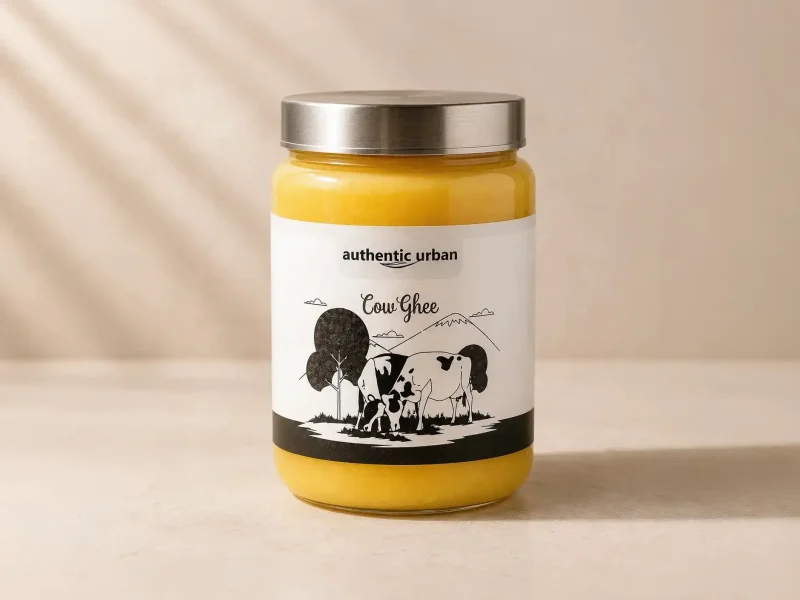 1 Litre
Kada prasad and atta halwa
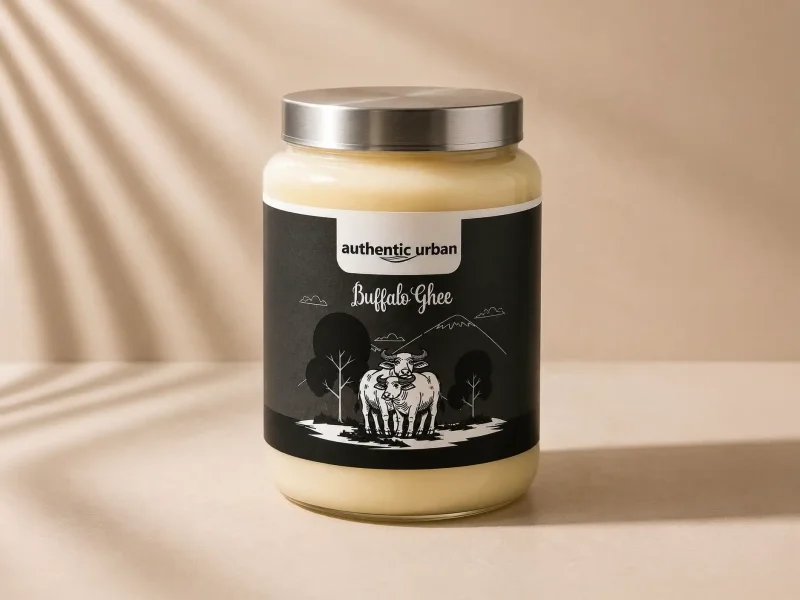 1 Litre
Each order is cooked after you place it, and the packing video is of that batch. Past order videos are on the shop.
FAQ
Kada prasad kaise banate hai?
Ek cup atta, ek cup pighla hua ghee, aur ek cup cheeni lo. Cheeni ko teen cup paani mein ubaal kar chashni garam rakho. Kadhai mein ghee garam karke atta daalo aur dheemi-madhyam aanch par 12 se 15 minute bhuno, jab tak rang gehra bhura aur khushbu sinki hui na ho jaaye. Aanch dheemi karke ubalti chashni daalo, tez chalao, aur 5 se 8 minute pakao jab tak ghee kinaaron par na dikhe.
Can I use jaggery instead of sugar in kada prasad?
You can make a very good atta halwa with jaggery, but most gurdwaras use white sugar, and the Sikh code names pure sugar as one of the three ingredients. For a home jaggery halwa, use the same weight of grated gur as sugar, dissolve it in the hot water off the flame, strain out any grit, and add it warm rather than boiling so the gur does not scorch. It turns darker and earthier.
Can I make kada prasad with oil or butter instead of ghee?
Not if you want kada prasad. The Sikh code names clarified butter, which is ghee, as one of the three ingredients. Oil roasts the atta but gives none of the toasted milk taste. Butter carries water and milk solids that spit and brown before the atta is done, so the roast turns bitter at the edges. For any atta halwa, ghee is the fat to use.
Can diabetics eat kada prasad?
A small hand portion, one thirty-second of a one-cup batch, holds roughly 6 g of added sugar and 1.5 teaspoons of ghee by USDA figures. Many people with diabetes take that small portion as prasad and adjust the rest of the meal. A full bowl is about 25 g of sugar and 6 teaspoons of ghee, which is a different matter. Ask your doctor or dietitian what fits your plan.
How is kada prasad served in a gurdwara?
The Sikh Reht Maryada says kada prasad is made in a clean vessel while reciting the scriptures, then covered with a clean cloth and placed before the Guru Granth Sahib. After the first five and last stanzas of Anand Sahib and the Ardas, it is touched with the kirpan. The first share goes to the five beloved ones, then it is given out equally to everyone present.
Is kada prasad the same as atte ka halwa?
It is an atte ka halwa, made the gurdwara way. Home atta halwa often uses less ghee, jaggery, milk, cardamom, and dry fruit, and each family has its own proportions. Kada prasad keeps to three ingredients in equal parts, plus water, with no nuts or flavourings. If you want a festive home halwa with dry fruit, use this method and add them at the end.
Can I make kada prasad in a non-stick pan?
Yes, for a small batch. A heavy non-stick kadhai roasts the atta evenly and makes stirring easier. Keep the flame at medium-low, because non-stick coatings should not be run on high heat, and use a wooden or silicone spatula. For batches of two cups of atta or more, a thick iron or steel kadhai holds heat better and handles the hiss of the syrup more safely.
About the editorial team
Authentic Urban TeamBilona ghee makers, Gir Somnath, Gujarat
We are the Parmar family in Gir Somnath, Gujarat. We have made ghee here since 2016 and sold it online since 2025. We make only Bilona ghee, test it every month, and anyone is welcome to visit and watch it being made. Our Gir cows and Jafarabadi buffalo are grass-fed village animals that graze near the Gir forest, with no hormones or milk boosters. We set their milk to curd, churn it, and cook the makkhan on a wood chulha. These articles come from that kitchen and from what customers ask us on WhatsApp. We are ghee makers, not doctors.
Sources
- Sikh Reht Maryada, Section Three, Article XII: Karhah Prashad (English text of the SGPC code), Sikh Missionary Society (UK). Checked 27 Sep 2026.
- Wheat flour, whole-grain (FDC ID 168893), SR Legacy, USDA FoodData Central. Checked 27 Sep 2026.
- Butter oil, anhydrous (FDC ID 173412), SR Legacy, USDA FoodData Central. Checked 27 Sep 2026.
- Sugars, granulated (FDC ID 169655), SR Legacy, USDA FoodData Central. Checked 27 Sep 2026.
- Dietary Guidelines for Indians, 2024 (Guideline 7, printed p. 54), ICMR-National Institute of Nutrition. Checked 27 Sep 2026.