Suji Ka Halwa Recipe: Ghee, Sugar, and Water in Grams
This suji ka halwa recipe uses 1 cup of suji (167 g), ½ cup of melted ghee (103 g), ¾ cup of sugar (150 g), and 2½ cups of boiling water. Roast the suji in the ghee for 8 to 12 minutes until light golden and nutty, pour in the water, add the sugar, and cook until it leaves the pan. It makes 6 bowls.
How do you make suji ka halwa at home?
Keep 2½ cups of water boiling on one burner. On the other, heat ½ cup of ghee in a heavy kadhai, add 1 cup of suji, and stir on medium-low for 8 to 12 minutes until it is light golden and smells nutty. Pour in the boiling water, stir hard, then add ¾ cup of sugar and cook 3 to 5 minutes until it leaves the pan.
Ingredients (6 bowls)
- 1 cup suji, fine or medium (167 g)
- ½ cup ghee, melted before measuring (103 g)
- ¾ cup sugar (150 g). A full cup for sweet-shop sweetness.
- 2½ cups water (600 ml), or half water and half milk
- ¼ tsp cardamom powder
- 2 tbsp cashews and 1 tbsp raisins (optional)
Equipment: a heavy kadhai, a flat spatula, and a second pan for the water.
Steps
- 1. Water on a side burner. Bring it to a rolling boil and keep it on a low flame.
- 2. Ghee in the kadhai on medium-low. Fry the cashews until golden and the raisins until they puff. Lift them out.
- 3. Suji into the same ghee. Stir without a break for 8 to 12 minutes, until light golden with a nutty smell.
- 4. Flame to low. Pour the boiling water in a thin stream and stir hard. It hisses and spits, so stand back.
- 5. When the water is soaked up (1 to 2 minutes), add the sugar and cardamom. Cook 3 to 5 minutes, stirring, until it leaves the sides. Top with the nuts and serve warm.
One of 6 bowls, without the nuts: about 347 kcal, 17.3 g fat (10.6 g saturated), 45.3 g carbohydrate with 25 g sugar, and 3.6 g protein, worked out from USDA FoodData Central. The water boils off and adds nothing. The same dish is sheera in Maharashtra, shiro in Gujarat, and rava kesari in the south; what changes between them is further down. The whole wheat version made in gurdwaras is a different ratio, on kada prasad.
What is the suji, ghee, sugar, and water ratio?
For a soft, glossy halwa: 1 cup suji, ½ cup ghee, ¾ to 1 cup sugar, and 2½ cups water. That is 1 : ½ : ¾ : 2½ by cup. Recipes online print anything from ⅓ cup to a full cup of ghee and 2 to 4 cups of water for the same cup of suji, which is why two "perfect" halwas come out so different.
Cups also hide the weights. By USDA's cup weights a cup of suji is 167 g, but a cup of melted ghee is 205 g. So "equal parts" by cup puts more ghee than suji in the pan by weight. If you cook from a scale, use the grams below.
Ingredient
Cups
Weight
Note
Suji (semolina, rava)
1 cup
167 g
Fine or medium rava. Bombay rava is medium.
Ghee, melted
½ cup
103 g
Melt before measuring. A packed cup of set ghee holds more.
Sugar
¾ cup
150 g
Use a full cup (200 g) for a sweeter, sweet-shop taste.
Water
2½ cups
600 ml
Boiling hot. Half of it can be milk.
Cup weights from USDA FoodData Central: 168933 (semolina, 167 g a cup), 173412 (butter oil, 205 g a cup), and 169655 (granulated sugar, 200 g a cup). One cup = 240 ml. Checked 28 September 2026.
How much ghee for 1 cup of suji?
Half a cup (103 g) gives a soft halwa that leaves the pan cleanly without ghee on the plate. Go down to ⅓ cup and it turns sticky as it cools; go up to a full cup and the ghee pools unless you add more water. Each row below is one of 6 bowls, with ¾ cup of sugar.
⅓ cup (68 g)
Grains show, a little sticky, dries out as it cools. Eat it warm.
297 kcal, 2.7 tsp ghee
Use: A lighter everyday bowl.
½ cup (103 g)
Soft and glossy, leaves the pan cleanly, no ghee on the plate.
347 kcal, 4 tsp ghee
Use: This recipe. Home and puja.
¾ cup (154 g)
Very glossy, a thin line of ghee shows at the edge of the plate.
421 kcal, 6 tsp ghee
Use: The rich, temple-style halwa many recipes print.
1 cup (205 g)
Ghee pools unless you add more water. Heavy after a few spoons.
496 kcal, 8 tsp ghee
Use: The equal-parts 1:1:1 recipes online.
Per bowl, worked out from USDA FoodData Central 168933, 173412 (4.27 g of ghee a teaspoon), and 169655. Equal-parts recipes also use a full cup of sugar, which adds about 32 kcal a bowl.
How much water for soft or firm halwa?
Two and a half cups of water for each cup of suji gives a soft halwa that sets to a mound in the bowl. Use 2 cups for a firm halwa you can cut, and 3 for a loose prasad. Water only changes the texture, not the calories.
2 cups (480 ml)
Firm. Holds its shape and can be pressed on a plate and cut once cool.
Use: Rava kesari pieces, or halwa for a tiffin.
2½ cups (600 ml)
Soft and spoonable when hot, sets to a soft mound in the bowl.
Use: This recipe.
3 cups (720 ml)
Loose and pudding-like when hot, firms up within the hour.
Use: Prasad served warm into cupped hands.
How long should you roast suji for halwa?
Eight to 12 minutes on a medium-low flame for a cup of suji, until it is light golden and smells like toasted bread. Stopping at the pale stage is the usual reason a halwa tastes floury. Going to brown makes it bitter. Suji roasts faster than atta, so do not use kada prasad timings here.
Minutes
What you see
Smell
What to do
0 to 3 min
Grains coated in ghee, still pale cream. Clumps here and there.
Smell: Raw wheat.
Do: Medium-low flame. Keep the spatula moving.
4 to 7 min
Loosens, ghee bubbles through it, the colour warms to ivory.
Smell: Faint biscuit.
Do: For a pale rava kesari, you can stop at the end of this stage.
8 to 12 min
Light golden, grains move like wet sand, ghee starts to show at the edge.
Smell: Nutty, like toasted bread.
Do: Put the water back to a boil. Flame to low. Pour now.
Past that
Brown patches and dark specks.
Smell: Sharp and burnt.
Do: Too far. The halwa will taste bitter; start again for prasad.
Trust your nose over the clock. At our chulha in Gir Somnath, the ghee comes off the flame when the bubbling goes quiet, the milk solids turn golden-brown, and the kitchen smells of toasted milk. A batch left past that point turns dark and bitter, and it never goes in a jar. Suji in ghee gives the same warning, only faster: the step from golden to scorched is a minute or two, so stay at the pan for the last few minutes. A thin pan browns the base while the top is still pale, which is why a heavy kadhai matters. More on heat and ghee is in cooking with ghee.
What does the ghee do in suji halwa?
It fries every grain. Suji roasted in hot fat gets its nutty taste, and each coated grain swells on its own when the water goes in instead of gluing into lumps. Dry-roasted suji with ghee stirred in at the end tastes flatter and sets stickier.
With so few ingredients, the ghee is also most of the flavour, and a stale jar shows across the whole kadhai. If your ghee smells sour, cheesy, or of nothing at all when warmed, read how to identify pure ghee. Butter holds water and milk solids that brown before the suji is done; the difference is on ghee vs butter.
Cow or buffalo ghee?
Both work. Buffalo ghee gives a richer, rounder halwa and is the one we reach for in sweets. Cow ghee gives a lighter taste and a more yellow colour, especially in monsoon, when green fodder makes our cow ghee deeper yellow. How the two differ is on cow vs buffalo ghee.
Measure it melted. In summer our ghee stays liquid in the jar and pours straight into the cup. In winter it sets to a fine grain, and a cup packed with set ghee holds more than a cup of melted ghee, which is the usual reason for ghee pooling on the plate. The grain is normal; why it forms is on why ghee is grainy.
Should you use water or milk for suji halwa?
Water gives the classic light, glossy halwa; milk gives a creamier, paler one that sets firmer. Half and half is the common middle. Whole milk for half the liquid adds about 31 kcal and 1.7 g fat a bowl by USDA figures.
Milk needs two changes. Bring it to a boil before it goes in, as with water, and keep the flame low afterwards, because milk catches on the base of the pan far sooner than water does. Add the sugar only after the milk is soaked up; sugar stirred into hot milk early makes it scorch.
Some cooks dissolve the sugar in the boiling water and pour it in as one hot syrup. It works and saves a step, but the suji swells more slowly in syrup than in plain water, so give it 2 to 3 extra minutes on low. Either way, the halwa goes loose when the sugar melts, then thickens again.
Why is my suji halwa lumpy, sticky, or dry?
Almost always the water temperature, the roast, or the ghee measure. Find your problem below.
Lumps the moment the water goes in
The water was warm, not boiling, or it went in all at once.
Fix: Keep the water at a rolling boil on the next burner. Flame to low, pour in a thin stream, and stir hard. Press any lump against the side of the pan with the back of the spatula.
Tastes raw or floury
The suji came off the flame before it turned golden and nutty.
Fix: Roast by colour and smell, not the clock. Once the water is in, extra cooking cannot fix a raw roast.
Sticky, gummy, sticks to the pan
Too little ghee for the suji, or very fine suji with too much water.
Fix: Keep the ghee at ½ cup for 1 cup of suji. With fine suji, cut the water to 2 cups.
Dry and crumbly, even when hot
Too little water, or it cooked too long after the sugar went in.
Fix: Stir in 3 to 4 tablespoons of boiling water on a low flame, cover for a minute, and stir again.
Ghee pooling on the plate
Solid, grainy ghee was scooped into the cup instead of melted first.
Fix: Melt, then measure. If it has already happened, tilt the pan and spoon the extra ghee off for tomorrow's dal.
Runny after the sugar goes in
Sugar melts into syrup and loosens the halwa for a few minutes.
Fix: Keep cooking on low, stirring, for 3 to 5 minutes. It thickens again and comes away from the pan.
Bitter aftertaste
The flame was too high while roasting, or a thin pan burnt the base.
Fix: Use a heavy kadhai on medium-low. Dark specks mean start again; sugar will not cover them.
How are sheera, rava kesari, and prasad halwa different?
They are the same method: suji roasted in ghee, hot liquid, sugar. The roast colour, the liquid, and what goes in at the end change by region. Start from the recipe above and make the change in the last column.
Suji ka halwa (North India)
Water or half milk, sugar, cardamom. Suji roasted to golden. Cashews, almonds, and raisins fried in the ghee first.
Change: This recipe as written.
Sheera or shiro (Maharashtra, Gujarat)
Often cooked in milk or half milk and water. The Satyanarayan puja sheera adds ripe mashed banana after the liquid.
Change: Use half milk. For the puja version, stir in 1 ripe banana, mashed, just before the sugar.
Rava kesari (Karnataka, Tamil Nadu)
Lighter roast, kesar or kesari colour, cashews and raisins in ghee, sometimes pressed on a greased plate and cut into pieces.
Change: Stop the roast at the ivory stage, use 2 cups of water, and add kesar soaked in 2 tbsp warm milk with the sugar.
Prasad halwa (temple and home puja)
More ghee, softer, served warm in small portions.
Change: Use ¾ cup ghee and 3 cups of water, and give out 12 small spoonfuls instead of 6 bowls.
Kesar gives colour slowly, so soak a pinch in 2 tablespoons of warm milk for 10 minutes first. The bright orange of a sweet-shop kesari usually comes from food colour, not saffron. Which ghee goes on the puja thali is covered in ghee for puja and havan. If you want the same roasted suji as a sweet you can pack, shape it into rava ladoo.
How much ghee and sugar is in one bowl of suji halwa?
One of 6 bowls holds about 17 g of ghee, close to 4 teaspoons, and 25 g of sugar, at 347 kcal. ICMR-NIN's 2024 dietary guidelines suggest limiting ghee or butter to 1 to 2 teaspoons a day and say limiting sugar to 25 g a day is better for health. So one bowl is two days' ghee and a whole day's sugar.
Portion of a 1-cup batch
kcal
Ghee
Sugar
Whole batch
2,080 kcal
Ghee 103 g, about 24 tsp
Sugar 150 g
1 of 6 bowls
347 kcal
Ghee 17 g, about 4 tsp
Sugar 25 g
1 of 8 small katoris
260 kcal
Ghee 13 g, about 3 tsp
Sugar 19 g
1 of 12 prasad spoonfuls
173 kcal
Ghee 8.5 g, about 2 tsp
Sugar 12.5 g
Worked out from USDA FoodData Central 168933, 173412, and 169655, checked 28 September 2026. Limits from ICMR-NIN, Dietary Guidelines for Indians 2024.
That is fine for a festival or a puja. It is a reason to serve small katoris rather than big bowls, and to go easy on ghee in dal and roti on a halwa day. Our family eats 1 to 2 teaspoons of ghee each a day and more in winter sweets, so a sweet day counts as the sweet day. How the daily limit works is on how much ghee per day, and with diabetes, read can diabetics eat ghee and ask your doctor what a halwa portion does to your plan.
How do you store and reheat suji halwa?
It is best warm, within a few hours. For leftovers, the UK Food Standards Agency advises cooling cooked food and putting it in the fridge within one to two hours, in smaller containers so it cools fast, and eating leftovers within 48 hours or freezing them. Reheat only once.
Suji halwa sets hard in the fridge because the ghee sets. To reheat, put a bowl in a pan on a low flame with 2 to 3 tablespoons of hot water or milk and stir until soft and glossy, or microwave it covered in 30-second bursts, stirring in between. You should not need extra ghee. The ghee jar itself needs no fridge; how to keep it is on ghee storage and shelf life. For a winter halwa that uses the same ghee, try gajar ka halwa.
Suji ka halwa: a recipe card to keep
Screenshot this and keep it by the stove.
- 1. For 6 bowls: 1 cup suji (167 g), ½ cup melted ghee (103 g), ¾ cup sugar (150 g), 2½ cups water (600 ml).
- 2. Water on the next burner. Bring it to a rolling boil and keep it there.
- 3. Ghee in a heavy kadhai on medium-low. Fry 2 tbsp cashews and 1 tbsp raisins, lift them out.
- 4. Suji in. Stir 8 to 12 minutes to light golden, with a nutty smell.
- 5. Flame to low. Pour the boiling water in a thin stream, stirring hard. Stand back; it spits.
- 6. When the water is soaked up, add the sugar and ¼ tsp cardamom. Cook 3 to 5 minutes until it leaves the pan.
- 7. Softer: 3 cups water. Firmer: 2 cups. Richer: ¾ cup ghee.
- 8. One of 6 bowls: 347 kcal, 4 tsp ghee, 25 g sugar. A festival bowl, not a daily one.
Which ghee for suji ka halwa?
With four ingredients, the ghee is most of the taste. Pick a plain ghee with nothing added that smells of toasted milk when it melts. For halwa and sweets, buffalo ghee gives the richer, rounder taste; our ranking of what is on sale, with prices, is best buffalo ghee in India.
For suji halwa we would use our Jafarabadi buffalo ghee, and our A2 Gir cow ghee for a lighter, more yellow halwa. Both come from grass-fed village animals near the Gir forest: the milk is set to curd overnight, churned by hand (Bilona), and the makkhan cooked in a matki on a wood chulha. The jar is made after you order, a video of it being cooked and packed comes on WhatsApp, and Varsha tastes every batch before it goes in a jar. We test every month against the FSSAI limits; the steps are on how we make ghee.
A lighter, more yellow halwa
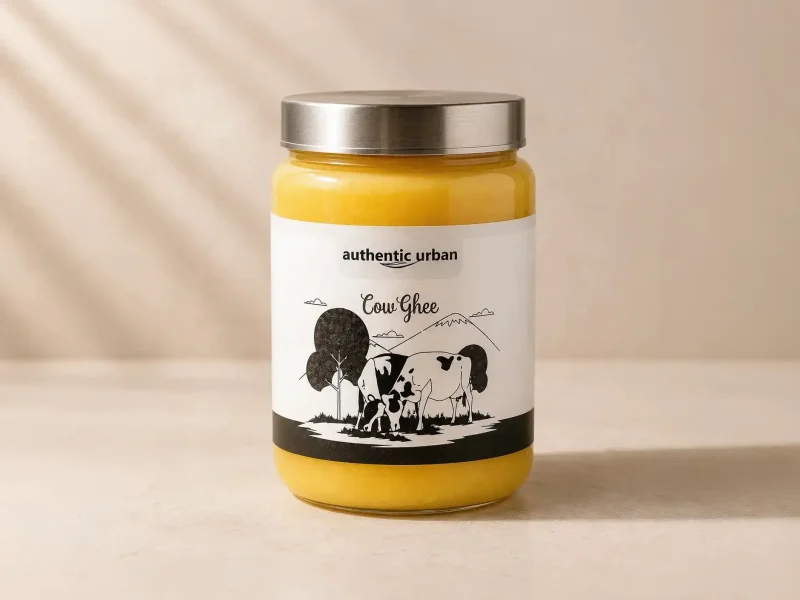 1 Litre
Suji halwa, sheera, and prasad
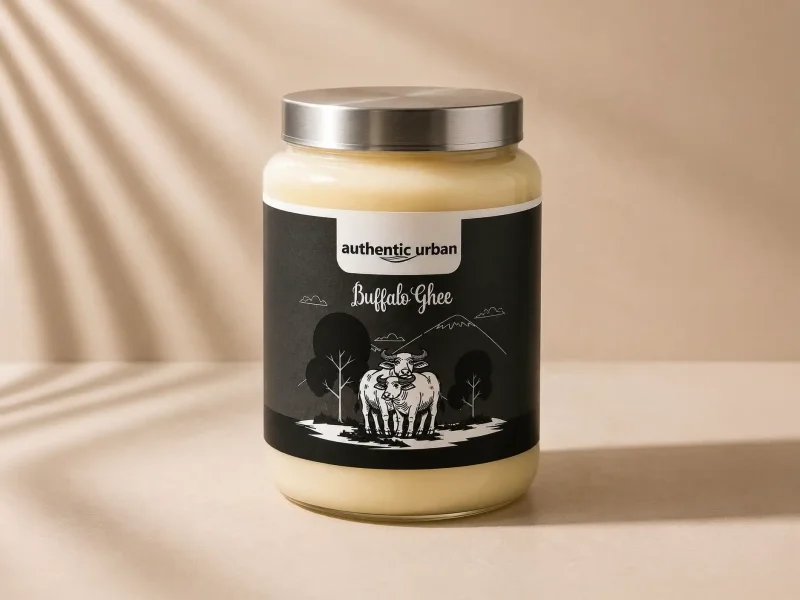 1 Litre
Each order is cooked after you place it, and the packing video is of that batch. Past order videos are on the shop.
FAQ
Suji ka halwa kaise banate hai?
Ek cup suji, aadha cup pighla hua ghee, teen-chauthai cup cheeni, aur dhai cup paani lo. Paani ko alag ubaal kar rakho. Kadhai mein ghee garam karke suji daalo aur dheemi-madhyam aanch par 8 se 12 minute bhuno, jab tak halka sunehra rang aur sinki hui khushbu na aa jaaye. Aanch dheemi karke ubalta paani daalo, tez chalao, phir cheeni aur elaichi daal kar 3 se 5 minute pakao.
Can I make suji halwa with jaggery instead of sugar?
Yes. Use the same weight of grated jaggery, about 150 g for a cup of suji. Melt it in the hot water off the flame and strain out any grit, then pour this warm, not boiling, jaggery water into the roasted suji so it does not split or scorch. The halwa turns brown and tastes of caramel. Jaggery is still sugar, so the portion sizes on this page apply to it as well.
Can I use oil or butter instead of ghee for suji halwa?
Oil will roast the suji, but the halwa tastes flat because the toasted milk flavour of ghee is gone. Butter is closer, but it holds water and milk solids that spit and brown before the suji is golden, so the edges can turn bitter. If you only have butter, melt it first, cook it until the foam settles, and then add the suji. Ghee remains the fat to use for halwa.
Which rava is best for suji halwa: fine, Bombay, or coarse?
Fine suji gives a smooth, soft halwa and roasts fastest, so watch the colour closely. Medium rava, often sold as Bombay rava, gives a halwa where you can feel each grain, the texture most sheera recipes aim for. Coarse or upma rava stays grainy and needs a little more water and time. Whichever you use, sieve out any lumps or insects before it goes into the ghee.
Can I give suji halwa to my baby or toddler?
Not the sweet version before age two. ICMR-NIN's 2024 dietary guidelines say no added sugar for children under two years old. For a child who already eats family food, a plain suji porridge without sugar, cooked soft in water or milk with a few drops of ghee, is closer to what they need. Ask your paediatrician when to start ghee and new grains for a baby under one.
How do I make suji halwa for 20 or more people?
Plan about one bowl per person, so 3½ cups of suji covers 20 people. Keep the same ratio: 3½ cups suji (585 g), 1¾ cups melted ghee (360 g), 2⅝ cups sugar (525 g), and about 8¾ cups water (2.1 litres). Big batches roast more slowly, so go by colour and smell. Use a wide, heavy kadhai no more than half full and have a second person pour the water.
About the editorial team
Authentic Urban TeamBilona ghee makers, Gir Somnath, Gujarat
We are the Parmar family in Gir Somnath, Gujarat. We have made ghee here since 2016 and sold it online since 2025. We make only Bilona ghee, test it every month, and anyone is welcome to visit and watch it being made. Our Gir cows and Jafarabadi buffalo are grass-fed village animals that graze near the Gir forest, with no hormones or milk boosters. We set their milk to curd, churn it, and cook the makkhan on a wood chulha. These articles come from that kitchen and from what customers ask us on WhatsApp. We are ghee makers, not doctors.
Sources
- Semolina, unenriched (FDC ID 168933), SR Legacy, USDA FoodData Central. Checked 28 Sep 2026.
- Butter oil, anhydrous (FDC ID 173412), SR Legacy, USDA FoodData Central. Checked 28 Sep 2026.
- Sugars, granulated (FDC ID 169655), SR Legacy, USDA FoodData Central. Checked 28 Sep 2026.
- Milk, whole, 3.25% milkfat, with added vitamin D (FDC ID 171265), SR Legacy, USDA FoodData Central. Checked 28 Sep 2026.
- Dietary Guidelines for Indians, 2024 (ghee limit, PDF p. 71; sugar, PDF p. 111; children under two, PDF p. 28), ICMR-National Institute of Nutrition. Checked 28 Sep 2026.
- How to chill, freeze and defrost food safely, Food Standards Agency (UK). Checked 28 Sep 2026.