Gajar Ka Halwa Recipe: Grams, Timings, and How Much Ghee
This gajar ka halwa recipe uses 1 kg of grated carrots, 1 litre of full cream milk, 1 cup of sugar (200 g), and ¼ cup of ghee (51 g). Cook the carrots in half the ghee, let the milk cook down into them with no lid, add the sugar only when the milk is almost gone, and finish with the rest of the ghee. About an hour on the flame, and it makes 8 bowls.
How do you make gajar ka halwa at home?
Grate 1 kg of carrots and cook them in 2 tablespoons of ghee for 8 to 10 minutes. Add 1 litre of full cream milk and cook it down, uncovered, on medium-low for 35 to 40 minutes. When almost no milk is left, add 1 cup of sugar and stir until thick again. Finish with 2 more tablespoons of ghee and cardamom.
Ingredient (8 bowls)
Measure
Weight
Note
Carrots, grated
1 kg
1,000 g
Weighed before peeling. Red Delhi carrots in winter, orange ones the rest of the year.
Milk, full cream
1 litre
1,017 g
Toned milk works but takes longer and tastes thinner.
Sugar
1 cup
200 g
¾ cup (150 g) if the carrots taste sweet raw.
Ghee, melted
¼ cup
51 g
2 tbsp to cook the carrots, 2 tbsp at the end.
Cardamom powder
½ tsp
About 1 g
Goes in with the last ghee.
Nuts and raisins
¼ cup
About 30 g
Optional. Not counted in the calories below.
Weights from USDA FoodData Central cup weights: 171265 (whole milk, 244 g a cup, so about 1,017 g a litre), 169655 (sugar, 200 g a cup), and 173412 (butter oil, 205 g a cup). One cup = 240 ml. Equipment: a heavy kadhai or wide thick pan, a box grater, and a flat spatula.
One of 8 bowls: about 282 kcal, 10.8 g fat (6.4 g saturated), 43.1 g carbohydrate with 37.3 g sugar, 3.5 g fibre, and 5.2 g protein, worked out from USDA FoodData Central, without the nuts. About 12 g of that sugar comes from the carrots and milk themselves; 25 g is the sugar you add. For a quicker halwa from the same ghee jar, see suji ka halwa.
How much ghee does gajar ka halwa need?
A quarter cup (51 g) for 1 kg of carrots gives a glossy, moist halwa with a shine of ghee at the edge and none pooling on the plate. Recipes online print anything from 2 tablespoons to ¾ cup for the same kilo of carrots. Most of the richness in gajar halwa comes from the litre of milk, not the ghee. Each row below is one of 8 bowls, with the same carrots, milk, and sugar.
2 tbsp (26 g)
Carrots cook and the halwa sets, but it looks dull and a little dry once cool.
254 kcal, ¾ tsp ghee
Use: A lighter everyday bowl. Eat it warm.
¼ cup (51 g)
Glossy, moist, a thin shine of ghee at the edge of the kadhai at the end.
282 kcal, 1½ tsp ghee
Use: This recipe. Home, guests, festivals.
½ cup (103 g)
Very glossy, ghee shows round the halwa on the plate.
338 kcal, 3 tsp ghee
Use: Sweet-shop style.
¾ cup (154 g)
Ghee pools in the pan and on the plate. Heavy after a few spoons.
394 kcal, 4½ tsp ghee
Use: The old wedding-style amount some recipes still print.
Per bowl, worked out from USDA FoodData Central 170393, 171265, 169655, and 173412 (4.27 g of ghee a teaspoon).
The ghee goes in two halves. The first 2 tablespoons cook the raw smell out of the carrots and coat them before the milk goes in, so they soften without turning to mush. The last 2 go in after the sugar, and that is the ghee you see shining at the end. Pour all of it in at the start and it floats on the milk for forty minutes doing nothing. How ghee works in other everyday dishes is on cooking with ghee.
How long does gajar ka halwa take, and how do you know it is done?
About an hour on the flame for 1 kg of carrots, most of it spent cooking down the milk. It is done when the halwa leaves the sides of the kadhai as one moist mass, looks glossy, and ghee shines at the edge. It firms up as it cools, so stop while it still looks a little soft.
Minutes
What you see
Smell
What to do
0 to 10 min
Grated carrots in 2 tbsp ghee. They wilt, shrink by about a third, and turn a deeper orange.
Smell: Raw carrot, then sweet.
Do: Medium flame. Stir every minute so the base does not catch.
10 to 50 min
Milk in. Boils, then settles to a slow bubble. Slowly thickens as the milk cooks down into the carrots.
Smell: Warm milk.
Do: Medium-low, no lid. Stir every 3 to 4 minutes, more often near the end.
50 min
Almost no liquid when you drag the spatula through. Carrots soft and pressed with milk solids.
Smell: Cooked milk, a little like rabdi.
Do: Now add the sugar.
50 to 60 min
Turns runny again as the sugar melts, then thickens and darkens a shade.
Smell: Caramel at the edges.
Do: Stir without a break. It spits, so use a long spatula.
Done
Last 2 tbsp ghee in. Leaves the sides as one moist mass, glossy, ghee shines at the edge.
Smell: Toasted milk and cardamom.
Do: Cardamom and nuts in, flame off. It firms as it cools.
Past that
Dry, sticks to the base, brown streaks.
Smell: Sharp, scorched.
Do: Off the flame. Stir in 3 to 4 tbsp warm milk.
The sugar rule matters most. Sugar pulls water out of the carrots, so if it goes in while the milk is still loose, the halwa turns runny and takes another twenty minutes to thicken. Wait until the spatula drawn across the base leaves a clear track that fills slowly.
Gajar season is our heavy-milk season too. In winter the milk at our kitchen in Gir Somnath is richer, and the same litres give more makkhan for ghee. You see the same thing in a kadhai of halwa: winter full cream milk reduces into a thicker, creamier halwa than summer milk does. At the chulha, ghee comes off the flame when the bubbling goes quiet and it smells of toasted milk. Gajar halwa gives a similar signal, when the bubbling slows and the smell turns from warm milk to toasted.
Which carrots are best for gajar ka halwa?
The long red carrots sold in North Indian markets in winter, often called Delhi carrots, make the classic halwa: sweet, juicy, and a deep red-orange. Orange carrots work all year. They are less sweet and give a brighter orange halwa, so keep the full cup of sugar and let the milk cook down fully.
- Taste one raw: sweet and crisp makes good halwa. Bitter, soapy, or bendy carrots stay that way after an hour of cooking.
- Skip the thick core: old, fat carrots have a pale, woody centre that stays stringy. Grate round it.
- Grate, do not chop: the medium side of a box grater, or the grating disc of a food processor. The fine side turns to mush; a chopper gives uneven bits.
- Weigh before peeling: 1 kg of carrots bought gives a little less after peeling and trimming, which is fine for this recipe.
Can you make gajar ka halwa with khoya or condensed milk?
Yes, and both change the texture more than the method. Khoya makes a richer, grainier halwa like the sweet shop's. Condensed milk cuts the cooking time roughly in half, but the halwa is sweeter and less toasted.
- With khoya: keep the recipe and crumble in 100 to 200 g of unsweetened khoya after the sugar has melted. Cook 5 minutes more. Cut the sugar to ¾ cup if you use the full 200 g.
- With condensed milk: cook the carrots in ghee, add 2 cups of milk (not a litre) and cook it down, then stir in 200 g of sweetened condensed milk in place of the sugar. Cook until it leaves the pan.
- With milk powder: no khoya? Whisk ½ cup of milk powder into ¼ cup of warm milk and add it after the sugar. It gives some of the khoya body.
- Pressure cooker: it saves the first half hour of softening; the method is in the FAQ below.
Why is my gajar ka halwa watery, dry, or bland?
Nearly always the milk: not cooked down enough before the sugar, cooked too far, or too thin to start with. Find your problem below.
Watery or runny
Sugar went in before the milk had cooked down, or the pan was covered and the steam dripped back in.
Fix: Keep cooking uncovered on medium-low, stirring, until the spatula leaves a clear track. It takes as long as it takes; do not add ghee to fix it.
Dry and chewy once cool
Cooked past the done stage, or too little ghee for the batch.
Fix: Warm it with 3 to 4 tbsp of milk on a low flame. Next time, stop while it still looks a little moist.
Pale and bland
Watery orange carrots, toned milk, or the milk was rushed on a high flame.
Fix: Taste a carrot raw before buying. Use full cream milk and let it reduce slowly; that is where the rabdi taste comes from.
Carrots still hard or stringy
Coarse grating, or old carrots with a woody core.
Fix: Grate on the medium side, and leave out the pale core of thick carrots. Cook them in ghee a few minutes longer before the milk.
Milk split into grains
Sour milk, or jaggery added while the milk was still boiling.
Fix: Keep cooking: it tastes fine and looks like khoya halwa. Use fresh milk, and add jaggery only once the milk has cooked down.
Burnt taste at the base
Thin pan, high flame, or scraping in the dark layer.
Fix: Move the halwa to a clean pan and leave the stuck layer behind. A heavy kadhai on medium-low stops it happening.
Which ghee is best for gajar ka halwa?
A plain ghee with nothing added, that smells of toasted milk when it melts. The last 2 tablespoons go in at the end, so their smell is the one you taste. A stale or sour jar shows across the whole kadhai. If your ghee smells cheesy, sour, or of nothing at all when warmed, read how to identify pure ghee. Butter carries water and milk solids that brown on the base long before the halwa is done; the difference is on ghee vs butter.
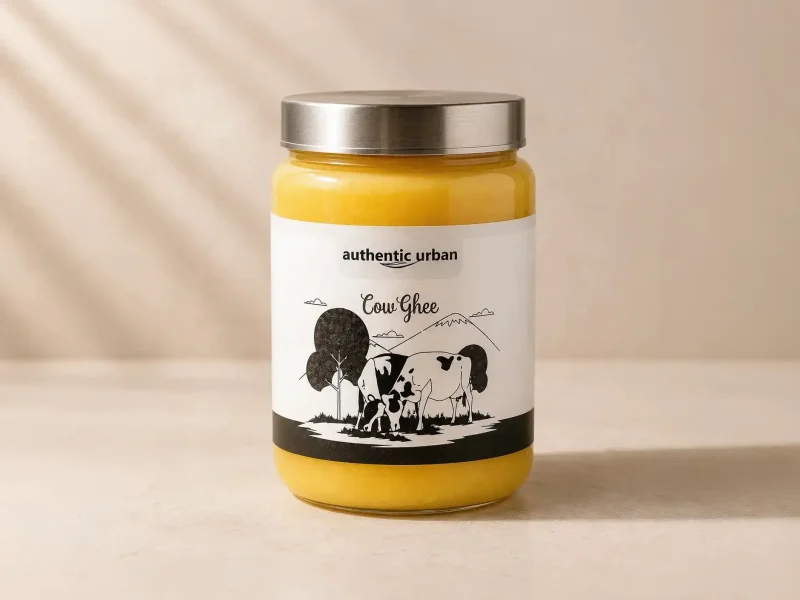
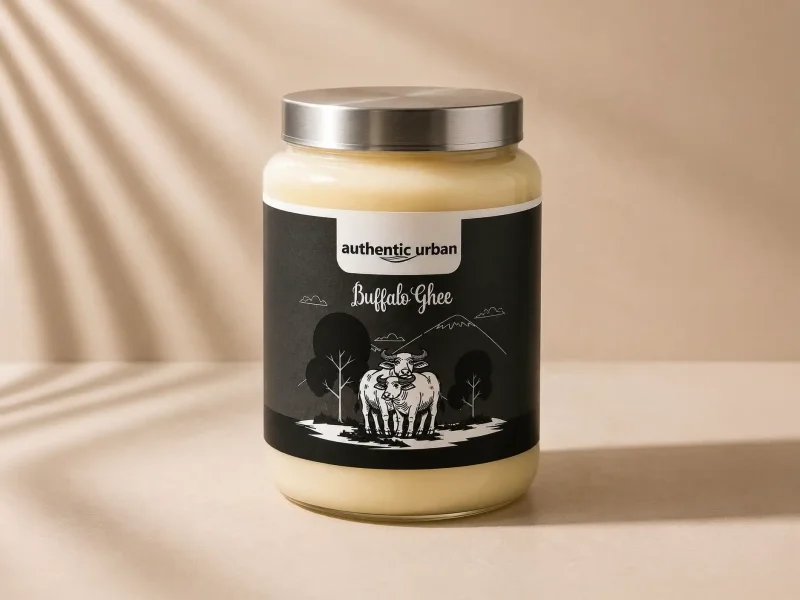
Cow or buffalo is a matter of taste. Buffalo ghee gives a rounder, richer halwa and is the one we reach for in winter sweets. Cow ghee is lighter and more yellow. How the two differ is on cow vs buffalo ghee.
Measure it melted. Gajar season is when ghee sets in the jar: in winter ours sets to a fine grain, and a spoon packed with set ghee holds more than a spoon of melted ghee. Warm the jar in a bowl of hot water for a minute first. The grain is normal; why it forms is on why ghee is grainy.
How much ghee and sugar is in one bowl of gajar ka halwa?
One of 8 bowls holds about 6.4 g of ghee, close to 1½ teaspoons, and 25 g of added sugar, at 282 kcal. ICMR-NIN's 2024 dietary guidelines suggest limiting ghee or butter to 1 to 2 teaspoons a day and say limiting sugar to 25 g a day is better for health. So one bowl is most of a day's ghee and all of a day's sugar.
Portion of a 1 kg batch
kcal
Ghee
Added sugar
Whole batch
2,253 kcal
Ghee 51 g, about 12 tsp
Added sugar 200 g
1 of 8 bowls
282 kcal
Ghee 6.4 g, about 1½ tsp
Added sugar 25 g
1 of 12 small katoris
188 kcal
Ghee 4.3 g, about 1 tsp
Added sugar 17 g
1 of 16 spoonfuls on a thali
141 kcal
Ghee 3.2 g, about ¾ tsp
Added sugar 12.5 g
Worked out from USDA FoodData Central 170393, 171265, 169655, and 173412, checked 29 September 2026. Limits from ICMR-NIN, Dietary Guidelines for Indians 2024.
Carrots and milk make gajar halwa one of the lighter Indian sweets per bowl, but the sugar is the same as any other. Serve small katoris, and go easy on ghee in dal and roti on a halwa day. Our family eats 1 to 2 teaspoons of ghee each a day and more in winter sweets, so a sweet day counts as the sweet day. How the daily limit works is on how much ghee per day, and with diabetes, read can diabetics eat ghee and ask your doctor what a halwa portion does to your plan.
Gajar halwa for children
Not the sweet version before age two: ICMR-NIN's 2024 guidelines say no added sugar for children under two years old. For older children, a few spoonfuls is a winter treat, with the nuts chopped fine or left out for small children. Carrots cooked in ghee do carry their beta-carotene well; that everyday version, without the sugar, is on ghee and nutrient absorption.
How do you store and reheat gajar ka halwa?
It is a milk dish, so treat it like any cooked food with milk in it. The UK Food Standards Agency advises cooling cooked food and putting it in the fridge within one to two hours, and eating leftovers within 48 hours or freezing them. Keep it in a lidded steel or glass box, not the kadhai.
It sets firm in the fridge because the ghee sets. Warm a portion in a pan on a low flame with 1 to 2 tablespoons of milk, stirring until soft and glossy and hot right through, or microwave it covered in 30-second bursts, stirring in between. You should not need more ghee. The ghee jar itself needs no fridge; how to keep it is on ghee storage and shelf life. For the other winter sweet in our kitchen, try gond ke ladoo, or for a halwa that needs no carrots at all, badam halwa.
Gajar ka halwa: a recipe card to keep
Screenshot this and keep it by the stove.
- 1. For 8 bowls: 1 kg carrots, 1 litre full cream milk, 1 cup sugar (200 g), ¼ cup melted ghee (51 g), ½ tsp cardamom, nuts to top.
- 2. Wash, peel, and grate the carrots on the medium side of the grater.
- 3. Heat 2 tbsp ghee in a heavy kadhai on medium. Cook the carrots 8 to 10 minutes until they wilt and smell sweet.
- 4. Pour in the milk, bring to a boil, then medium-low with no lid. Stir every few minutes for 35 to 40 minutes.
- 5. When the spatula leaves a clear track and almost no milk is left, add the sugar. Stir 8 to 10 minutes until thick again.
- 6. Add the last 2 tbsp ghee. Done when it leaves the sides as one glossy mass. Cardamom and nuts in, flame off.
- 7. One of 8 bowls: 282 kcal, 1½ tsp ghee, 25 g sugar. A winter bowl, not a daily one.
Which ghee should you buy for gajar ka halwa?
The last spoon of ghee is what you smell when the kadhai comes off the flame, so pick a plain ghee with nothing added that smells of toasted milk when it melts. For halwa and sweets, buffalo ghee gives the richer, rounder taste; our ranking of what is on sale, with prices, is best buffalo ghee in India.
We make and sell ghee, so weigh this with that in mind. For gajar halwa we would use our Jafarabadi buffalo ghee, and our A2 Gir cow ghee for a lighter, more golden halwa. Both come from grass-fed village animals near the Gir forest: the milk is set to curd overnight, churned by hand (Bilona), and the makkhan cooked in a matki on a wood chulha. The jar is made after you order, a video of it being cooked and packed comes on WhatsApp, and Varsha tastes every batch before it goes in a jar. We test every month against the FSSAI limits; the steps are on how we make ghee.
A lighter, more golden halwa
 1 Litre
Gajar halwa and winter sweets
 1 Litre
Each order is cooked after you place it, and the packing video is of that batch. Past order videos are on the shop.
FAQ
Gajar ka halwa kaise banate hai?
Ek kilo gajar kaddukas karke do chammach ghee mein 8 se 10 minute bhuno. Ek litre full cream doodh daalo, ubaal aane ke baad dheemi-madhyam aanch par bina dhakkan ke 35 se 40 minute pakao, beech beech mein chalate raho. Jab doodh lagbhag sukh jaye, ek cup cheeni daal kar phir gaadha hone tak pakao. Aakhir mein do chammach ghee, elaichi aur meve daalo. Halwa kinaare chhodne lage to aanch band.
Can I make gajar ka halwa in a pressure cooker?
Yes, to save the first half hour. Cook the grated carrots in 2 tbsp ghee in an open cooker for 5 minutes, add 1 cup of the milk, and cook to 1 whistle on medium. Let the pressure drop on its own, open, pour in the rest of the milk, and reduce it uncovered. The carrots are soft by then, so the halwa is ready in about 35 minutes. Carry on with sugar and ghee as usual.
Can I make gajar ka halwa with jaggery instead of sugar?
Yes. Use about the same weight, 200 g of grated jaggery for 1 kg of carrots, and add it only after the milk has cooked right down and the flame is low. Jaggery added to boiling milk can make it split into grains. The halwa turns brown and tastes of caramel. Jaggery is still sugar by the ICMR-NIN count, so the bowl size stays the same.
How much gajar ka halwa do I need for 20 guests?
Plan one small katori each, so 2 kg of carrots makes enough for 20 to 24 people. Keep the ratio: 2 kg carrots, 2 litres full cream milk, 400 g sugar, and ½ cup (about 100 g) ghee. Use your widest, heaviest kadhai or two pans, because a deep pot takes far longer to reduce 2 litres of milk. Allow about an hour and a half on the flame.
Does gajar ka halwa keep the vitamin A of carrots?
Much of it. USDA FoodData Central lists 100 g of raw carrot at 835 µg of vitamin A as retinol activity, almost all from beta-carotene. Beta-carotene is fat-soluble, so cooking the carrots in ghee and milk helps you absorb it. Some is lost in long cooking. The sugar and ghee still make gajar halwa a winter sweet, not a way to get vitamins; a carrot sabzi does that job better.
Can I freeze gajar ka halwa?
Yes. Cool it quickly, pack it in small lidded boxes, one or two servings each, and freeze. The UK Food Standards Agency advises freezing leftovers as soon as possible if you will not eat them within 48 hours. Thaw a box in the fridge overnight and warm it in a pan with a splash of milk, stirring, until it is hot right through. Reheat only the portion you will eat.
About the editorial team
Authentic Urban TeamBilona ghee makers, Gir Somnath, Gujarat
We are the Parmar family in Gir Somnath, Gujarat. We have made ghee here since 2016 and sold it online since 2025. We make only Bilona ghee, test it every month, and anyone is welcome to visit and watch it being made. Our Gir cows and Jafarabadi buffalo are grass-fed village animals that graze near the Gir forest, with no hormones or milk boosters. We set their milk to curd, churn it, and cook the makkhan on a wood chulha. These articles come from that kitchen and from what customers ask us on WhatsApp. We are ghee makers, not doctors.
Sources
- Carrots, raw (FDC ID 170393), SR Legacy, USDA FoodData Central. Checked 29 Sep 2026.
- Butter oil, anhydrous (FDC ID 173412), SR Legacy, USDA FoodData Central. Checked 29 Sep 2026.
- Sugars, granulated (FDC ID 169655), SR Legacy, USDA FoodData Central. Checked 29 Sep 2026.
- Milk, whole, 3.25% milkfat, with added vitamin D (FDC ID 171265), SR Legacy, USDA FoodData Central. Checked 29 Sep 2026.
- Dietary Guidelines for Indians, 2024 (ghee limit, PDF p. 71; sugar, PDF p. 111; children under two, PDF p. 28), ICMR-National Institute of Nutrition. Checked 29 Sep 2026.
- How to chill, freeze and defrost food safely, Food Standards Agency (UK). Checked 29 Sep 2026.