Kaju Katli Recipe: Soft Kaju Barfi in Grams, 2 tsp Ghee
This kaju katli recipe makes about 30 pieces from 250 g cashews, 150 g sugar, 80 ml water, and 2 tsp ghee. Grind the cashews fine, cook them on low in a boiled sugar syrup for 5 to 7 minutes, and take the pan off the flame the moment a cooled pinch rolls into a soft ball that does not stick. Knead, roll to 5 mm, and cut.
What goes into kaju katli, and in what ratio?
Five parts cashew to three parts sugar by weight: 250 g cashews, 150 g sugar, 80 ml water to melt it, and 2 teaspoons of ghee. That gives soft katli that holds a clean diamond. Recipes online swing from equal weights of cashew and sugar to half as much sugar; more sugar sets harder and sweeter, less sugar gives a softer, more crumbly piece.
Ingredient
For 30 pieces
What it does
Cashews, whole
250 g
The body of the sweet, and almost all of its fat. Whole cashews grind to a finer, drier powder than broken bits.
Sugar
150 g (¾ cup)
Sweetness and the set. Every 10 g more makes the katli firmer and quicker to turn hard.
Water
80 ml
Only enough to melt the sugar. More water means a longer cook, and a longer cook means oilier katli.
Ghee
2 tsp, plus ½ tsp to grease
Keeps the dough smooth while you knead and roll, and adds the aroma. More than this makes it greasy.
Elaichi powder
¼ tsp (optional)
Flavour. A few saffron strands or 1 tsp rose water work too.
Equipment: a mixer jar for dry grinding, a fine sieve, a heavy non-stick or thick steel pan about 22 cm across, a flat spatula, two sheets of butter paper, a rolling pin, and a sharp knife. A thin pan catches the cashews on the base before the middle is cooked. A heavy pan and a low flame matter just as much in our ghee Mysore pak recipe, the other set sweet in a Diwali box.
How do you make kaju katli, step by step?
Grind, boil a quick syrup, cook the powder in it on low until it passes the ball test, then knead and roll while warm. The whole cook is under 15 minutes; the care goes into the grinding and into when you stop.
1. Grind the cashews to a dry powder
Use cashews at room temperature and a completely dry mixer jar. Pulse for 2 to 3 seconds, stop, shake the jar, and pulse again. Running the mixer for longer warms the cashews and pushes out their oil, and within seconds you have a paste. Sieve the powder, grind the coarse bits once more, and sieve again. If the powder turns clumpy, spread it on a plate for 15 minutes to cool before the next pulse.
2. Boil a quick syrup
Put 150 g sugar and 80 ml water in the heavy pan on a medium flame and stir until every crystal melts. Then stop stirring and let it boil for 1 to 2 minutes, until the bubbles look thick and glossy. Stirring a boiling syrup hard can make it crystallise, which shows up later as a sandy bite.
3. Cook the cashews on low, and add the ghee
Turn the flame to low and tip in all the cashew powder at once. Stir and press out lumps without stopping. At about 3 minutes, add 2 teaspoons of ghee and the elaichi. By 5 minutes the mixture thickens and starts to come away from the sides as one soft mass. Start the ball test now, and repeat every 30 seconds.
4. Knead, roll, and cut while warm
Tip the mass onto a sheet of butter paper greased with ½ teaspoon of ghee. When you can hold it, after 3 to 5 minutes, knead with the heel of your hand for about a minute until it turns smooth and the cracks close. Put the second sheet on top and roll to an even 5 mm. Peel off the top sheet, cut straight lines 4 cm apart, then cut across on the slant for diamonds. Press on varak now if you use it, and leave the sheet to set for 30 minutes before you lift the pieces.
Do you need one-string syrup for kaju katli?
No. A syrup boiled for 1 to 2 minutes after the sugar melts works, because the cashews keep cooking in it and the ball test decides when to stop. One-string syrup is the halwai method and sets faster, which leaves less room for error. What each one gives you:
Dissolve and boil
Test: Sugar fully melted, then a rolling boil for 1 to 2 minutes. No string test.
Katli: This recipe. Forgiving for a first batch; the cashew cook does the rest, and the ball test tells you when to stop.
One string
Test: A cooled drop pulls one clean thread between finger and thumb. About 5 minutes of boiling.
Katli: The halwai way. Sets faster and firmer, so the cashew cook is shorter: check the ball after 3 minutes.
Past one string
Test: Two threads, or sugar crystals on the spoon.
Katli: Hard, sugary katli. Add 2 tbsp water, bring it back to a boil, then add the cashews.
How do you know the kaju katli mixture is done?
Take a pinch, let it cool for 10 seconds, and roll it between greased fingers. If it forms a smooth, soft ball that does not stick, the pan comes off the flame that second. Coming away from the sides of the pan is only the first sign; the ball is the one to trust, because the mixture keeps firming for a minute off the flame.
The pinch
Mixture is
What to do
Sticks to your greased fingers, will not roll
Not done
Do: Cook 30 to 60 seconds more on low and test again.
Rolls into a smooth, soft ball that does not stick
Done
Do: Take it off the flame now and tip it out. It firms as it cools.
Cracks or crumbles as you roll it
Gone too far
Do: Off the flame. Sprinkle 1 to 2 tbsp warm milk or water and knead it in while warm.
When in doubt, stop early. A slightly soft dough can go back on the flame for 30 seconds; an overcooked one only comes back partly, with milk. Stopping on a sign, not a clock, is how we finish ghee too: at the chulha in Gir Somnath the pot comes off when the bubbling goes quiet and the milk solids turn golden-brown, and a minute too long gives a dark, bitter batch.
Why is my kaju katli hard, sticky, or cracked?
Hard katli was cooked too long; sticky katli not long enough; cracks mean it went a little far or cooled before rolling. Find what you see below.
Hard katli, snaps instead of bites
Cooked past the soft-ball stage, or the syrup went past one string.
Fix: Break it up, add 2 tbsp warm milk, and warm it on the lowest flame, pressing and stirring, for 1 to 2 minutes until it softens. Knead and roll again. Next time stop at the first soft ball.
Sticky dough that will not hold
Pulled off the flame too early, or too much water in the syrup.
Fix: Let it cool 5 minutes first; warm dough always feels softer. Still sticky? Back in the pan on low for 1 more minute, then do the ball test again.
Cracks while kneading or rolling
Slightly overcooked, or the dough went cold before you rolled it.
Fix: Knead in ½ tsp ghee and a few drops of warm milk. Roll while it is still warm to the touch.
Oily surface, ghee on the paper
Cashews ground too long into a paste, or too much ghee added.
Fix: Blot the top with kitchen paper. Next time pulse the cashews in short bursts and keep the ghee to 2 tsp.
Grainy, sandy bite
Coarse powder, or sugar crystallised from stirring the syrup hard while it boiled.
Fix: Sieve the powder and grind the coarse bits again. Stir the syrup only until the sugar melts, then leave it to boil.
Knife drags and tears the diamonds
Cut too late, after it set, or the knife is dry.
Fix: Cut within 10 minutes of rolling, while warm. Wipe the knife with a drop of ghee between cuts.
How much ghee goes in kaju katli, and why so little?
Two teaspoons for 250 g of cashews, because the cashews bring their own fat. USDA FoodData Central lists raw cashews at 43.8 g of fat per 100 g, so this batch already holds about 110 g of cashew fat. The 2 teaspoons of ghee add about 8.5 g. Ghee here is for a smooth dough and the aroma, not for richness, and a tablespoon more shows up as a greasy film on the paper.
One piece (about 14 g): 68 kcal, 3.9 g fat, 0.8 g saturated fat, 7.5 g carbohydrate, 5 g sugar, 1.5 g protein, worked out from USDA FoodData Central for the cashews, sugar, and ghee, over 30 pieces. The ghee is under 4% of those calories. Two teaspoons is about 10 ml, which costs around ₹20 of our buffalo ghee or ₹24 of our cow ghee at September 2026 prices; the cashews are the bill. The full label for a spoon of ghee is on ghee nutrition facts.
Cow or buffalo ghee for kaju katli?
Buffalo ghee, if you want the katli to stay white. It is paler than cow ghee and has a rounder, milky taste that sits well under cashew. Cow ghee works too and gives a faint yellow tint, more so in the monsoon, when green fodder makes our cow ghee more yellow. With only 2 teaspoons in the batch, either is fine; how the two differ in the kitchen is on cow vs buffalo ghee.
Melt the ghee before you measure it. Our ghee cools grainy, and a teaspoon scooped from a cold jar in winter holds more than a teaspoon poured. The grain is normal and melts in the pan; why it forms is on why ghee is grainy. Where ghee earns its place in other sweets, in bigger amounts, is on cooking with ghee.
How much sugar and ghee for 1 kg of kaju katli?
For 1 kg of cashews, use 600 g sugar, 320 ml water, and 8 teaspoons of ghee, for about 120 pieces and about 1.6 kg of katli. Keep sugar at 60% of the cashew weight and water at about half the sugar, whatever the size.
Cashews
Sugar
Water
Ghee
Pieces
Cashews 250 g
Sugar 150 g
Water 80 ml
Ghee 2 tsp
About 30 pieces
Cashews 500 g
Sugar 300 g
Water 160 ml
Ghee 4 tsp
About 60 pieces
Cashews 1 kg
Sugar 600 g
Water 320 ml
Ghee 8 tsp (about 2⅔ tbsp)
About 120, in two batches pieces
Cook 1 kg in two batches of 500 g. A big mass heats unevenly, and by the time the middle passes the ball test the edges have gone hard; it is also too heavy to stir without stopping. Grind all the powder first and keep it covered. Two people help: one stirs, the other greases the paper and rolls the first batch while the second cooks. For a mixed Diwali box, the soft, spoonable nut sweet is badam halwa, and the one that keeps longest at room temperature is besan ladoo.
Is the silver varak on kaju katli safe to eat?
Food-grade silver leaf is allowed in India when it meets FSSAI's standard, and it is only decoration: katli tastes the same without it. Under Regulation 2.11.4, as reported on FSSAI's own news page in November 2018, the leaf must be silver of at least 999 parts in 1,000, weigh no more than 2.8 g a square metre, and be made without any material of animal origin at any stage.
The risk is fake leaf. In the same 2018 report, Gujarat's food commissioner said cases of aluminium foil passed off as silver leaf had come down under state checks, which tells you they happen. At home, buy varak in a sealed pack with an FSSAI licence number on it, or skip it. Press it on while the katli is still warm and slightly tacky, through its backing paper, and do not rub it with your fingers.
How long does homemade kaju katli last?
About a week in a closed box in a cool room, and two to three weeks in the fridge. Lay butter paper between layers so the pieces and the varak do not stick. Take them out of the fridge 30 minutes before serving so the katli softens. Throw out any piece that smells stale or rancid, a sign the cashew fat has gone off, or shows mould.
Five pieces carry about 25 g of sugar. ICMR-NIN's 2024 dietary guidelines suggest keeping sugar to 25 g a day and ghee or butter to 1 to 2 teaspoons, so the katli box is a festival treat, not a daily one. Our family eats 1 to 2 teaspoons of ghee each a day and more in winter sweets, and on a sweets day we go lighter on ghee in dal and roti. The reasoning is on how much ghee per day, and with diabetes, read can diabetics eat ghee first. The ghee jar itself needs no fridge; see ghee storage and shelf life.
Kaju katli recipe card to keep
Screenshot this and keep it by the stove.
- 1. Grind 250 g whole cashews in 2 to 3 second pulses to a fine, dry powder. Sieve; grind the coarse bits again.
- 2. Syrup: 150 g sugar in 80 ml water on medium. Stir until melted, then boil 1 to 2 minutes without stirring.
- 3. Flame to low. Add the cashew powder and stir without stopping.
- 4. At 3 minutes add 2 tsp ghee and ¼ tsp elaichi. Keep stirring.
- 5. From 5 minutes, test: a pinch, cooled 10 seconds, rolled in greased fingers. A soft, smooth, non-sticky ball means done. Usually 5 to 7 minutes.
- 6. Tip onto greased butter paper. Cool 3 to 5 minutes, then knead 1 minute until smooth.
- 7. Roll between two sheets of butter paper to 5 mm. Cut lines 4 cm apart one way, then on the slant. Makes about 30.
- 8. Varak on top if you like. Set 30 minutes, then box between butter paper. 68 kcal and 5 g sugar a piece.
Which ghee for kaju katli?
Only 2 teaspoons go in, so pick a plain ghee with nothing added that smells of toasted milk when it melts; a stale or off smell carries straight into a sweet this mild. The checks for a good jar are on how to identify pure ghee, and our ranking of what is on sale for mithai, with prices, is best buffalo ghee in India.
For kaju katli we would use our Jafarabadi buffalo ghee, which keeps the katli white, and our A2 Gir cow ghee if a faint gold does not bother you. Both come from grass-fed village animals near the Gir forest; the milk is set to curd overnight, churned, and the makkhan cooked in a matki on a wood chulha. The jar is made after you order, a video of it being cooked and packed comes on WhatsApp, and Varsha tastes every batch before it goes in a jar. We test every month against the FSSAI limits; the steps are on how we make ghee.
A faint golden katli
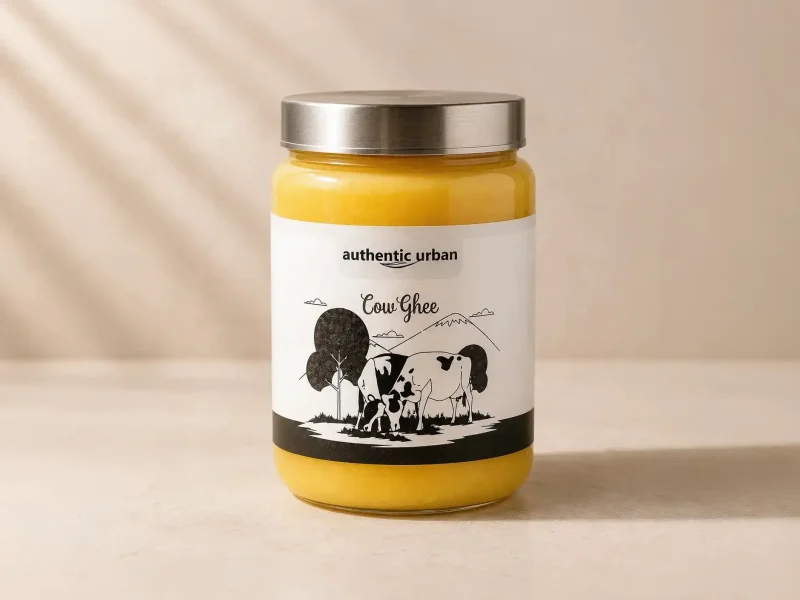 1 Litre
White katli and festival mithai
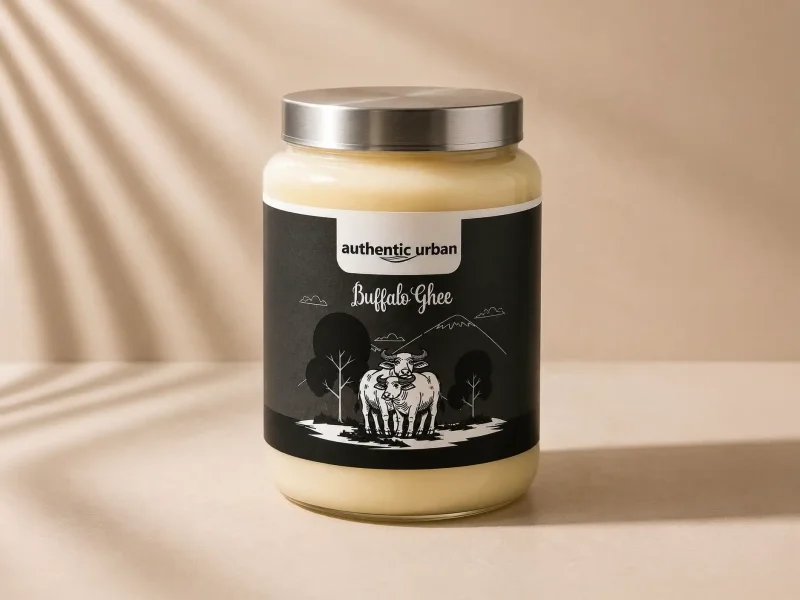 1 Litre
Each order is cooked after you place it, and the packing video is of that batch. Past order videos are on the shop.
FAQ
Kaju katli kaise banate hai?
250 g kaju ko chhote pulse mein pees kar bareek powder banao aur chhaan lo. 150 g cheeni ko 80 ml paani mein ghol kar 1 se 2 minute ubaalo. Aanch dheemi karke kaju powder daalo aur lagatar chalao, 3 minute baad 2 chammach ghee daalo. 5 se 7 minute mein chutki bhar mishran thanda karke goli banao; chipke nahi toh taiyar hai. Butter paper par 5 mm belkar diamond kaato.
Can I make kaju katli without ghee?
Yes. Cashews carry so much fat of their own that the katli sets without it, and many halwais use none in the dough. You lose a little of the smooth feel while kneading and the toasted-milk aroma, and the dough sticks more to the paper and knife. Grease the butter paper with a few drops of neutral oil instead, and knead with slightly wet hands if it clings.
Can I add milk powder to kaju katli?
You can swap up to 50 g of the cashews for milk powder to stretch an expensive batch. The katli turns creamier and a little softer, closer to a milk barfi, and it browns faster, so keep the flame low and test the ball a minute earlier. Use plain milk powder with no added sugar, and sieve it in with the cashew powder so it does not form lumps.
Can I make kaju katli with jaggery or no sugar?
Jaggery works but changes the sweet: the katli turns brown, tastes of caramel, and stays softer, so roll it a little thicker. Use about the same weight of grated gur, melt it in the water, and strain out any grit. Without sugar or gur the dough will not set by cooking. Date paste pressed into cashew powder gives a soft, no-cook sweet that must stay in the fridge.
Can diabetics eat kaju katli?
One piece from this recipe carries about 5 g of added sugar and 68 kcal. Two pieces is 10 g, which is 40% of the 25 g a day ICMR-NIN suggests as a limit for everyone, so it adds up fast on a festival day. For someone with diabetes, ask your doctor or dietitian whether one piece fits your plan, and count it within the day rather than on top.
What is the difference between kaju katli and kaju barfi?
Mostly the thickness and the cut. Katli means a thin slice: rolled to about 5 mm and cut into diamonds, smooth and soft. Kaju barfi is usually set thicker, often 1 to 2 cm in a tray, and cut into squares, sometimes with milk powder or khoya added for a richer bite. The dough is the same, so this recipe makes either one.
About the editorial team
Authentic Urban TeamBilona ghee makers, Gir Somnath, Gujarat
We are the Parmar family in Gir Somnath, Gujarat. We have made ghee here since 2016 and sold it online since 2025. We make only Bilona ghee, test it every month, and anyone is welcome to visit and watch it being made. Our Gir cows and Jafarabadi buffalo are grass-fed village animals that graze near the Gir forest, with no hormones or milk boosters. We set their milk to curd, churn it, and cook the makkhan on a wood chulha. These articles come from that kitchen and from what customers ask us on WhatsApp. We are ghee makers, not doctors.
Sources
- Nuts, cashew nuts, raw (FDC ID 170162), SR Legacy, USDA FoodData Central. Checked 28 Sep 2026.
- Sugars, granulated (FDC ID 169655), SR Legacy, USDA FoodData Central. Checked 28 Sep 2026.
- Butter oil, anhydrous (FDC ID 173412), SR Legacy, USDA FoodData Central. Checked 28 Sep 2026.
- Dietary Guidelines for Indians, 2024 (Guideline 7 on ghee; added sugar), ICMR-National Institute of Nutrition. Checked 28 Sep 2026.
- FSSAI asks states to ensure food-grade silver leaf not of animal origin (FnB News, 9 November 2018, quoting Regulation 2.11.4), FSSAI news archive. Checked 28 Sep 2026.