Motichoor Ladoo Recipe: Fine Ghee Boondi, in Grams
This motichoor ladoo recipe makes about 20 ladoos from 184 g besan (2 cups). Tap a thin batter through a fine jhara into ghee, fry the boondi 30 to 40 seconds so they stay soft, soak them in sugar syrup boiled just short of one string, rest 20 minutes, and shape by hand. The kadhai needs about 500 ml of ghee, and most of it comes back out.
How do you make motichoor ladoo at home?
Whisk 184 g besan with water into a thin batter. Boil 300 g sugar in 180 ml water to a sticky syrup. Tap the batter through a fine jhara into hot ghee, fry the tiny boondi for 30 to 40 seconds, and drop them into the warm syrup. Rest 20 to 30 minutes, then press into about 20 ladoos.
Ingredients (about 20 ladoos)
Boondi
- 184 g besan, 2 cups, sieved
- 300 to 340 ml water, added slowly
- A pinch of turmeric, or a few saffron strands soaked in 1 tbsp warm water
- About 500 ml ghee for frying, melted before measuring
Syrup (chashni)
- 300 g sugar, 1½ cups
- 180 ml water
- 4 green elaichi, crushed, and a few saffron strands
- ½ tsp lemon juice
To finish
- 1 tbsp ghee, plus a little for your palms
- 1 tbsp melon seeds (magaz) and a few chopped pistachios
Equipment: a motichoor jhara (the perforated ladle with the smallest holes), a second slotted spoon to lift the boondi, a kadhai about 24 cm across, and a wide pan for the syrup.
Steps
- 1. Whisk the besan and turmeric with 250 ml water, then add the rest a spoon at a time until the batter pours in a thin, steady stream. Rest 10 minutes.
- 2. Syrup: sugar, water, elaichi, and saffron in the wide pan. Once the sugar melts, boil 6 to 8 minutes until a cooled drop feels sticky and stretches a little, but no firm thread holds. Add the lemon juice. Keep it warm on the lowest flame.
- 3. Heat the ghee on medium. A drop of batter should rise at once with steady bubbles and not brown.
- 4. Hold the jhara 8 to 10 cm above the ghee. Pour 2 tbsp of batter onto it and tap the rim with a spoon so drops fall one by one. Cover the ghee surface once, not twice.
- 5. Fry 30 to 40 seconds, until the boondi are set but still pale and soft. Lift them out, drain a few seconds, and drop them into the syrup.
- 6. Wipe the jhara and dry it fully before the next batch. Let the ghee come back up to heat.
- 7. When all the boondi are in, stir in 1 tbsp ghee and the melon seeds. Cover and rest 20 to 30 minutes, stirring once, until the syrup is soaked up.
- 8. Grease your palms. Squeeze a lime-sized portion firmly, then roll it smooth. Press on pistachios. Leave 1 hour to set before boxing.
One ladoo: at least 99 kcal and 15 g of sugar, before the ghee the boondi keep from frying, worked out from USDA FoodData Central for the besan, sugar, and the tablespoon of ghee in the mix. How much frying ghee ends up in each ladoo depends on your heat and your jhara, so we show you how to weigh it in the ghee section below. For the unfried ladoo made from roasted besan, see our besan ladoo recipe.
What batter and jhara make fine motichoor boondi?
A thin besan batter that pours in a steady stream, and a jhara with the smallest holes you can buy, sold as a motichoor jhara. The holes set the size of the boondi. A regular boondi jhara, with bigger holes, makes boondi ladoo, however carefully you tap it.
Besan soaks up water unevenly from one pack to the next, which is why we give a range. Add the last 50 to 90 ml a spoon at a time, then fry three or four test drops before the whole batch. What the test drops tell you:
What the test drop does
Batter is
What to do
Boondi come out with little tails
Batter too thick
Do: Whisk in 1 to 2 tbsp water and test again.
Drops spread flat or break up in the ghee
Batter too thin
Do: Whisk in 1 to 2 tbsp besan, rest 5 minutes, test again.
Drops fall as round pearls and float up at once
Right
Do: Fry the whole batch at this thickness.
Tap, do not pour. Pour a little batter on the jhara and knock the rim with a spoon, or spread the batter across the holes with the back of a ladle. Batter pushed through too fast joins into strings. If there are two of you, one holds the jhara and taps, the other lifts the boondi out, and the batches go twice as fast.
How hot should the ghee be, and how long do you fry boondi?
Medium heat, where a drop of batter floats up at once with steady bubbles but does not brown, and 30 to 40 seconds a batch. Motichoor boondi come out soft and pale, not crisp. Crisp boondi cannot drink the syrup, and that is the most common reason homemade motichoor turns hard.
Each batch of cool batter drops the heat, so wait a few seconds between batches for the bubbling to pick up again. If the drops sink and sit, the ghee is too cool and the boondi will soak it up. If they brown before you lift them, turn the flame down a notch. How ghee holds up at frying heat, and which dishes to fry in ghee or in oil, is on ghee for deep frying.
Dry the jhara every time. We see why at the chulha in Gir Somnath: ghee is ready only once all the water in the makkhan has boiled away, so it runs far hotter than anything water-based on the stove. A wet jhara held over hot ghee spits, and a splash of ghee burns worse than a splash of boiling dal. Keep a dry cloth by the kadhai and children away from it.
What syrup consistency for motichoor ladoo?
Sticky, just short of one string: a cooled drop between finger and thumb feels tacky and stretches a little, but no firm thread holds. That gives soft, moist ladoos. Recipes online range from barely boiled syrup to a full one string; this is what each one gives you.
Just dissolved, 2 to 3 minutes of boiling
Test: Watery, no stickiness between finger and thumb.
Ladoo: Boondi stay wet and the mixture will not hold a shape for a long time. Ladoos slump and sweat in the box.
Sticky, just short of one string, 6 to 8 minutes
Test: A cooled drop feels sticky and stretches a little, but no firm thread holds.
Ladoo: This recipe. Soft, moist ladoos that shape after 20 to 30 minutes of resting and stay soft for days.
One string, 9 to 11 minutes
Test: A cooled drop pulls one clean thread that holds.
Ladoo: Firmer ladoos that shape sooner and travel well. Shape them warm; they set fast and can turn hard by the next day.
Past one string
Test: Two threads, or the syrup starts to crystallise on the spoon.
Ladoo: Hard, sugary ladoos. Add 2 to 3 tbsp water and bring it back to a boil before the boondi go in.
The lemon juice stops the syrup crystallising while the boondi go in batch by batch. Keep the syrup warm, not boiling: if it keeps cooking on the flame it creeps past one string while you fry. A firm one-string syrup is the right choice for a set sweet like Mysore pak, but for motichoor it only pays off when the ladoos must travel or keep longer.
Why are my motichoor ladoos hard, crumbly, or oily?
Almost always the boondi were fried too long, the syrup went too far or not far enough, or the ghee was too cool. Find the problem below.
Boondi too big, like boondi ladoo
The jhara holes are too wide, or the batter was poured, not tapped through.
Fix: Use a motichoor jhara with the smallest holes you can find. Pour a little batter on it and tap the rim so drops fall one by one. Wipe and dry the jhara between batches; clogged holes make bigger drops.
Mixture will not bind
Boondi fried crisp, or the syrup was too thin.
Fix: Cover the pan and wait 10 more minutes. If it still falls apart, sprinkle 2 tbsp warm water or milk, press it together in the pan on the lowest flame for a minute, then shape while warm.
Too wet and sticky to shape
Syrup boiled too short, or too much of it.
Fix: Cook the mixture on the lowest flame, stirring gently, for 2 to 3 minutes until it pulls together, then let it cool until you can hold it.
Hard ladoos the next day
Syrup boiled past one string, or boondi fried until crisp.
Fix: Next time stop the syrup short of one string and fry the boondi only until set. For this batch, crumble the ladoos, sprinkle warm water, warm them in a covered pan for a minute, and reshape.
Greasy ladoos, ghee on the plate
Ghee too cool while frying, so the boondi soaked instead of setting, or boondi not drained.
Fix: Let the ghee come back up between batches: a test drop should rise at once. Drain each batch in the jhara over the kadhai for a few seconds, then on a steel sieve.
Brown, crunchy boondi
Ghee too hot, or fried too long.
Fix: Turn the flame down a notch. Lift each batch at 30 to 40 seconds, while the boondi are still soft and have not changed colour.
How much ghee does motichoor ladoo need, and how much stays in?
About 500 ml in the kadhai, which is roughly 427 g by USDA's weight for a cup of ghee, plus 1 tablespoon in the mixture. Most of the frying ghee comes back out. The boondi keep only part of it, and the amount depends on your heat and how thin the batter is, so no recipe can give you an exact figure.
You can find your own. Weigh the kadhai with the ghee before frying, and again once the leftover ghee has cooled, with the crumbs strained out. The difference, divided by 20, is the frying ghee in each ladoo. ICMR-NIN's 2024 dietary guidelines put fat at 9 kcal a gram, so every gram adds 9 kcal on top of the 99 kcal floor. As an example of the sum, 60 g gone from the kadhai is 3 g a ladoo: 27 kcal more, and about 0.7 of a teaspoon of ghee. A study of fried besan droplets by Bhat and Bhattacharya (2001) found that boondi lose water much faster than they take up fat, which is why short, hot batches keep the ladoo lighter.
Ghee for the kadhai
500 ml costs
Note
Buffalo ghee (₹1,999 a litre)
about ₹1,000
Our pick for boondi and mithai. Richer taste for less money.
Cow ghee (₹2,399 a litre)
about ₹1,200
A lighter taste and a more yellow boondi.
Our own jar prices on authenticurban.com, September 2026. Most of this ghee is not used up; see below.
What to do with the leftover ghee
Strain it through a fine sieve or cloth, and cook dal, sabzi, or the next halwa with it within a day or two. Do not fry in it again. ICMR-NIN's 2024 guidelines say oil once used for frying should be filtered and used for curries, not for frying again, and we treat ghee the same way. Ghee that fried boondi also carries a little besan, which darkens fast on the next heating. Why reheated frying fat is a problem is on reheating ghee.
Cow or buffalo ghee for motichoor?
Both fry boondi well. Buffalo ghee gives a richer, rounder taste, costs less for a full kadhai, and is the one we reach for in mithai. Cow ghee is lighter and gives a more yellow boondi. The full difference is on cow vs buffalo ghee.
Melt the ghee before you measure it. Our ghee cools grainy, and in winter it sets to a fine grain, so a cup scooped from a cold jar holds far more ghee than a cup of melted ghee. The grain is normal and melts away in the kadhai; why it forms is on why ghee is grainy.
Motichoor ladoo vs boondi ladoo: what is the difference?
The size of the boondi and how long they fry. Motichoor boondi are tiny, from the finest jhara, fried soft and pressed into a smooth ladoo where you barely see the pearls. Boondi ladoo uses bigger drops from a wider jhara, often fried a little crisper, so the ladoo is grainy and each boondi shows.
The batter, syrup, and ghee are the same, so this recipe makes boondi ladoo too: use a boondi jhara, make the batter a little thicker so the bigger drops hold their shape, and fry 10 to 15 seconds longer. Other fried sweets that soak in syrup work on the same heat rules, from desi ghee jalebi to gulab jamun.
How many motichoor ladoos from 1 kg besan?
About 110 lime-sized ladoos, with 1.63 kg of sugar in the syrup. Keep the sugar at about 1.6 times the besan by weight and the syrup water at 60% of the sugar, whatever the size of the batch.
Besan
Sugar
Syrup water
Frying ghee
Ladoos
Besan 184 g (2 cups)
Sugar 300 g (1½ cups)
Syrup water 180 ml
Frying ghee 500 ml in the kadhai
About 20 ladoos
Besan 368 g (4 cups)
Sugar 600 g (3 cups)
Syrup water 360 ml
Frying ghee 500 ml, topped up once
About 40 ladoos
Besan 500 g
Sugar 815 g
Syrup water 490 ml
Frying ghee 750 ml to 1 litre
About 55 ladoos
Besan 1 kg
Sugar 1.63 kg
Syrup water 980 ml
Frying ghee 1 litre, topped up as it falls
About 110 ladoos
The frying ghee does not grow with the batch, because you fry in turns: top it up with fresh ghee from the jar when the level falls. For 1 kg of besan, make the syrup in two pans so it does not overcook while you fry for an hour, and mix the batter in two halves so the second half does not thicken as it stands. Buy ghee for a festival batch by weight; the checks for a good jar are on how to identify pure ghee.
How long do motichoor ladoos last?
Three to four days in a closed box in a cool room, and up to a week in the fridge. These are soft, syrup-soaked ladoos with moisture in them, so they do not keep like a dry besan ladoo. Lay butter paper between layers so they do not stick.
Take them out of the fridge an hour before serving; cold ladoos are firm and the ghee taste is muted until they warm. Throw out any ladoo that smells sour or shows mould. The ghee jar itself needs no fridge; how to keep it is on ghee storage and shelf life.
One ladoo carries about 15 g of sugar; ICMR-NIN's 2024 guidelines suggest keeping sugar to 25 g a day and ghee or butter to 1 to 2 teaspoons. That is fine for a festival plate, and a reason to stop at one or two. Our own family eats 1 to 2 teaspoons of ghee each a day and more in winter sweets, and we go lighter on ghee in dal and roti that day. The reasoning is on how much ghee per day, and with diabetes, read can diabetics eat ghee first.
Motichoor ladoo recipe card to keep
Screenshot this and keep it by the stove.
- 1. Batter: 184 g besan (2 cups), a pinch of turmeric or soaked saffron, about 300 to 340 ml water added slowly. Whisk smooth, rest 10 minutes.
- 2. Test drop: round pearls that float at once. Tails mean too thick, flat drops mean too thin.
- 3. Syrup: 300 g sugar, 180 ml water, 4 crushed elaichi, a few saffron strands. Boil 6 to 8 minutes to sticky, just short of one string. Add ½ tsp lemon juice. Keep warm.
- 4. Ghee: about 500 ml in a kadhai on medium. A drop of batter rises at once with steady bubbles and does not brown.
- 5. Hold the motichoor jhara 8 to 10 cm above the ghee. Pour a little batter on it and tap the rim. Fry 30 to 40 seconds, until set but still pale and soft.
- 6. Lift, drain a few seconds, and drop the boondi straight into the warm syrup. Wipe and dry the jhara before every batch.
- 7. Stir in 1 tbsp ghee and 1 tbsp melon seeds. Cover and rest 20 to 30 minutes until the syrup is soaked up.
- 8. Grease your palms with ghee. Press lime-sized portions firmly, then roll. Makes about 20. At least 99 kcal and 15 g sugar each, plus the frying ghee.
Which ghee for motichoor ladoo?
The boondi fry in ghee and the ghee goes into the mixture too, so the jar is most of the taste. Pick a plain ghee with nothing added that smells of toasted milk when it melts, and buy it by weight for a festival batch. For fried sweets, buffalo ghee gives the richer taste for less per kadhai; our ranking of what is on sale, with prices, is best buffalo ghee in India.
For motichoor we would fry in our Jafarabadi buffalo ghee, and use our A2 Gir cow ghee if you like a lighter, more yellow ladoo. Both come from grass-fed village animals near the Gir forest; the milk is set to curd overnight, churned, and the makkhan cooked in a matki on a wood chulha. The jar is made after you order, a video of it being cooked and packed comes on WhatsApp, and Varsha tastes every batch before it goes in a jar. We test every month against the FSSAI limits; the steps are on how we make ghee.
A lighter, more yellow boondi
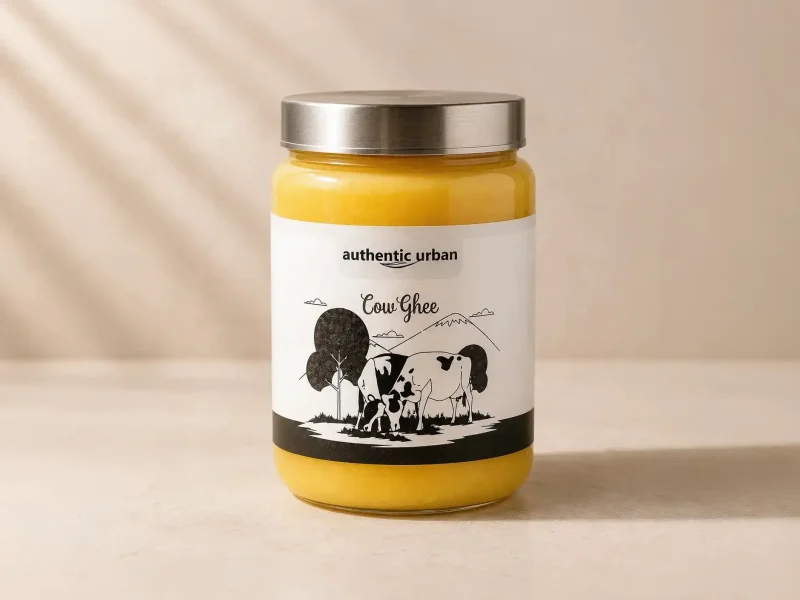 1 Litre
Frying boondi and festival mithai
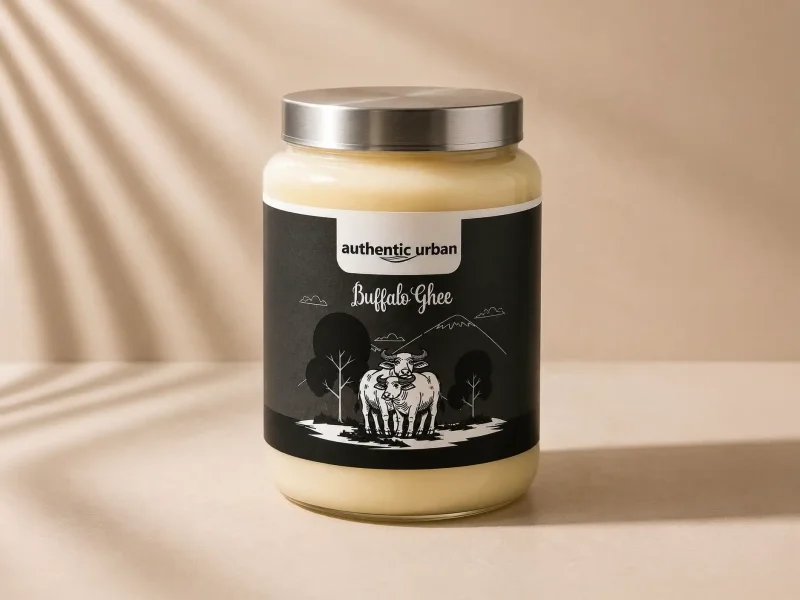 1 Litre
Each order is cooked after you place it, and the packing video is of that batch. Past order videos are on the shop.
FAQ
Motichoor ladoo kaise banate hai?
184 g besan mein dheere dheere lagbhag 300 ml paani milakar patla ghol banao. 300 g cheeni aur 180 ml paani ki chipchipi chashni banao, ek taar se thoda pehle. Kadhai mein ghee garam karo, motichoor jhare par ghol daal kar kinare ko thapthapao, aur boondi ko 30 se 40 second talo. Boondi ko garam chashni mein daalo, 20 minute dhak kar rakho, phir ghee lage haathon se ladoo banao.
Can I fry the boondi in oil and still get a ghee taste?
Partly. Many home cooks fry the boondi in oil to save ghee and stir 2 to 3 tablespoons of ghee into the soaked boondi before shaping. You get some ghee aroma, but less than boondi fried in ghee, because most of the taste goes in during frying. A half-and-half mix of ghee and oil in the kadhai is a fair middle path. Use fresh oil either way.
Why is shop motichoor ladoo so bright orange?
Usually added food colour in the batter. Home ladoos made with only a pinch of turmeric or a few saffron strands come out a softer golden yellow, and taste the same. If you want the festival orange, buy a colour sold for food with an FSSAI licence on the pack and use a tiny pinch in the batter, not in the syrup, so the boondi colour evenly.
Can I make motichoor ladoo with jaggery instead of sugar?
You can, but it will not look or feel like motichoor. Jaggery syrup is darker and does not hold a clean string, so the boondi turn brown and the ladoos stay softer and stickier. Use the same weight of grated gur as sugar, dissolve it in the water, strain out any grit, and boil it gently to a sticky stage. Eat them within two or three days.
Can diabetics eat motichoor ladoo?
One ladoo from this recipe carries about 15 g of sugar before counting the ghee the boondi keep from frying, which is more than half of the 25 g a day ICMR-NIN suggests as a limit for everyone. For someone with diabetes, even one ladoo is a real sugar load. Ask your doctor or dietitian whether half a ladoo on a festival day fits your plan.
How many days ahead can I make motichoor ladoo for a puja or wedding?
Two days ahead is safe for soft ladoos made with syrup short of one string, kept in a closed box in a cool room. For three or four days, or if the ladoos will travel, boil the syrup to one string so they set firmer, and keep them in the fridge once the room is warm. Bring them out an hour before serving so the ghee softens.
About the editorial team
Authentic Urban TeamBilona ghee makers, Gir Somnath, Gujarat
We are the Parmar family in Gir Somnath, Gujarat. We have made ghee here since 2016 and sold it online since 2025. We make only Bilona ghee, test it every month, and anyone is welcome to visit and watch it being made. Our Gir cows and Jafarabadi buffalo are grass-fed village animals that graze near the Gir forest, with no hormones or milk boosters. We set their milk to curd, churn it, and cook the makkhan on a wood chulha. These articles come from that kitchen and from what customers ask us on WhatsApp. We are ghee makers, not doctors.
Sources
- Chickpea flour (besan) (FDC ID 174288), SR Legacy, USDA FoodData Central. Checked 28 Sep 2026.
- Sugars, granulated (FDC ID 169655), SR Legacy, USDA FoodData Central. Checked 28 Sep 2026.
- Butter oil, anhydrous (FDC ID 173412), SR Legacy, USDA FoodData Central. Checked 28 Sep 2026.
- Dietary Guidelines for Indians, 2024 (energy per gram of fat; Guideline 7 on ghee and used frying oil; added sugar), ICMR-National Institute of Nutrition. Checked 28 Sep 2026.
- Bhat K.K. and Bhattacharya S. Deep fat frying characteristics of chickpea flour suspensions. International Journal of Food Science and Technology 36, 499-507 (2001), Wiley. Checked 28 Sep 2026.