Ghee for Burns and Sunburn: Is It Safe, and When to Use
Ghee for burns is safe only later, never on a fresh burn. Hold the burn under cool running water for 20 minutes, cover it loosely, and put nothing greasy on it: WHO and NHS first aid both rule out oil and butter. Ghee has one job here, days later, as a thin layer on skin that has closed and feels dry.
Can you put ghee on a burn?
Not on a fresh one. The first thing on a burn is cool running water for 20 minutes, and then a loose cover. The NHS says not to put any creams, oils, or butter on burns or scalds, and the WHO burns fact sheet names oil, haldi (turmeric), paste, and raw cotton as things not to apply. Ghee is a fat like butter, so it waits.
Where ghee does fit is the healing stage: once a small burn has closed over, the heat has gone, and the new skin feels tight and dry. Then 2 or 3 drops, warmed between clean fingers, soften it the way ghee softens cracked heels. That is moisture, not burn treatment. This page is for small burns at home and everyday sunburn. The WHO counts over 1 million people in India moderately or severely burnt every year; those burns belong in hospital, not with any home remedy.
What should you do in the first 20 minutes after a burn?
Cool it under running water for the full 20 minutes, then cover it. These six steps follow the WHO and NHS first aid pages, in the order you would do them in a kitchen.
1. Move away from the heat
Switch off the gas, put the pan down, step out of the sun. Your own safety first, then the burn.
2. Cool running water, 20 minutes
Tap water that feels cool, not ice cold, running over the burn. The NHS says to start as soon as possible, within 3 hours. Use a timer: 20 minutes feels long.
3. Take off rings, bangles, and clothes near it
Before the skin swells. Anything stuck to the burn stays on for a doctor to remove.
4. Cover loosely
A layer of cling film laid on top, not wrapped round, or a clean cloth. No sticky plaster, no cotton wool.
5. Pain relief if you need it
Paracetamol or ibuprofen, as the label or your pharmacist says.
6. Nothing else on it
No ghee, butter, oil, haldi, toothpaste, or ice. Do not pop a blister.
Two mistakes are common. People stop the water after a minute because the sting eases, but the sting comes back and the skin underneath is still hot. And people reach for ice, which the WHO says deepens the injury. Cool tap water for 20 minutes is enough; cool only the burn and keep the rest of the person warm, because the WHO also warns that cooling for too long can chill the whole body (hypothermia), a bigger risk for small children.
Why not ghee, butter, oil, or toothpaste on a fresh burn?
Because a greasy layer holds heat in while the burn needs heat pulled out. Running water carries warmth away from the skin all the time it flows. A coat of ghee or oil does the opposite: it sits on top and slows the heat and water leaving the skin, so the burn can go on cooking for longer.
There is a second problem. Ghee, butter, toothpaste, and haldi are not clean for broken skin, and a doctor has to wash every one of them off before looking at a burn, which hurts. Many Ayurveda and home-remedy pages tell you to apply ghee straight away because it is "cooling". Ghee does feel cool when it comes out of a cold jar, for a moment. The belief about ghee cooling the body is about eating it, as we explain on is ghee heating or cooling. On a burn, it is the water that cools.
Which kitchen burns can you treat at home?
A small red burn with no blister can usually be cared for at home after cooling; anything that blisters, spreads, or is on a child needs a doctor. Kitchens make the same few burns again and again, so here they are with what to do and when to go.
Burn
How it looks
What to do
See a doctor
Finger touches a hot tawa or kadai
Red, sore, no blister
20 minutes under the tap. Usually fine at home.
Doctor: If it blisters or still hurts badly the next day
Hot ghee or oil splash while frying
Red spots that can blister over a few hours
20 minutes under the tap, even for small spots. Oil clings to skin.
Doctor: Any blister, or a splash on the face or eyes
Steam from a pressure cooker or kettle
Often worse than it first looks
20 minutes under the tap. Check again after a few hours.
Doctor: Face or neck, a wide area, or blisters
Spilt chai, dal, or boiling water
Wide patch, wet clothes hold the heat
Take off wet clothes first, then 20 minutes under cool water.
Doctor: Anything bigger than a small patch, and any spill on a child
Hot wax or diya oil
Small, deep spot
20 minutes under the tap. Leave stuck wax on.
Doctor: If the spot is white, leathery, or numb
Acid, bleach, or a cleaning chemical
Any
Rinse with running water.
Doctor: Always. The NHS sends chemical burns to emergency
Electric shock from a plug or wire
Can look tiny outside
Switch off the power before you touch the person.
Doctor: Always. The NHS sends electrical burns to emergency
Hot fat is the burn we think about most. Our makkhan (the butter churned from curd) cooks in a matki on a wood chulha for 45 to 90 minutes before it turns to ghee, and it is only ghee once the water in the makkhan has boiled away, so hot ghee is hotter than any pot of boiling dal. A splash of hot ghee or oil sticks to the skin instead of running off like water, which is why even a small spot needs the full 20 minutes under the tap. If you fry at home, the pan and the heat matter more than the fat; the frying rules are on ghee smoke point and deep frying.
Is ghee good for sunburn?
Not on the first day, when the skin is hot and tight; yes, a thin layer, once it starts to peel. The NHS advice for sunburn is to get out of the sun, cool the skin with a cool shower, bath, or damp towel, drink plenty of water, and use after-sun or an unperfumed moisturiser. It also says to avoid petroleum jelly on sunburn, and ghee is just as heavy and greasy.
So on day one, cool water and a light moisturiser or plain aloe gel. After two or three days, when the heat has gone and the skin starts to flake, a drop or two of ghee on the dry patches helps them feel less rough. Do not pull the flakes, and keep the skin covered from the sun until it has fully healed. Blistered or swollen sunburn, or sunburn with fever, shivering, or dizziness, is a doctor visit, and so is any sunburn on a baby or young child. For skin that feels hot after a day outdoors but is not burnt, an aloe and ghee mix is one of the packs on ghee face packs.
When can you apply ghee on a burn that is healing?
Once the skin has closed, there is no blister or weeping, and the burn no longer feels hot. For a small first-degree burn (red skin, no blister), that is often after a few days. The table shows each stage, and it is the part worth saving.
Stage of the burn
Ghee?
What to use instead, or how
Fresh burn, first 20 minutes
Ghee: No
Cool running water only
Red, hot, sore skin, day 1
Ghee: No
Cool cloth, a light unperfumed moisturiser or plain aloe gel
Blister, whole or burst
Ghee: No
Loose clean cover; a doctor or pharmacist for dressings
Wet, weeping, or yellow crust
Ghee: No
A doctor: these can be signs of infection
Skin closed, no heat left, dry and tight
Ghee: Yes, thin
2 or 3 drops, warmed between clean fingers, once or twice a day
Sunburn peeling after a few days
Ghee: Yes, thin
A drop or two on the dry flakes; do not pull them
Pink new skin or an old mark
Ghee: If you like
Scar care, with sunscreen by day
How to apply ghee for burns on healed skin
Wash your hands, take a small spoonful out of the jar with a dry spoon into a separate pot, warm 2 or 3 drops between your fingertips until they turn clear, and press them onto the dry skin. Do not rub hard on new skin. Once or twice a day is enough. Stop if the skin turns red, itchy, or bumpy, and try it first on a spot of healthy skin if you have reacted to creams before.
Ghee will not stop a burn from leaving a mark, and it will not fade one. What to expect on a mark that has already formed is on ghee for scars. If the skin around an old burn stays dry and itchy for weeks, that can turn into a rash of its own; see ghee for eczema for what ghee can and cannot do there. People who prefer a lighter, creamier fat on skin sometimes use washed ghee, made as shown on shata dhauta ghrita; the same rule applies: healed skin only.
When does a burn need a doctor?
The NHS sends very large or deep burns, burns on the face, genitals, or bottom, and all chemical and electrical burns to emergency care. We make ghee; we are not doctors, so take any of these signs to one, and skip every home remedy while you wait.
- Any blister bigger than a small coin, or blisters in more than one spot.
- A burn on the face, eyes, hands, feet, genitals, or bottom, or across a joint.
- Skin that looks white, grey, brown, or leathery, or feels numb. A burn that does not hurt can be the deepest kind.
- Any chemical or electrical burn.
- Any burn or sunburn on a baby or young child.
- Pain that gets worse after the first day, pus, a bad smell, spreading redness, or a fever.
- Sunburn with fever, shivering, dizziness, feeling sick, headache, or cramps.
- Diabetes, or anyone whose skin heals slowly, with a burn that has not settled in two days.
Burns on a baby's skin need extra care; daily baby skin care with ghee is a separate question, answered on ghee for baby massage, and none of it applies to broken or burnt skin.
Burn first aid checklist
Screenshot this, or stick it inside a kitchen cupboard door.
- Heat off, step back.
- Cool running water, 20 minutes, on a timer.
- Rings, bangles, and wet clothes off; stuck cloth stays.
- Cling film laid on, or a clean cloth. No cotton wool.
- Nothing greasy: no ghee, butter, oil, or toothpaste. No haldi, no ice.
- Blister, big burn, child, face, chemical, or electric: doctor.
- Ghee only once the skin has closed and the heat has gone.
Which ghee for healed skin?
For skin, the jar matters less than keeping it clean: a separate pot, a dry spoon, and ghee that smells fresh. How long ghee keeps once open, and how to tell when it has gone off, is on ghee storage and shelf life, and five purity checks are on how to identify pure ghee.
For a jar that does the daily dal and a small skin pot, we would pick our own A2 Gir cow ghee: milk from grass-fed Gir cows near the Gir forest, set to curd overnight, churned by hand (the Bilona method), and cooked after you order, with a video of your jar sent on WhatsApp. For paratha and sweets, our Jafarabadi buffalo ghee is the richer jar. We test every month against the FSSAI limits; the steps are on how we make ghee. Our ranking of the cow ghee on sale is on best cow ghee in India.
A small skin pot and the daily teaspoon
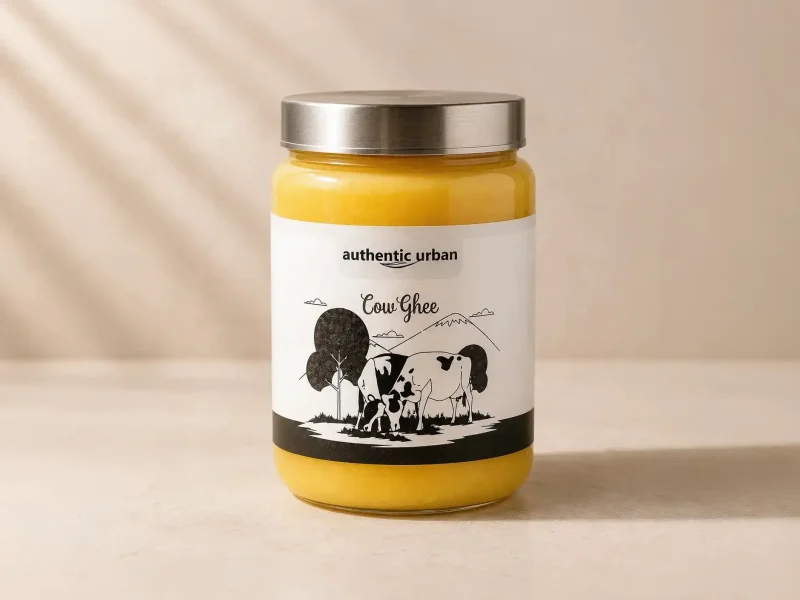 1 Litre
Paratha, halwa, and winter sweets
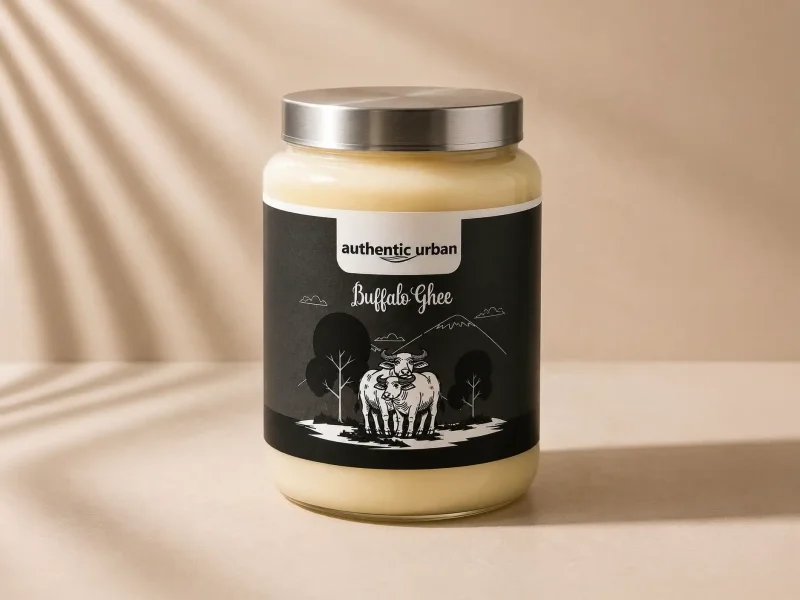 1 Litre
Each order is cooked after you place it, and the packing video is of that batch. Past order videos are on the shop.
FAQ
Is ghee cooling for burns, as Ayurveda says?
Ayurveda texts describe ghee as cooling in the body, and many families take that to mean it cools a burn. On skin it works the other way round. A layer of fat sits on top and slows the heat and moisture leaving the skin, while running water carries heat away. WHO and NHS first aid both leave oil and butter off a fresh burn for that reason. The tradition fits the healing days, not the first hour.
Can I put ghee on a burn on my child or baby?
Not on the burn itself. Cool it under cool running water for 20 minutes, keep the child warm otherwise, and get any burn on a baby or young child seen by a doctor, even a small one; their skin is thinner and a burn can be deeper than it looks. Once a doctor is happy the skin has healed, a drop of ghee on a dry patch is fine if the skin takes it well.
Does ghee remove burn marks?
No. Ghee can make healed, tight skin feel softer, and softer skin can make a mark look less dry, but it does not erase a scar or change its colour. Burn marks fade slowly over months on their own, and sun darkens them, so sunscreen does more for a mark than any oil. A raised, itchy, or spreading scar is one for a dermatologist, not a kitchen jar.
Is aloe vera or coconut oil better than ghee for a burn?
For the first hours, none of them. Cool running water comes first. Once the burn is cooled, plain aloe gel is lighter than any fat and many people find it soothing on unbroken red skin or sunburn. Coconut oil and ghee are both fats and belong to the same later stage, on skin that has closed and feels dry. Pick whichever your skin tolerates, and use a thin layer.
Can I use ghee from the kitchen jar on healed skin?
Yes, but not straight from the jar with your fingers. Take a small spoonful out with a dry, clean spoon into a separate little pot, and use that for skin. Fingers and water in the main jar spoil ghee faster and carry germs back into the food. Use ghee that smells fresh and nutty; a sour or stale smell means it has gone off, and old fat is not for skin either.
What should I eat while a burn heals?
Your usual home meals, with enough water and some protein at every meal: dal, curd, paneer, eggs, or pulses. Skin rebuilds from what you eat, and a burn that stings makes people skip meals. Ghee on your dal and roti is fine at your usual 1 or 2 teaspoons; eating more does not heal a burn faster. For a large burn, the hospital team will advise on diet.
About the editorial team
Authentic Urban TeamBilona ghee makers, Gir Somnath, Gujarat
We are the Parmar family in Gir Somnath, Gujarat. We have made ghee here since 2016 and sold it online since 2025. We make only Bilona ghee, test it every month, and anyone is welcome to visit and watch it being made. Our Gir cows and Jafarabadi buffalo are grass-fed village animals that graze near the Gir forest, with no hormones or milk boosters. We set their milk to curd, churn it, and cook the makkhan on a wood chulha. These articles come from that kitchen and from what customers ask us on WhatsApp. We are ghee makers, not doctors.
Sources
- Burns: fact sheet, World Health Organization. Checked 27 Sep 2026.
- Burns and scalds, NHS. Checked 27 Sep 2026.
- Sunburn, NHS. Checked 27 Sep 2026.