Ghee for Psoriasis: Is It Good to Eat or Put on Plaques?
Ghee for psoriasis is fine to eat at 1 to 2 teaspoons a day, and a thin layer can soften dry, scaly plaques the way any plain moisturiser does. It does not treat psoriasis, eating more of it will not clear plaques, and it never replaces the creams, tablets, or light therapy your dermatologist set.
Is ghee good for psoriasis?
As food and as a moisturiser, yes for most people; as a treatment, no. Psoriasis patients can eat ghee at the usual 1 to 2 teaspoons a day, and a few drops after a bath can make dry plaques feel less tight. We found no trial of plain kitchen ghee, eaten or applied, on psoriasis. The only study people quote used a medicated ghee at doses no kitchen would serve.
The NHS describes psoriasis as a common condition that causes dry, flaky, itchy patches with silvery-white scales, comes in flare-ups, and cannot be cured, only managed. It is not contagious. We make ghee in Gir Somnath; we are not skin doctors. This page is for someone who already has a diagnosis and wants to know where ghee fits on the plate and on the skin. Which cream, tablet, or light treatment you need is your dermatologist's call.
Psoriasis me ghee kha sakte hai? How much a day
Yes, psoriasis me ghee kha sakte hai, within 1 to 2 teaspoons a day. ICMR-NIN's 2024 Dietary Guidelines for Indians ask everyone to limit ghee or butter to 1 to 2 teaspoons a day, or avoid it, and psoriasis gives no reason to go above that. At home our family eats 1 to 2 teaspoons each, on roti, dal, and khichdi. What changes the amount is your weight and your cholesterol, not your skin:
Your situation
Ghee a day
How
Adult with mild psoriasis, normal weight and cholesterol
1 to 2 tsp a day
Spread over lunch and dinner, on dal, roti, or khichdi. This is the ICMR-NIN 2024 limit for ghee or butter.
Overweight, or advised to lose weight
½ to 1 tsp a day
Weight loss is the diet change the psoriasis doctors' review backs most strongly. Every teaspoon counts, so measure it.
High LDL, diabetes, or heart disease as well
½ to 1 tsp, or as your doctor says
Psoriasis often sits beside these. Ghee is mostly saturated fat; your lipid report sets the amount, not your skin.
On tablets, injections, or light therapy for psoriasis
Your usual family amount
Keep every dose. Ghee does not replace or boost treatment. Ask your dermatologist before starting any "ghee cleanse".
Joint pain as well (psoriatic arthritis)
1 to 2 tsp a day
Same limit. Joint pain with psoriasis needs a doctor's check, not a larger spoon.
Pregnant, or a child with psoriasis
Normal food amounts only
No extra ghee as a remedy. The NHS lists pregnancy as a psoriasis trigger; the doctor plans treatment.
Measure with a 5 ml spoon for a week; most people pour more than they think. How the teaspoons split between cooking and topping, by age, is on how much ghee per day. If a rich dal-chawal dinner and a late night leave you tired, that is the meal, not the psoriasis talking. You can work out your whole home's daily ghee and oil with our ghee and oil calculator.
What does the medicated ghee study on psoriasis show?
It shows less than the websites quoting it suggest. The study came from India in 1999 (Kumar and colleagues, in the Indian Journal of Dairy and Biosciences), and it is best known through a 2010 review in the journal Ayu by Sharma, Zhang, and Dwivedi. The review calls it a preliminary clinical study. Psoriasis patients were given a medicated ghee in daily rising doses of 60 ml over 7 days. Their blood fats fell, and they had less scaling, redness, and itch.
Three things matter before anyone copies it at home. First, it was a medicated ghee (ghee cooked with herbs), not plain ghee from the kitchen. Second, 60 ml is about 12 teaspoons. Doses that size belong to snehapana, the Ayurvedic ghee cleanse done under a practitioner; they are not a daily food amount. Third, the review describes no comparison group, so we cannot tell how much of the change came from the ghee, the herbs, the diet, or plaques settling on their own. Why snehapana is not something to try at home is on is a ghee detox safe at home, and how herb-cooked ghees differ from kitchen ghee is on medicated ghee (ghritam).
Can you apply ghee on psoriasis plaques?
Yes, on dry, unbroken plaques, as a moisturiser beside your treatment. The NHS lists moisturisers (emollients) as part of psoriasis care, alongside vitamin D and steroid creams, coal tar, light therapy, and medicines. Plain ghee is a fat, so on a dry plaque it can soften scale and ease the tight feeling. Where it fits depends on where the psoriasis is:
Where
Ghee?
What to do
Dry plaques on elbows, knees, back
Ghee: Yes, thin
A few drops after a bath to soften scale. Your prescribed cream stays the treatment.
Scalp plaques
Ghee: Before a wash only
A little on the scales an hour before washing, then the medicated shampoo your doctor named.
Cracked palms and soles
Ghee: Yes, at night
On unbroken skin, with cotton socks or gloves. Deep, bleeding cracks need a doctor.
Nails that dent, pit, or lift
Ghee: Only as cuticle care
Ghee cannot reach nail psoriasis under the nail. A dermatologist decides treatment.
Folds: groin, under the breasts, genitals
Ghee: No
Warm, damp skin. Use only what your doctor prescribes for folds.
Skin turning red fast, or pus-filled bumps
Ghee: No
Emergency. The NHS says call 999 or go to A&E; in India, go to a hospital the same day.
Not sure whether the flakes on your head are psoriasis or dandruff? The differences, and why oil can feed dandruff yeast, are on ghee for dandruff and dry scalp. For split heels without psoriasis, see ghee for cracked heels.
How to apply ghee on psoriasis, step by step
1. Patch test for two days
A drop on a small plaque and on normal skin of the inner arm, morning and night. Any sting, spread, or new redness: stop.
2. Use a separate small pot
Take ghee out with a clean spoon. The NHS says never put fingers into an emollient pot, and never share it.
3. Apply after a bath
Pat the skin almost dry. Scale softens best when the skin is still slightly damp.
4. Warm a few drops between clean fingers
Until they turn clear, then smooth over the plaque. Do not rub scale off.
5. Keep the medicine first
Steroid, vitamin D, or coal tar products go on as your doctor told you. Put ghee on at a different time of day.
6. Never pick or scrape scale
The NHS lists skin injury as a psoriasis trigger. Let softened scale lift in the next wash.
Good ghee cools grainy, so a spoon from the jar can feel gritty on a sore plaque; a few seconds between warm fingers turns it clear and smooth. What matters more for skin is water. Our makkhan (butter churned from curd) cooks on a low flame for 45 to 90 minutes, and it is ghee only once all the water has boiled away. A batch taken off too early stays cloudy, keeps moisture, and spoils fast; we never pack one, it stays in our kitchen. Wet fingers do the same thing to a skin pot, so keep it small, dry, and fresh. How long an open jar keeps is on ghee storage and shelf life.
One warning for Indian homes: the NHS says clothing and bedding that have soaked up an emollient burn more easily, and ghee is a fat. After putting it on your arms or legs, change the kurta or dupatta and wash your hands before you go near the gas, a chulha, or the diya at the mandir. If you want a lighter cream for plaques, washed ghee is covered on shata dhauta ghrita for psoriasis, with the same limits.
Does ghee reduce psoriasis inflammation from the gut?
No study shows it. You will read that the butyric acid in ghee heals a "leaky gut" and calms psoriasis from inside. Ghee does contain butyric acid, but a teaspoon is a small amount, most butyrate in the gut is made by bacteria from fibre, and we found no psoriasis trial of ghee or of butyrate from food. What butyrate per spoon really is, and what fibre does, is on butyrate and gut health.
The opposite fear is also overdone. Ghee is mostly saturated fat, and ICMR-NIN's 2024 guidelines say saturated fat can increase inflammation and LDL cholesterol, which is why the 1 to 2 teaspoon limit exists. Within that limit, ghee on dal is not a psoriasis trigger on any NHS or AAD list. What the ghee, dairy, and CLA trials show about inflammation markers is on is ghee anti-inflammatory, and for joint pain, ghee for joint pain.
What helps psoriasis more than ghee?
Treatment first, then weight, alcohol, and smoking. A 2018 systematic review by the medical board of the US National Psoriasis Foundation, in JAMA Dermatology, looked at 55 studies. The only diet change it strongly recommended was a lower-calorie diet for weight loss in people who are overweight, and it said diet should always go alongside standard medical treatment, never instead of it.
Take the treatment you were prescribed
The NHS lists creams, light therapy, and medicines. Psoriasis cannot be cured, but these keep it in check.
Lose weight if you are overweight
The 2018 National Psoriasis Foundation review strongly recommends a lower-calorie diet for weight loss here. The AAD says some treatments that failed start working after weight loss.
Cut down alcohol
The AAD says treatment works less well in men who drink 2 or more drinks a day and women who drink 1 or more.
Stop smoking
The NHS lists smoking among psoriasis triggers.
Go gluten-free only after a blood test
The same review supports it only for people whose blood test shows gluten sensitivity.
Moisturise every day, even when clear
With the emollient your doctor named, or plain ghee on dry plaques if it suits you.
In an Indian kitchen, losing weight usually means less oil and ghee in the cooking and fewer fried snacks, not cutting ghee to zero. If the sabzi is swimming in oil, that is the first place to cut; the swap is on ghee vs vegetable oil, and a full plan is on ghee for weight loss. Psoriasis with dry, cracked skin can look like eczema, but they are different conditions; how ghee fits eczema is on ghee for eczema.
When should you stop ghee and see a doctor?
Stop ghee at the first sign your skin dislikes it, and see a doctor whenever psoriasis changes fast or your joints hurt. The NHS asks you to see a GP if treatment is not working, causes side effects, or you get recurring joint pain, and to call an ambulance or go to A&E for the first two signs below. This page is general information, not medical advice.
- The plaque stings, spreads, or turns redder after ghee.
- Skin that quickly turns red with white, pus-filled bumps that join together. The NHS says call 999 or go to A&E.
- Red, scaly, pus-filled bumps on the tips of fingers or toes. Same emergency advice.
- Joint pain, stiffness, or swelling that keeps coming back. It can be psoriatic arthritis.
- Treatment that is not working, or causes side effects.
- Cracks that bleed, or skin that is hot, swollen, or oozing.
Ghee for psoriasis: a checklist to save
Screenshot this for the bathroom shelf.
- Keep every cream, tablet, and light session your dermatologist set.
- Eat ghee at your usual 1 to 2 teaspoons a day; less if you need to lose weight.
- Patch test two days before ghee goes on a plaque.
- Separate small skin pot, clean spoon, never fingers in the jar.
- A few warmed drops after a bath, on dry, unbroken plaques only.
- Never pick scale, and never ghee on folds or pus-filled skin.
- Change clothes and wash hands before going near the gas, a chulha, or a diya.
- Stop at the first sting or spread.
Which ghee for the plate and a skin pot?
For psoriasis, pick a ghee with nothing added: no colour, no flavour, no perfume, and a fresh, toasted-milk smell. Five checks for a pure jar are on how to identify pure ghee. If milk ever upsets your stomach, ghee has almost no lactose; that is explained on ghee and lactose intolerance.
For the daily dal and a small skin pot, we would pick our own A2 Gir cow ghee: milk from grass-fed Gir cows near the Gir forest, set to curd overnight, churned by hand (the Bilona method), and cooked after you order, with a video of your jar sent on WhatsApp. For paratha and sweets, our Jafarabadi buffalo ghee is the richer jar. We test every month against the FSSAI limits, including moisture; the steps are on how we make ghee. Our ranking of the cow ghee on sale is on best cow ghee in India.
The daily teaspoon and a small skin pot
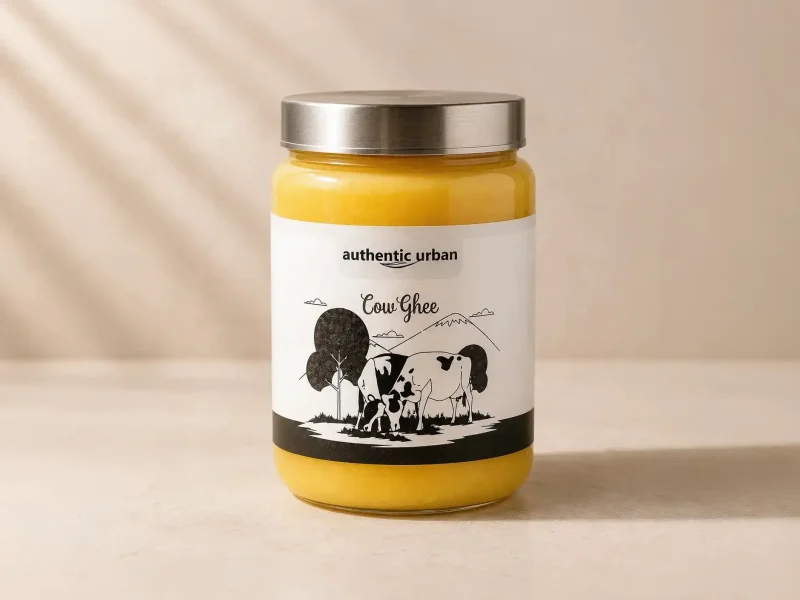 1 Litre
Paratha, halwa, and winter sweets
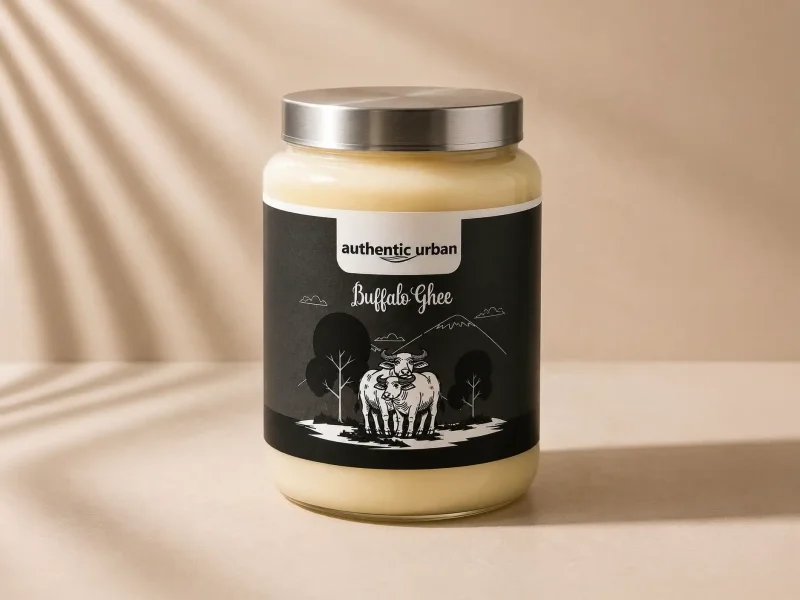 1 Litre
Each order is cooked after you place it, and the packing video is of that batch. Past order videos are on the shop.
FAQ
Can ghee cure psoriasis permanently?
No. The NHS says psoriasis cannot be cured, only managed, and it comes in flare-ups and quiet spells. Food and moisturisers cannot change that. A thin layer of ghee can make dry plaques feel softer, and eating it in normal amounts is fine, but a clear spell after starting ghee is usually the disease settling or the treatment working. Stories of a permanent ghee cure leave that out.
Is cow ghee or buffalo ghee better for psoriasis?
Neither has been tested on psoriasis. For eating, the amount matters more than the animal: stay within 1 to 2 teaspoons a day. For skin, cow ghee is softer and melts at a lower warmth, so a few drops spread thin without rubbing. Buffalo ghee sets firmer and feels heavier on a plaque. Whichever you use, it should smell fresh and never have water in it.
Can I mix haldi, neem, or camphor into ghee for psoriasis?
Better not. Each extra ingredient is one more thing that can sting or cause an allergy, and camphor burns on cracked skin. Haldi also stains the plaque yellow, which hides whether it is getting better or worse. If you want to try ghee, try it plain, so you know what your skin is reacting to. Herbal medicated ghees are medicines and belong with the practitioner who prescribes them.
Can psoriasis spread through a shared ghee jar?
No. The NHS says psoriasis is not contagious, so family members cannot catch it from you, your towel, or the kitchen jar. The reason to keep a separate small pot for skin is hygiene: fingers carry water and skin flakes into the ghee, and water is what makes ghee go stale. The NHS also advises never sharing an emollient with anyone.
Does dairy trigger psoriasis, and should I stop ghee?
Dairy is not on the NHS list of psoriasis triggers, and the 2018 doctors' review did not recommend cutting dairy for psoriasis. Ghee is almost pure milk fat with very little milk protein or lactose. If you notice a flare every time you eat something, keep a food diary and show it to your doctor, rather than cutting whole food groups on your own.
Can I put ghee on my child's psoriasis?
Ask the child's doctor first, and use the emollient they name. A rash on a child can be psoriasis, eczema, a fungal infection, or something else, and each needs different care. If the doctor agrees to plain ghee on dry patches, do a two-day patch test, use a clean spoon and a separate pot, and keep the child away from the stove and diyas afterwards.
About the editorial team
Authentic Urban TeamBilona ghee makers, Gir Somnath, Gujarat
We are the Parmar family in Gir Somnath, Gujarat. We have made ghee here since 2016 and sold it online since 2025. We make only Bilona ghee, test it every month, and anyone is welcome to visit and watch it being made. Our Gir cows and Jafarabadi buffalo are grass-fed village animals that graze near the Gir forest, with no hormones or milk boosters. We set their milk to curd, churn it, and cook the makkhan on a wood chulha. These articles come from that kitchen and from what customers ask us on WhatsApp. We are ghee makers, not doctors.
Sources
- Psoriasis, NHS. Checked 28 Sep 2026.
- Psoriasis: treatment, NHS. Checked 28 Sep 2026.
- The effect of ghee (clarified butter) on serum lipid levels and microsomal lipid peroxidation (Sharma, Zhang, Dwivedi), Ayu 2010;31(2):134-140, Ayu (via PubMed Central). Checked 28 Sep 2026.
- Dietary Recommendations for Adults With Psoriasis or Psoriatic Arthritis From the Medical Board of the National Psoriasis Foundation: A Systematic Review (Ford et al.), JAMA Dermatology 2018;154(8):934-950, JAMA Dermatology. Checked 28 Sep 2026.
- Healthy diet and other lifestyle changes that can improve psoriasis, American Academy of Dermatology. Checked 28 Sep 2026.
- Dietary Guidelines for Indians, 2024, ICMR-National Institute of Nutrition. Checked 28 Sep 2026.