Ghee for Scars: Does It Work, and How to Use It Safely
Ghee for scars can keep a healed scar soft while you massage it, but no study shows it fades, flattens, or fills a scar, and it should never go on an open wound. On closed skin, a pea-sized dab massaged in once or twice a day, with sunscreen by day, is a fair routine after a patch test.
Can you put ghee on a wound?
No, not while it is open. A cut, graze, or surgical wound needs clean water, a thin layer of petroleum jelly, and a plaster until the skin has closed. Ghee from the kitchen jar is not sterile, and a wound is the one place on the body where that matters. Once there is no scab, no ooze, and the stitches are out, ghee can go on as a moisturiser.
The American Academy of Dermatology (AAD) gives the steps for a small cut: wash it gently with mild soap and water, keep it moist with petroleum jelly so it does not form a scab (scabbed wounds take longer to heal), cover it with a bandage, and change the bandage every day. It says antibacterial ointment is not needed if the wound is cleaned daily. The NHS adds that rinsing under tap or bottled water is enough to clean it. Pages that sell ghee as a wound healer skip the point that it is a food fat, opened and spooned from many times, not a sealed tube.
Where the wound is
What to do
Ghee?
Fresh cut, still bleeding
Press with a clean folded cloth and raise the limb. Deep cuts, spurting blood, or glass in the wound: emergency care.
No
Clean cut or graze, first days
Rinse with tap water, wash around it with mild soap, a thin layer of petroleum jelly, and a plaster changed daily.
No. A kitchen jar is not sterile.
Stitches, staples, or a surgical wound
Follow the written plan from your doctor until the stitches are out and the wound is signed off.
No, until your doctor says it has healed
Red, swollen, warm, leaking pus, or you have a fever
A doctor the same day. The wound may be infected.
No
Closed, no scab, pink new skin
Massage and moisturise, and keep it out of the sun.
Yes, after a patch test
Old scar, pale or white
Moisturise if it feels tight. Changes now come slowly.
Yes, for softness only
From the AAD wound care page and the NHS cuts and grazes page, checked 29 September 2026.
Get help for these. The NHS says to call for urgent advice if a cut has soil, pus, or body fluids in it, came from an animal or human bite, is longer than about 5 cm, or you feel unwell or feverish; and to go to emergency care for bleeding that will not stop, bright red spurting blood, numbness, a deep wound, or glass stuck in it. You may need a tetanus injection. Burns have their own first aid (cool running water, not ghee), set out on ghee for burns.
What about Jatyadi ghrita and Ayurveda?
Ayurveda does use ghee on wounds, but as a medicine, not from the kitchen. Jatyadi ghrita is ghee cooked with a set of herbs, and a 2026 review in the Journal of Ayurveda and Integrated Medical Sciences notes that the old texts give more than one recipe for it, used for deep ulcers, fistula, and pilonidal sinus, and that the lack of a standard recipe makes results hard to compare. A 2016 study in the journal Ayu tested it on wounds in diabetic rats and found it healed about as well as mupirocin, an antibiotic ointment. That is a prepared medicine, used by a trained vaidya, tested in animals. It says nothing about plain ghee from a jar. Other ghee medicines and how they are made are on medicated ghee (ghritam).
Does ghee help scars fade?
Not in any study we could find. Ghee can make a closed scar feel softer and less tight, and massage is part of scar care, so it can be the fat you massage with. But no trial has tested ghee on human scars, and the vitamins other pages credit do not add up to a treatment.
The vitamin E claim. Many pages say the vitamin E in ghee fades scars. In a 1999 trial in Dermatologic Surgery, 15 people put plain ointment on one half of a surgical scar and the same ointment with vitamin E on the other half for four weeks. In 90% of scars the vitamin E half looked no better or worse, and one in three people got a rash from it. The authors advised against vitamin E on surgical wounds. Ghee barely has any: USDA FoodData Central lists 2.8 mg of vitamin E and 840 µg of vitamin A in 100 g, so a full teaspoon holds about 0.14 mg of vitamin E, and the dab you rub on a scar far less. What ghee gives skin from the plate is on ghee nutrition facts.
What does help. The NHS says most scars fade and flatten on their own, and can take up to 2 years or more to do it. It suggests massaging a healed scar with a water-based cream several times a day, up to 10 minutes each time, and keeping it out of the sun for at least a year. Ghee is a fat, not a water-based cream, so treat it as the night-time option and a cream as the daytime one if the shine bothers you.
Ghee for scars by type: which ones can it help?
Flat, closed scars that feel dry or tight are where ghee fits. It does nothing for dents, colour, or scars that keep growing. The NHS names these scar types; here is what ghee can and cannot do for each.
Scar
What it looks like
What ghee can do
What does more
Fine-line scar after a small cut or surgery
Thin line, a little raised at first
Keeps it soft while it flattens and fades on its own
Time, massage, and sunscreen
Dark marks after pimples
Flat brown or black spots, no dent
Nothing for the colour
Sunscreen every day; they fade slowly without treatment
Pitted or atrophic (acne, chickenpox)
Dents or holes below the skin surface
Cannot fill a dent
A dermatologist: laser and other clinic treatments
Hypertrophic
Raised and firm, stays inside the wound line
Softens the surface only
Silicone gel or sheets; usually flattens over time
Keloid
Raised, hard, shiny, spreads past the wound
Not the answer; do not rub hard
A dermatologist: steroid injections, silicone, freezing
Contracture (often after a burn)
Tight skin that pulls and limits movement
Eases dryness only
A doctor and physiotherapy, soon
Scar types from the NHS scars page, checked 29 September 2026.
Dark marks after pimples are not true scars, and sun makes them darker, so daily sunscreen does more for them than any fat. Whether ghee on the face causes more pimples in the first place is on ghee for acne marks. Stretch marks are scars too, from skin stretching fast; the belly routine for pregnancy and after is on ghee for stretch marks.
How to apply ghee on scars
Wait until the skin is fully closed, patch test, then massage a pea-sized dab into the scar with slow, firm circles once or twice a day, and cover it with sunscreen by day.
1. Wait until it is fully closed
No scab, no ooze, stitches out, and a yes from your doctor for a surgical scar. Before that, follow the wound plan, not a kitchen remedy.
2. Patch test for 2 days
A little ghee on the inner arm, twice a day. Redness, itch, or small bumps mean ghee is not for your skin.
3. Use a small separate bowl
Take a week of ghee out of the kitchen jar with a dry spoon. Fingers that touch skin never go back into the jar you cook from.
4. A pea-sized dab, warmed in the fingers
Enough to cover a 5 cm scar with a thin shine. Never heat ghee on the stove for skin.
5. Massage with firm, slow pressure
Small circles along the scar and just past its edges. The NHS suggests massage several times a day, up to 10 minutes at a time.
6. Sunscreen by day
SPF 30 or higher on the scar, or keep it covered. The NHS says to shield a scar from the sun for at least a year.
7. A photo each month
Same light, same angle. Scars change too slowly to judge in the mirror day to day.
Why the dry spoon matters. In our kitchen in Gir Somnath, a batch taken off the chulha too early stays cloudy, keeps water, and spoils fast, which is why it never goes in a jar. Water is what lets ghee go off, and wet fingers or a damp spoon put it back in. That is the reason for a small skin bowl kept apart from the cooking jar. How to keep the main jar fresh for months is on how to store ghee.
On acne scars and the face
Only on skin with no active pimples, and only at night. A thick layer of fat on oily, acne-prone skin can bring new bumps, which then leave new marks. Start two or three nights a week and wipe off what has not sunk in after 15 minutes. If the face feels better sealed overnight, the full-face method, and who should skip it, is on ghee slugging. Sensitive, flushing skin should read ghee for rosacea and sensitive skin first.
On surgery and C-section scars
After the stitches are out and your surgeon says the wound has healed, not before. The AAD says to follow your doctor on stitch care. Many surgeons hand out a written scar plan with silicone gel or sheets; if yours did, follow it, and use ghee only on the days the plan allows a moisturiser. Stop if the line turns red, hot, opens, or bleeds. For a new mother, when to start eating ghee again after a C-section is on ghee after delivery.
On burn scars
Only once the burn has fully healed into pink or pale skin. Burn scars are the ones most likely to tighten into a contracture, so a scar that starts to pull on a finger, elbow, or neck needs a doctor early, not more massage. When ghee can go on a healed burn, and how, is on ghee on a healed burn.
Is ghee better than silicone gel or a scar cream?
No. For raised or red new scars, silicone gel or sheets are what the NHS and AAD list, and ghee has not been tested against them. Ghee's place is as a cheap, plain massage fat for a flat scar that feels dry.
Product
What the sources say
Good for
Watch for
Ghee
No trial on scars
A soft, plain massage fat for a closed scar; one ingredient, no perfume
Not for open wounds; greasy; can block pores on the face
Petroleum jelly
The AAD's pick to keep a healing wound moist
Sold sterile and sealed; cheap
Greasy
Water-based cream
What the NHS names for scar massage
Daytime massage without the shine
Perfume on sensitive skin
Vitamin E oil or capsule
No effect or worse in 90% of scars in a 1999 trial; a rash in 1 in 3
Little
Contact dermatitis
Silicone gel or sheets
Listed by the NHS and AAD for raised scars, burns, and lasting redness
Raised, red, new scars
Price; needs daily wear
Dermatologist (steroid, freezing, laser)
Listed by the NHS for keloids and scars that bother you
Keloids, pitted acne scars, thick scars
Cost, several visits
From the AAD, the NHS scars page, and Baumann and Spencer (1999), checked 29 September 2026.
If ghee is already in your kitchen and the scar is flat and closed, it costs nothing extra to try, and one ingredient makes a reaction easy to trace. Shata dhauta ghrita, ghee washed with water until it turns into a light cream, spreads more easily on the face; what the washing changes, and the rat study on wounds, is on shata dhauta ghrita.
When should you see a doctor about a scar?
When a scar hurts, itches badly, keeps growing, turns warm or swollen, leaks, or limits movement. The NHS lists pain, swelling, warmth, and discharge as reasons to see a GP.
- A scar spreading past the wound, or hard and shiny: it may be a keloid. The NHS says keloids do not flatten without treatment.
- Tight skin that pulls on a joint after a burn: a contracture. See a doctor soon.
- Pitted acne or chickenpox scars that bother you: a dermatologist can explain clinic options; no home fat fills a dent.
- A healed wound that reopens, bleeds, or turns red and hot: stop the ghee and get it checked the same day.
- A rash or bumps where you massage: stop the ghee for a week, and switch to a plain water-based cream if they return.
- Diabetes, or a wound on the foot that is slow to close: your doctor first; heel cracks and diabetic feet are covered on ghee for cracked heels.
We make ghee; we are not doctors. A doctor or dermatologist decides how a wound or scar should be treated.
A scar care checklist
Eight lines, from the fresh cut to the old scar. Screenshot it if it helps.
- Open wound, bleeding, or stitches still in: no ghee. Clean water, petroleum jelly, a plaster.
- Red, hot, swollen, pus, or fever: see a doctor today.
- Closed skin only, after a 2-day patch test on the inner arm.
- A pea-sized dab from a separate bowl, never from the cooking jar.
- Slow, firm circles along the scar, up to 10 minutes.
- SPF 30 or more on the scar every day, for at least a year.
- Raised, spreading, itchy, or tight scar: a dermatologist, not more ghee.
- A photo a month. Scars can take 2 years or more to settle.
Which ghee for the scar bowl?
On skin, freshness matters more than the label: plain ghee with nothing added, that melts clear and smells of toasted milk, not sour or stale. A jar that smells off has no place near a scar. Five ways to check yours at home are on how to identify pure ghee.
We make and sell ghee, so weigh this with that in mind. For the kitchen jar that also fills the small skin bowl, we would pick our own A2 Gir cow ghee: milk from grass-fed Gir cows, set to curd overnight, churned, and cooked in a matki on a wood chulha, made after you order, with a video of your jar sent on WhatsApp. Our Jafarabadi buffalo ghee sets firmer, which some people like as a thicker balm. We test every month against the FSSAI limits; the steps are on how we make ghee. Our ranking of the cow ghee on sale is on best cow ghee in India.
The skin bowl and the daily teaspoon
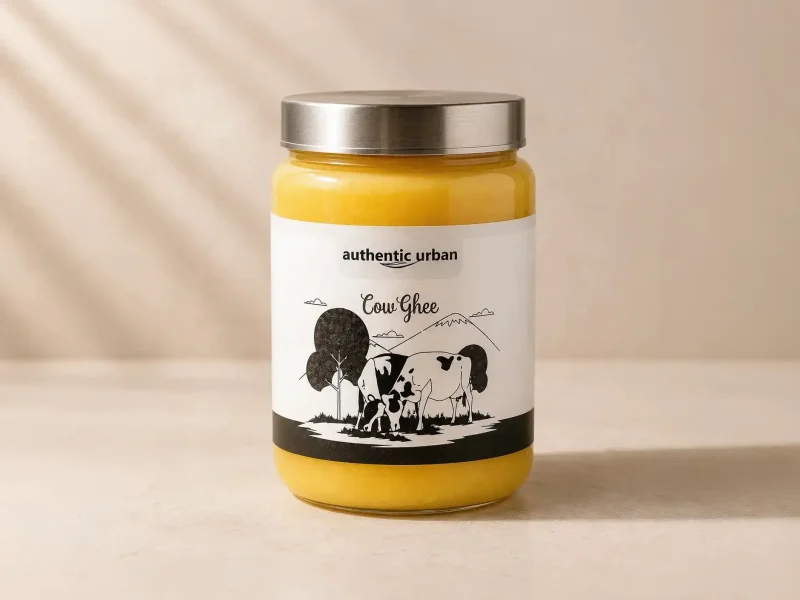 1 Litre
A thicker balm for knees and elbows
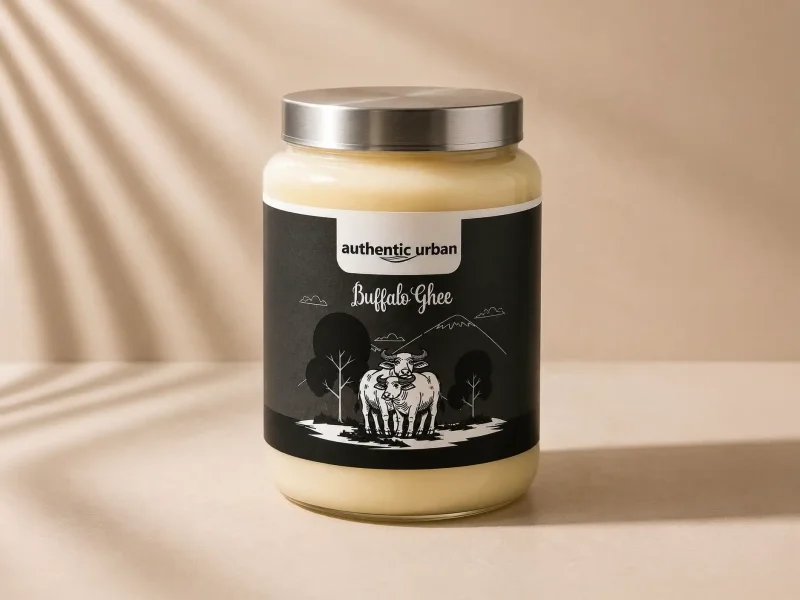 1 Litre
Each order is cooked after you place it, and the packing video is of that batch. Past order videos are on the shop.
FAQ
Does eating ghee help wounds heal faster?
No study shows that eating ghee speeds up wound healing. Skin repairs itself from protein, vitamin C, zinc, and enough calories overall, so dal, eggs, curd, paneer, fruit, and vegetables matter more than extra fat. A teaspoon or two of ghee on dal or roti is a normal amount for most adults. If a wound is slow to heal, or you have diabetes, that is a question for your doctor.
Can I put haldi and ghee on a cut?
Not on an open cut. Turmeric from the kitchen and ghee from the cooking jar are not sterile, turmeric stains the wound so a doctor cannot see infection, and neither replaces cleaning it. Rinse the cut under running tap water, wash the skin around it with mild soap, add a thin layer of petroleum jelly, and cover it with a plaster. Once the skin has closed, plain ghee for softness is fine after a patch test.
Can ghee remove old chickenpox marks?
No. Chickenpox marks that sit below the skin are atrophic scars: the skin lost tissue as it healed, and no oil or fat can fill that dent back in. Ghee can keep the area soft if it feels dry. Flat, pale chickenpox marks often fade a little more with years. For deep pits on the face, a dermatologist can explain laser and other clinic options and what each costs.
Is ghee safe on a child's scar?
On a closed scar in an older child, a small dab of ghee after a patch test is generally fine as a moisturiser. For a baby under one, check with the paediatrician before putting anything on a scar. Keep ghee off any wound that is still open or scabbed, and see a doctor for a scar that turns red, raised, or itchy months after the injury.
Cow or buffalo ghee for scars?
Either works the same way on skin, as both are almost pure milk fat that seals in water. Cow ghee is softer and melts faster between the fingers, so it spreads more easily on a small scar. Buffalo ghee sets firmer and feels thicker, which some people like on a dry scar on the knee or elbow. Freshness matters more than the animal: skip any ghee that smells sour or stale.
Is shata dhauta ghrita better than plain ghee for scars?
It feels lighter. Shata dhauta ghrita is ghee washed with water many times until it turns into a soft white cream, so it spreads more easily and feels less greasy on the face. No study in people shows it fades scars better than plain ghee, and a lighter feel is the main difference you will notice. Like plain ghee, it goes only on skin that has fully healed.
About the editorial team
Authentic Urban TeamBilona ghee makers, Gir Somnath, Gujarat
We are the Parmar family in Gir Somnath, Gujarat. We have made ghee here since 2016 and sold it online since 2025. We make only Bilona ghee, test it every month, and anyone is welcome to visit and watch it being made. Our Gir cows and Jafarabadi buffalo are grass-fed village animals that graze near the Gir forest, with no hormones or milk boosters. We set their milk to curd, churn it, and cook the makkhan on a wood chulha. These articles come from that kitchen and from what customers ask us on WhatsApp. We are ghee makers, not doctors.
Sources
- Minimize a scar: Proper wound care tips from dermatologists, American Academy of Dermatology. Checked 29 Sep 2026.
- Scars, NHS. Checked 29 Sep 2026.
- Cuts and grazes, NHS. Checked 29 Sep 2026.
- The effects of topical vitamin E on the cosmetic appearance of scars (Baumann LS, Spencer J), Dermatologic Surgery 25(4), 1999, pp. 311-315, Europe PMC. Checked 29 Sep 2026.
- Experimental and histopathological observation scoring methods for evaluation of wound healing properties of Jatyadi Ghrita (Jamadagni PS et al.), Ayu 37(3-4), 2016, pp. 222-229, Europe PMC. Checked 29 Sep 2026.
- Jathyadi Ghrita for Wound Healing: A Review of Ayurvedic Texts and Contemporary Modifications (Shifna MA, Rajasree G, Shafeer MS), JAIMS 11(3), 2026, Journal of Ayurveda and Integrated Medical Sciences. Checked 29 Sep 2026.
- Butter oil, anhydrous (FDC ID 173412), SR Legacy, USDA FoodData Central. Checked 29 Sep 2026.