Is Ghee Anti-Inflammatory? What Studies Show, and How Much
Is ghee anti-inflammatory? No human trial shows it, and the trials that fed people ghee did not measure inflammation. A teaspoon or two on dal is not inflammatory either. ICMR-NIN's 2024 guidelines link saturated fat, which is about 62% of ghee, to more inflammation, so keep ghee to 1 to 2 teaspoons a day and put your effort into weight, sugar, fibre, and treatment.
Is ghee anti-inflammatory or inflammatory?
Neither, at the amount most Indian families eat. No trial has shown that eating ghee lowers CRP or any other inflammation marker in people. At 1 to 2 teaspoons a day, the limit ICMR-NIN's 2024 dietary guidelines set for ghee or butter, there is also no evidence it raises inflammation. Large amounts are a different story, because of the saturated fat.
Search this question and you get two loud camps. One says ghee is anti-inflammatory because it has butyrate, CLA, and vitamins; some of those pages even list vitamin D, which USDA FoodData Central puts at zero in ghee. The other says all fat from animals is inflammatory and swaps it for seed oils. Both lean on lab studies, and both skip the few human trials. This page goes through what those trials measured, what the fats in a teaspoon actually are, and how much ghee fits if you already live with an inflammatory condition.
Chronic inflammation here means the slow, low-grade kind that sits behind joint disease, skin conditions like psoriasis, bowel disease, and heart and metabolic problems. A cut or a sprain that swells and settles in days is acute inflammation, the body doing its job, and no food should switch that off. For the wider verdict on ghee, see is ghee healthy.
What do studies on ghee and inflammation actually show?
Very little that is about ghee itself, and none of it supports calling ghee an anti-inflammatory food. These are the studies that come closest, and what each one can and cannot tell you.
Study
What it found
What it means for you
Ghee vs olive oil, 30 healthy adults, 4 weeks (British Journal of Nutrition, 2021)
Found: About 30 g of ghee a day raised apoB and non-HDL cholesterol against olive oil. The trial did not measure CRP or any inflammation marker.
Means: The best ghee trial we have cannot answer the inflammation question. It does show what 6 teaspoons a day does to lipids.
Coffee with 1 tbsp ghee and 1 tbsp MCT oil, 6 adults (Current Developments in Nutrition, 2021)
Found: One high-fat cup did not change monocyte counts or their TLR4 marker against black coffee.
Means: No sign that one fatty drink sparks inflammation. Six people and one cup is too small to say more.
52 dairy trials, reviewed (Critical Reviews in Food Science and Nutrition, 2017)
Found: Dairy overall leaned anti-inflammatory, most clearly in people with metabolic disorders, and pro-inflammatory in people allergic to cow's milk.
Means: Dairy is not the inflammatory food some diets claim. This is about dairy foods in general, not a ghee trial.
CLA supplements, 14 studies pooled (Cardiovascular Therapeutics, 2017)
Found: CLA capsules raised CRP by 0.63 mg/dL on average, the opposite of the "CLA fights inflammation" line.
Means: Pages that call ghee anti-inflammatory because of its CLA have the evidence backwards, at least for capsules.
Butyrate in cell and animal studies
Found: Butyrate calms gut inflammation in the lab. A teaspoon of ghee carries about 0.16 g of it (USDA).
Means: Real in the lab, small on the plate. Gut bacteria make far more from fibre.
Each study is listed under Sources at the end of the page. Checked 27 September 2026.
Why the CLA claim is backwards
The CLA row is the one to remember. Grass-fed ghee does carry some CLA, and many pages use it as the main reason ghee "fights inflammation". When researchers pooled 14 studies of CLA capsules in 2017, CRP went up, not down. The CLA in a spoon of ghee is far less than a capsule, so the fair reading is that CLA gives no reason to eat more ghee for inflammation. The levels in ghee and what the supplement trials show are on CLA in ghee, and the butyrate numbers are on butyrate in ghee.
What six teaspoons a day did in the ghee trial
The ghee vs olive oil trial deserves a second look too. Its 30 volunteers ate about 30 g of ghee a day, roughly six teaspoons, for four weeks. Their apoB and non-HDL cholesterol rose compared with olive oil. That is the heart-risk side of eating a lot of ghee, and it is why the amount matters more than any "anti-inflammatory" label. What that means for a cholesterol report is on ghee for cholesterol.
Is ghee more inflammatory than seed oils?
Ghee has far less omega-6 than seed oils and far more saturated fat, and neither fact makes one of them the inflammatory fat. The "seed oils cause inflammation" argument rests on omega-6 (linoleic acid). The "ghee causes inflammation" argument rests on saturated fat. Here is what a teaspoon of each actually holds.
USDA FoodData Central SR Legacy, values per 100 g divided by 20. Checked 27 September 2026.
| Item | Value |
|---|---|
| Ghee | 113 mg |
| Mustard oil | 765 mg |
| Groundnut oil | 1,600 mg |
| Sunflower oil | 3,285 mg |
1 tsp (5 g)
Omega-6
Saturated fat
Where the number comes from
Ghee
Omega-6: 113 mg
Saturated fat: 3.1 g
USDA 173412, butter oil (ghee)
Mustard oil
Omega-6: 765 mg
Saturated fat: 0.6 g
USDA 172337
Groundnut oil
Omega-6: 1,600 mg
Saturated fat: 0.8 g
USDA 171410, peanut oil
Sunflower oil
Omega-6: 3,285 mg
Saturated fat: 0.5 g
USDA 171025, high-linoleic type
Two things from ICMR-NIN's 2024 guidelines put this in proportion. First, omega-6 is not a poison: the guidelines set a minimum of about 6.6 g of omega-6 a day on a 2,000 kcal diet, and nuts, seeds, and dal supply much of it. Second, the same guidelines say plainly that saturated fat raises LDL cholesterol and increases inflammation. A teaspoon of ghee carries 3.1 g of saturated fat, five or six times what the same spoon of mustard or sunflower oil has.
So the useful rule is about amounts, not camps. A teaspoon or two of ghee on dal, with the rest of the cooking done in a mix of oils, keeps both saturated fat and omega-6 in a sensible place. Frying pakoras in ghee, or pouring it by the ladle, is where saturated fat piles up. The full oil comparison is on ghee vs vegetable oil. Whatever the fat, do not let it smoke: the burnt, bitter smell of an overheated pan is a sign it has broken down. More on that in ghee smoke point.
How much ghee a day if you have an inflammatory condition?
Usually the same 1 to 2 teaspoons as anyone else, less if your weight, LDL, or gut says so, and whatever your doctor allows during a flare. ICMR-NIN's 2024 guidelines ask adults to limit ghee or butter to 1 to 2 teaspoons a day, and to keep all visible fat (ghee plus cooking oil) near 20 g for a woman and 30 g for a man with a desk job.
If you are
Ghee a day
Why
Healthy adult, no condition
Ghee: 1 to 2 tsp a day, as ICMR-NIN advises
On dal, roti, or khichdi, inside your total fat for the day.
Overweight, or a waist that keeps growing
Ghee: 1 tsp a day
Body fat itself drives low-grade inflammation, so the calories matter more than the kind of fat.
High LDL, heart disease, or diabetes
Ghee: 1 tsp or less, as your doctor sets
Saturated fat is the concern here, and 1 tsp of ghee has 3.1 g of it.
Rheumatoid arthritis, psoriasis, or lupus on treatment
Ghee: 1 to 2 tsp if your doctor has no fat limit for you
Ghee is food here, not therapy. Keep every prescribed dose.
Crohn's or ulcerative colitis in a flare
Ghee: What your gastroenterologist or dietitian allows
Fat can worsen loose stools in a flare. Their plan comes first.
Allergic to cow's milk protein
Ghee: Ask your allergist before any
The 2017 dairy review saw a pro-inflammatory pattern in milk allergy.
Daily limits from ICMR-NIN Dietary Guidelines for Indians 2024, printed p. 54. A guide for home cooking, not a treatment plan. Checked 27 September 2026.
In our family, each of us eats 1 to 2 teaspoons a day on roti, dal, and khichdi, a little more in winter sweets. We make ghee for a living and still do not go past that, and we would not tell anyone with a diagnosis to eat more for their joints or skin. Work out your own household's ghee and oil with the ghee calculator, or read the age-by-age amounts on how much ghee per day.
Old "anti-inflammatory ghee protocols" that ask for 2 to 3 tablespoons a day, or a spoon on an empty stomach, add 6 to 9 teaspoons of saturated fat with no trial behind them. People with gallstones, a fat-restricted diet, or a milk allergy should also read who should not eat ghee. Joint pain in particular, with warm ghee massage, is covered on ghee for joint pain.
What lowers chronic inflammation more than ghee?
Body weight, packaged food and sugar, and your prescribed treatment all matter more than which fat is on the dal. These are the changes with a named source behind them.
Change
Why it matters
Lose weight if your waist is high
ICMR-NIN's 2024 guidelines say excess body weight causes low-grade chronic inflammation.
Cut packaged snacks, sweets, and sugary drinks
The same guidelines say high-fat or high-sugar foods cause inflammation and change the gut bacteria.
Eat fish, if you eat it, once or twice a week
Fish carry EPA and DHA, the long-chain omega-3s. Ghee has none. 100 g of mackerel has about 2.3 g (USDA).
Stew or simmer more, char less
ICMR-NIN notes that charred, grilled meat forms AGEs, which raise inflammation, and slow cooking in liquid cuts them.
Fill half the plate with vegetables, dal, and whole grains
The fibre feeds gut bacteria that make butyrate, far more than any spoon of ghee carries.
Take the treatment you were prescribed
For RA, psoriasis, IBD, or lupus, medicines control the inflammation. Food works alongside them.
ICMR-NIN Dietary Guidelines for Indians 2024, printed pp. 52, 64, 85, 94; USDA FoodData Central 175119. Checked 27 September 2026.
Omega-3s have the best human evidence of any fat here. NCCIH, the US government's centre for complementary health, cites a 2022 review of 30 studies with 1,420 people in which foods rich in omega-3s may have eased pain and swollen, tender joints in rheumatoid arthritis, as an addition to medicine. Ghee has no EPA or DHA at all, so it cannot stand in for fish, and vegetarian homes can lean on mustard oil, walnuts, and flaxseed for plant omega-3. Haldi cooked in a little ghee is a pleasant habit, covered on turmeric milk with ghee, but it does not replace any of the changes above.
What does a CRP test tell you about inflammation?
A CRP test shows how much inflammation there is in your body, but not where it is or what is causing it. The liver makes C-reactive protein (CRP) when there is inflammation. MedlinePlus, the US National Library of Medicine's health site, says a value of about 0.8 to 1.0 mg/dL or lower is thought to be healthy.
Infections, bowel disease, lupus, rheumatoid arthritis, asthma, and smoking can all push CRP up. A related test, hs-CRP, picks up very small rises and is used to estimate heart risk. That scale helps read the CLA finding above: a rise of 0.63 mg/dL is large next to a healthy level near 1. It is also why a single CRP report, or a change after a few weeks of eating differently, needs a doctor to read it. Ask them before you change your diet to chase a number, and do not treat a raised CRP as a ghee problem.
When is inflammation a doctor question, not a diet one?
Any new, lasting, or worsening symptom needs a doctor before any change in ghee. We make ghee; we are not doctors, and a diagnosis and its treatment are theirs to decide. See one soon for:
- A joint that is hot, red, and swollen, especially with fever.
- Morning stiffness that lasts long after you get up, or swelling in the same joints on both sides.
- Blood or mucus in the stool, diarrhoea that lasts weeks, or weight loss you cannot explain.
- A new rash with joint pain or fever, or patches of scaly skin that keep spreading.
- A raised CRP or ESR on a report, or any flare of a condition you already have.
Never stop or cut a prescribed medicine because your diet feels better. Skin conditions are covered on ghee for psoriasis, always alongside a dermatologist.
An anti-inflammatory kitchen checklist you can keep
Screenshot this. It keeps ghee in its place and puts the effort where the evidence is.
- Measure your ghee with a real teaspoon for one week. Most families pour more than they think.
- Keep it to 1 to 2 teaspoons a day, on food, not a spoon on an empty stomach "for inflammation".
- Keep your total visible fat (ghee plus oil) near 20 g for a woman or 30 g for a man with a desk job.
- Swap one packaged snack or sweet a day for fruit, chana, or curd.
- Add fish, walnuts, or flaxseed a few times a week if they suit your diet.
- Cook dal, sabzi, and meat by simmering; do not let the tadka or the pan smoke.
- Check your waist every month with a tape at the navel.
- If you have a diagnosed condition, note joint, skin, or gut symptoms weekly and take the note to your doctor.
Which ghee to keep for the daily teaspoon?
Since no ghee is an inflammation remedy, choose a jar for purity and taste, and walk past any label that promises to fight inflammation. Warm a spoon: good ghee smells of toasted milk, not sour or waxy, and curd-churned ghee often sets grainy when cool. The quick checks are on how to identify pure ghee, and our ranking of cow ghee on sale is best cow ghee in India.
We make and sell ghee, so weigh this with that in mind. For the daily teaspoon we would pick our own A2 Gir cow ghee: milk from grass-fed Gir cows near the Gir forest, set to curd overnight, churned, and cooked slowly in a matki on a wood chulha in Gir Somnath. It is made after you order, and a video of your jar being cooked and packed comes on WhatsApp. For parathas and sweets, our Jafarabadi buffalo ghee is the richer jar. We test every month against the FSSAI limits; the steps, and the open invitation to watch a batch being made, are on how we make ghee.
The daily teaspoon on dal
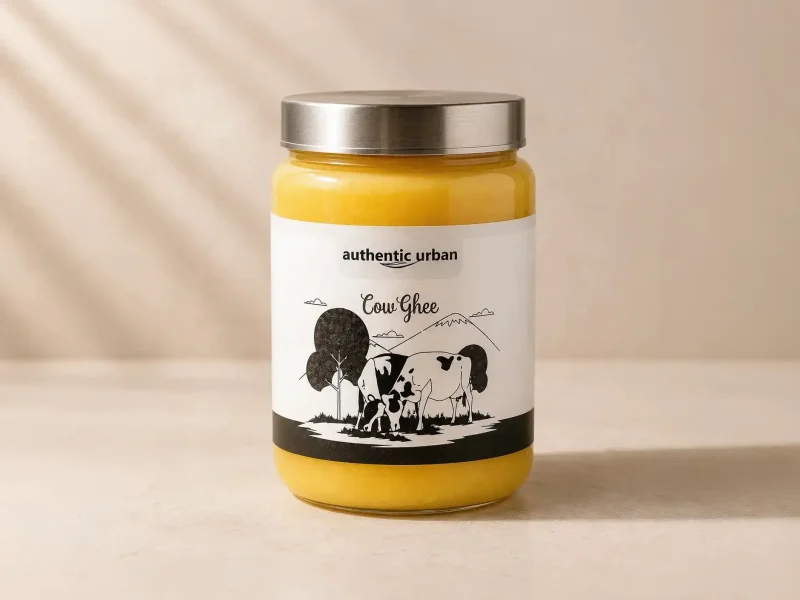 1 Litre
Paratha and winter sweets
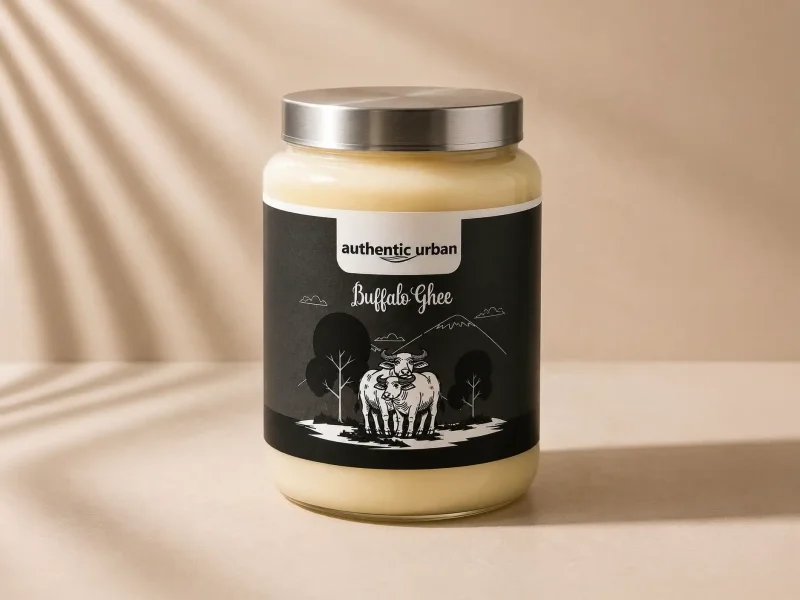 1 Litre
Each order is cooked after you place it, and the packing video is of that batch. Past order videos are on the shop.
FAQ
Kya desi ghee se sujan kam hoti hai?
Kisi human trial ne yeh nahi dikhaya. Ghee ek khana hai, sujan ki dawa nahi. ICMR-NIN 2024 ke hisaab se din mein 1 se 2 chammach ghee kaafi hai, aur zyada saturated fat sujan badha sakta hai. Sujan kam karne mein wazan, kam meetha aur packet wala khana, sabzi, dal, aur doctor ki di hui dawa zyada kaam aati hai. Jodon mein sujan ya bukhar ho to doctor ko dikhayein.
Is ghee better than butter for inflammation?
Neither has a trial behind it for inflammation. Both are milk fat with the same saturated fat per gram of fat. Ghee has the water and most milk solids cooked out, so it has almost no lactose, which helps people whose stomach reacts to milk sugar. Butter has a little of both. For someone with a milk protein allergy, neither is safe without an allergist.
Is A2 or Gir cow ghee more anti-inflammatory?
No study we could find tested it. A2 describes the beta-casein protein in the milk, and ghee is at least 99.5% fat under FSSAI rules, so very little protein is left either way. Gir cow ghee is a choice for taste, sourcing, and how it is made. Anyone selling A2 ghee as an inflammation remedy is going past what the evidence says.
Does turmeric with ghee reduce inflammation?
Curcumin, the main compound in turmeric, is studied for inflammation, and it dissolves in fat, so cooking haldi in a little ghee is a sensible pairing. The amount of curcumin in a pinch of haldi is small, though, and no trial has tested haldi in ghee for chronic inflammation. Enjoy it in dal and doodh, and do not treat it as a medicine.
Can I apply ghee on a swollen joint?
Warm ghee rubbed on a stiff joint is a household tradition, and the massage and warmth may feel good. It does not reach inside the joint or reduce inflammation there. Do not rub a joint that is hot, red, and newly swollen, or one after an injury; that needs a doctor to rule out infection, gout, or a fracture. Stop if the skin gets a rash.
Is buffalo ghee more inflammatory than cow ghee?
There is no trial comparing them for inflammation. Both are milk fat that must meet the same FSSAI limits, and both are mostly saturated fat. Buffalo ghee tastes richer, so people tend to use it in sweets and parathas. Whichever you choose, the amount matters more than the animal: keep the daily total to 1 to 2 teaspoons.
About the editorial team
Authentic Urban TeamBilona ghee makers, Gir Somnath, Gujarat
We are the Parmar family in Gir Somnath, Gujarat. We have made ghee here since 2016 and sold it online since 2025. We make only Bilona ghee, test it every month, and anyone is welcome to visit and watch it being made. Our Gir cows and Jafarabadi buffalo are grass-fed village animals that graze near the Gir forest, with no hormones or milk boosters. We set their milk to curd, churn it, and cook the makkhan on a wood chulha. These articles come from that kitchen and from what customers ask us on WhatsApp. We are ghee makers, not doctors.
Sources
- Dietary Guidelines for Indians, 2024 (printed pp. 52, 54, 64, 85, 94), ICMR-National Institute of Nutrition. Checked 27 Sep 2026.
- Butter oil, anhydrous (FDC ID 173412), SR Legacy, USDA FoodData Central. Checked 27 Sep 2026.
- Oil, sunflower, linoleic (approx. 65%) (FDC ID 171025), SR Legacy, USDA FoodData Central. Checked 27 Sep 2026.
- Oil, mustard (FDC ID 172337), SR Legacy, USDA FoodData Central. Checked 27 Sep 2026.
- Oil, peanut, salad or cooking (FDC ID 171410), SR Legacy, USDA FoodData Central. Checked 27 Sep 2026.
- Fish, mackerel, Atlantic, raw (FDC ID 175119), SR Legacy, USDA FoodData Central. Checked 27 Sep 2026.
- Effects of diets rich in ghee or olive oil on cardiometabolic risk factors in healthy adults: a two-period, crossover, randomised trial (Mohammadi Hosseinabadi and Nasrollahzadeh, 2021), British Journal of Nutrition. Checked 27 Sep 2026.
- Impact of Coffee Containing Medium-Chain Triglyceride Oil and Ghee on Markers of Cellular Inflammation in Young Healthy Humans (Jackson et al., 2021), Current Developments in Nutrition, via PubMed Central. Checked 27 Sep 2026.
- Dairy products and inflammation: A review of the clinical evidence (Bordoni et al., 2017), Critical Reviews in Food Science and Nutrition. Checked 27 Sep 2026.
- Effects of conjugated linoleic acid supplementation on serum C-reactive protein: A systematic review and meta-analysis of randomized controlled trials (Mazidi et al., 2017), Cardiovascular Therapeutics, via PubMed. Checked 27 Sep 2026.
- Food Safety and Standards (Food Products Standards) Chapter 2.1: Dairy products and analogues, version 01.09.2023 (ghee standard, p. 27), FSSAI. Checked 27 Sep 2026.
- Omega-3 Supplements: What You Need To Know (updated November 2024), National Center for Complementary and Integrative Health (NCCIH). Checked 27 Sep 2026.
- C-Reactive Protein (CRP) Test, MedlinePlus, U.S. National Library of Medicine. Checked 27 Sep 2026.