Ghee for Kids: How Much a Day, and Does It Help the Brain?
Ghee for kids is fine every day at 1 to 2 level teaspoons, spread over meals, inside the child's total fats and oils: ICMR-NIN's 2024 guidelines give 20 g a day at 4 to 6 years and 25 g at 7 to 9, oil included. Ghee helps a child absorb vitamins from the vegetables, but it has almost no omega-3 or DHA, so it is not a brain food on its own.
How much ghee should kids eat a day?
One to two level teaspoons of ghee a day (5 to 10 g) for a school child or a teenager, on hot roti, rice, or dal. That ghee sits inside one budget for all fats and oils, which ICMR-NIN's 2024 guidelines set by age: 20 g at 4 to 6 years, 25 g at 7 to 9, and 30 to 55 g for older children. The rest of that budget is the cooking oil.
Most pages on this topic give "2 to 3 teaspoons" or even tablespoons of ghee and never count the oil in the tadka. Our own old version of this page said 1 to 2 tablespoons for 6 to 12 year olds, which on its own is past a 7 year old's whole day of fat. We rewrote it around the guideline's table.
We are the Parmar family in Gir Somnath, Gujarat, and we make ghee. We are not doctors. At home each of us eats 1 to 2 teaspoons a day on roti, dal, and khichdi, and "can I give it to my child, and how much?" is one of the questions we get most on WhatsApp. This page is for children from 4 to 18. For 1 to 3 year olds the split is different, on ghee for toddlers, and babies under one are on ghee for babies.
ICMR-NIN Dietary Guidelines for Indians 2024, Table 1.6 (printed p. 11), for children growing normally. Checked 28 September 2026.
| Item | Value |
|---|---|
| Child, 4 to 6 years | 20 g a day |
| Child, 7 to 9 years | 25 g a day |
| Girl, 10 to 12 years | 30 g a day |
| Boy, 10 to 12 years | 35 g a day |
| Girl, 13 to 18 years | 40 g a day |
| Boy, 13 to 15 years | 45 g a day |
| Boy, 16 to 18 years | 55 g a day |
How much ghee for kids by age, with the oil counted?
Take the day's fats and oils for the child's age, keep 1 to 2 teaspoons of it for ghee, and cook with the rest. ICMR-NIN counts a level teaspoon of oil or ghee as 5 g, so the grams turn into teaspoons easily. The ghee line barely moves with age; the oil is what grows.
Age
Energy a day
All fats and oils
Ghee
Oil left
Child, 4 to 6 years
about 1,370 kcal
20 g (4 tsp)
1 to 2 tsp
2 to 3 tsp
Child, 7 to 9 years
about 1,710 kcal
25 g (5 tsp)
1 to 2 tsp
3 to 4 tsp
Girl, 10 to 12 years
about 2,060 kcal
30 g (6 tsp)
1 to 2 tsp
4 to 5 tsp
Boy, 10 to 12 years
about 2,230 kcal
35 g (7 tsp)
1 to 2 tsp
5 to 6 tsp
Girl, 13 to 18 years
about 2,410 to 2,490 kcal
40 g (8 tsp)
1 to 2 tsp
6 to 7 tsp
Boy, 13 to 15 years
about 2,860 kcal
45 g (9 tsp)
1 to 2 tsp
7 to 8 tsp
Boy, 16 to 18 years
about 3,300 kcal
55 g (11 tsp)
1 to 2 tsp
9 to 10 tsp
Energy and fats and oils: ICMR-NIN Dietary Guidelines for Indians 2024, Table 1.6 (printed p. 11), for children of normal weight and activity. Teaspoon = 5 g (printed p. 113). The ghee column is ours, inside ICMR-NIN's 1 to 2 teaspoon line for ghee or butter (printed p. 54). Checked 28 September 2026. Not a prescription for your child.
Two things follow. A 5 year old's whole day is 4 teaspoons of fat, so a ladle of ghee on the rice uses it up in one meal. And a teenage boy has room for 9 to 10 teaspoons of oil, but his ghee line is still about 2. If your home cooks everything in ghee, the child can have more ghee and less oil, as long as the total stays the same. To add up the ghee and oil your whole house uses, try our ghee calculator. The adult numbers are on how much ghee per day.
Is ghee good for a child's brain?
Ghee supports a child's brain only in the way any good fat does: the brain needs dietary fat, and fat carries vitamins A, D, E, and K into the body. It does not supply the fats most linked to the brain. USDA FoodData Central lists no DHA and no EPA in ghee, and only a trace of plant omega-3. No human study shows ghee raises a child's memory, marks, or IQ.
Several brand pages say ghee is rich in omega-3 for a child's brain. The numbers do not back that. USDA lists 1.45 g of 18:3 fat (the group plant omega-3 belongs to) in 100 g of ghee, which is about 0.07 g in a teaspoon. ICMR-NIN puts the minimum omega-3 intake at 0.6 to 1.2% of the day's energy, about 2.2 g on a 2,000 kcal diet, and names nuts, oilseeds, flax, chia, and fish as the foods that carry it.
Portion
18:3 omega-3 fat
DHA
1 teaspoon ghee (5 g)
0.07 g
0 g
10 g walnuts (about 5 halves)
0.91 g
0 g
5 g flaxseed (about 1 teaspoon, ground)
1.14 g
0 g
Worked out from USDA FoodData Central, SR Legacy 173412, 170187, and 169414, per 100 g. Checked 28 September 2026.
So ten grams of walnuts give a child about 13 times the omega-3 of a teaspoon of ghee. Keep the ghee for taste and for the vitamins in the sabzi, and add a few walnut halves or ground flax to the day for omega-3. Families who eat fish get DHA from it; ghee cannot stand in for that.
Ayurveda texts call ghee medhya, good for the intellect, and grandparents often give an extra spoon in exam weeks. That is tradition, not a tested result. What does help a school child think is a full breakfast, enough iron, sleep, and ICMR-NIN's 60 minutes of active play a day. The adult side of this question, with the memory studies, is on ghee for brain health, and the exam-day plate is under ghee for focus. Iron and ghee are on ghee for anemia.
What does a school day with ghee look like?
A school day needs about 1½ teaspoons of ghee in all: half at breakfast and one in the tiffin. ICMR-NIN's sample menu for a 7 to 9 year old puts no oil in breakfast, 15 g in lunch, and 10 g in dinner, and most of that comes from cooking. This is our worked day on that menu, not a second rule.
Meal
What goes in
Ghee
Breakfast, 8 am
ICMR-NIN's menu for a 7 to 9 year old has no oil here: soaked and boiled whole grains, beans, chutney, and nuts. At home that is often poha, upma, or a roti. Half a teaspoon of ghee on the roti or stirred into upma is enough.
½ tsp
Tiffin lunch, 1 pm
The menu puts 15 g of oil in lunch. A tiffin of roti with sabzi or dal-rice already carries most of that from the cooking. Rub 1 teaspoon of ghee into the hot roti or rice before you pack it.
1 tsp
Milk, 5 pm
100 ml milk after school. No ghee needed; the milk has its own fat.
none
Dinner, 7 to 8 pm
10 g of oil in the menu, from the family dal and sabzi. Ghee on one roti only if the day still has room.
0 to ½ tsp
Meal times and oil per meal: ICMR-NIN Dietary Guidelines for Indians 2024, Figure 5.2, a 25 kg child of 7 to 9 years (printed p. 40). Figure 5.1 gives a 4 to 6 year old 10 g of oil at lunch and 10 g at dinner (printed p. 39). Checked 28 September 2026.
Tiffin ideas, with the ghee in each
Dish
Ghee
How to pack it
Roti or paratha roll
½ to 1 tsp
Rub the ghee in while the roti is hot, then roll it with dry sabzi or paneer bhurji. Wet sabzi goes in a separate box so the roti does not go soggy.
Jeera rice or pulao with dal
1 tsp
Stir it into the hot rice. Pack the dal in a leak-proof box.
Upma, poha, or daliya
½ tsp
Cook in oil and finish with the ghee off the flame. Add peanuts and a squeeze of lemon.
Thepla or methi paratha
½ tsp each
Cook with a little oil on the tawa and brush ghee only on the one you pack on top.
Besan or dry fruit ladoo
about 1 tsp in each
A weekend treat, not the daily tiffin. It carries sugar, and ICMR-NIN keeps a child's sugar under 25 to 30 g a day.
Ghee sets as it cools, so a roti packed at 7 am and eaten at 1 pm keeps the ghee soaked in only if you rubbed it in hot. In our kitchen we see the same thing in the jar: curd-churned ghee cools grainy in winter and stays liquid through a hot summer, and both are normal. The recipes are on ghee paratha, ghee rice, and besan ladoo. ICMR-NIN also asks parents to avoid packaged foods and snacks heavy in oil, salt, and sugar for older children, so a ghee roti roll beats a packet of chips in the tiffin even though it has fat.
Does ghee help kids grow taller or gain weight?
Ghee does not make a child taller, and it helps weight gain only by adding energy, about 44 kcal a teaspoon by USDA's figures. Height and healthy weight come from enough total food, protein from dal, milk, paneer, and eggs, calcium from milk, curd, and ragi, sleep, and play.
It helps to know what normal growth looks like before worrying. ICMR-NIN says a child between 2 and 10 years gains about 1.5 to 3 kg and grows about 6 to 7 cm a year. The growth spurt starts at about 10 to 12 in girls and two years later in boys, and at its peak a child can grow 9 to 10 cm and gain 8 to 10 kg in a year. That is when a teenager's appetite, and fat budget, jump.
If the pediatrician says your child is underweight, adding a teaspoon of ghee to dal is an easy way to add energy, and they will tell you how much. On its own, a spoon of ghee on a plate of rice fills a small stomach without the protein it needs. The adult version is on ghee for weight gain.
Which kids should eat less ghee, or ask a doctor first?
Children with a milk allergy, children above their growth chart for weight, and children with a heart, liver, kidney, or gallbladder condition need the doctor's number, not a chart. Everyone else can follow the table above. Keep this list where you pack the tiffin.
If your child has
What to do
A diagnosed milk allergy
Ghee keeps only a trace of milk protein, but the allergist decides whether it is safe.
Above the growth chart for weight
Keep ghee to the 1 teaspoon line and cut fried snacks, sweets, and packaged food first. The pediatrician sets the plan.
Weight flat for months, or a very poor eater
See the pediatrician before adding fat. The cause is often not calories.
A heart, liver, kidney, or gallbladder condition, or very high cholesterol in the family
The doctor gives the fat number, not a general chart.
Loose, greasy stools after more ghee
Go back to the amount before, and call the doctor if it lasts or there is blood.
Why ghee carries so little milk protein is on does ghee have casein, and what too much ghee does is on ghee side effects. This page is general information from a family that makes ghee, not medical advice for your child.
Which ghee is best for kids, cow or buffalo?
Either is ghee, and ICMR-NIN does not pick between them. Most families put cow ghee on a child's roti and dal because it tastes lighter, and keep buffalo ghee for parathas, ladoo, and halwa. Both count the same toward the day's fat. "Cow or buffalo for my child?" is one of the questions parents ask us most.
What matters more is that the jar is real ghee, cooked well. In our kitchen a batch left too long on the chulha turns dark and bitter and smells burnt, and one taken off too early stays cloudy, keeps moisture, and spoils fast. Neither is packed. Keep vanaspati and "vegetable ghee" out of a child's food; why is on ghee vs Dalda. The kitchen tests are on how to identify pure ghee, or you can check your jar in 2 minutes. The ranked list of jars for young children is best ghee for babies in India.
A 7-point ghee check for a school child's week
- Count ghee and oil together: 20 g a day at 4 to 6 years, 25 g at 7 to 9, more for older children (ICMR-NIN).
- Keep ghee to 1 to 2 level teaspoons a day inside that total, on hot roti, rice, or dal.
- Cook the tadka and the paratha in oil, and add the ghee at the table.
- Rub ghee into a hot roti before packing the tiffin; a cold roti does not take it in.
- For omega-3, add walnuts, ground flax, or fish. Ghee has almost none.
- Ladoo, halwa, and ghee-shakkar are treats, not the daily spoon.
- Weigh and measure at the clinic before adding ghee for growth.
Which ghee for a school child's plate?
At 1½ teaspoons a school day, one child uses about 225 g of ghee a month, so a 250 ml jar kept for the tiffin lasts about a month. How curd Bilona (curd churned by hand) differs from ghee made from cream is on the Bilona method, and the full list of cow ghee brands is on best cow ghee in India.
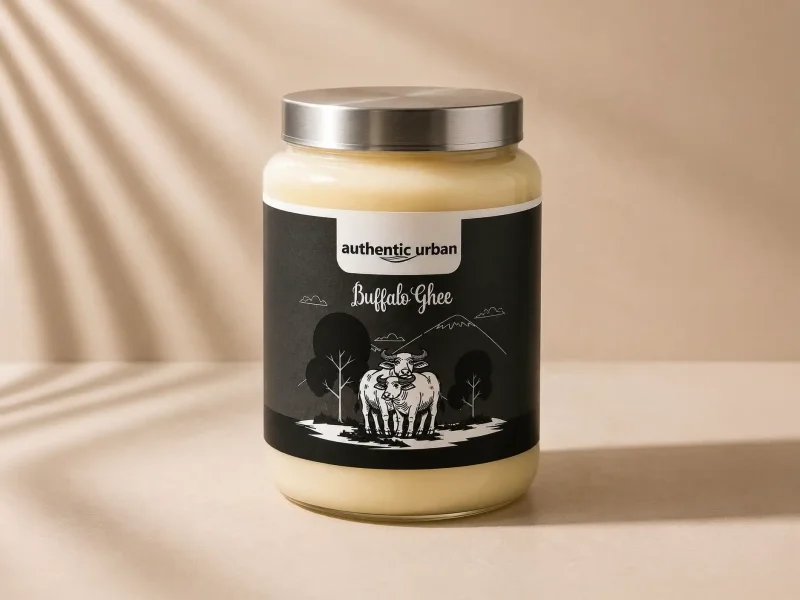
We make and sell ghee, so weigh this with that in mind. For a child's daily plate we would use our own A2 Gir cow ghee: milk from grass-fed Gir cows with no hormone injections, set to curd overnight, churned, and cooked in a matki on a wood chulha. It is made after you order, and a video of your jar being cooked and packed comes on WhatsApp. For weekend parathas and winter sweets, our Jafarabadi buffalo ghee is the richer jar. Varsha tastes every batch before it is packed, and we test every month against the FSSAI limits; the steps are on how we make ghee.
The tiffin roti and the teaspoon on dal
 1 Litre
Weekend parathas, ladoo, and halwa
 1 Litre
Each order is cooked after you place it, and the packing video is of that batch. Past order videos are on the shop.
FAQ
Is ghee good for kids?
Yes, in the right amount. Ghee is a clean, tasty fat that helps a child absorb vitamins A, D, E, and K from the vegetables in the same meal, and it makes plain roti and dal easier to eat. It does not supply protein, iron, calcium, or omega-3 in useful amounts. Keep it to 1 to 2 teaspoons a day inside the child's total fats and oils.
Can I give my child ghee in milk at night?
Now and then, yes, but it is not needed. Milk already has its own fat, and a teaspoon of ghee in the glass is about 44 kcal (USDA) that counts toward the day's fats and oils. If you give it, take the ghee off dinner. For a child who is overweight or brushes teeth before the milk, skip it and keep the ghee on food instead.
Does ghee increase height in kids?
No food raises height by itself, and no study shows ghee does. Height comes from genes, enough total food and protein, calcium from milk, curd, and ragi, sleep, and active play. ICMR-NIN says children grow about 6 to 7 cm a year between 2 and 10. If your child is below that, a pediatrician should look at the growth chart, not add ghee.
Is ghee better than butter for kids?
Both are milk fat, and both count toward the same 1 to 2 teaspoon line in ICMR-NIN's guidelines. Ghee has had the water and milk solids cooked out, so it keeps longer, has almost no lactose, and suits tadka and hot roti. Butter usually carries added salt. For a tiffin roti, ghee is the easier choice. Neither should be spread thickly at every meal.
Can teenagers eat more ghee than younger kids?
Teenagers need more fat in total: ICMR-NIN gives 40 to 55 g of fats and oils a day to a 13 to 18 year old, against 20 g at 4 to 6. The extra room mostly goes to cooking oil. The ghee line stays about 1 to 2 teaspoons, a little more on a sports day for a very active teen who is not overweight.
Is ghee safe for a child with a cough or cold?
Yes. A cold is caught from a virus, not from ghee, and ICMR-NIN asks parents to keep feeding a sick child so they do not lose weight. Soft khichdi with the usual teaspoon of ghee helps a poor appetite. A child with a high fever, fast breathing, or a cough that will not settle needs a doctor, whatever they ate.
About the editorial team
Authentic Urban TeamBilona ghee makers, Gir Somnath, Gujarat
We are the Parmar family in Gir Somnath, Gujarat. We have made ghee here since 2016 and sold it online since 2025. We make only Bilona ghee, test it every month, and anyone is welcome to visit and watch it being made. Our Gir cows and Jafarabadi buffalo are grass-fed village animals that graze near the Gir forest, with no hormones or milk boosters. We set their milk to curd, churn it, and cook the makkhan on a wood chulha. These articles come from that kitchen and from what customers ask us on WhatsApp. We are ghee makers, not doctors.
Sources
- Dietary Guidelines for Indians, 2024 (Table 1.6, printed p. 11; Guideline 5, printed pp. 37-40; fats, printed p. 54; activity, printed p. 71; household measures, printed p. 113), ICMR-National Institute of Nutrition. Checked 28 Sep 2026.
- Butter oil, anhydrous (SR Legacy 173412), USDA FoodData Central. Checked 28 Sep 2026.
- Nuts, walnuts, english (SR Legacy 170187), USDA FoodData Central. Checked 28 Sep 2026.
- Seeds, flaxseed (SR Legacy 169414), USDA FoodData Central. Checked 28 Sep 2026.