Ghee for Babies: When to Start, How Much, Which Ghee
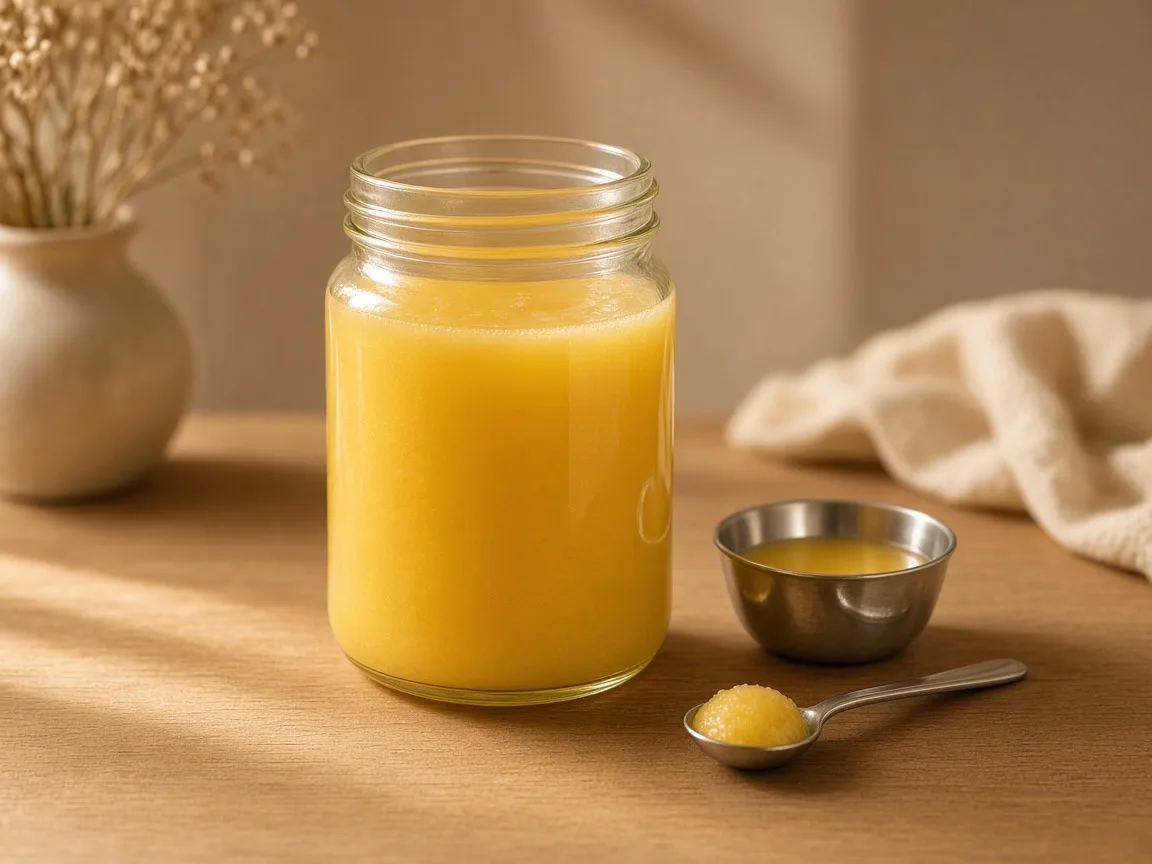
Ghee for babies can start soon after 6 months, stirred into the baby's cooked food, never given on its own and never put in a bottle. ICMR-NIN's 2024 diet chart for a 6 to 8 month old puts 1 teaspoon (5 g) of oil or ghee into each of two cooked meals, and its table gives babies of 7 to 12 months about 10 g of fats and oils a day alongside breast milk. Your pediatrician can change that for your baby.
Can babies eat ghee, and from what age?
Yes, from soon after 6 months, when the baby starts solid food. Before that, ICMR-NIN's 2024 guidelines say breast milk only: no other feed, not even water. After 6 months ghee goes into the baby's dal, khichdi, or vegetable mash, where it counts as the oil in that meal.
"Can I give ghee to my baby?" is one of the questions we get most on WhatsApp, so this page is our answer, with the numbers from India's own dietary guidelines rather than ours. We are the Parmar family in Gir Somnath, Gujarat, and we make ghee. We are not doctors. A baby born early, with reflux, a milk allergy, or slow weight gain needs the pediatrician's plan, and their number replaces anything here. Massaging a newborn with ghee is a separate question, on baby massage with ghee, and the mother's own spoon is on ghee for breastfeeding.
Why six months, and not four?
Because that is when breast milk stops being enough. ICMR-NIN puts a 6 to 12 month old's need at 650 to 720 kcal and 9 to 10.5 g of protein a day, while breast milk gives about 500 kcal and 5 g of protein. The gap has to come from food. Before 6 months there is no gap to fill, so ghee, water, and ghutti only take the place of milk. A grandmother's advice to start at four months is common in Indian homes; the guideline is not.
How much ghee for babies by age?
About a teaspoon in each cooked meal is what ICMR-NIN's own charts use: two meals a day at 6 to 8 months, and 10 g of fats and oils a day in total at 7 to 12 months. That is oil and ghee together. We do not set our own number for babies under one; this table is the guideline's, laid out for a kitchen.
Age
Fat a day (ICMR-NIN)
In ICMR-NIN's chart
In the kitchen
Birth to 6 months
None
Breast milk only. ICMR-NIN says no other feed, not even water.
No ghee by mouth, and none in a bottle.
6 to 8 months
About 10 g oil or ghee a day
Two cooked meals a day (dal-rice, wheat-rajma khichdi), each with 5 g oil or ghee (1 tsp), plus mashed fruit.
The first days the bowl is only 2 or 3 teaspoons of food, so it holds only a little of that teaspoon. The ghee grows with the bowl.
9 to 12 months
10 g fats and oils a day
Three meals a day. Two cooked meals carry 5 g oil or ghee each; the third gets its fat from nuts.
Ghee in one meal and oil in the other is as good as ghee in both.
1 to 3 years
20 g fats and oils a day
Family food. Three meals with 7, 7, and 6 g oil or ghee, plus milk and nuts.
Toddler portions have their own page (linked below).
From ICMR-NIN Dietary Guidelines for Indians 2024: Table 1.6 (fats and oils a day), Figures 4.1, 4.2, and 4.4 (sample diet charts), and the household measures annexure (5 g oil or ghee is 1 teaspoon). Amounts are for raw ingredients and a baby growing normally. Checked 26 September 2026. Not a prescription for your child.
Most pages on this topic start at "2 or 3 drops" and creep up by quarter teaspoons. The drops are not wrong for the first days, because ICMR-NIN starts a baby on only two or three teaspoons of food, and the ghee in that little bowl really is a few drops. But the guideline's chart for a 6 to 8 month old ends at a full teaspoon per meal, in two meals. Many families stay far below that out of worry, and then wonder why the bowl does not fill the baby.
The other half of the table matters as much: the teaspoon is for the meal's fat, whatever it is. If the khichdi already has oil in the tadka, a second teaspoon of ghee on top doubles it. After the first birthday the baby moves to family food, and the numbers and finger foods are on ghee for toddlers.
How do you introduce ghee to a baby?
Stir it into the first cooked food, a thin dal porridge, and let it grow with the bowl. ICMR-NIN asks parents to start with thin but not watery dal for 4 to 5 days, then make it thicker, and to bring in each new food alone for 4 to 5 days so any intolerance shows. Here is how that first fortnight looks with ghee in it.
-
1. Days 1 to 4
Thin (not watery) moong or toor dal porridge, 2 to 3 teaspoons of it, once a day. Stir a little ghee into the warm pot, not the cold bowl. Watch the nappy and the skin.
-
2. Days 5 to 8
Same food, a little thicker, until it spreads on the plate instead of flowing. The bowl gets bigger as the baby wants more, and so does the ghee in it.
-
3. Days 9 to 12
Add one new food, such as rice slurry or mashed potato, and keep it for 4 to 5 days before the next one. Ghee is not a "new food" each time; it rides along.
-
4. From week 3
Two cooked meals a day, each with its teaspoon of oil or ghee, as in the ICMR-NIN chart. No salt, no sugar. Breastfeed after the meal.
Warm the ghee in the pot with the dal, then let the bowl cool to just warm before feeding. Do not melt it and pour it into the mouth, and do not dip a finger or pacifier in it. ICMR-NIN also asks for no salt and no sugar in a baby's food; ghee gives the flavour. Meal ideas for these months are on ghee recipes for baby weaning, and the family version of the first dish is our ghee khichdi (mash it well and leave out the salt for the baby's share).
Should you use ghee or oil in baby food?
Either. ICMR-NIN writes "oil/ghee" in every infant meal it suggests and does not rank one above the other for babies. Most Indian homes use ghee for the baby's bowl because it tastes of milk, which babies know, and because it needs no strong tadka. Groundnut or other cooking oil in one meal and ghee in the other is fine.
For adults, ICMR-NIN groups ghee with butter as saturated fat and asks for 1 to 2 teaspoons a day; the reasons are on ghee side effects. For babies, the guideline's own charts use oil or ghee in every cooked meal, inside those small amounts. What stays out is vanaspati and "vegetable ghee", which are hydrogenated fat, and packaged food high in fat, salt, and sugar, such as biscuits and chips, which ICMR-NIN says must be avoided. How vanaspati differs from ghee is on ghee vs vanaspati.
Is ghee good for babies? What it does and does not do
Ghee is good for babies as a source of energy in a small stomach, and it helps the vitamins A, D, E, and K in vegetables get absorbed. It does not supply the protein, iron, and other minerals a baby runs short of after six months. Those come from dal, egg, greens, and the rest of the bowl.
ICMR-NIN notes that per kilo of body weight, a baby's need for vitamins and minerals is five to ten times an adult's. That is why its charts pair every teaspoon of oil or ghee with dal, a green leafy vegetable, and fruit, and bring in well-cooked egg, fish, or meat from eight months. A bowl of rice and ghee alone fills the baby without feeding them.
Ghee will not make a baby "strong", cure colic, build immunity, or speed up teething. It may soften stools a little for some babies, but constipation after starting solids is usually about water and texture; more on that at ghee for constipation. If the baby is underweight, the pediatrician decides how much extra fat, and in what.
Is ghee safe for a baby with milk allergy? The red flags
Ghee keeps only a trace of milk protein, so many babies who react to milk handle it, but a baby with a diagnosed cow's milk protein allergy should have ghee only after the doctor or allergist says so. The trace is small, not zero. The detail is on does ghee have casein.
For every baby, watch the days after a new food. ICMR-NIN says that if an intolerance to a food persists, seek medical advice for a diagnosis. Keep this table on the fridge.
What to do
When you see
Go to a doctor at once
Swelling of the lips, face, or eyes, fast or noisy breathing, a limp or floppy baby. The NHS lists these as signs of a severe allergic reaction.
Stop new foods and call the pediatrician
Hives or a rash after a meal, repeated vomiting, or blood in the stool. Write down what went in and when.
Cut the ghee back
Very loose, greasy stools after you raised the amount, or a baby too full of fat to eat the dal and vegetables.
Not a ghee problem
Weight dropping off the growth chart, constipation that lasts, or a baby who refuses most food. More ghee is not the fix; the pediatrician is.
Which ghee is best for babies?
The best ghee for a baby is pure cow ghee with one ingredient on the label, an FSSAI licence number, and a clean toasted-milk smell. Cow or buffalo are both ghee, and ICMR-NIN does not pick between them; most families use cow ghee for the baby bowl because it is lighter in taste and softer in the jar. A2 on the label describes the milk's protein, and ghee keeps very little protein, so it is a choice, not a baby requirement.
What we would check first is that the jar is real ghee and cooked well. In our kitchen, a batch left too long on the chulha turns dark and bitter and smells burnt; one taken off too early stays cloudy, keeps moisture, and spoils fast. Neither is packed. Good curd-churned ghee often sets grainy when it cools, stays liquid through a hot summer, and turns more yellow in the monsoon when the cows eat green fodder. Those changes are normal and fine for a baby. Sour or soapy is not. The kitchen tests are on how to identify pure ghee, and a ranked list of jars for this job is best ghee for babies in India.
A 5-point check before ghee goes in the baby bowl
- One ingredient on the label: ghee, or milk fat. Nothing else.
- An FSSAI licence number printed on the jar, which you can check on the FSSAI FoSCoS site.
- Warm half a spoon: it should smell of toasted milk. Sour, soapy, waxy, or burnt means it is not for the baby bowl.
- Not vanaspati, "vegetable ghee", or a blend. Those are a different fat.
- A small jar only for the baby, opened with a dry spoon, so it stays clean and you notice any change in smell.
Once open, keep the jar shut, away from the stove and sunlight, and use a dry spoon; the rest of the storage rules are on how long ghee lasts.
Which ghee for baby's first foods?
At a teaspoon in two meals a day, a 250 ml jar lasts a baby about three weeks, which is the size we would keep only for the baby bowl. How curd Bilona (curd churned by hand) differs from ghee made from cream is on the Bilona method.
We make and sell ghee, so weigh this with that in mind. For the baby bowl we would use our own A2 Gir cow ghee: milk from grass-fed Gir cows with no hormone injections, set to curd overnight, churned, and cooked in a matki on a wood chulha. It is made after you order, and a video of your jar being cooked and packed comes on WhatsApp. For the rest of the family's cooking, our Jafarabadi buffalo ghee is the richer jar. Varsha tastes every batch before it is packed, and we test every month against the FSSAI limits; the steps are on how we make ghee.
The teaspoon in baby's dal and khichdi
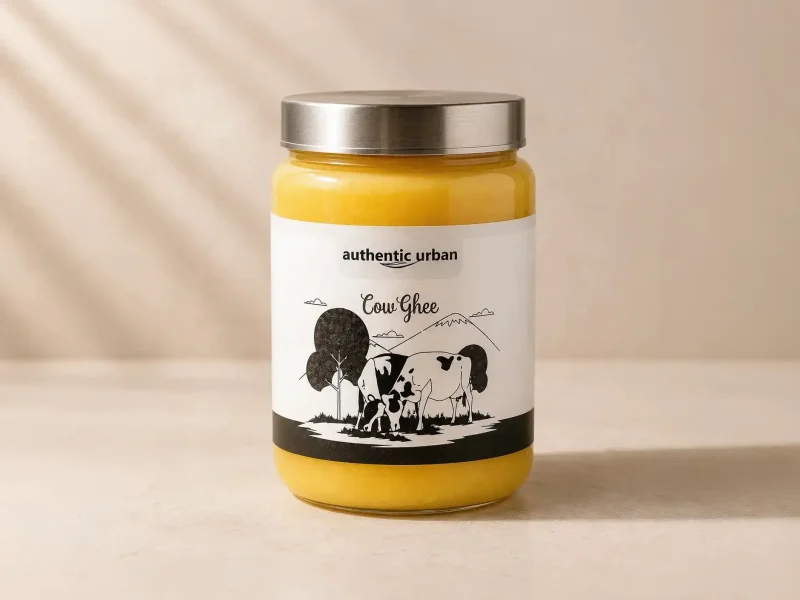 1 Litre
Family cooking, paratha, and sweets
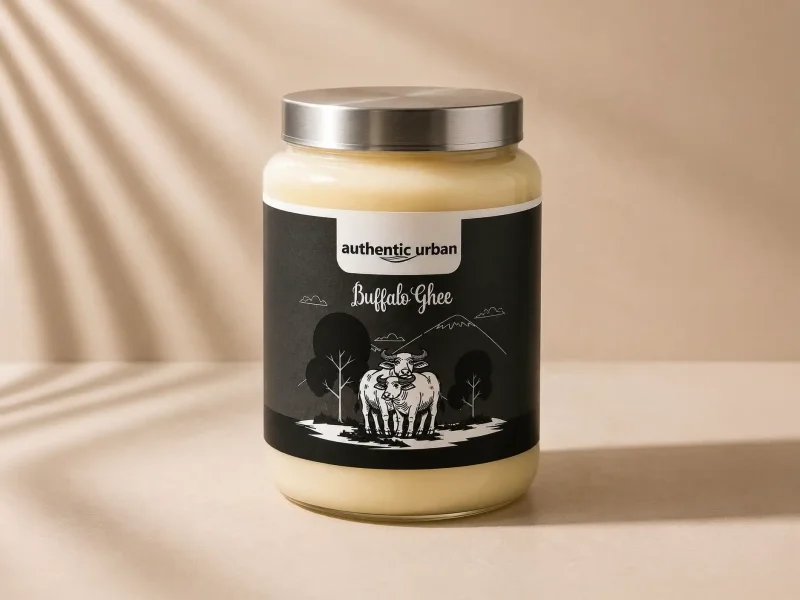 1 Litre
Each order is cooked after you place it, and the packing video is of that batch. Past order videos are on the shop.
FAQ
Can I give ghee to my baby every day?
Yes. Once a baby is eating cooked solids after six months, oil or ghee goes into the food every day in ICMR-NIN's own diet charts, about a teaspoon in each cooked meal. Daily is normal. What matters is that the ghee sits inside a proper meal of cereal, dal, and vegetables, and replaces the oil rather than coming on top of it. Your pediatrician can change the amount for your baby.
Does ghee help a baby gain weight?
Ghee adds energy to a small bowl, so it can help a baby who eats well but little. It will not fix poor weight gain on its own, because babies also need protein, iron, and enough meals a day. If your baby is slipping on the growth chart, see the pediatrician before adding more fat. They may want to check feeding, illness, or milk supply first.
Can ghee help my baby's constipation?
A teaspoon of ghee in warm dal or khichdi may make stools a little softer for some babies, and many families use it that way. Constipation after starting solids is often about too little water, thick food, or low fibre, so look at those too. Do not keep adding ghee. If hard stools last more than a few days, or there is blood or pain, call your pediatrician.
Is homemade ghee safe for babies?
Yes, if it is cooked well. Ghee must be cooked until the milk solids turn golden-brown and the bubbling stops, then strained into a dry jar. Undercooked ghee keeps water and can go sour quickly, which you do not want near a baby. Use a clean dry spoon every time, and throw it out if it smells sour, cheesy, or grows mould.
Can I give ghee to my baby during a cold or loose motions?
Keep feeding. ICMR-NIN asks parents to take extra care to feed a child during and after diarrhoea or an infection, to prevent malnutrition, and to continue breastfeeding. Keep the usual teaspoon in soft khichdi if the baby eats it. If stools are very frequent and watery, hold back on extra fat until they settle, and see a doctor for signs of dehydration.
Is ghee better than butter for babies?
For cooking a baby's food, ghee is the easier pick. Most table butter in India is salted, and ICMR-NIN says salt need not be added to complementary food at all. Ghee also keeps longer without the fridge and does not burn as easily when you warm the dal. Unsalted white butter is fine now and then; count it in the same teaspoon.
About the editorial team
Authentic Urban TeamBilona ghee makers, Gir Somnath, Gujarat
We are the Parmar family in Gir Somnath, Gujarat. We have made ghee here since 2016 and sold it online since 2025. We make only Bilona ghee, test it every month, and anyone is welcome to visit and watch it being made. Our Gir cows and Jafarabadi buffalo are grass-fed village animals that graze near the Gir forest, with no hormones or milk boosters. We set their milk to curd, churn it, and cook the makkhan on a wood chulha. These articles come from that kitchen and from what customers ask us on WhatsApp. We are ghee makers, not doctors.
Sources
- Dietary Guidelines for Indians, 2024 (Table 1.6, printed p. 11; Guidelines 3 and 4, printed pp. 25-31; household measures, printed p. 113), ICMR-National Institute of Nutrition. Checked 26 Sep 2026.
- Food allergy: symptoms and when to get help, NHS. Checked 26 Sep 2026.