Adulterated Ghee: How Fake Ghee Is Made and How to Spot It
Adulterated ghee is ghee stretched or replaced with a cheaper fat: refined soybean, sunflower, palm, or coconut oil, vanaspati, and sometimes animal body fat, then coloured and flavoured to pass as ghee. In September 2026, Maharashtra's FDA seized about 2,464 kg of ghee, sunflower oil, and vanaspati from a Mumbai unit mixing the three. Each of these fats leaves a mark that an FSSAI lab test can find, and most of them leave nothing you can see in the kitchen.
What is adulterated ghee made of?
Mostly refined vegetable oil and vanaspati, with starch, colour, and flavour to hide them. Recent Indian seizures found sunflower, soybean, coconut, and palm oil, vanaspati, and interesterified vegetable fat. The fake part is usually the fat itself. Real ghee, by FSSAI's standard, is at least 99.5% milk fat and nothing else.
This page is for anyone who has read a seizure headline and wants to know what was actually in the jar, whether it matters for health, and how a lab tells the difference. The kitchen tests themselves are on how to identify pure ghee. Here we go fat by fat.
Each adulterant, and the test that catches it
Save this table. The lab column comes from FSSAI's own standards for ghee and for vegetable oils, so it is the same yardstick a food safety officer uses.
What is mixed in
Why it is used
What catches it in a lab
At home
Refined soybean or sunflower oil
Why: Cheap, sold by the tanker, no taste of its own.
Lab: β-sitosterol, a plant sterol, must be absent from ghee. Linoleic acid in ghee must be 0.5 to 3.5%; soybean oil carries 48 to 59%.
At home: Usually nothing you can see at small amounts.
Palm oil or palmolein
Why: Half-solid at room temperature, so the jar sets like ghee.
Lab: Plant sterol by HPLC and triglyceride S-values by gas chromatography. The older BR reading moves clearly only at about 10% palm oil.
At home: Nothing reliable. It was chosen because it hides.
Coconut or palm kernel oil
Why: Cheap in the south, sets firm in the cold.
Lab: Lauric acid: 1.5 to 4% in ghee, 44 to 53.2% in coconut oil.
At home: Sometimes a coconut note when warm.
Vanaspati (hydrogenated vegetable fat)
Why: Looks like ghee in the tin and sets grainy.
Lab: By law vanaspati must carry sesame oil, so the Baudouin test turns red. Ghee must test negative.
At home: The acid test for it is lab work, not a kitchen job.
Animal body fat (tallow, lard)
Why: Cheap solid fat with no plant sterol to give it away.
Lab: Missed by the plant sterol test. Needs triglyceride S-values, which have separate equations for beef tallow and for lard.
At home: Nothing reliable.
Starch, mashed potato, flour
Why: Adds weight and body to thin fat.
Lab: Iodine turns blue.
At home: Yes: iodine drops on melted ghee turn blue.
Added colour and flavour
Why: Makes an oil blend look yellow and smell of ghee.
Lab: FSSAI says the raw material for ghee must be free from added colour and flavour. Coal tar dyes show pink or crimson with acid.
At home: A jar that is the same bright yellow in every season.
Sources: FSSAI Chapter 2.1 (pp. 27-28) and Chapter 2.2 (pp. 48, 50-51), version 01.09.2023; FSSAI Food Safety on Wheels manual (2017), pp. 29-31; Ramani et al., International Journal of Food Science (2025). Checked 27 September 2026.
How is fake ghee made?
By blending a cheap fat with a little real ghee, or with none, then adding colour and a ghee flavour and filling it into packs that look genuine. We describe it here only from what food safety teams found, never as a method.
Where and when
What was found
Seized, and by whom
Mumbai, Maharashtra21 September 2026
White and yellow "ghee" made by mixing refined sunflower oil, vanaspati, and branded ghee, sold as "Pooja Ghee"
About 2,464 kg of ghee, oil, and vanaspati seizedMaharashtra FDA
Bengaluru, KarnatakaNovember 2025
Ghee blended with coconut and palm oil and packed to look like a co-operative dairy's packs; tests for animal fat were pending
8,136 litres seizedBengaluru CCB and the KMF vigilance wing
Deesa and Palanpur, Banaskantha, GujaratFebruary 2025
Ghee adulterated with soybean oil and interesterified vegetable fat
About 4,000 kg seizedRaid reported by Gulf News
Sources: Business Today (23 September 2026), Gulf News (26 November 2025 and 26 February 2025).
Three patterns repeat. In the first, real ghee is stretched: the Mumbai unit mixed branded ghee with sunflower oil and vanaspati, so the jar still smelled partly of ghee. In the second, there is no milk at all, and a blend of oils goes into copied packs of a brand people already trust, as in the Bengaluru case. In the third, a solid vegetable fat such as interesterified fat or vanaspati gives the blend a ghee-like set in the tin.
The jobs of the extras are simple. Vanaspati and palm oil make the blend set. Colour covers for the missing yellow. A ghee flavour covers for the missing smell, which is why FSSAI requires that the raw material for ghee be free from added flavour and colour, and why vanaspati must not carry a ghee-like colour or flavour. How vanaspati differs from ghee, and why its trans fat matters, is on Dalda vs ghee.
Why is ghee adulterated so often?
Because milk fat is slow and expensive, and seed oil is fast and cheap. In our kitchen in Gir Somnath, about 30 to 35 litres of Gir cow milk make 1 kg of cow ghee, and 22 to 25 litres of Jafarabadi buffalo milk make 1 kg of buffalo ghee. Oil is pressed or extracted by the tonne. How often ghee fails official tests compared with milk and oil is in ghee adulteration statistics.
Time adds to the cost. We set the milk to curd overnight for 8 to 12 hours, churn it for 30 to 45 minutes until the makkhan comes up, and cook that makkhan in a matki on the chulha for 45 to 90 minutes. Curd to ghee takes the better part of two days. Anyone who skips the milk skips all of that.
You can use this against any jar. Multiply what a litre of milk costs you by 30 for cow ghee, or by 22 for buffalo. If a kilo of "pure desi ghee" costs less than that milk, before labour, fuel, jar, and delivery, something else is in it. What goes into the price of a Bilona jar is broken down on why A2 Bilona ghee is expensive.
Is adulterated ghee harmful to health?
It depends on what is in it, and you rarely know. A blend of food-grade oils is not poison, but you pay ghee prices for oil. The real risks come from what cannot be checked: vanaspati, dyes that are not food colours, animal fat, and the hygiene of an illegal unit.
- Vanaspati is legal on its own, with trans fat capped at 2% by weight since 1 January 2022 under FSSAI's standard. Inside a fake ghee jar there is no label to tell you it is there, or how much.
- Colour. FSSAI's rapid-test manual includes a test for coal tar dyes in ghee and butter, because they turn up. Those are not colours meant for food.
- Animal body fat matters to vegetarian families and to anyone buying ghee for puja or prasad. It is also the adulterant most tests miss (see below).
- Seed oils high in linoleic acid can go rancid faster than ghee, so a blend may spoil early in the jar.
- No batch, no recall. A unit that fills copied packs cannot trace or pull back a bad lot.
If someone in the house feels unwell after eating from a suspect jar, see a doctor and take the jar with you. For the fat itself, the comparison with everyday cooking oils is on ghee vs vegetable oil, and natural vs factory trans fat is on does ghee contain trans fat.
How do labs detect adulterated ghee?
By checking the jar against the FSSAI ghee standard, line by line. Each line is a range that milk fat falls inside and most other fats do not. A report that shows all of these lines, for your batch, tells you far more than a stamp that says "pure".
FSSAI ghee limits, and what each line catches
Line on the report
FSSAI limit for ghee
What a fail points to
Milk fat
Limit: At least 99.5%
A fail points to: Water, starch, and solids left in
Moisture
Limit: At most 0.5%
A fail points to: Undercooked or watered ghee
Butyro-refractometer (BR) reading at 40 °C
Limit: 40.0 to 44.0
A fail points to: Large amounts of liquid oil
Reichert Meissl (RM) value
Limit: At least 24.0
A fail points to: Missing short-chain milk fatty acids, so any big dilution
Polenske value
Limit: 0.5 to 2.0
A fail points to: Coconut and palm kernel fats, which push it up
Baudouin test
Limit: Negative
A fail points to: Vanaspati and sesame oil
β-sitosterol
Limit: Absent
A fail points to: Vegetable oils
Butyric acid (C4:0)
Limit: 1 to 5%
A fail points to: Any non-milk fat: seed oils carry none
Linoleic acid (C18:2)
Limit: 0.5 to 3.5%
A fail points to: Soybean, sunflower, and other seed oils
Free fatty acids (as oleic acid)
Limit: At most 2.0%
A fail points to: Old, rancid, or badly made ghee
Source: FSSAI Food Products Standards, Chapter 2.1, version 01.09.2023, pp. 27-28 (ghee column and Table 1, fatty acid composition). Checked 27 September 2026.
What the older tests miss
A jar can pass the old lines and still be cut. In a 2025 study from the College of Dairy Science in Amreli, Gujarat, the BR reading showed a clear change only once palm oil reached 10% of the ghee. Triglyceride S-values by gas chromatography and plant sterols by HPLC caught palm oil at 5%.
The β-sitosterol method FSSAI told labs to use in March 2019 was written for four oils: soybean, groundnut, coconut, and sunflower. It works because plant oils carry plant sterols and milk fat does not, which is also why it cannot see beef tallow or lard. Those need the S-value equations, which have their own ranges for palm oil and beef tallow and for lard. So when a seller shows you a report, check which lines it covers, not just that it says "complies". How to read the rest of the sheet is on ghee lab test reports.
How can you check for adulterated ghee at home?
You can catch starch and a badly made jar at home, but not a careful oil blend. Be clear with yourself about which one you are testing for.
For starch, FSSAI's rapid-test manual melts a little ghee, lets it cool, and adds 2 to 3 drops of iodine solution: blue means starch. The same manual's test for vanaspati uses concentrated hydrochloric acid, which burns skin, so leave that one to a lab. The one check we trust in our own kitchen is smell. Our ghee comes off the chulha when the bubbling goes quiet, the solids turn golden-brown, and the room smells of toasted milk. Warm a spoon from any jar and that smell should come back. A flat, waxy, or old-oil smell is a warning.
Colour is a weaker sign than people think. Our cow ghee turns deeper yellow in the monsoon, when the cows eat green fodder, and buffalo ghee is white all year; see white ghee vs yellow ghee. A jar that is the same bright yellow in every season is more suspicious than one that changes. The full set of kitchen tests, with what each result means, is on which home ghee tests work, or you can check your jar in 2 minutes with our purity checker.
Read the pack before you open it. FSSAI's standard names the product "Ghee" only when it meets the ghee standard, so the ingredient line should say milk fat, cow ghee, or buffalo ghee and nothing more. "Vegetable fat", "vanaspati", "hydrogenated", "flavour", or "colour" on a ghee pack means it is not pure ghee. Listing red flags, from price to reviews, are on ghee brands to avoid.
What should you do if you think your ghee is fake?
Stop using it, keep the jar and the bill, and report it. Five steps, in order:
-
1
Stop cooking with it
Put the jar aside. Do not pour it into another container.
-
2
Keep the proof
The jar with its lid and label, the bill or order page, and a photo of the batch number and FSSAI licence.
-
3
Check the licence
Look up the 14-digit number on foscos.fssai.gov.in. A licence that does not exist, or belongs to another business, is itself a finding.
-
4
Ask the seller for the batch report
A lab report for that batch should show the Baudouin test and β-sitosterol lines. Which lines it shows matters more than the lab's logo.
-
5
Report it
FSSAI's Food Safety Connect, on foscos.fssai.gov.in, takes consumer concerns about food safety violations. Your state food safety office can sample the product in the market.
For ghee used in puja, havan, or a diya, the same rules apply: buy food-grade ghee with a licence and a clean ingredient line. More on that is in our ghee for puja guide.
Which ghee can you check for yourself?
The safest jar is one where you can see the milk turn into ghee. That means a named animal, a method you can watch, a licence you can look up, and a batch report with the Baudouin and β-sitosterol lines on it. How other brands compare, and how we ranked them, is on best ghee in India, and the curd method itself is on the Bilona method.
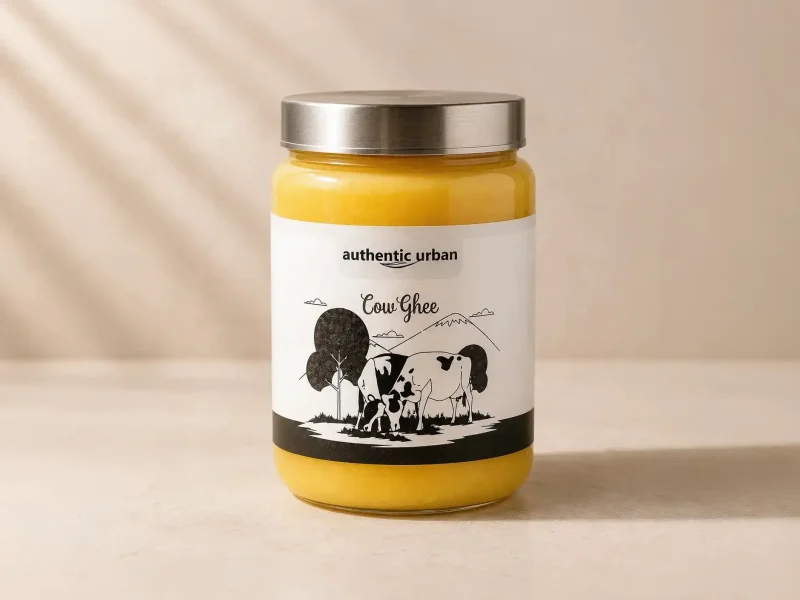
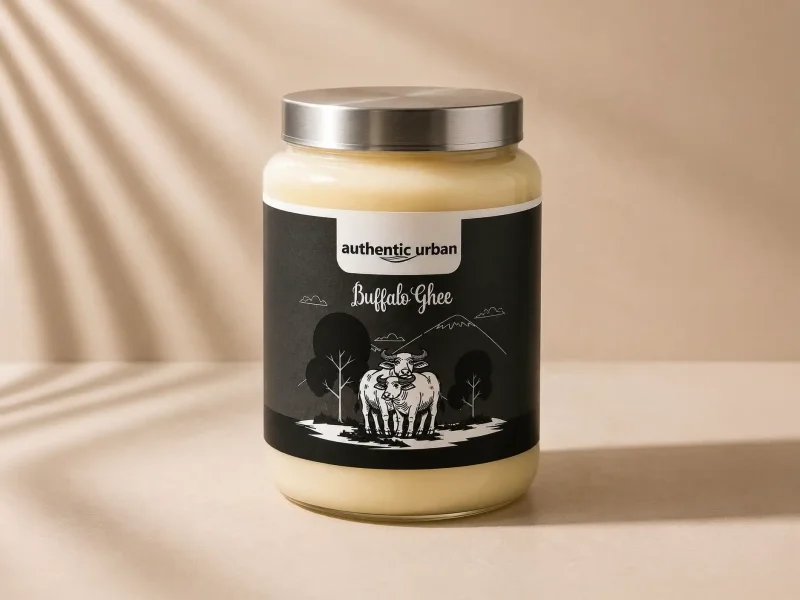
We make both jars below, so read this as our own pick. We cook your jar after you order and send a video of that jar being cooked and packed on WhatsApp before it ships. Our A2 Gir cow ghee is from grass-fed Gir cow milk only, for the daily spoon. Our Jafarabadi buffalo ghee is for halwa, ladoo, and paratha. We test every month against the FSSAI limits, including the Baudouin test and β-sitosterol, and anyone can come and watch a batch being made; see how we make ghee.
Gir cow ghee: the daily teaspoon
 1 Litre
Buffalo ghee: sweets and paratha
 1 Litre
Each order is cooked after you place it, and the packing video is of that batch. Past order videos are on the shop.
FAQ
Is "Pooja ghee" or "diya ghee" safe to eat?
Only if the pack is sold as ghee and meets the FSSAI ghee standard, which asks for milk fat only. In the September 2026 Mumbai case, the seized product sold as "Pooja Ghee" was a mix of sunflower oil, vanaspati, and branded ghee. Read the ingredient line on any lamp or puja pack. If it lists vegetable fat or oil, it is not ghee and does not belong in food.
Can a famous brand's pack still be fake?
Yes, when the pack itself is a copy. In November 2025, police in Bengaluru seized adulterated ghee made to look like a well-known co-operative dairy's packs, and the case was found with that dairy's own vigilance team. The real brand was the victim. Buy from the brand's own shop or a large retailer, and check that the batch number, dates, and licence on the pack are printed cleanly.
Is ghee made from cream or malai fake ghee?
No. FSSAI allows ghee to be made from milk or products obtained from milk, so cream ghee is real ghee. It is not Bilona ghee, which is made from curd churned into makkhan, and it should not be sold as Bilona. Cream ghee that is labelled as cream ghee is a legal product. Calling it Bilona is a false label claim, not adulteration of the fat.
Is white ghee a sign of adulteration?
Not by itself. Buffalo ghee is naturally white or pale cream, and our Jafarabadi buffalo ghee comes out of the matki that colour too. Cow ghee is yellow, and it turns deeper yellow in the monsoon, when the cows eat green fodder. A white jar sold as cow ghee is worth a question to the seller. A white jar sold as buffalo ghee is normal.
Why is fake ghee seized more often before festivals?
Demand for ghee jumps before Diwali, Navratri, and wedding season, when homes and sweet shops buy in bulk, and that is when food safety teams step up sampling. The Mumbai seizure in September 2026 was reported as action ahead of the festive season. It is a good time to buy from a seller you already trust, and to check new sellers more carefully.
Does adulterated ghee go bad faster than real ghee?
It can. Seed oils such as soybean and sunflower are high in linoleic acid, which oxidises faster than the saturated fat that makes up most of ghee, so a blend can turn rancid sooner. Starch and leftover water also shorten shelf life. A jar that smells sharp, soapy, or like old oil a few weeks after opening deserves a closer look, whatever the reason.
About the editorial team
Authentic Urban TeamBilona ghee makers, Gir Somnath, Gujarat
We are the Parmar family in Gir Somnath, Gujarat. We have made ghee here since 2016 and sold it online since 2025. We make only Bilona ghee, test it every month, and anyone is welcome to visit and watch it being made. Our Gir cows and Jafarabadi buffalo are grass-fed village animals that graze near the Gir forest, with no hormones or milk boosters. We set their milk to curd, churn it, and cook the makkhan on a wood chulha. These articles come from that kitchen and from what customers ask us on WhatsApp. We are ghee makers, not doctors.
Sources
- Food Safety and Standards (Food Products Standards) Chapter 2.1: Dairy products and analogues, version 01.09.2023 (2.1.8 Milk fat products and ghee, pp. 26-29), FSSAI. Checked 27 Sep 2026.
- Food Safety and Standards (Food Products Standards) Chapter 2.2: Fats, oils and fat emulsions, version 01.09.2023 (vanaspati, p. 48; fatty acid table, pp. 50-51), FSSAI. Checked 27 Sep 2026.
- Manual of Methods for Food Safety on Wheels, 2017 (starch, coal tar dyes, and vanaspati in ghee, pp. 29-31), FSSAI. Checked 27 Sep 2026.
- FSSAI releases new method to detect adulteration in ghee with veg oils, Food and Beverage News, 30 March 2019, FSSAI media archive. Checked 27 Sep 2026.
- Ramani A. et al. Detection of palm oil adulteration in clarified milk fat (ghee). International Journal of Food Science, 2025, doi:10.1155/ijfo/4673218, Wiley (open access, PMC11824851). Checked 27 Sep 2026.
- Fake ghee, blood stains, rats, roaches: Mumbai FDA takes action against 5 eateries ahead of festive season, 23 September 2026, Business Today. Checked 27 Sep 2026.
- Bengaluru couple arrested for running fake Nandini ghee factory, 26 November 2025, Gulf News. Checked 27 Sep 2026.
- 4,000kg adulterated ghee worth Rs17.5 lakh seized in Gujarat's Banaskantha raid, 26 February 2025, Gulf News. Checked 27 Sep 2026.
- Food Safety Connect: general information, FSSAI (FoSCoS). Checked 27 Sep 2026.