Ghee Brands to Avoid in India: 10 Red Flags Before You Buy
Ghee brands to avoid in India are not a fixed list of names: avoid any jar or seller that shows three or more of the 10 red flags below, and walk away at once from a jar with no FSSAI licence or a batch your state has banned. The flags are on the pack and the listing, so you can check them before you pay. We make ghee ourselves, so our own pick comes at the end, with the reasons.
Which ghee brands should you avoid in India?
Avoid the jar, not the logo. Any ghee with no licence you can look up, a batch named in a food safety ban, or three of the red flags below is one to skip, whoever makes it. The same brand can sell a good batch and a failed one, and a fake can wear a famous brand's pack.
That is why this page names no brand as bad. Food safety departments ban batches, not brands, and in the fake ghee cases we have written about in how fake ghee is made, the real brand in one Bengaluru case was the victim of a copied pack. A list of names would go out of date the week it was written. The flags work on any jar: a local dairy, an Instagram brand, or a supermarket shelf.
This page is for the moment before you pay. Once a jar is in your kitchen, the smell, melt, and iodine tests are in how to identify pure ghee.
10 red flags on a ghee jar or listing
Each flag takes under a minute to check from the pack, the listing, or one message to the seller. One flag alone can be a small maker's slip; several together are a pattern.
1. "100% pure" or "100% natural" on the jar
What you see
A big "100%" next to pure, natural, or desi on the label or in the ads.
Why it matters
FSSAI asked every food business in May 2025 to stop using "100%" on labels and ads, because the term is not defined in food law and suggests other jars are impure. A brand still printing it is ignoring the regulator.
Check
Read the front and back of the pack, and the listing photos.
2. No FSSAI licence, or one that does not match
What you see
No 14-digit number, a smudged one, or a number that brings up a different business.
Why it matters
Packed ghee cannot be sold legally without it. A copied number is how fake packs borrow a real maker's name.
Check
Search the number on foscos.fssai.gov.in and match the name, address, and validity date.
3. A batch your state has banned
What you see
The brand, batch number, and packing date match a food safety order in the news.
Why it matters
State food safety departments ban specific batches after lab tests. The order names a batch, so the number on your jar is what matters.
Check
Match brand, batch, and packing date against the order, not just the brand name.
4. "A2" or "desi cow" with no breed and no farm
What you see
A2 in large type, but no cow breed, no village, and no farm named anywhere.
Why it matters
A2 is a claim about which cows gave the milk. With no breed or place attached, nothing on the jar can back it.
Check
Look for a named breed (Gir, Sahiwal, Kankrej, Tharparkar) and where the milk comes from.
5. "Bilona" with no word about curd
What you see
Bilona or "hand-churned" on the jar, but the method never mentions curd or dahi.
Why it matters
Bilona means milk set to curd, churned into makkhan, then cooked. Without the curd step it is cream ghee with a traditional name.
Check
Read the method on the pack or site. Ask how long the curd sets.
6. A price below the milk it needs
What you see
An A2 Bilona cow ghee jar that costs less per kg than 30 litres of cow milk where you live.
Why it matters
In our kitchen, 30 to 35 litres of Gir cow milk make 1 kg of Bilona ghee. A jar priced under that milk bill has to be cutting something.
Check
Multiply your local milk price by 30 and compare it with the price per kg.
7. "Organic" with no India Organic logo
What you see
Organic in the name or ads, but no certification mark and no certifier on the pack.
Why it matters
FSSAI's organic rules expect the India Organic logo and the certification body's name and accreditation number on the label. Without them, "organic" is only a word.
Check
Look for the logo and the certifier line on the back of the pack.
8. Anything besides milk fat in the ingredients
What you see
Vegetable fat, vanaspati, "flavour", colour, or a preservative in the ingredient list, or a name like "cooking medium".
Why it matters
Ghee is milk fat and nothing else. A blend can be legal when it says so, but then it is not ghee.
Check
Read the ingredient line and the product name, not the front picture.
9. A listing you cannot trace to the brand
What you see
A marketplace or social media listing "sold by" an unknown seller, blurry pack photos, and reviews that never mention smell, grain, or cooking.
Why it matters
Copies of well-known packs are sold this way. A real buyer's review usually talks about the food, not "good product".
Check
Buy from the brand's own shop or its own listing, and read the three-star reviews.
10. A seller who will not answer simple questions
What you see
No reply, or only "trust us", when you ask which animal, which method, which batch, or for a report.
Why it matters
A maker knows where the milk came from and how the jar was cooked. Dodging the question is the flag that ties the others together.
Check
Send the five questions below before you pay.
Two things are missing from this list on purpose. Colour is not a flag: our own cow ghee turns more yellow in the monsoon when the animals eat green fodder, and stays liquid in the jar in summer. Grain is not a flag either, as why ghee is grainy explains. Both change with season and cooling, in good ghee and bad.
How many red flags before you walk away?
Three. Two flags are a reason to buy the smallest size and test it; three mean skip the jar, however good the offer. Two flags stand alone: no licence you can verify, or a batch named in a ban. Screenshot this and use it on the next listing you open.
Red flags
What to do
0 flags
Buy it, then run the home checks on the first jar.
1 flag
Ask the seller about it. A clear answer clears it.
2 flags
Buy the smallest size first and test it at home.
3 or more
Walk away, whatever the price or the brand.
Flag 2 or 3
Walk away on that flag alone: no licence, or a banned batch.
The quick version of the ten: no "100%", a licence that matches, no banned batch, a named breed, curd in the method, a price above the milk, a real organic mark if it says organic, only milk fat in the ingredients, a listing that traces to the brand, and a seller who answers. If you would rather tick boxes on your phone, our ghee purity checker walks through a jar in two minutes.
How do you check a ghee brand's FSSAI licence?
Search the 14-digit number from the jar on foscos.fssai.gov.in, then match three things: the business name, the address, and the validity date. All three should agree with the maker or packer printed on the pack.
For our own jar, the number on the label is 20725045000021. It comes up for our kitchen in Kodinar, Gir Somnath, valid from 16 January 2025 to 15 January 2027. That is what a clean match looks like. A number that brings up a different company, a different state, or a licence that has lapsed is flag 2, and on its own a reason not to buy.
Keep in mind what a licence does not tell you. It shows the business is registered to make or sell food. It does not show that this batch was tested, that the milk was A2, or that the ghee was churned from curd. For that you need a batch report, and how to read one line by line is in ghee lab test report.
Has any ghee been banned in India?
Yes, batch by batch. State food safety departments test samples from shops, and when a batch fails they can order it off the market. On 30 August 2026, the Jammu and Kashmir Food and Drugs Administration banned the sale, storage, and distribution of 10 ghee batches, as reported by Ommcom News.
The lab findings in that order are the ones to know: β-sitosterol, a marker of vegetable fat that should never be in ghee; a positive Baudouin test, which points to vanaspati; fatty-acid profiles that did not look like milk fat; and readings outside the FSSAI limits. What each of those lines means, and which fat it catches, is in each adulterant, and the test that catches it.
The department's own advice to buyers was to check the brand, the batch number, and the date of packing, and to report any banned batch they saw on sale. That is the point of flag 3. A ban covers the batches it names; the next batch from the same maker may be fine, and a batch from a brand you trust may not be. Your jar's batch number is the only thing that settles it.
Is "100% pure" on a ghee jar a red flag?
Yes. On 30 May 2025, FSSAI advised all food businesses not to use "100%" on labels, packaging, or ads. Its press release says the term is not defined anywhere in the Food Safety and Standards Act or its rules, and that it creates a false impression of absolute purity.
FSSAI pointed to two parts of its 2018 advertising and claims rules: claims must be truthful, unambiguous, and not misleading, and no claim may run down other makers. A "100% pure" ghee suggests every other jar is less than pure. Ghee that meets the FSSAI standard is already at least 99.5% milk fat, so the extra words add nothing a legal jar does not already have.
A "100%" claim does not prove the ghee is bad. It tells you the brand either has not read the regulator's advice in more than a year or chose to ignore it, which is worth knowing before you trust its other claims.
What price is too cheap for A2 Bilona ghee?
Anything below the cost of the milk. In our kitchen, 30 to 35 litres of Gir cow milk make 1 kg of Bilona cow ghee, and 22 to 25 litres of Jafarabadi buffalo milk make 1 kg of buffalo ghee. Multiply by what a litre of milk costs where you live.
Worked through: if cow milk costs you ₹60 a litre, 30 litres is ₹1,800, before the curd, the two days of work, the fire, the jar, and the delivery. A jar sold as A2 Gir Bilona for well under that per kg is flag 6. Bilona also yields less ghee per litre of milk than cream ghee, which is why a real Bilona jar costs more than dairy ghee.
Price only works in one direction. A low price on a premium claim is a flag; a high price is not proof of anything. What goes into the price of a kilo is broken down in why A2 Bilona ghee is expensive, and today's price per litre across types is in ghee price in India.
Do A2, Bilona, Gir, and organic on a label mean anything?
Only when something on the jar backs them up. Each word needs one fact beside it: A2 needs a breed, Bilona needs curd, Gir needs a place, and organic needs a certification mark.
- A2: a claim about the cows, since A1 and A2 are two forms of a milk protein. It means something only with a named Indian breed. Whether it matters inside a spoon of ghee is in A2 vs A1 ghee.
- Bilona: milk set to curd, churned, then the makkhan cooked. If the method skips curd, it is cream ghee. The full method is in the Bilona method.
- Gir: a breed from Saurashtra in Gujarat. A seller using it should be able to tell you where the herd is.
- Organic: FSSAI's Jaivik Bharat guidance tells buyers to look for the India Organic logo, the FSSAI licence, and the name, logo, and accreditation number of the certification body. We do not call our own ghee organic, because it is not certified; we say grass-fed and no hormones instead.
"Desi ghee" and "pure ghee" on their own do not name an animal or a method. A label that says only those words is not a flag by itself, but it tells you nothing to pay extra for.
Should you avoid ghee sold on Amazon, Flipkart, or Instagram?
No, but buy from the brand, not from whoever lists it. On a marketplace, check the "sold by" line: it should be the brand or a seller the brand names on its own site. An unknown seller at a lower price than the brand's own shop is how copied packs reach buyers.
On Instagram and WhatsApp shops, look for a real address, a licence you can check, and someone who answers questions. Look at the photos: a real jar has a batch number and a packing date you can read. For a ₹2,000 jar, a two-minute check of the seller is worth it.
What should you ask a ghee seller before you pay?
Five questions, sent in one message. A real maker answers them in a line each; a trader reselling someone else's ghee usually cannot. Here is what a good answer and a bad answer sound like, with our own answers where they fit.
Ask
Good answer
Red flag
Which animal and breed gave the milk?
Good: A named breed and a place: "Gir cows, around our village in Gir Somnath."
Red flag: "Desi cows" or "A2 cows" and nothing more.
Is it made from curd or from cream?
Good: Curd, with the setting time: ours sets 8 to 12 hours overnight.
Red flag: "Traditional method" with no step named.
When was my batch made?
Good: A batch number and packing date, or "after you order".
Red flag: No date, or a stock jar of unknown age.
Can I see a test report for this batch?
Good: A report against the FSSAI ghee limits, or when the next one is due.
Red flag: A certificate with no batch, no lab, or no date.
Why does it cost what it costs?
Good: The milk per kg, the method, and the delivery, in numbers.
Red flag: Only "premium quality" or a discount timer.
These are close to the questions we get on WhatsApp every week: is it pure and how do I check, why the price, why is it grainy, cow or buffalo for me. We think a buyer should ask every brand the same things, including us.
What if you already bought a jar with red flags?
Stop using it for now, keep the jar and the bill, and test it. Warm a teaspoon and smell it, and run the iodine test for starch; both are in which home ghee tests work. A clean result does not clear a jar, because a careful oil blend passes every kitchen test.
If the batch is named in a ban, or you still suspect it, report it through FSSAI and let a lab decide. The steps, from the complaint to getting a sample tested, are in what to do with fake ghee. If vanaspati is what worries you, why it matters for the heart is in ghee vs vanaspati.
Which ghee passes all ten checks?
Any jar that clears the ten flags and gives you a way to follow up is worth buying. The brands we would compare, on price and method, are in best ghee in India, and the cow-only list is in best cow ghee in India.
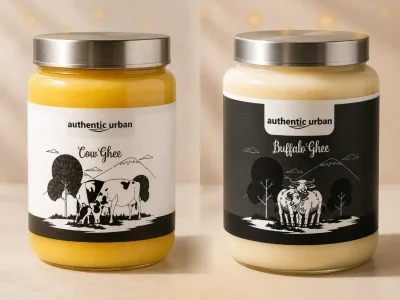
We make the two jars below, so read this as our own pick, checked against our own list. No "100%" on the label. Our FSSAI licence is printed on every jar and matches on FoSCoS. Our A2 Gir cow ghee is Gir cow milk only, and our Jafarabadi buffalo ghee is from the local breed, both from grass-fed village animals. Every jar is set to curd, churned, and cooked in a matki on a wood chulha after you order, tested every month against the FSSAI limits, and you get a video of your own jar being cooked and packed on WhatsApp. Anyone can visit Gir Somnath and watch; see how we make ghee.
Gir cow ghee: the daily teaspoon
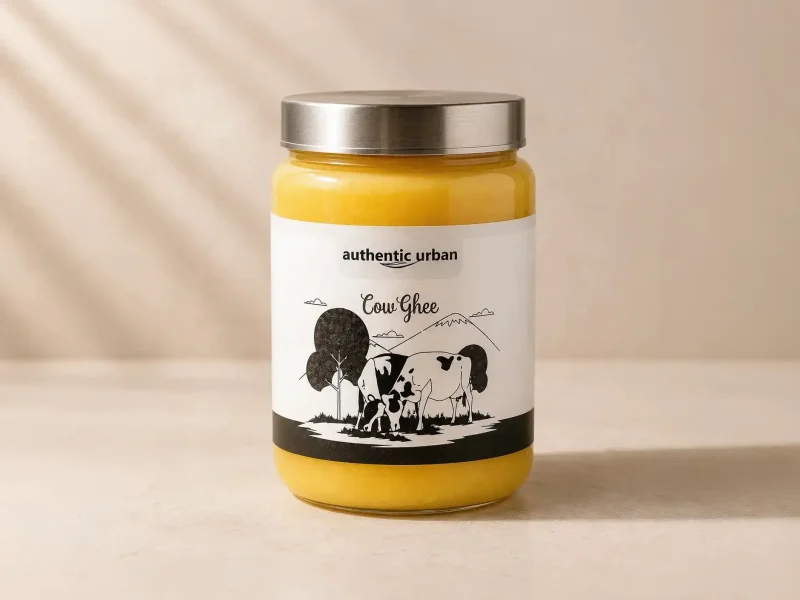 1 Litre
Buffalo ghee: sweets and paratha
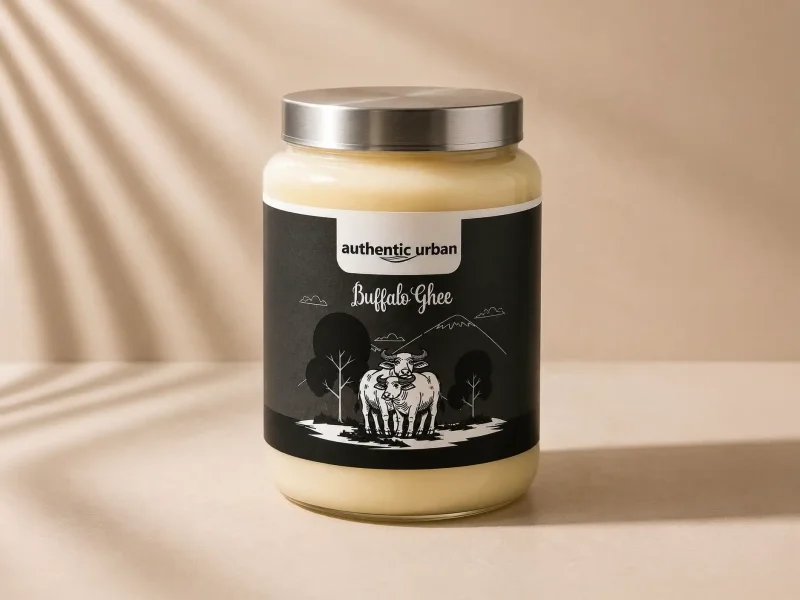 1 Litre
Each order is cooked after you place it, and the packing video is of that batch. Past order videos are on the shop.
FAQ
Which is the best ghee to buy instead?
We would put our own first, and we say that knowing we make it. Our Gir cow and Jafarabadi buffalo ghee is curd-churned Bilona, cooked after you order, tested every month against the FSSAI limits, and you get a video of your own jar being cooked and packed. After ours, the brands we rank next are GirOrganic, Gavyamart, Rosier Foods, and Two Brothers Organic Farms, which name the Gir breed and a curd method on their own pages.
Is branded ghee safer than loose ghee from a local dairy?
Not by default. Packed ghee must carry a licence number, a batch, and dates you can check, which gives you something to trace if a jar goes wrong. Loose ghee gives you none of that, but a local maker you can visit and watch at work may be more trustworthy than an anonymous online brand. Judge the proof on offer, not the packaging.
Is a big dairy brand ever on a list of ghee to avoid?
A brand does not go on or off a list as a whole. Food safety orders name specific batches, and copies of well-known dairy packs have been sold by fraudsters, so the risk usually sits with one batch or one seller. Buy big brands from their own shop or a large store, and check that the batch number and dates on your jar are printed cleanly.
Does a colour change between two jars of the same brand mean fake ghee?
No. Small-batch ghee changes colour with the season. Our cow ghee turns more yellow in the monsoon, when the animals eat green fodder, and it is one of the most common questions we get on WhatsApp. Buffalo ghee is always whiter than cow ghee. What deserves a question is a smell of wax or old oil, or an ingredient list that is not just milk fat.
Are online reviews useful for spotting bad ghee?
Some are. Skip the five-star lines that only say "good product" and read the three-star ones. Real buyers mention the smell when warmed, whether the jar set grainy or smooth, how it tasted on dal, and whether it leaked in transit. A listing with hundreds of reviews and none of those details is a pattern worth noting, though not proof on its own.
Can a shop sell ghee that fails the FSSAI standard?
Not legally. Ghee sold in India has to meet the FSSAI limits for moisture, milk fat, free fatty acids, the Baudouin test for vanaspati, and β-sitosterol for vegetable oil. When a state lab finds a batch that fails, the food safety department can ban its sale, and shops must take it off the shelf. Reporting a suspect jar is how many such batches get tested.
About the editorial team
Authentic Urban TeamBilona ghee makers, Gir Somnath, Gujarat
We are the Parmar family in Gir Somnath, Gujarat. We have made ghee here since 2016 and sold it online since 2025. We make only Bilona ghee, test it every month, and anyone is welcome to visit and watch it being made. Our Gir cows and Jafarabadi buffalo are grass-fed village animals that graze near the Gir forest, with no hormones or milk boosters. We set their milk to curd, churn it, and cook the makkhan on a wood chulha. These articles come from that kitchen and from what customers ask us on WhatsApp. We are ghee makers, not doctors.
Sources
- FSSAI asks FBOs to not use "100%" claims in food labelling and promotions; flags term as potentially misleading for consumers (press release, 30 May 2025), FSSAI. Checked 28 Sep 2026.
- J&K FDA prohibits sale, storage and distribution of 10 ghee batches (report of the Jammu and Kashmir Food and Drugs Administration order, 30 August 2026), Ommcom News. Checked 28 Sep 2026.
- Food Safety and Standards (Food Products Standards) Chapter 2.1: Dairy products and analogues, version 01.09.2023 (2.1.8 Milk fat products and ghee, limits p. 27), FSSAI. Checked 28 Sep 2026.
- Jaivik Bharat: consumer guidance on organic food labels, FSSAI. Checked 28 Sep 2026.