Khichdi Recipe: Moong Dal, Water Ratio, and How Much Ghee
For a khichdi recipe for four, pressure cook ½ cup (100 g) yellow moong dal and ½ cup (100 g) rice in 4 cups of water with turmeric and salt for 3 whistles, then pour a tadka of cumin, ginger, and hing in 1 tablespoon of ghee over it. Finish each bowl with ½ teaspoon of ghee. That is about 1¼ teaspoons of ghee and 225 kcal a bowl.
Moong dal khichdi recipe in grams
Equal weights of yellow moong dal and rice, four times their volume in water, three whistles, and a ghee tadka poured on at the end. That is the everyday khichdi of most Indian homes, and it takes about 45 minutes with a short soak. The dal and rice cook together until soft; the ghee goes in last, where it does the most for the taste.
Ingredients (serves 4)
- ½ cup (100 g) yellow moong dal
- A heaped ½ cup (100 g) rice, any everyday rice
- 4 cups (about 1 litre) water
- ½ tsp turmeric and 1 tsp salt
- Tadka: 1 tbsp ghee, 1 tsp cumin, 1 tsp grated ginger, 1 dried red chilli, 6 curry leaves, a pinch of hing
- To finish: ½ tsp ghee on each bowl (2 tsp in all)
- Optional: 1 cup chopped carrot, peas, or lauki in the cooker; 2 cloves garlic in the tadka
Equipment: a 3 litre pressure cooker (or a heavy pot), a small tadka pan, and a ladle for stirring.
Steps
- 1. Wash the dal and rice together 3 times, rubbing them between your fingers. Soak 15 minutes if you have time. Drain.
- 2. Into the cooker: dal, rice, water, turmeric, salt, and any vegetables. Medium flame, 3 whistles, about 12 to 15 minutes.
- 3. Turn off the heat and let the pressure drop by itself, about 10 minutes. Do not lift the whistle.
- 4. Open and stir hard with the ladle for a minute, so some grains break and the pot turns creamy. Add ½ cup hot water if it already looks stiff.
- 5. Tadka: heat 1 tbsp ghee on medium until a cumin seed sizzles the moment it goes in. Cumin for 10 to 15 seconds, until one shade darker. Ginger, chilli, and curry leaves for 20 seconds. Hing last, 2 seconds.
- 6. Pour the tadka straight onto the hot khichdi, stir, and serve with ½ tsp ghee on each bowl.
One bowl, a quarter of the pot: about 225 kcal, 7.8 g protein, 5.8 g fat (3.4 g saturated), and 35.6 g carbohydrate, worked out from USDA FoodData Central for raw mung beans, raw white rice, and ghee. Spices, ginger, and salt add very little and are not counted.
Stand back at step 6. Ghee is only ready once all the water in the makkhan has boiled away, which is why hot ghee sits well above the heat of boiling dal, and a splash of it burns worse than a splash of khichdi. When the tadka meets the wet pot it spits for a second. Pour it from the pan's edge, close to the surface, and keep children away from the stove. How ghee behaves at tadka heat is on ghee smoke point, and the tadka itself, spice by spice, on ghee dal tadka.
How much water for khichdi?
Four cups of water for ½ cup dal and ½ cup rice gives soft, spoonable khichdi in a pressure cooker. Use 3 cups for firm khichdi with grains you can see, and 5 cups for a very soft pot. A pot on the stove loses water to steam, so it needs about a cup more than a cooker.
Texture
Pressure cooker
Pot on the stove
Firm, grains you can see (Gujarati vaghareli style)
Cooker: 3 cups water. 2 whistles on medium.
Pot: 3½ cups. Simmer covered 25 min, stir every 5 min.
Soft and spoonable (this recipe)
Cooker: 4 cups water. 3 whistles on medium, then let the pressure drop by itself.
Pot: 5 cups. Simmer covered 30 to 35 min, stir every 5 min.
Very soft, almost pourable (sick days, older parents)
Cooker: 5 cups water. 4 whistles, then mash with the ladle.
Pot: 6 cups. Simmer 40 min, mash at the end.
For ½ cup moong dal and ½ cup rice, washed and drained. Unsoaked, or with vegetables, add ¼ to ½ cup water.
Khichdi keeps thickening for 20 minutes after the stove goes off. If you are serving it straight away, the soft row is right. If it will sit in a closed dabba until lunch, take the very soft row, or plan to loosen it with hot water.
How much ghee in khichdi?
About 1¼ teaspoons a bowl: 1 tablespoon for the tadka of a pot for four, plus ½ teaspoon on each bowl. That is enough to bloom the spices and leave a shine on top. Much less and the cumin tastes raw; much more and the ghee pools on the bowl without adding anything you can taste.
ICMR-NIN's 2024 dietary guidelines suggest limiting ghee or butter to 1 to 2 teaspoons a day, and keeping all added fat, oil and ghee together, to about 27 to 30 g a day on a 2,000 kcal diet. A bowl of this recipe fits inside that with room for the ghee on your roti. At home in Gir Somnath each of us eats 1 to 2 teaspoons of ghee on an ordinary day, and khichdi is one of the places it goes.
Pot of 4
Ghee in the pot
Ghee a bowl
kcal
Sat. fat
How it turns out
Sick-day
In the pot: 2 tsp, no tadka
A bowl: ½ tsp on top
197 kcal
Saturated fat 1.5 g
Plain and gentle. The ghee goes on the hot bowl at the end, where you smell it most.
This recipe
In the pot: 5 tsp (1 tbsp tadka + ½ tsp a bowl)
A bowl: 1¼ tsp
225 kcal
Saturated fat 3.4 g
Enough to bloom the cumin and hing and leave a shine on each bowl.
Rich, dhaba or wedding style
In the pot: 4 tbsp
A bowl: 3 tsp (1 tbsp)
290 kcal
Saturated fat 8.1 g
Ghee pools on top. Over the ICMR-NIN daily line in one bowl, so keep it for a festival plate.
Per bowl, a quarter of the pot. USDA FoodData Central: mung beans 174256, rice 169756, ghee 173412 (1 tbsp = 12.8 g, 1 tsp about 37 kcal). Daily line: ICMR-NIN Dietary Guidelines for Indians 2024. Checked 28 September 2026.
At our live prices a teaspoon of our cow ghee costs about ₹12 and of our buffalo ghee about ₹10, so the ghee in this pot comes to ₹50 to ₹60, or about ₹15 a bowl. Measure it melted: in winter the ghee we make sets to a firm grain in the jar and in summer it stays liquid, so a heaped spoon from a cold jar holds far more than a teaspoon. The full daily budget is on how much ghee per day, and calories by the spoon on ghee nutrition facts.
When does the ghee go in: the cooker, the tadka, or on top?
Mostly in the tadka and on top, not in the cooker. Ghee cooked for 15 minutes under pressure with the dal loses the smell you are paying for; ghee that meets hot cumin, or melts on a hot bowl, keeps it.
- In the cooker: only ½ teaspoon, and only if your cooker froths out of the whistle. The fat settles the foam a little. It adds almost no taste.
- In the tadka: 1 tablespoon for a pot of four. Cumin, hing, and curry leaves only give up their smell in hot fat, and the fat then carries it through the pot.
- On the bowl: ½ teaspoon, straight from the jar onto hot khichdi. This is the toasted-milk smell that makes people ask what ghee you used.
If you want to cut the ghee, cut it from the top, not the tadka. A tadka in 2 teaspoons still works for a pot of four if you keep the pan small so the ghee covers the cumin. More on choosing the fat for each job is on cooking with ghee.
Which dal is best for khichdi?
Yellow moong dal, for an everyday or sick-day pot: it cooks in the same time as the rice and turns soft without soaking. Toor dal gives the heavier home khichdi of Gujarat and Maharashtra, and green moong with skin gives a more filling bowl. Each needs a small change in water and whistles.
Yellow moong (dhuli moong)
Change: None. Soak 15 min or skip it. Cooks in the same time as the rice.
Mild, soft, the classic khichdi.
Green moong with skin (chilka or sabut)
Change: Soak 1 hour. Add ½ cup water and 1 more whistle.
Earthier, a little grainy. More filling.
Toor (arhar)
Change: Soak 30 min. Add ½ cup water and 1 more whistle.
The Gujarati and Maharashtrian home khichdi. Heavier, nuttier.
Masoor (red, split)
Change: No soak. Same water and whistles as yellow moong.
Turns very soft and a little orange. Good for a quick weekday pot.
Changes are against the recipe above: ½ cup dal, ½ cup rice, 4 cups water, 3 whistles.
For a Gujarati vaghareli khichdi, make the firm row from the water table with toor dal, then fry a sliced onion, a diced potato, and a spoon of peanuts in the tadka ghee before the cooked khichdi goes in, and stir it in the pan for 2 minutes. In Gujarat khichdi usually comes to the table with kadhi. Sabudana khichdi is a different dish altogether, cooked dry with no dal or rice; it is on Navratri vrat recipes.
How do you make khichdi when you are unwell?
Use the very soft row from the water table, leave out the chilli, garlic, and onion, skip the tadka, and put ½ teaspoon of ghee on each hot bowl. That is the sick-day row in the ghee table: about 197 kcal a bowl, soft enough to eat with little appetite, and plain enough for an upset stomach.
Khichdi is food that is easy to eat, not a medicine, and the ghee in it does not treat a fever, a cold, or loose motions. If vomiting or loose motions go on for more than a day, if someone cannot keep water down, or if a child or older parent looks dry and drowsy, see a doctor instead of waiting on the khichdi. Home remedies for a cough and cold, and which ones have any testing, are on ghee for cough and cold.
For a baby, khichdi is a common first food, but the grams, the texture, and the ghee are different from a family pot, and salt stays out. Use the baby recipe on baby khichdi with ghee instead of a bowl from this one.
Why is my khichdi watery, stiff, or bland?
Watery khichdi comes from too much water or pressure let out by hand, stiff khichdi from cooling, and bland khichdi from a tadka made in ghee that was not hot enough. Find your problem below.
Watery
Too much water for your rice, or the pressure was let out by hand while the grains were still drinking.
Fix: Simmer it open for 5 minutes, stirring. Next time let the pressure drop on its own, which takes about 10 minutes.
Stiff, sets like cement
Normal as khichdi cools: the rice and dal keep soaking up water.
Fix: Stir in ½ cup hot water per bowl and warm it for 2 minutes. Turn off the stove when it looks a little looser than you want.
Dal still hard
Old dal, hard water, or salt and tomato added before the dal softened.
Fix: Add ½ cup water and give it 1 or 2 more whistles. Soak old dal for 30 minutes next time.
Froth or water out of the whistle
Moong foams as it boils, and a cooker filled past half pushes the foam into the vent.
Fix: Fill the cooker to half at most. Skim the first foam in an open cooker before the lid goes on, or add ½ tsp of the tadka ghee to the water.
Burnt at the bottom
High flame, too little water, or a thin cooker.
Fix: Medium flame for the whistles. Serve from the top, leave the burnt layer, and do not stir it in.
Bland, or tadka tastes bitter
Cumin went into cool ghee, or it went dark brown and burnt.
Fix: Heat until one seed sizzles at once. Pull the pan off the heat when the cumin is one shade darker, then add hing.
How long does khichdi keep, and can you reheat it?
Eat leftover khichdi within 24 hours and reheat it only once, because it is mostly cooked rice. The NHS advises cooling cooked rice within 1 hour and keeping it in the fridge, since spores of some food poisoning bacteria survive cooking, multiply in rice left warm, and make toxins that reheating does not destroy.
Spread the leftover khichdi in a wide steel plate so it cools fast, then box it and put it in the fridge. It will be solid by morning. Loosen it with ½ cup hot water per bowl and heat until it bubbles and is steaming hot all through; the NHS gives 70°C at the centre for 2 minutes. Add the ½ teaspoon of ghee after reheating, not before. Do not leave the cooker on the stove overnight, even with the lid shut.
What do you eat with khichdi?
Something sour and something crunchy: curd or kadhi, and papad or pickle. In Gujarat it is kadhi; in the north, curd, papad, and achaar; for a fuller meal, a dry sabzi like jeera aloo or baingan bharta, and a plate of cucumber and onion. Curd also adds protein to a bowl that has 7.8 g of its own. If the side is already cooked in ghee, keep the khichdi to the tadka and skip the spoon on top.
If you want rice without dal, cooked in ghee with whole spices, that is ghee rice. If you watch your blood sugar, the size of the rice portion matters more than the ghee on it; what the studies say is on can diabetics eat ghee.
Cow or buffalo ghee for khichdi?
Cow ghee, if you keep one jar for khichdi. Its lighter, toasted-milk smell comes through a plain moong pot, and the yellow colour shows on the bowl. Buffalo ghee works well in the tadka of a rich toor or vaghareli khichdi in winter; it tastes heavier and sets firmer in the jar.
"Cow or buffalo for me?" is one of the questions customers ask us most on WhatsApp. For khichdi the answer is the one you enjoy eating: both are almost pure milk fat with about the same calories a spoon. The side-by-side is on cow vs buffalo ghee.
Khichdi recipe card to keep by the stove
Screenshot it for the next time you cook.
- 1. For 4: ½ cup (100 g) yellow moong dal, a heaped ½ cup (100 g) rice, 4 cups water, ½ tsp turmeric, 1 tsp salt.
- 2. Wash dal and rice together 3 times. Soak 15 minutes if you have time. Drain.
- 3. Cooker: dal, rice, water, turmeric, salt. Medium flame, 3 whistles. Let the pressure drop by itself, about 10 minutes.
- 4. Open, stir hard to break the grains a little. Add hot water if it looks stiff.
- 5. Tadka: 1 tbsp ghee until a cumin seed sizzles at once. 1 tsp cumin, 10 to 15 seconds. Ginger, chilli, curry leaves, 20 seconds. Hing, 2 seconds. Pour on.
- 6. Serve hot with ½ tsp ghee on each bowl.
- 7. About 225 kcal and 1¼ tsp of ghee a bowl. Leftovers: fridge within 1 hour, eat within 24 hours, reheat once.
Which ghee for khichdi?
The ½ teaspoon on top is eaten raw, so the jar has to smell of toasted milk when it melts, not flat or stale. Pick a plain ghee with nothing added. The home checks are on how to identify pure ghee, and our ranking of the cow ghee on sale is best cow ghee in India.
We make and sell ghee, so weigh this with that in mind. For khichdi we would use our A2 Gir cow ghee, and our Jafarabadi buffalo ghee for a rich winter pot. Both come from grass-fed village animals near the Gir forest; the milk is set to curd overnight, churned, and the makkhan cooked in a matki on a wood chulha. The jar is made after you order, a video of it being cooked and packed comes on WhatsApp, and Varsha tastes every batch before it goes in a jar. We test every month against the FSSAI limits; the steps are on how we make ghee.
Tadka and the spoon on top
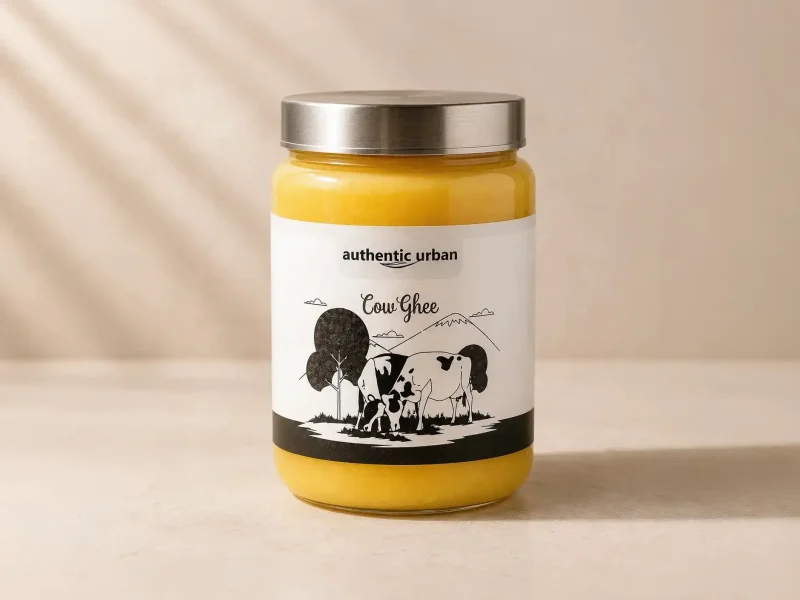 1 Litre
Rich winter khichdi
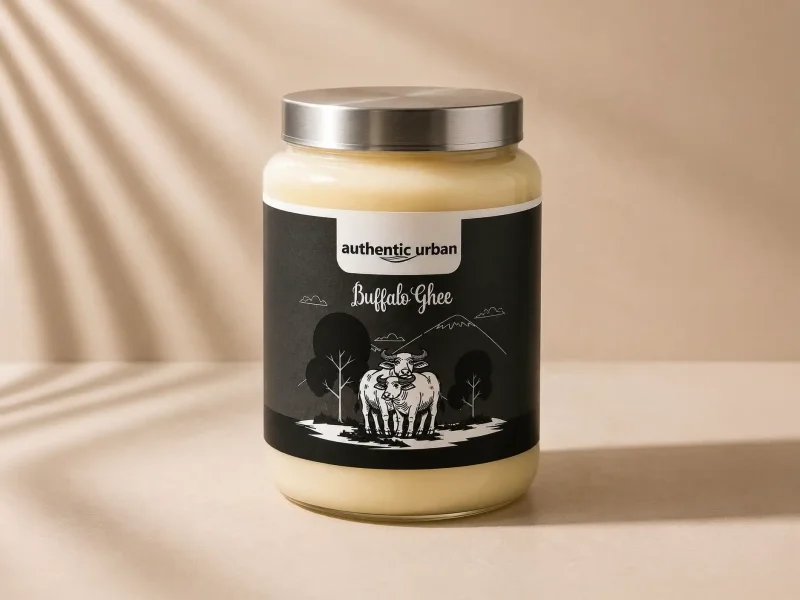 1 Litre
Each order is cooked after you place it, and the packing video is of that batch. Past order videos are on the shop.
FAQ
Should I soak the dal and rice for khichdi?
For yellow moong and white rice, a 15 minute soak is optional; it saves about one whistle and gives a smoother pot. Green moong with skin needs about an hour and toor dal about 30 minutes, or the dal stays firm while the rice turns to mush. Always drain the soaking water and measure fresh water, so the ratio in the table stays right.
Can I make khichdi in an Instant Pot or electric rice cooker?
Yes. In an Instant Pot, use the same 4 cups of water, cook on high pressure for 8 to 10 minutes, and let the pressure release naturally for 10 minutes. In a plain electric rice cooker, use about 4½ cups, stir once halfway through, and let it rest on warm for 10 minutes. Make the ghee tadka in a small pan and pour it over at the end.
Can I make khichdi with brown rice, dalia, or millet?
Yes, but each needs more water and time than white rice. Brown rice wants a 1 hour soak, about 1 extra cup of water, and 5 to 6 whistles. Broken wheat (dalia) cooks close to white rice with ½ cup more water. Foxtail or little millet needs a 30 minute soak and 3 to 4 whistles. The ghee tadka and the amount per bowl stay the same.
Is khichdi the same as ven pongal?
Close cousins. Ven pongal, from Tamil Nadu, is rice and roasted moong dal cooked very soft, finished with a ghee tadka of black pepper, cumin, ginger, curry leaves, and cashews. It usually carries more ghee than a weekday khichdi and no turmeric. North and west Indian khichdi uses turmeric and a cumin and hing tadka. The water and whistles in this recipe work for both.
Can I use oil or butter instead of ghee in khichdi?
Yes. Any cooking oil makes a good tadka for cumin and hing; the khichdi simply smells of the spices instead of toasted milk. Butter burns in a tadka because it still has water and milk solids, which ghee has had cooked out. If you like butter, make the tadka in oil and put a small piece of butter on the hot bowl instead of the ghee.
Is khichdi good for weight loss?
A bowl of this recipe has about 225 kcal and 7.8 g of protein, which is a modest, filling meal. What changes the number is the portion and the ghee: the rich pot in the table adds about 65 kcal a bowl. For a lighter plate, add a cup of chopped vegetables to the cooker, keep to one bowl with curd or salad, and stay at ½ tsp of ghee on top.
About the editorial team
Authentic Urban TeamBilona ghee makers, Gir Somnath, Gujarat
We are the Parmar family in Gir Somnath, Gujarat. We have made ghee here since 2016 and sold it online since 2025. We make only Bilona ghee, test it every month, and anyone is welcome to visit and watch it being made. Our Gir cows and Jafarabadi buffalo are grass-fed village animals that graze near the Gir forest, with no hormones or milk boosters. We set their milk to curd, churn it, and cook the makkhan on a wood chulha. These articles come from that kitchen and from what customers ask us on WhatsApp. We are ghee makers, not doctors.
Sources
- Mung beans, mature seeds, raw (FDC ID 174256), SR Legacy, USDA FoodData Central. Checked 28 Sep 2026.
- Rice, white, long-grain, regular, raw, unenriched (FDC ID 169756), SR Legacy, USDA FoodData Central. Checked 28 Sep 2026.
- Butter oil, anhydrous (FDC ID 173412), SR Legacy, USDA FoodData Central. Checked 28 Sep 2026.
- Dietary Guidelines for Indians, 2024 (Guideline 7, visible fats), ICMR-National Institute of Nutrition. Checked 28 Sep 2026.
- Starchy foods and carbohydrates (storing and reheating rice), NHS. Checked 28 Sep 2026.