Is Ghee Good for Cough and Cold? How Much and How to Use
Is ghee good for cough? It can soothe a dry, scratchy throat, but it does not treat a cough or a cold. Half a teaspoon of warm ghee with a teaspoon of honey, or ghee on hot khichdi, is a fair home comfort for adults and children over 1. Rest, fluids, and time do the real work; a cough past 3 weeks needs a doctor.
Is ghee good for cough and cold?
Ghee is fine to eat with a cough or cold and may make a dry throat feel better, but no trial shows it shortens either. Use ½ to 1 teaspoon at a time, in warm food or with honey, and keep the day to 1 to 2 teaspoons, the limit ICMR-NIN's 2024 guidelines set for everyone. The honey in a honey-ghee lick is the part with trial evidence.
A common cold lasts 1 to 2 weeks and a cough usually clears in 3 to 4 weeks, the NHS says, with or without home remedies. Colds are caused by viruses, so antibiotics do not help either. That leaves comfort: something warm for the throat, food that is easy to eat, and sleep. Ghee fits into that as a food. This page is for everyday coughs and colds in adults and children. Asthma and long-term breathing trouble are on ghee for asthma, and daily ghee for when you are well is on does ghee help immunity.
How do you use ghee for cough and cold at home?
Most Indian homes use ghee in five ways when someone has a cold: a lick with honey, haldi doodh, khichdi, a sonth-gur mix, and a warm chest rub. Here is each with the amount, how to do it, and what it rests on, plus the one to leave for later.
Remedy
How much
How
Based on
Honey and ghee lick for a dry, tickly cough
1 tsp raw honey with ½ tsp warm (not hot) ghee
Mix at room temperature and let it sit on the tongue before swallowing. Unequal amounts, never cooked. Only for age 1 and over.
Honey: tested in children. Ghee: tradition.
Haldi doodh with ghee
1 cup warm milk, a pinch of haldi and black pepper, ¼ to ½ tsp ghee
Early evening rather than in bed. Sip it warm, not scalding.
A warm drink helps; the ghee carries the haldi. Tradition.
Moong dal khichdi or dal-rice with ghee
½ to 1 tsp on top of the bowl
A soft, light meal when appetite is low. Ghee goes on at the end, not into a deep tadka.
Sick-day food. Tradition.
Sonth (dry ginger) with ghee and gur
A pinch of sonth, ½ tsp ghee, a small piece of gur
Warm the ghee, take it off the flame, stir in sonth and gur. Once or twice a day, adults.
Household winter tradition. Not tested.
Warm ghee rubbed on the chest and back
About 1 tsp, warm to the touch
Test on the inner arm first. Not on broken skin, and keep it away from a baby's nose and mouth.
Comfort and massage. Tradition.
Ghee drops in the nose (nasya)
Skip during a cold
Not with a blocked nose, fever, or sinus infection. Children: no.
Tradition, for when you are well.
Amounts for adults unless stated. Children are covered in their own section below.
Honey and ghee for cough: the one rule
Mix them at room temperature and in unequal amounts. Ayurvedic texts warn against equal weights of honey and ghee and against cooking honey, and the ratio question has its own page: ghee and honey together. Warm the ghee gently until it just melts, let it cool for a minute, then stir in the honey. The NHS suggests hot lemon and honey for a cough, and notes it is not suitable for babies under 1.
For the haldi doodh, the step-by-step recipe and the fixes for a bitter or oily cup are on turmeric ghee golden milk. Drink it in the early evening. A glass of rich milk right before lying down can bring on acidity in some people, and that alone can set off a night cough.
Does ghee cure a cough, or kill germs?
No. We found no human study showing that ghee kills the viruses behind a cold or shortens a cough. The pages that rank for this question often say ghee is antibacterial and clears infection; here is what each common claim rests on.
The claim
What is actually known
Ghee kills the germs that cause a cold
No human study we found. Colds are caused by viruses; the NHS notes even antibiotics do not work on them.
Ghee coats the throat and calms the cough
Plausible as comfort, since warm fat feels smooth on a raw throat. Not tested. We found no trial of plain kitchen ghee for cough.
Honey eases a cough
The best-tested part of the honey-ghee lick. A 2018 Cochrane review of 6 trials in 899 children aged 1 to 18 found honey probably cut cough frequency more than no treatment or a placebo.
Ghee makes more phlegm (kapha)
No study we found. Many families cut milk and ghee during a wet cough anyway. If a spoon seems to make yours thicker, drop it for a few days; nothing is lost.
More ghee in winter prevents colds
No evidence. Rest, fluids, and not spreading the virus do more. The daily limit stays the same in winter.
In the Cochrane review, honey did about as well as dextromethorphan, a common ingredient in cough syrups, though the evidence for that comparison was weak. So if you reach for one thing in the kitchen for a child's dry cough, make it the honey, and let the ghee be the part that makes it pleasant to take.
How much ghee should you eat with a cold?
The same as on a well day: 1 to 2 teaspoons across the day for an adult, split across meals. A cold is not a reason to double it. USDA FoodData Central puts a 5 g teaspoon of ghee at about 44 kcal and 5 g of fat, 3.1 g of it saturated. Three or four remedies a day, each with a spoon of ghee, add up fast.
A simple sick day for an adult: honey-ghee lick in the morning (½ tsp ghee), khichdi at lunch (½ tsp), haldi doodh in the early evening (¼ to ½ tsp). That stays inside 2 teaspoons. If you already cook in ghee, count that too. What too much does, and who should keep ghee low whatever the season, is on who should not eat ghee.
Winter is when colds go round the house, and it is also our best ghee season in Gir Somnath: the milk is richer, the churn gives more makkhan per litre, and the ghee sets in a fine grain. It is when we make adadiya pak and gond ke ladoo. Each of us still eats 1 to 2 teaspoons a day on roti, dal, and khichdi, with the sweets as the extra. With someone coughing at home, the sweets are what we would cut first, not the spoon on the khichdi.
Can you give ghee to a child with a cold or cough?
Yes, as food, in small amounts, from the age your child already eats ghee. The rules that matter for children are about honey, steam, and the nose, not the ghee.
Age
Ghee
Avoid
Under 1 year
Only as food, in khichdi or dal, if your doctor has already started ghee
Avoid: No honey at all (risk of infant botulism). No nasya, no chest rub near the face, no steam, no home cough mixtures.
1 to 5 years
¼ to ½ tsp in warm khichdi, dal, or roti
Avoid: No steam from a bowl of hot water and no hot drinks (scald risk, per the NHS). No nasya. Honey is fine from age 1, ½ to 1 tsp.
6 years and over
½ tsp in food, or a small honey-ghee lick for a dry cough
Avoid: Same limits as adults, in smaller amounts. Fever, wheeze, or fast breathing: doctor first.
Honey and steam rules from the NHS common cold page and the 2018 Cochrane review. Your paediatrician's advice comes first.
For babies, when ghee starts and how much goes in each meal is on ghee for babies, and for 1 to 3 year olds on ghee for toddlers. A child under 5 with a sore throat should see a GP, the NHS says. Wheezing or hard breathing in a child of any age is a doctor's job, not a kitchen one.
Is ghee better for a dry cough or a wet cough?
A dry, tickly cough is where a warm spoon of ghee with honey feels most useful. With a wet cough full of phlegm, many families cut back on milk, ghee, and rich food for a few days.
That split comes from Ayurveda, which reads a dry cough as vata (dryness) and a wet, heavy one as kapha (mucus), and uses ghee mainly for the first. It is household tradition, not a tested rule. In practice it asks little of you: keep the ½ teaspoon on dal if it sits well, drop it if the phlegm feels thicker, and lean on warm water, soups, and ginger. Why ghee is called cooling in one text and warming in another is on is ghee heating or cooling.
What about ghee in the nose for a blocked nose?
Leave it during a cold. Nasya, a few drops of warm ghee in each nostril, is a household tradition for dry nasal passages in a well person, and it is skipped with a blocked nose, fever, or sinus infection. It is not for children. How it is done and who should avoid it is on ghee in nose (nasya).
What helps a cough and cold more than ghee?
Rest, plenty of fluids, and time help more than any spoon. The NHS adds a few more things that work at home.
- Gargle with half a teaspoon of salt dissolved in a glass of warm water for a sore throat (adults and older children).
- Hot lemon and honey, which the NHS says can work much like a cough syrup. Not for babies under 1.
- Paracetamol or ibuprofen for aches and fever, following the pack or a pharmacist.
- Staying home while you have a high temperature, so it does not go round the house or office.
Antibiotics are not one of them: the NHS says GPs do not recommend them for colds. Ghee sits alongside these as food, and it never replaces a medicine a doctor has given you or your child.
When does a cough or cold need a doctor?
See a doctor if a cough lasts more than 3 weeks, a high temperature lasts more than 3 days, or a cold is getting worse instead of better. Those are the NHS's lines, and no home remedy changes them.
Get help the same day if the cough is very bad or getting worse fast, you have chest pain, you find it hard to breathe, you are coughing up blood, or the side of your neck is swollen and painful. Go to emergency care at once for severe difficulty breathing, not being able to swallow, or a high-pitched noise when breathing in.
Also see a doctor if you are losing weight without trying, or you have a weak immune system from diabetes, chemotherapy, or another long-term condition. A regular cough that is really wheezing is covered on the asthma page linked above; ghee does not open the airways.
An 8-point ghee checklist for a cough or cold
Keep this on the fridge for the winter. It covers adults and children.
- Keep the day's ghee to 1 to 2 teaspoons, the ICMR-NIN limit, sick or well.
- Put the ghee on soft food (khichdi, dal, roti), not into fried snacks.
- For a dry cough, try 1 tsp honey with ½ tsp warm ghee, mixed at room temperature.
- Never cook honey with ghee, and never give honey to a baby under 1.
- Drink plenty of water and warm fluids, and rest.
- Gargle with half a teaspoon of salt in a glass of warm water for a sore throat.
- Skip nasya and steam bowls for children, and nasya for anyone with a blocked nose.
- Cough past 3 weeks, fever past 3 days, chest pain, blood, or hard breathing: see a doctor.
Which ghee for cold-season home remedies?
For a spoon that goes straight onto the tongue or into a child's bowl, you want ghee you trust. Well-made ghee smells of toasted milk when warmed and often sets grainy when cool. A batch cooked too hard turns dark, bitter, and smells burnt; one cooked too little stays cloudy and spoils fast. We keep both kinds at home and never pack them. How to check any jar is on how to identify pure ghee, and our ranking of the cow ghee on sale is best cow ghee in India.
We make and sell ghee, so weigh this with that in mind. For the honey lick and haldi doodh we would pick our own A2 Gir cow ghee: grass-fed Gir milk set to curd overnight, churned, and cooked in a matki on a wood chulha, made after you order, with a video of your jar sent on WhatsApp. At ₹2,399 a litre, a ½ teaspoon costs about ₹6. Our Jafarabadi buffalo ghee is the richer jar for gond ladoo and winter sweets. We test every month against the FSSAI limits; the steps are on how we make ghee.
Honey lick, haldi doodh, khichdi
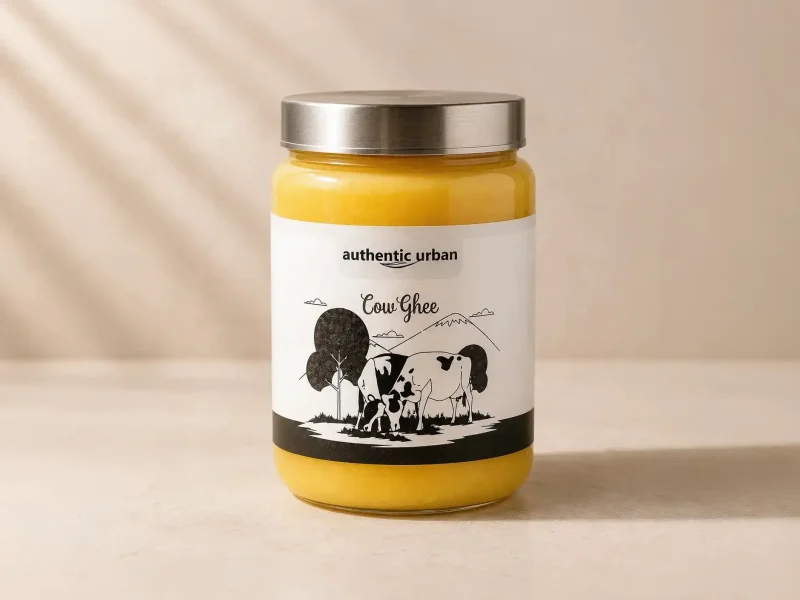 1 Litre
Gond ladoo and winter sweets
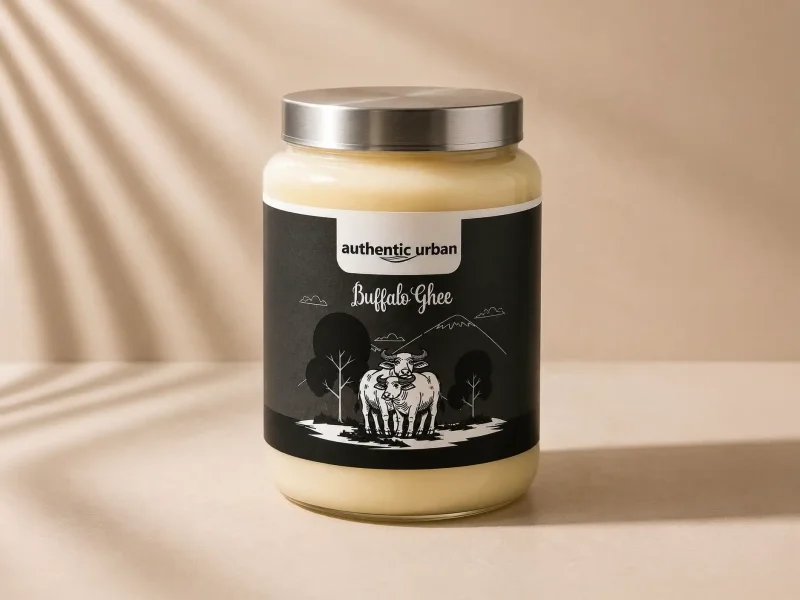 1 Litre
Each order is cooked after you place it, and the packing video is of that batch. Past order videos are on the shop.
FAQ
Sardi khansi me ghee kha sakte hai?
Haan, thoda sa. With a cold or cough, ½ to 1 teaspoon of ghee on khichdi, dal, or roti is fine for most adults, and the day's total stays at 1 to 2 teaspoons. For a dry khansi, a lick of 1 teaspoon honey with ½ teaspoon warm ghee is a common home habit. Ghee does not cure sardi. Fever for more than 3 days or saans lene me takleef needs a doctor.
Is ghee with black pepper good for cough?
It is a common household remedy: a pinch of crushed black pepper in ½ teaspoon of warm ghee, sometimes with a little gur or honey. The pepper gives a warm, sharp taste that many people find soothing on a scratchy throat. We found no trial of this mix for cough. Keep it to adults and older children, and stop if the pepper makes the coughing worse.
Is cow ghee or buffalo ghee better for a cold?
Neither is proven better for a cold. Both are almost pure milk fat, about 44 kcal a teaspoon. Cow ghee is lighter and is the usual choice for haldi doodh, a honey lick, and a child's khichdi. Buffalo ghee is richer and firmer, better for gond or winter sweets than for a sick day. The amount you eat matters more than the animal the milk came from.
Should I stop eating ghee during a fever?
Not necessarily. A small spoon on light food is fine if you can eat. Many people lose their appetite with fever, and a little ghee makes khichdi or dal easier to finish. Skip heavy, fried, or very rich food until you feel better. Drink plenty of fluids. A high temperature for more than 3 days, or a very sick child, needs a doctor, not a change in diet.
Can I drink warm water with ghee for a sore throat?
You can, but the ghee floats on top and most people find it oily. For a sore throat the NHS suggests a salt-water gargle, plenty of fluids, and warm lemon with honey. If you like the ghee habit, stir ½ teaspoon into a cup of warm water or thin dal and sip it. Stop if it makes you feel sick, and see a doctor if the throat is no better after a week.
Does ghee help a cough at night?
A honey-ghee lick before bed may help a dry night cough, mostly because of the honey, which trials in children found reduced coughing. Take it at least a few minutes before lying down, and sleep with your head a little raised. Heavy ghee milk right at bedtime can bring on acidity, which itself triggers coughing in some people. A night cough lasting weeks needs a doctor.
About the editorial team
Authentic Urban TeamBilona ghee makers, Gir Somnath, Gujarat
We are the Parmar family in Gir Somnath, Gujarat. We have made ghee here since 2016 and sold it online since 2025. We make only Bilona ghee, test it every month, and anyone is welcome to visit and watch it being made. Our Gir cows and Jafarabadi buffalo are grass-fed village animals that graze near the Gir forest, with no hormones or milk boosters. We set their milk to curd, churn it, and cook the makkhan on a wood chulha. These articles come from that kitchen and from what customers ask us on WhatsApp. We are ghee makers, not doctors.
Sources
- Cough, NHS. Checked 26 Sep 2026.
- Common cold, NHS. Checked 26 Sep 2026.
- Sore throat, NHS. Checked 26 Sep 2026.
- Honey for acute cough in children (Cochrane Database of Systematic Reviews, 2018, CD007094), Cochrane. Checked 26 Sep 2026.
- Dietary Guidelines for Indians, 2024 (ghee or butter 1 to 2 teaspoons a day, printed p. 54), ICMR-National Institute of Nutrition. Checked 26 Sep 2026.
- Butter oil, anhydrous (FDC ID 173412), SR Legacy, USDA FoodData Central. Checked 26 Sep 2026.