Ghee for Weight Gain: How Much, With Milk, and Which Ghee
Ghee for weight gain helps, but only as a small part of the extra food. One teaspoon (5 g) adds about 44 kcal, while a steady, healthy gain needs about 300 to 500 extra kcal a day. Keep ghee to 1 to 2 teaspoons on dal, roti, or in warm milk, and get the rest from milk, dal, eggs, peanuts, and one more small meal.
Does ghee help you gain weight?
Yes, a little. Ghee is almost pure fat, about 44 kcal in a teaspoon by USDA FoodData Central figures, so a spoon on dal or roti makes a meal richer without making it bigger. The NHS suggests that underweight adults add around 300 to 500 extra kcal a day. Two teaspoons of ghee give about 88 kcal of that, so the rest has to come from more food.
That gap is where most advice online goes wrong. To reach even 300 kcal from ghee alone you would need about 7 teaspoons a day, several times ICMR-NIN's 2024 advice to keep ghee or butter to 1 to 2 teaspoons. That much fat, with almost no protein, tends to add soft weight and upset the stomach. This page is for adults who are thin and want to gain on purpose. If you are losing weight without trying, start with the doctor section below. Gym bulking and shakes are on ghee for muscle building, and children aged 1 to 3 who are not gaining are covered on ghee for toddlers.
Are you underweight? Check your BMI first
You are underweight if your BMI is below 18.5. ICMR-NIN's 2024 guidelines say Indian adults should aim for a BMI between 18.5 and 23, lower than the Western range, because Asians carry more body fat at the same BMI. Find your height below and see the healthy weight range.
Height
Below this, underweight
Healthy up to
150 cm
41.6 kg
51.8 kg
155 cm
44.4 kg
55.3 kg
160 cm
47.4 kg
58.9 kg
165 cm
50.4 kg
62.6 kg
170 cm
53.5 kg
66.5 kg
175 cm
56.7 kg
70.4 kg
180 cm
59.9 kg
74.5 kg
Weight at BMI 18.5 and 23 (weight in kg divided by height in metres, squared), the healthy range for Indian adults in ICMR-NIN Dietary Guidelines for Indians 2024, printed pp. 62 and 63. Checked 27 September 2026. Not for children or teenagers.
If you are above the first number, you are not underweight, even if you feel thin. You may want more muscle rather than more weight, and that is a protein and exercise question more than a ghee one.
How much ghee a day for weight gain?
One to two teaspoons a day, spread over two meals, is enough for most underweight adults. ICMR-NIN's 2024 guidelines allow 27 to 30 g of cooking fat and oil in a 2,000 kcal day, and ask that ghee or butter stay at 1 to 2 teaspoons of it. A dietitian may set more for someone very thin; that is their call, made with your reports in hand.
Your situation
Ghee a day
Where the rest comes from
Healthy adult, BMI under 18.5, no health condition
Ghee: 1 to 2 tsp a day, on dal, roti, rice, or in milk
The rest: Add milk, dal, eggs, peanuts, and a fourth small meal
Low appetite, cannot finish big plates
Ghee: 1 tsp on each of two meals
The rest: Five or six smaller meals instead of three large ones
Lifting weights to gain muscle
Ghee: 1 to 2 tsp; the protein matters more
The rest: Dal, curd, paneer, eggs, or meat at every meal
High LDL, fatty liver, or gallstones
Ghee: Only what your doctor allows
The rest: Calories from milk, dal, and grains, not extra fat
Losing weight without trying
Ghee: No change until a doctor has seen you
The rest: A check-up first; see the list below
Ghee limit and cooking fat from ICMR-NIN Dietary Guidelines for Indians 2024, printed p. 54. Smaller, more frequent meals from the NHS advice for underweight adults. Checked 27 September 2026.
Posts that tell thin people to eat three to six tablespoons a day are asking for 336 to 672 kcal of pure fat, at about 112 kcal a tablespoon. That crowds out the dal and roti you need for protein, and on a weak stomach it often ends in loose, oily stools. At home our family eats 1 to 2 teaspoons each a day on roti, dal, and khichdi, and a little more only in winter, in sweets like adadiya pak and gond. For the daily amount for other people in your house, see how much ghee per day, or work out your home's daily ghee and oil with the ghee calculator.
What to eat with ghee to gain weight
Eat foods that bring calories and protein together: milk, dal, eggs, peanuts, curd, and paneer, with one teaspoon of ghee to make the meal easier to finish. Here is what each common add-on gives, next to a teaspoon of ghee.
USDA FoodData Central SR Legacy (173412, 173944, 171287, 171265, 172430, 172421), per the portions shown, checked 27 September 2026.
| Item | Value |
|---|---|
| 1 tsp ghee (5 g) | 44 kcal |
| Banana, 120 g | 107 kcal |
| 2 eggs (100 g) | 143 kcal |
| Glass of whole milk (244 g) | 149 kcal |
| Peanuts, 30 g | 170 kcal |
| Thick dal, 150 g cooked | 174 kcal |
Add-on
Calories
Protein
1 tsp ghee (5 g)
44 kcal
0 g
Banana, 120 g
107 kcal
1.3 g
2 eggs (100 g)
143 kcal
12.6 g
Glass of whole milk (244 g)
149 kcal
7.7 g
Peanuts, 30 g
170 kcal
7.7 g
Thick dal, 150 g cooked
174 kcal
13.5 g
USDA FoodData Central SR Legacy, per 100 g values scaled to each portion. Dal uses boiled whole lentils as the nearest match to a thick home dal. Checked 27 September 2026.
Two add-on days that reach 300 to 500 kcal
Keep your usual breakfast, lunch, and dinner, and add one of these. In both, ghee is under a quarter of the extra calories.
Veg day with milk
- Glass of warm whole milk at 5 pm 149 kcal
- 1 tsp ghee stirred into that milk 44 kcal
- Handful of peanuts (30 g) mid-morning 170 kcal
- 1 tsp ghee on the lunch dal 44 kcal
407 kcal extra, 15.4 g protein. Ghee: 22% of the extra.
Egg day
- 2 boiled eggs with breakfast 143 kcal
- Banana (120 g) at 11 am 107 kcal
- Extra katori of thick dal (150 g) at dinner 174 kcal
- 1 tsp ghee on the dinner roti 44 kcal
468 kcal extra, 27.4 g protein. Ghee: 9% of the extra.
The NHS advice for underweight adults follows the same pattern: smaller meals more often, snacks between them, milky drinks between meals rather than just before, and calories from nuts, seeds, and dairy rather than from chocolate, cakes, and sugary drinks. The full label for a spoon of ghee, with its vitamins, is on ghee nutrition facts.
Is milk with ghee good for weight gain?
Yes, it is one of the easier add-ons: a glass of warm whole milk with one teaspoon of ghee gives about 193 kcal and 7.7 g of protein, by USDA figures. Almost all of the protein and most of the calories come from the milk. The ghee adds 44 kcal and makes the glass feel richer.
- Warm one glass of whole milk until it steams, then take it off the flame.
- Stir in 1 teaspoon of ghee. A pinch of haldi or elaichi is a common home addition; skip the sugar, or keep it to a little jaggery.
- Drink it between meals, around 5 pm, or one to two hours before bed. A glass right before dinner fills you up and you eat less.
- Count the teaspoon in your 1 to 2 for the day. Two glasses a day means one of them goes without ghee.
Skip the bedtime glass if you get acid reflux lying down, and use curd or paneer instead of milk if milk gives you gas. The timing rules for a night spoon are on milk with ghee at night, and a version with haldi and black pepper is turmeric ghee golden milk.
Which ghee is best for weight gain: cow or buffalo?
Neither puts on more weight. FSSAI sets the same minimum of 99.5% milk fat for all ghee, cow or buffalo, so a teaspoon of either gives about the same 44 kcal. Pick by taste and the job: cow ghee for the spoon on dal and in milk, buffalo ghee for paratha and sweets.
Many pages say buffalo ghee is "better for weight gain because it has more fat". That mixes up the milk and the ghee. Buffalo milk is richer, which is why about 22 to 25 litres of our Jafarabadi buffalo milk make 1 kg of ghee, against 30 to 35 litres of Gir cow milk. Once the water and milk solids are cooked out, both jars are nearly pure fat. Buffalo ghee sets whiter and tastes heavier, and some people find that harder to eat by the spoon.
What matters more on a weight-gain plan is that the ghee is real, since you are eating it every day. Warm a spoon and smell it: good ghee smells of toasted milk, not wax, soap, or nothing at all. Five home checks are on how to identify pure ghee, the two ghees side by side are on cow vs buffalo ghee, and our ranking of cow ghee on sale is best cow ghee in India.
Do you need protein and exercise to gain weight?
Yes, if you want the new weight to be muscle rather than fat. ICMR-NIN's 2024 guidelines say protein is not used for building muscle without physical activity or strength exercise, and that the body also needs enough energy from carbohydrates and fats for protein to do that job. Ghee helps with the energy part only; it has almost no protein.
- Protein: ICMR-NIN puts the adult requirement at 0.83 g per kg of body weight a day, about 42 g for a 50 kg person. A katori of thick dal, a glass of milk, and two eggs cover most of it.
- No powders needed: the same guidelines say most people meet their protein from food, and that intakes above about 1.6 g per kg a day add no further muscle, even with training.
- Strength work: the NHS suggests strength training or yoga, which also helps appetite. Three days a week of squats, push-ups, or weights is a start.
If you already train in a gym and want to bulk, the shakes and timing around workouts are on ghee for muscle building.
Who should see a doctor before trying to gain weight?
See a doctor first if you are losing weight without changing what you eat or how active you are. The NHS lists an overactive thyroid, type 1 diabetes, coeliac disease and other gut conditions, depression, anxiety, eating disorders, some medicines, and cancer among the causes. We make ghee; we are not doctors, and no amount of it fixes any of these.
- Weight falling for no clear reason, or weight loss that comes with any other new symptom.
- A fear of gaining weight, skipping meals, or making yourself sick after eating.
- High LDL cholesterol or heart disease: read ghee for cholesterol before adding any fat.
- Fatty liver, even when thin: see ghee for fatty liver.
- Gallstones, pancreatitis, or diarrhoea after fatty meals. Other groups who should ask first are listed under who should not eat ghee.
The NHS stresses that the sooner a cause of weight loss is found, the sooner it can be treated. A blood test costs less than months of trying to eat your way past a thyroid problem.
A four-week weight gain checklist
Follow these for four weeks, then judge by your own weekly numbers. Screenshot the list if it helps.
- Work out your BMI on day 1. If it is 18.5 or above, you may not need to gain at all.
- Weigh yourself once a week, same day, before breakfast, and write it down.
- Add 300 to 500 kcal a day from the add-on table, not from ghee alone.
- Keep ghee to 1 to 2 teaspoons a day, counting the milk and the roti.
- Eat protein at every meal: dal, curd, paneer, eggs, or meat.
- Do strength exercise or yoga three days a week; it builds muscle and appetite.
- After four weeks, if the weight has not moved at all, eat a little more or see a doctor.
If you are also trying to lose weight at another point in life, the rules flip: ghee becomes a teaspoon to swap, not add. That side is on ghee for weight loss.
Which ghee for a weight-gain plan?
On a weight-gain plan you eat ghee every day, often straight on rice or stirred into milk, where you taste it with nothing to hide it. Buy a jar you enjoy and trust: warm a little and it should smell of toasted milk, and curd-churned ghee often sets grainy when cool. How curd Bilona (curd churned by hand) differs from cream ghee is on the Bilona method.
We make and sell ghee, so weigh this with that in mind. For the spoon on dal and in milk we would pick our own A2 Gir cow ghee: grass-fed Gir milk set to curd overnight, churned, and cooked in a matki on a wood chulha, made after you order, with a video of your jar sent on WhatsApp. At ₹2,399 a litre, two 5 ml teaspoons a day cost about ₹24, or about ₹720 a month. For paratha and winter sweets, our Jafarabadi buffalo ghee is the richer jar at ₹1,999 a litre, about ₹10 a teaspoon. We test every month against the FSSAI limits; the steps are on how we make ghee.
The spoon on dal and in milk
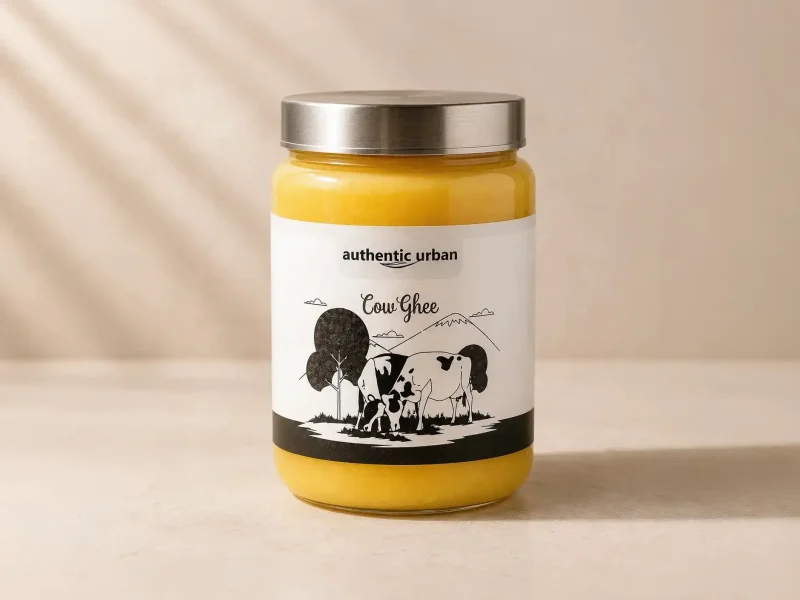 1 Litre
Paratha and winter sweets
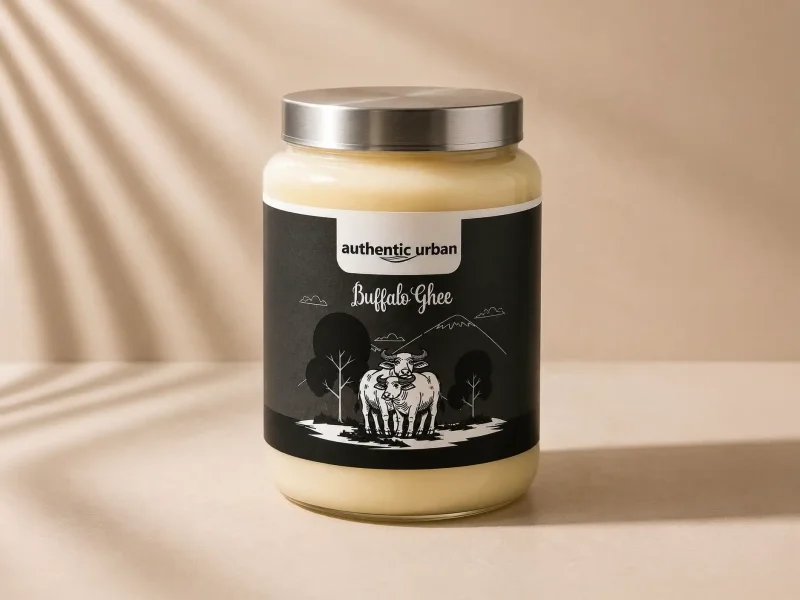 1 Litre
Each order is cooked after you place it, and the packing video is of that batch. Past order videos are on the shop.
FAQ
Weight badhane ke liye ghee kaise khaye?
Din mein 1 se 2 chammach ghee kaafi hai: ek chammach dal ya roti par, aur ek garam doodh mein. Ek chammach ghee mein lagbhag 44 kcal hoti hai, isliye vajan badhane ka baaki kaam doodh, dal, ande, moongphali, aur ek extra chhota khana karta hai. NHS ke hisaab se din mein 300 se 500 kcal extra lein, aur har hafte vajan likhein.
Is ghee better than a mass gainer powder?
For most people, real food does the job without either. ICMR-NIN's 2024 guidelines advise against protein supplements for building muscle and say most people meet their protein needs from a normal diet. A glass of milk with a teaspoon of ghee and a handful of peanuts gives close to what a small gainer serving does, with no powder to buy. If a doctor has prescribed a supplement for a medical reason, follow that instead.
Can ghee make my face or cheeks fuller?
No food puts weight on one part of the body. When you gain, it spreads in the pattern your body already has, and for many people the face fills out along with the rest. Ghee rubbed on the cheeks does not add fat there either. If your face looks hollow along with sudden weight loss, see a doctor rather than trying to fix it with food.
Can teenagers eat ghee to gain weight?
Yes, in normal kitchen amounts, 1 to 2 teaspoons a day on dal and roti. But the adult BMI line of 18.5 does not apply to children and teenagers: ICMR-NIN notes that their weight is judged against charts for age and sex. A thin teenager who is growing, active, and eating well may be fine. One who is losing weight, skipping meals, or worried about their body should see a doctor.
Are gond ke ladoo or panjeeri good for weight gain?
They are dense in calories, with ghee, nuts, and sugar together, so one ladoo adds a lot to a day. That is why households make them in winter. The NHS advises against relying on sweets and sugary food to gain weight, so treat one as a treat after a meal, not as the plan. Plain nuts, milk, and an extra katori of dal give the calories with more protein and less sugar.
Will ghee give me belly fat instead of muscle?
Extra calories of any kind, eaten without exercise, are stored mostly as fat, and ghee is no different. Muscle needs protein and a reason to grow: ICMR-NIN says protein is not used for muscle building without physical activity or resistance exercise. Keep ghee to 1 to 2 teaspoons, eat protein at every meal, and do strength work three days a week, and more of the gain will be muscle.
About the editorial team
Authentic Urban TeamBilona ghee makers, Gir Somnath, Gujarat
We are the Parmar family in Gir Somnath, Gujarat. We have made ghee here since 2016 and sold it online since 2025. We make only Bilona ghee, test it every month, and anyone is welcome to visit and watch it being made. Our Gir cows and Jafarabadi buffalo are grass-fed village animals that graze near the Gir forest, with no hormones or milk boosters. We set their milk to curd, churn it, and cook the makkhan on a wood chulha. These articles come from that kitchen and from what customers ask us on WhatsApp. We are ghee makers, not doctors.
Sources
- Dietary Guidelines for Indians, 2024 (Guideline 7, printed p. 54; Guideline 8, printed pp. 58 to 60; Guideline 9, printed pp. 62 and 63), ICMR-National Institute of Nutrition. Checked 27 Sep 2026.
- Advice for underweight adults, NHS. Checked 27 Sep 2026.
- Unintentional weight loss, NHS. Checked 27 Sep 2026.
- Butter oil, anhydrous (FDC ID 173412), SR Legacy, USDA FoodData Central. Checked 27 Sep 2026.
- Milk, whole, 3.25% milkfat, with added vitamin D (FDC ID 171265), SR Legacy, USDA FoodData Central. Checked 27 Sep 2026.
- Egg, whole, raw, fresh (FDC ID 171287), SR Legacy, USDA FoodData Central. Checked 27 Sep 2026.
- Peanuts, all types, raw (FDC ID 172430), SR Legacy, USDA FoodData Central. Checked 27 Sep 2026.
- Lentils, mature seeds, cooked, boiled, without salt (FDC ID 172421), SR Legacy, USDA FoodData Central. Checked 27 Sep 2026.
- Bananas, raw (FDC ID 173944), SR Legacy, USDA FoodData Central. Checked 27 Sep 2026.
- Food Safety and Standards (Food Products Standards) Chapter 2.1: Dairy products and analogues, version 01.09.2023 (2.1.8 Standard for Milk Fat Products, p. 27), FSSAI. Checked 27 Sep 2026.