Ghee Nutrition Facts: Calories Per Spoon, Fat, Vitamins
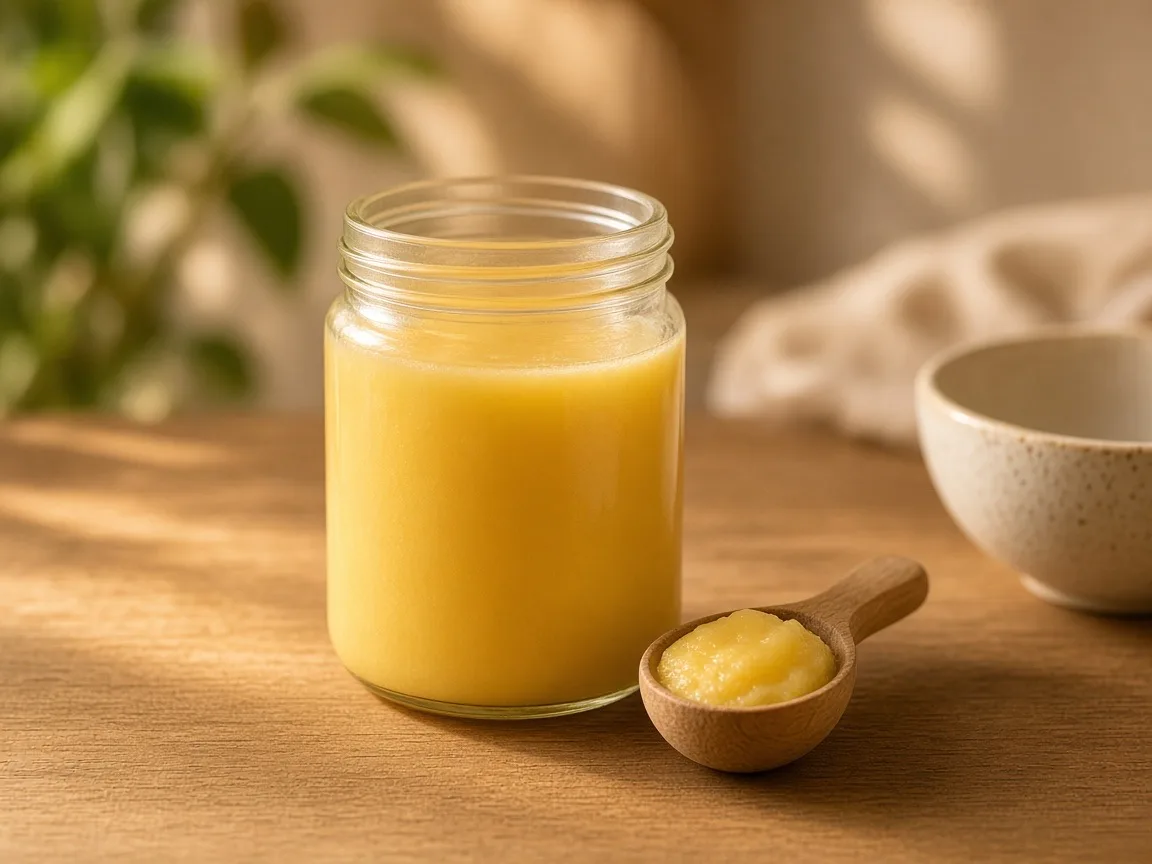
Ghee nutrition facts in one line: a teaspoon of ghee (5 g) has 44 calories and 5 g of fat, and a tablespoon (12.8 g) has 112 calories. Ghee is 99.5% fat, with vitamins A, E, and K, no carbohydrate, and almost no protein. ICMR-NIN suggests keeping it to 1 or 2 teaspoons a day.
How many calories are in ghee?
One teaspoon of ghee has 44 calories and one tablespoon has 112. Ghee gives about 8.8 calories per gram, according to USDA FoodData Central, and the Indian household teaspoon that ICMR-NIN uses in its diet charts holds 5 g of oil or ghee. Here is the whole range in one table.
Amount
Weight
Calories
Note
1 teaspoon
5 g
44
The ICMR-NIN household teaspoon
2 teaspoons
10 g
88
The top of the ICMR-NIN daily range
1 tablespoon
12.8 g
112
The USDA tablespoon
100 g
100 g
876
The USDA reference amount
Most calorie mistakes come from the spoon, not the ghee. "One spoon" in an Indian kitchen usually means a teaspoon, and a tablespoon is about two and a half of those by weight. If you log tablespoons while pouring teaspoons, or the other way round, your food diary is off by more than double. If you are counting calories to lose weight, see ghee for weight loss.
Ghee nutrition facts per teaspoon, tablespoon, and 100 g
Ghee is 99.5% fat, and most of that fat is saturated. The rest of the label is small: a little cholesterol, vitamins A, E, and K, and almost no protein or carbohydrate. These are USDA's figures for ghee, listed there as anhydrous butter oil, worked out for an Indian teaspoon. What ghee is, and how it differs from butter, is on what is ghee.
Nutrient
1 tsp
1 tbsp
100 g
Calories
44 kcal
112 kcal
876 kcal
Total fat
5.0 g
12.7 g
99.5 g
Saturated fat
3.1 g
7.9 g
61.9 g
Mono-unsaturated fat
1.4 g
3.7 g
28.7 g
Poly-unsaturated fat
0.2 g
0.5 g
3.7 g
Cholesterol
13 mg
33 mg
256 mg
Protein
0 g
0 g
0.3 g
Carbohydrate
0 g
0 g
0 g
Vitamin A (RAE)
42 µg
108 µg
840 µg
Vitamin E
0.14 mg
0.36 mg
2.8 mg
Vitamin K
0.4 µg
1.1 µg
8.6 µg
Vitamin D
0
0
0 (USDA)
A teaspoon gives about 42 µg of vitamin A. That is useful, but it is a top-up, not a main source. Ghee's bigger job with vitamins is as a carrier: ICMR-NIN notes that fats help the body take up the fat-soluble vitamins A, D, E, and K from the rest of the meal. A teaspoon on hot dal or sabzi does exactly that. More on how ghee helps you absorb vitamins.
Does ghee have vitamin D?
Not in a meaningful amount. USDA FoodData Central lists vitamin D in ghee as 0, even though many ghee labels and articles claim otherwise. What ghee does is help you absorb vitamin D from foods that have it, and from supplements your doctor prescribes, when you take them with a meal that has some fat.
If you are low on vitamin D, sunlight and the dose your doctor gives you matter far more than any spoon of ghee. We cover that on ghee for vitamin D.
Ghee vs oil and butter: calories and saturated fat
Per tablespoon, ghee has slightly fewer calories than the common Indian cooking oils, because a tablespoon of ghee weighs a little less. The real difference is saturated fat: a tablespoon of ghee has about 7.9 g, three to six times more than groundnut, mustard, or sunflower oil.
USDA FoodData Central, SR Legacy, each food's own tablespoon weight. Checked 26 September 2026.
| Item | Value |
|---|---|
| Mustard oil | 124 kcal |
| Coconut oil | 121 kcal |
| Sunflower oil | 120 kcal |
| Groundnut (peanut) oil | 119 kcal |
| Ghee | 112 kcal |
| Butter | 102 kcal |
Per 1 tbsp
Weight
kcal
Sat fat
Ghee
12.8 g
112
7.9 g
Butter
14.2 g
102
7.2 g
Groundnut (peanut) oil
13.5 g
119
2.3 g
Mustard oil
14 g
124
1.6 g
Sunflower oil
13.6 g
120
1.4 g
So swapping ghee for oil does not save calories, and swapping oil for ghee does not add many. It changes the kind of fat. That is why the practical rule is to use ghee where you taste it, a teaspoon on roti or in the tadka, and a cooking oil for frying and the rest of the day's cooking. The full comparison is on ghee vs vegetable oil and ghee vs butter.
How much ghee should you eat a day?
ICMR-NIN's Dietary Guidelines for Indians (2024) say to limit ghee or butter to 1 to 2 teaspoons a day. That is 5 to 10 g, or 44 to 88 calories. The same guidelines put all visible fat, oil and ghee together, at about 20 g a day for a sedentary woman and 30 g for a sedentary man, more for people doing heavy physical work.
Saturated fat is the part to watch. ICMR-NIN counts more than 10 g a day of visible saturated fat, from ghee, butter, or coconut and palm oil in cooking, as high. Two teaspoons of ghee bring about 6 g. At home, our family eats 1 to 2 teaspoons each a day, on roti, dal, and khichdi, which sits right in that range. If you have a heart, cholesterol, liver, or kidney condition, ask your doctor for your own limit. More on how much ghee per day and ghee side effects.
Do cow, buffalo, A2, or Bilona ghee have different nutrition?
The calories and fat are the same: every kind of ghee is almost pure milk fat. What changes is colour, taste, texture, and a little of the vitamin A picture. Cow ghee is yellow because it carries beta-carotene, which USDA lists in ghee, from the green fodder cows eat. Our own Gir cow ghee turns more yellow in the monsoon, when the grazing is greenest. Buffalo ghee is white or ivory and sets firmer, with the same calories.
A2 describes the protein in the milk, and ghee has almost no protein left, so A2 does not change the nutrition label. Bilona describes the method, curd churned into makkhan and then cooked, which changes the aroma and grain rather than the calories. More on white ghee vs yellow ghee and what A2 ghee is.
Which ghee do we eat at home?
The nutrition label is the same for any real ghee, so choose on what the label cannot show: the milk, the method, and how fresh the jar is. Smell it warm, look for grain once it cools, and check the FSSAI number.
Our teaspoon a day is our own A2 Gir cow ghee: grass-fed Gir milk set to curd, churned, and cooked in a matki on the chulha, made after you order and tested every month against the FSSAI limits. See how we make it.
A2 Gir cow ghee: the daily teaspoon
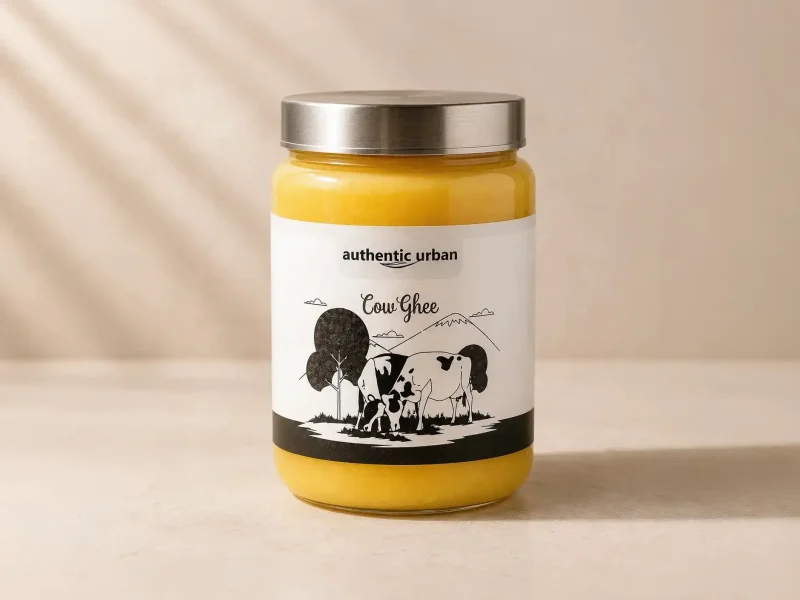 1 Litre
Buffalo ghee: sweets and parathas
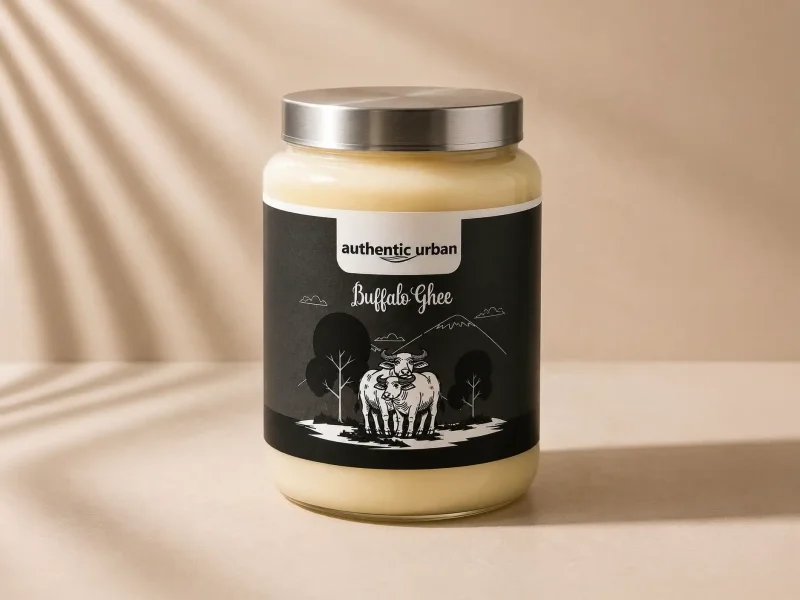 1 Litre
Each order is cooked after you place it, and the packing video is of that batch. Past order videos are on the shop.
FAQ
Is ghee healthier than cooking oil?
Neither wins on every count. Per tablespoon, ghee has slightly fewer calories than sunflower, mustard, or groundnut oil, but three to six times their saturated fat. That is why ICMR-NIN suggests keeping ghee to 1 or 2 teaspoons a day and using oils for the rest of your cooking fat. Ghee for the food you taste it in, oil for the kadhai.
Does ghee have protein?
Almost none. USDA lists 0.28 g of protein in 100 g of ghee, which is about 0.01 g in a teaspoon. Making ghee removes the milk solids, where the protein is. That is also why well-made ghee has very little lactose or casein. It is a fat, not a protein food, so count your protein from dal, paneer, curd, and eggs.
Is ghee keto-friendly?
Yes, for carbs: ghee has zero carbohydrate, so it fits a keto plan. Calories still count. A tablespoon is 112 kcal of fat, and keto does not make those calories disappear. If you are on keto for a medical reason, follow the fat limit your doctor or dietitian gives you rather than adding ghee freely.
How much cholesterol is in ghee?
USDA lists 256 mg of cholesterol per 100 g of ghee. That is about 13 mg in a 5 g teaspoon and 33 mg in a tablespoon. If you have high cholesterol or heart disease, your doctor will tell you how much ghee and other saturated fat fits your diet. For most people, the ICMR-NIN limit of 1 to 2 teaspoons a day is the useful number.
Do desi ghee and pure ghee have different calories?
No. Desi, pure, cow, buffalo, A2, and Bilona ghee are all almost pure milk fat, about 8.8 kcal per gram. What changes between jars is the milk, the method, the taste, and the colour, not the calories. A jar mixed with vegetable oil or vanaspati would also stay near the same calories, which is why calories cannot tell you if ghee is pure.
Does heating ghee destroy its nutrients?
Normal cooking does not change the calories or the fat in ghee. What to avoid is reusing the same ghee for frying again and again: fat that is heated over and over breaks down and starts to smell and taste off. Use it the way most Indian kitchens do, a teaspoon in the tadka or on hot food, and keep fresh ghee for eating.
About the editorial team
Authentic Urban TeamBilona ghee makers, Gir Somnath, Gujarat
We are the Parmar family in Gir Somnath, Gujarat. We have made ghee here since 2016 and sold it online since 2025. We make only Bilona ghee, test it every month, and anyone is welcome to visit and watch it being made. Our Gir cows and Jafarabadi buffalo are grass-fed village animals that graze near the Gir forest, with no hormones or milk boosters. We set their milk to curd, churn it, and cook the makkhan on a wood chulha. These articles come from that kitchen and from what customers ask us on WhatsApp. We are ghee makers, not doctors.
Sources
- Butter oil, anhydrous (FDC ID 173412), SR Legacy, USDA FoodData Central. Checked 26 Sep 2026.
- Butter, without salt (FDC ID 173430), SR Legacy, USDA FoodData Central. Checked 26 Sep 2026.
- Oil, sunflower, linoleic (approx. 65%) (FDC ID 171025), SR Legacy, USDA FoodData Central. Checked 26 Sep 2026.
- Oil, mustard (FDC ID 172337), SR Legacy, USDA FoodData Central. Checked 26 Sep 2026.
- Oil, peanut, salad or cooking (FDC ID 171410), SR Legacy, USDA FoodData Central. Checked 26 Sep 2026.
- Oil, coconut (FDC ID 171412), SR Legacy, USDA FoodData Central. Checked 26 Sep 2026.
- Dietary Guidelines for Indians, 2024 (Guideline 7, pp. 71-73; HFSS definition, p. 110; household measures, p. 130), ICMR-National Institute of Nutrition. Checked 26 Sep 2026.