Vitamin D in Ghee: How Much, and Does It Help Deficiency?
Vitamin D in ghee is close to zero: USDA FoodData Central lists 0 micrograms per 100 g, so no amount of ghee fixes a vitamin D deficiency. What ghee can do is help a vitamin D tablet absorb when you take it with a meal that has a teaspoon of fat. For low vitamin D, sunlight, eggs or fortified milk, and the dose your doctor sets do the work.
How much vitamin D is in ghee?
None worth counting. USDA FoodData Central, the reference most nutrition labels lean on, lists ghee (butter oil) at 0 µg of vitamin D per 100 g, and salted butter at 0 too. A teaspoon of ghee gives you about 44 kcal and a little vitamin A, but no vitamin D. If you are low, ghee cannot bring your level up.
You will still read that a tablespoon has "10 to 15 IU" or even "9.2 micrograms". Our own older version of this page carried the first figure, and we have taken it out because we could not find a measurement behind it. One nutrition site shows 0 IU in its own table and 9.2 µg in its FAQ on the same page. The 9.2 µg figure would be nearly the NHS daily amount from one spoon, which no lab table supports. The full ghee label, spoon by spoon, is on ghee nutrition facts.
Colour does not change this either. A common WhatsApp question to us is why this month's cow ghee looks more yellow than the last jar. In the monsoon our Gir cows eat green fodder and the ghee comes out more yellow. That yellow tells you what the cows ate. It is not a sign of vitamin D, and no jar on the shelf, ours included, has a measured vitamin D number to show you. Grass-fed ghee has other reasons to choose it, set out in grass-fed vs regular ghee.
Which foods have vitamin D, compared with ghee?
Eggs, oily fish, and packs fortified under FSSAI rules carry real vitamin D; ghee and ordinary Indian milk carry little or none. The NHS puts the daily amount at 10 µg (400 IU) for adults and children over one. Here is what common portions give, in IU (1 µg is 40 IU).
USDA FoodData Central SR Legacy (ghee, eggs, mushrooms, salmon); FSSAI Schedule I minimum levels for fortified oil and milk; NHS vitamin D page. Checked 27 September 2026.
| Item | Value |
|---|---|
| 1 tsp ghee (5 g) | 0 IU |
| 100 g white mushrooms | 7 IU |
| 1 tsp fortified oil (5 g) | 22 IU |
| 1 glass fortified milk (200 ml) | 40 IU |
| 2 eggs (about 100 g) | 82 IU |
| 100 g farmed salmon | 441 IU |
| NHS daily amount | 400 IU |
Portion
µg
IU
Where the number comes from
1 tsp ghee (5 g)
µg: 0
IU: 0
USDA 173412, butter oil (ghee)
100 g white mushrooms
µg: 0.2
IU: 7
USDA 169251, raw, not sun-dried
1 tsp fortified oil (5 g)
µg: 0.55 to 0.8
IU: 22 to 32
FSSAI range, 0.11 to 0.16 µg per g of oil
1 glass fortified milk (200 ml)
µg: 1 to 1.5
IU: 40 to 60
FSSAI range, 5 to 7.5 µg per litre
2 eggs (about 100 g)
µg: 2
IU: 82
USDA 171287, whole egg; the yolk holds it
100 g farmed salmon
µg: 11
IU: 441
USDA 175167, Atlantic, raw
NHS daily amount
µg: 10
IU: 400
NHS, adults and children over 1
Fortified rows use the lowest level FSSAI allows, so the chart does not overstate them. Checked 27 September 2026.
Two things stand out for an Indian kitchen. First, the fortified cooking oil in a tadka carries more vitamin D than the ghee beside it, because FSSAI's fortification rules set 0.11 to 0.16 µg per gram of fortified oil and ghee has no such rule. Look for the +F mark on the pack. Second, even fortified foods are small next to 400 IU; a 2014 review in Nutrients by Ritu and Gupta noted that dairy in India is rarely fortified at all. How ghee and oil compare on everything else is on ghee vs vegetable oil.
For families that eat eggs, an egg cooked in half a teaspoon of ghee is the simplest vitamin D food on the list, and the yolk is where the vitamin sits. Amounts and methods are in eggs with ghee. Vegetarian homes that skip eggs rely on the sun, fortified packs, and, when a doctor finds a low level, a tablet.
Does ghee help your body absorb vitamin D?
Yes, a little fat in the meal helps a vitamin D tablet absorb, and ghee counts as that fat, but more ghee does not help more. Vitamin D dissolves in fat, so it travels into the body with the fat you eat. The best trial evidence comes from two studies by the same Tufts University team.
What the two absorption trials found
- 2015, Journal of the Academy of Nutrition and Dietetics: 50 healthy older adults took one 50,000 IU vitamin D3 dose with breakfast. Those whose breakfast had fat (30% of its calories) had 32% more vitamin D3 in their blood at the 12-hour peak than those who ate a fat-free breakfast. The type of fat made no difference.
- 2013, Journal of Bone and Mineral Research: 62 older adults took the same dose with no meal, a high-fat meal, or a low-fat meal. The low-fat meal gave the best 12-hour rise. After 30 and 90 days, the blood level of 25-hydroxy vitamin D (the number on your report) was the same in all three groups.
Read together: take the tablet with a normal meal, not on an empty stomach, and do not load up on fat for it. The half to one teaspoon of ghee on the dal or roti at that meal is plenty, and so is the oil in the sabzi. Neither trial used ghee, and both were in older adults in Boston, so treat this as a meal habit, not a promise about your report. The same fat-and-vitamin logic for carrots, palak, and other vegetables is on ghee and nutrient absorption.
How should you take a vitamin D tablet with ghee?
With lunch or dinner, alongside the ghee or oil already in the meal, at the dose and schedule your doctor wrote. The table below covers the common situations. Across the day, ICMR-NIN's 2024 dietary guidelines ask adults to limit ghee or butter to 1 to 2 teaspoons, so the spoon with your tablet comes out of that allowance.
If you are
What to do
Ghee
Daily vitamin D tablet from your doctor
What to do: Take it with lunch or dinner, not with morning tea on an empty stomach.
Ghee: The ½ to 1 tsp already on your dal or roti is enough.
Weekly or monthly high-dose sachet or capsule
What to do: Take it on the day your doctor set, with your main meal. If you miss one, ask before doubling up.
Ghee: No extra ghee. Normal meal fat does the job.
No tablet, just want more vitamin D
What to do: Sun on arms and face, eggs if you eat them, milk or oil with the +F mark.
Ghee: Adds none. Keep it for taste, inside 1 to 2 tsp a day.
High LDL or a doctor-set fat limit
What to do: Take the tablet with a meal cooked in the oil you already use.
Ghee: Not needed. In the trial, the type of fat made no difference.
Pregnant, or giving drops to a child
What to do: Your doctor or paediatrician sets the dose. Do not add a shop tablet on top.
Ghee: Ghee in food as usual for age. It is not a vitamin D source.
Meal fat from Dawson-Hughes 2013 and 2015; daily ghee limit from ICMR-NIN Dietary Guidelines for Indians 2024, printed p. 54. Checked 27 September 2026.
At home we eat 1 to 2 teaspoons each a day on roti, dal, and khichdi, and that is the amount we would keep to with a tablet as well. For the daily amount by age and activity, see how much ghee per day, or work out your household's ghee and oil with the ghee calculator. Old plans of 2 to 3 tablespoons of ghee "for vitamin D" add saturated fat and calories and no vitamin D at all.
How much sun do you need for vitamin D?
ICMR-NIN's 2024 guidelines suggest about 30 minutes of sunlight, preferably between 11 am and 2 pm, to keep vitamin D levels up, and ask pregnant women to get at least 15 minutes of direct sunlight. Skin makes vitamin D from sunlight, which is why the sun, not food, is the main source for most Indians.
Plenty of sun in the sky does not mean plenty on the skin. The Ritu and Gupta review points to three things that cut what Indian skin makes: darker skin, whose melanin works as a natural sunscreen; clothing and customs that keep skin covered; and days spent indoors. The NHS advises people of south Asian background, and anyone who is mostly indoors or covered outside, to consider a daily supplement all year. Practical sun means arms and face open, on a terrace or a walk, and it means not burning.
Why are so many Indians low on vitamin D?
It depends on who is measuring and which cut-off they use. The national child nutrition survey figures (CNNS 2019) that ICMR-NIN reprints in its 2024 guidelines found low 25-hydroxy vitamin D in 13.7% of children aged 1 to 4, 18.2% at 5 to 9, and 23.9% at 10 to 19. Smaller studies of adults, gathered in the 2014 Nutrients review, report 70% to 100% deficiency in many groups.
The gap is partly about the line drawn. A 2026 systematic review in Cureus by Laik and colleagues, covering 78 studies, argues that India applies Western cut-offs built for North American populations, which makes the "epidemic" look bigger than the bone disease seen in clinics. The authors found the parathyroid hormone response levels off near 10 to 12 ng/mL and suggest a lower Indian cut-off. That is one review, not a new guideline, but it is a good reason not to treat a borderline report as an emergency, or to start high doses without a doctor.
When should you test or see a doctor about vitamin D?
Test when a doctor suggests it, or when you have bone pain, muscle weakness, a fracture from a small fall, or a condition that affects absorption. We make ghee; we are not doctors, and the dose for a low report is theirs to set, along with when to recheck.
- Taking more than one product: a daily tablet, a weekly sachet, and a multivitamin can stack up. The NHS says not to take more than 100 µg (4,000 IU) a day unless a doctor advises it.
- Signs of too much: the NHS warns that long-term excess raises calcium in the blood (hypercalcaemia), which can weaken bones and damage the kidneys and heart. Food cannot push you that high; stacked tablets can.
- Kidney disease, liver disease, or gut conditions: vitamin D is handled differently, so the dose needs a doctor.
- Pregnancy and babies: doses for both come from the doctor. Ghee in pregnancy is covered on ghee during pregnancy, and ghee in a baby's food on ghee for babies.
Bone health needs calcium, protein, and movement as well as vitamin D; how ghee fits there is on ghee for bone health. People with gallstones or a doctor-set fat limit should also read who should not eat ghee.
A vitamin D plan you can keep
Screenshot this. It puts ghee where it belongs: in the meal, not in place of the sun or the tablet.
- Get a 25-hydroxy vitamin D blood test only if your doctor asks, or you have bone pain, weakness, or a fracture from a small fall.
- If a tablet is prescribed, take it with lunch or dinner, with the teaspoon of ghee or oil already in that meal.
- Get about 30 minutes of sun on your arms and face most days, as ICMR-NIN suggests, without burning.
- Eat eggs a few times a week if your family eats them; the vitamin D is in the yolk.
- Buy milk or cooking oil with the +F mark, which FSSAI uses for fortified packs.
- Keep ghee to 1 to 2 teaspoons a day. More ghee adds no vitamin D.
- Never go above 4,000 IU (100 µg) a day on your own; the NHS names this as the safe upper limit.
- Retest only when your doctor says, and take the old report with you.
Which ghee to keep for everyday meals?
Since no ghee is a vitamin D source, pick a jar for purity and taste, and ignore any label that promises vitamin D without a lab report. Warm a spoon: good ghee smells of toasted milk, not sour or waxy, and curd-churned ghee often sets grainy when cool. Five quick checks are on how to identify pure ghee, and our ranking of cow ghee on sale is best cow ghee in India.
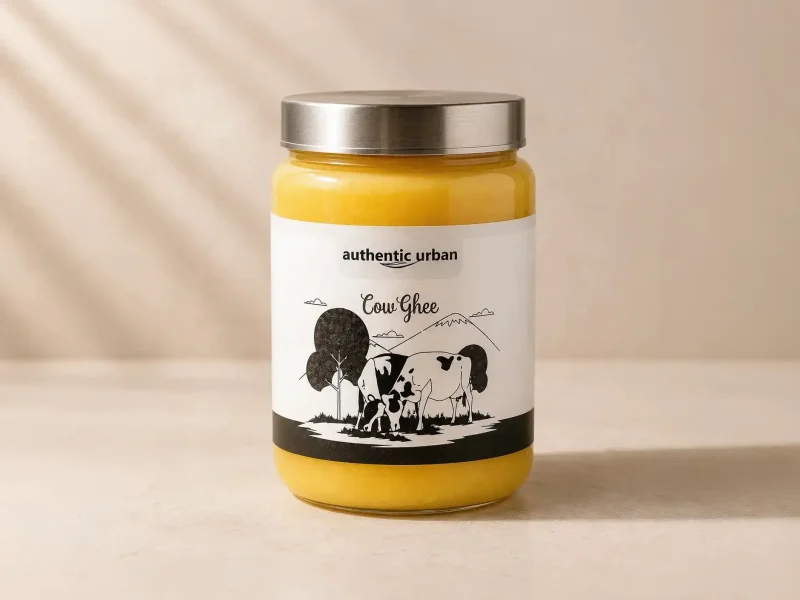
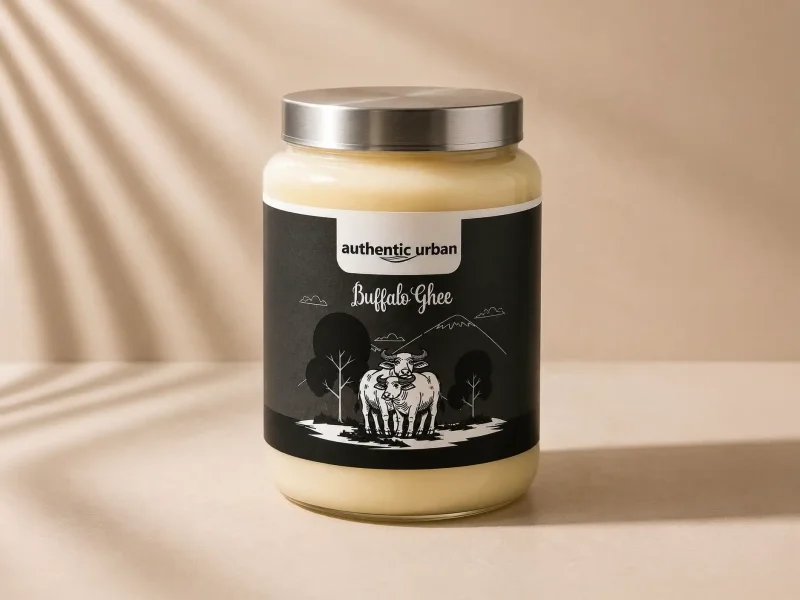
For the daily teaspoon we would pick our own A2 Gir cow ghee: milk from grass-fed Gir cows near the Gir forest, set to curd overnight, churned, and cooked slowly in a matki on a wood chulha in Gir Somnath. It is made after you order, and a video of your jar being cooked and packed comes on WhatsApp. For parathas and sweets, our Jafarabadi buffalo ghee is the richer jar. We test every month against the FSSAI limits; the steps, and the open invitation to watch a batch being made, are on how we make ghee.
The daily teaspoon on dal
 1 Litre
Paratha and winter sweets
 1 Litre
Each order is cooked after you place it, and the packing video is of that batch. Past order videos are on the shop.
FAQ
Kya desi ghee mein vitamin D hota hai?
Nahi, kaam ki matra mein nahi. USDA FoodData Central ghee mein vitamin D 0 dikhata hai, chahe cow ghee ho ya buffalo ghee. Vitamin D ki kami ho to dhoop (roz lagbhag 30 minute, ICMR-NIN ke hisaab se), ande, +F wala doodh ya tel, aur doctor ki di hui dawa kaam aati hai. Dawa khane ke saath lein jismein thoda ghee ya tel ho.
Does A2 or grass-fed ghee have more vitamin D?
No figure we could find shows it. USDA lists ghee at zero vitamin D, and we have not seen a lab report from any brand, ours included, that measures it. A2 is about the milk protein, not vitamins. In our kitchen the monsoon's green fodder makes cow ghee more yellow, but colour is not a vitamin D test. Any jar claiming a vitamin D number should show a lab report for that batch.
Can I mix a vitamin D sachet in milk with ghee?
If your doctor has given you a sachet to mix in milk, a glass with a meal works, and a little ghee in it is fine. The fat in the meal helps the vitamin absorb; the 2015 trial saw about a third more reach the blood with a fat-containing breakfast. Do not heat the sachet on the stove, and do not split or double doses on your own.
Is ghee or butter better for vitamin D?
Neither is a source. USDA lists both salted butter and ghee at zero vitamin D per 100 g. Both are milk fat, so either one on your plate helps a tablet taken with that meal absorb, as would oil. Ghee keeps longer and suits Indian cooking; butter has water and milk solids left in. Choose by taste and use, not by vitamin D.
Can too much vitamin D be harmful?
Yes. The NHS says adults should not take more than 100 micrograms (4,000 IU) a day unless a doctor advises it, because too much over a long time raises calcium in the blood. That can weaken bones and damage the kidneys and heart. Food and ghee cannot push you that high; stacked shop tablets and weekly sachets taken too often can.
Does ghee help with vitamin D in winter?
No more than in summer, since ghee carries no vitamin D in any season. Winter matters because the sun is weaker and people stay covered, so skin makes less. Sit in the midday sun with arms and face open when you can, and keep eggs or fortified milk in your meals. If your doctor has prescribed a winter course, take it with food.
About the editorial team
Authentic Urban TeamBilona ghee makers, Gir Somnath, Gujarat
We are the Parmar family in Gir Somnath, Gujarat. We have made ghee here since 2016 and sold it online since 2025. We make only Bilona ghee, test it every month, and anyone is welcome to visit and watch it being made. Our Gir cows and Jafarabadi buffalo are grass-fed village animals that graze near the Gir forest, with no hormones or milk boosters. We set their milk to curd, churn it, and cook the makkhan on a wood chulha. These articles come from that kitchen and from what customers ask us on WhatsApp. We are ghee makers, not doctors.
Sources
- Butter oil, anhydrous (FDC ID 173412), SR Legacy, USDA FoodData Central. Checked 27 Sep 2026.
- Butter, salted (FDC ID 173410), SR Legacy, USDA FoodData Central. Checked 27 Sep 2026.
- Egg, whole, raw, fresh (FDC ID 171287), SR Legacy, USDA FoodData Central. Checked 27 Sep 2026.
- Mushrooms, white, raw (FDC ID 169251), SR Legacy, USDA FoodData Central. Checked 27 Sep 2026.
- Fish, salmon, Atlantic, farmed, raw (FDC ID 175167), SR Legacy, USDA FoodData Central. Checked 27 Sep 2026.
- Food Safety and Standards (Fortification of Foods) Regulations, compendium version III, 30.09.2021 (Schedule I: fortified oil and milk), FSSAI. Checked 27 Sep 2026.
- Dietary Guidelines for Indians, 2024 (Table II; printed pp. 17, 42, 54), ICMR-National Institute of Nutrition. Checked 27 Sep 2026.
- Vitamin D, NHS. Checked 27 Sep 2026.
- Dietary fat increases vitamin D-3 absorption (Dawson-Hughes et al., J Acad Nutr Diet, 2015), Journal of the Academy of Nutrition and Dietetics, via PubMed. Checked 27 Sep 2026.
- Meal conditions affect the absorption of supplemental vitamin D3 but not the plasma 25-hydroxyvitamin D response to supplementation (Dawson-Hughes et al., J Bone Miner Res, 2013), Journal of Bone and Mineral Research, via PubMed. Checked 27 Sep 2026.
- Vitamin D Deficiency in India: Prevalence, Causalities and Interventions (Ritu and Gupta, Nutrients, 2014), Nutrients, via PubMed Central. Checked 27 Sep 2026.
- A Systematic Review of Evidence, Misinterpretations, and the Urgent Need for Population-Specific Reference Standards Related to Vitamin D Deficiency in India (Laik et al., Cureus, 2026), Cureus, via PubMed Central. Checked 27 Sep 2026.