Grass Fed Ghee vs Regular Ghee: Is It Worth Paying More?
Grass fed ghee vs regular ghee: grass-fed ghee has more omega-3 and CLA, about 2 to 2.5 times more in the best milk study, but both start so low that a teaspoon of either is still mostly saturated fat at about 44 calories. Buy grass-fed ghee for taste, freshness, and how the animals live, not as a health upgrade, and keep any ghee to 1 or 2 teaspoons a day.
Grass fed ghee vs regular ghee: which is better?
A little, in a few fats. Ghee from cows that graze has more omega-3 and more CLA (conjugated linoleic acid, a fat made in the cow's stomach from grass). It is often more yellow. It has the same calories, it is still mostly saturated fat, and it cooks the same. So the gap is real but small, and it does not change how much ghee you should eat.
Most pages on this question repeat "500% more CLA" and "rich in K2" with no source. We went to the numbers instead: one large milk study, the USDA entry for ghee, and the FSSAI ghee standard. The table sums up what the feed moves and what it leaves alone.
What
Grass-fed ghee
Regular ghee
Does feed change it?
Calories
Grass-fed: About 44 kcal a teaspoon
Regular: About 44 kcal a teaspoon
Changes? No. Fat is fat.
Saturated fat
Grass-fed: Still most of the fat
Regular: About 3.1 g a teaspoon
Changes? Not enough to change the daily limit
Omega-3
Grass-fed: Higher
Regular: About 72 mg of 18:3 a teaspoon
Changes? Yes, in milk studies, but from a small base
CLA
Grass-fed: Higher
Regular: Small amounts
Changes? Yes, in milk studies
Colour (cow ghee)
Grass-fed: Deeper yellow in green-fodder months
Regular: Paler on dry feed
Changes? Yes, from beta-carotene, but dye and season can fool you
Vitamin K2
Grass-fed: No Indian data
Regular: No figure in USDA's entry
Changes? Unknown. Skip the claim.
Smoke point, taste of the tadka
Grass-fed: Same kitchen use
Regular: Same kitchen use
Changes? Method and freshness matter more
Price per litre
Grass-fed: Usually sold as small-batch curd ghee
Regular: Dairy jars and tins
Changes? Yes, often three times or more
Regular ghee figures per 5 g teaspoon from USDA FoodData Central, butter oil anhydrous (173412). Grass-fed direction from Benbrook et al., Food Science & Nutrition, 2018. Checked 27 September 2026.
"Regular ghee" here means ghee from animals fed mostly on bought cattle feed and dry fodder, the milk that goes into most dairy jars and tins. It is not fake or bad ghee. If you want the full label of any ghee, see ghee nutrition facts.
What does a grass diet change in ghee?
Mainly the small fats: omega-3 and CLA go up, and the omega-6 to omega-3 ratio drops. The best numbers come from milk, not ghee, because nobody has published a large grass-fed vs regular ghee study.
Benbrook and colleagues (Food Science & Nutrition, 2018) tested milk from 100% grass-fed cows against organic and conventional milk across three regions of the United States. Per 100 g of milk:
Per 100 g milk
Grass-fed
Organic
Conventional
Total omega-3
0.049 g
0.032 g
0.020 g
Total CLA
0.043 g
0.023 g
0.019 g
Omega-6 to omega-3
0.95 to 1
2.28 to 1
5.77 to 1
Benbrook et al., Food Science & Nutrition, 2018. Checked 27 September 2026.
That is 147% more omega-3 and 125% more CLA than conventional milk. Those are the real figures behind the "up to 5 times" lines you see on shop pages, and they are closer to 2.5 times. Two limits to keep in mind. The study was funded by the dairy cooperative that sells the grass-fed milk, and three of its authors worked there. And these were American herds on grain-heavy feed on one side and pure pasture on the other, a wider gap than between most Indian village animals and dairy animals.
Even the authors' own diet modelling shows the ceiling: dairy from grass-fed milk supplied only about 3% of the DHA (the long-chain omega-3 in fish) that fish would. Grass-fed ghee is not a fish-oil substitute. CLA in depth, and why ghee will not act like a CLA capsule, is on CLA in ghee.
How much omega-3 is in a teaspoon of ghee?
About 72 mg of 18:3 fatty acids (the group plant omega-3 belongs to) in a 5 g teaspoon of regular ghee, and no EPA or DHA at all, per USDA FoodData Central. If a grass-fed jar carried 2.5 times that, as grass-fed milk did in the study, the teaspoon would hold about 180 mg.
That is a real difference on paper and a small one on your plate. The same USDA entry gives the omega-6 (18:2) at 2.25 g and the 18:3 at 1.45 g per 100 g, so even regular ghee runs at roughly 1.6 to 1, a ratio people often search for. In a day, your ratio is set by the cooking oil you use by the spoonful across every meal, not by one teaspoon of ghee. Swapping a seed oil for groundnut or mustard oil moves it far more; the oils are compared on ghee vs vegetable oil.
Does grass-fed ghee have vitamin K2?
Nobody has measured it for Indian ghee that we could find, so we leave the claim out. USDA's ghee entry lists only 8.6 µg of vitamin K1 per 100 g, about 0.4 µg a teaspoon, and gives no K2 figure. Pages that promise "3 to 5 times more K2" do not show a test. Vitamin A is real: about 42 µg a teaspoon in regular ghee, and some more in deep yellow cow ghee.
Is grass-fed ghee healthier for the heart or weight?
Not in any way a trial has shown. No study has fed people grass-fed ghee against regular ghee and measured cholesterol, weight, or heart events. What we know is the fat itself: about 3.1 g of saturated fat a teaspoon in regular ghee, and grass-fed ghee is still mostly saturated fat.
ICMR-NIN's 2024 dietary guidelines say to limit ghee or butter to 1 to 2 teaspoons a day, or avoid it, and they make no exception for the cow's diet. So the grass-fed jar gets the same teaspoon as any other. If your LDL is high, or you have heart disease or diabetes, your doctor or dietitian sets your fat limit first; the detail is on is ghee bad for cholesterol, and weight portions are on ghee for weight loss.
What does grass-fed mean on an Indian ghee label?
Whatever the brand wants it to mean. The FSSAI ghee standard sets moisture (at most 0.5%), milk fat (at least 99.5%), free fatty acids, and purity tests, and the whole FSSAI dairy chapter never mentions grass or pasture. There is no Indian grass-fed certificate to look for.
In practice, most village cows and buffalo in India eat a mix: grazing and green fodder when it grows, dry fodder and some feed when it does not. In Gujarat's dry months fresh grass is scarce for everyone's animals. So a useful grass-fed claim tells you where the animals graze and what they eat the rest of the year.
Ours, for example: our Gir cows and Jafarabadi buffalo, and our partner farmers' animals, are village animals that graze on pasture near the Gir forest, with no hormone injections or milk boosters. Rajesh looks after the animals and knows which season the milk runs heavy. Partner farms are chosen on a checklist, and a vet visits each one daily. That is what we mean by grass-fed, and it is the kind of detail to ask any brand for.
Is deep yellow colour proof of grass-fed ghee?
No, but it is a clue. Green fodder carries beta-carotene into the milk fat, which is why cow ghee turns more yellow. We see it every year: in the monsoon, when the animals eat green fodder, our cow ghee comes out more yellow, and customers message us on WhatsApp asking why the colour differs from their last jar. Winter milk is richer and the grain finer. But colour can be added, and breed and method change it too. Ghee that is the same bright yellow every single month is worth a question. More on colour in white ghee vs yellow ghee.
Is grass-fed ghee worth the price?
Worth it for taste, freshness, and knowing the animals, not for extra nutrition. At two teaspoons a day, the gap between a small-batch curd ghee and a dairy jar is about ₹17 a day for one person.
Ghee Price Index, September 2026: each brand's own shop page, or BigBasket where the brand does not sell the pack itself; our own live price.
| Item | Value |
|---|---|
| Authentic Urban A2 Gir cow ghee (Bilona) | ₹2,399 a litre |
| Cow ghee made from curd, median of 9 | ₹2,399 a litre |
| Cow ghee with no curd claim, median of 13 | ₹720 a litre |
Our price index does not record grass-fed claims, because the word means too little on a label. The nearest split is what the pack says it is made from. Cow ghee made from curd had a median of ₹2,399 a litre, about ₹12.0 a teaspoon. Cow ghee with no curd claim had a median of ₹720, about ₹3.6 a teaspoon. Brand by brand figures are in our Ghee Price Index, September 2026.
Most of that gap pays for the milk and the method, not the grass. About 30 to 35 litres of milk go into 1 kg of our cow ghee, set to curd overnight, churned, and cooked on a wood chulha, which takes the better part of two days. Why curd ghee costs what it does is laid out on why Bilona ghee is expensive.
Choose grass-fed ghee if
- You eat ghee every day and want the teaspoon to taste of fresh milk.
- You care how the animals are kept, and the brand shows you.
- You are already buying curd ghee and want to know the animals graze too.
Regular ghee is fine if
- The budget is tight. Pure regular ghee in the right amount is a sound food.
- You use ghee only now and then, in a festival sweet.
- You were buying grass-fed only for omega-3. Two meals of fish a week, or a spoon of flax or walnuts, give far more.
Three kitchens: grass-fed or regular ghee?
A family that eats a teaspoon each on dal and roti
This is where a grass-fed curd ghee earns its price: you taste it every day. Keep it to 1 or 2 teaspoons each and cook the sabzi in oil. At home we eat 1 to 2 teaspoons each a day, on roti, dal, and khichdi.
A home that deep fries in ghee
Do not buy grass-fed ghee for the kadhai. A full kadhai of any ghee is days of saturated fat, and the feed makes no difference once it is frying. Fry in a liquid oil, used once. Heat limits are on ghee smoke point.
Someone buying grass-fed ghee for omega-3
If the milk study holds for ghee, the extra is about a tenth of a gram a teaspoon. Keep the ghee you like, and get omega-3 from fish, flax, or walnuts. If a doctor has told you to raise omega-3, ask what food or supplement they want you on.
How to check a grass-fed ghee claim: 7 points
Save or screenshot this before you buy. Then check the jar itself with how to identify pure ghee.
- 1 The label or site names the animal and the breed (Gir cow, Jafarabadi buffalo), not just "desi".
- 2 It says where the animals graze and what they eat in the dry months, not only "grass-fed".
- 3 You can see the animals or the kitchen: a farm visit, or a video of your own batch.
- 4 The FSSAI licence number is printed and checks out on foscos.fssai.gov.in.
- 5 The colour changes a little through the year. Ghee that looks the same bright yellow every month deserves a question.
- 6 The price makes sense for curd ghee from pasture animals. A "grass-fed" jar at dairy-tin prices does not add up.
- 7 It does not promise weight loss, heart protection, or "K2-rich" on the label.
Grass-fed and A2 are two separate claims: one is the feed, the other is the breed. The breed side is on Gir cow ghee vs regular ghee, and the organic label on A2 vs organic ghee.
Which grass-fed ghee do we keep at home?
Whichever brand you choose, ask to see the animals or the kitchen. Warm a spoon: it should smell of toasted milk. Slow-cooked curd ghee often turns grainy as it cools, and cow ghee shifts in colour with the seasons. Our full ranking of jars is on best cow ghee in India.
We make both jars below, so weigh our view with that in mind. Our A2 Gir cow ghee and Jafarabadi buffalo ghee come from grass-fed village animals near the Gir forest, set to curd, churned, and cooked in a matki after you order, with a video of your jar on WhatsApp. We test every month against the FSSAI limits, and anyone can visit; see how we make ghee.
Gir cow ghee: the daily teaspoon
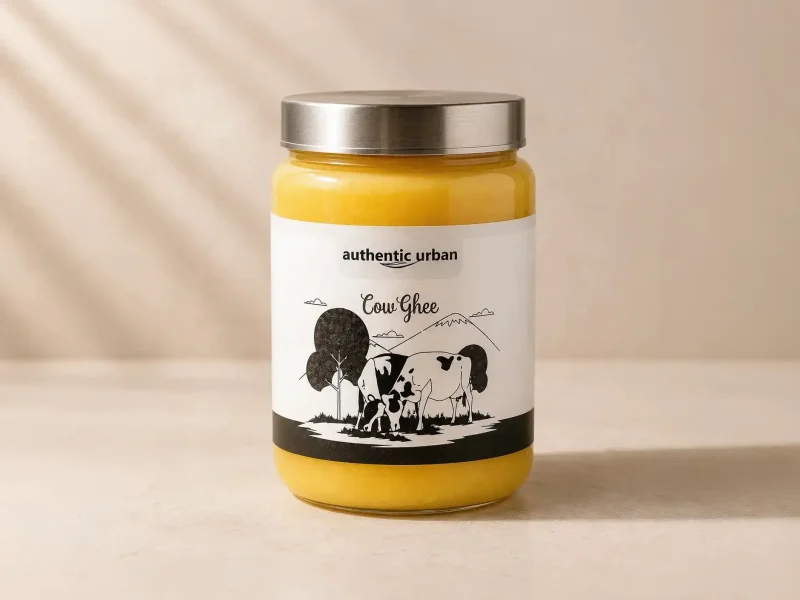 1 Litre
Buffalo ghee: paratha and halwa
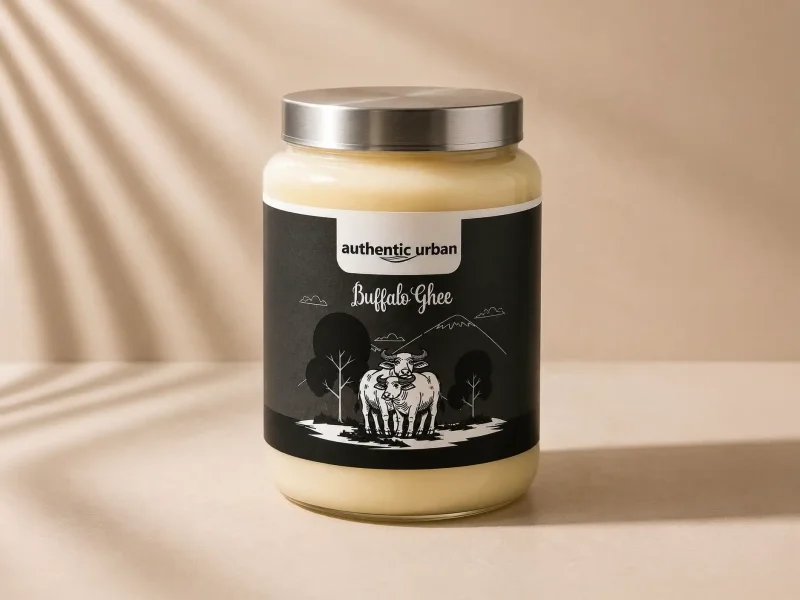 1 Litre
Each order is cooked after you place it, and the packing video is of that batch. Past order videos are on the shop.
FAQ
Which is the best grass fed ghee in India?
We put our own A2 Gir cow ghee first, and we make it, so weigh that. Our Gir cows and Jafarabadi buffalo are village animals that graze near the Gir forest, with no hormone injections, and the milk is set to curd, churned, and cooked on a chulha after you order. You get a video of your jar. Among other brands, pick one that names its breed and farms and lets you visit.
Is grass fed ghee A2?
Not by itself. Grass-fed is about what the cow eats. A2 is about the breed, since Indian breeds like Gir give A2 milk. A crossbred cow on pasture is grass-fed but not A2, and a Gir cow fed mostly on bought feed is A2 but not grass-fed. Ghee is nearly all fat, so the A2 protein matters far less in ghee than in milk.
Is grass fed ghee good for babies and children?
For a child over one year, a small spoon of any pure ghee on dal, rice, or khichdi is the usual Indian way, and grass-fed ghee is fine for that. It is not a special baby food, and the extra omega-3 is small. Do not start ghee for a baby under one without asking your paediatrician how and when to add fat to meals.
Is imported grass fed ghee from New Zealand or the US better?
Not for nutrition in any way that shows up on your plate. The grass-fed milk studies come from pasture dairies abroad, and imported jars can be real grass-fed ghee. But they travel far and cost more. Village ghee from grazing animals in India carries the same kind of difference, and you can visit the farm.
Does grass fed ghee taste different?
Often a little. Ghee from green-fodder months tends to smell fresher and look more yellow, and ghee from dry feed is paler and milder. But how the ghee is made changes the taste more than the feed: curd ghee cooked slowly smells of toasted milk, while cream ghee is flatter. A burnt or stale jar tastes bad whatever the cow ate.
Is grass fed ghee better for weight loss?
No. A teaspoon of any ghee has about 44 calories, and the extra CLA and omega-3 in grass-fed ghee are small. No trial has shown grass-fed ghee helps anyone lose weight. Weight follows the total amount of fat and food you eat. Keep ghee to 1 or 2 teaspoons a day, where you can taste it, and cook the rest in a liquid oil.
About the editorial team
Authentic Urban TeamBilona ghee makers, Gir Somnath, Gujarat
We are the Parmar family in Gir Somnath, Gujarat. We have made ghee here since 2016 and sold it online since 2025. We make only Bilona ghee, test it every month, and anyone is welcome to visit and watch it being made. Our Gir cows and Jafarabadi buffalo are grass-fed village animals that graze near the Gir forest, with no hormones or milk boosters. We set their milk to curd, churn it, and cook the makkhan on a wood chulha. These articles come from that kitchen and from what customers ask us on WhatsApp. We are ghee makers, not doctors.
Sources
- Enhancing the fatty acid profile of milk through forage-based rations, with nutrition modeling of diet outcomes (Benbrook CM et al.), 2018, Food Science & Nutrition. Checked 27 Sep 2026.
- Butter oil, anhydrous (FDC ID 173412), SR Legacy, USDA FoodData Central. Checked 27 Sep 2026.
- Dietary Guidelines for Indians, 2024 (Guideline 7, printed p. 54), ICMR-National Institute of Nutrition. Checked 27 Sep 2026.
- Food Safety and Standards (Food Products Standards) Compendium, Chapter 2.1: Dairy products and analogues, version 01.09.2023 (p. 27, ghee), FSSAI. Checked 27 Sep 2026.