Can You Reuse Ghee After Frying? How Many Times Is Safe
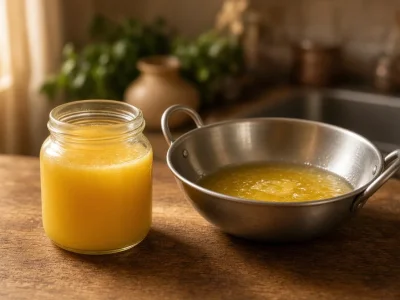
You can reuse ghee after frying once: filter it, cook your dal or sabzi with it within a day or two, and do not fry in it again. That is ICMR-NIN's household rule for any frying fat, and ghee is no exception. The 'two or three times' you read elsewhere is FSSAI's upper limit for food stalls, not advice for your kitchen.
How many times can you reuse ghee after frying?
Once, and not for frying. ICMR-NIN's 2024 dietary guidelines say fat used once for frying should be filtered, may be used to cook a curry, should be eaten within a day or two, and should not be used to fry again. They also say used fat should not be mixed with fresh. So the puri ghee from Sunday night becomes Monday's dal tadka, and that is the end of it.
This page is for the home cook who has half a kadhai of good ghee left after a festival fry and does not want to waste it, or who has heard that reheated ghee turns toxic. Whether you should deep fry in ghee at all, and at what heat, is on ghee smoke point and deep frying. Here we deal with what is left in the kadhai afterwards.
Why do some sites say you can reuse ghee 2 or 3 times?
Because they are quoting a rule written for food businesses. FSSAI's guidance note on used cooking oil (06/2018) tells small food businesses not to use the same oil more than three times, and adds that once is ideal. For households, the same note says something stricter: fry once, then use the filtered fat for curry, eat it within a day or two, and avoid frying in it again.
The note is written about cooking oil, and ICMR-NIN's rule covers "oils/fat". Neither makes an exception for ghee, and we do not either. Ghee does hold up to heat better than seed oils (more on that below), but that buys you a margin of safety on the first fry, not a licence for a second one.
You may also see a lab study where ghee stayed stable for 15 frying cycles. That work, cited in a 2026 review in Frontiers in Food Science and Technology, fried gulab jamun under vacuum at 120°C for 5 minutes a cycle. A kadhai on a gas flame runs at 160 to 180°C in open air, so the result does not carry over to a home fry.
Is reheated ghee toxic?
Heated once, no. Heated again and again, it builds up breakdown products you do not want to eat every day. ICMR-NIN's 2024 guidelines explain that repeated heating of oils and fats oxidises their polyunsaturated fat into harmful compounds that may raise the risk of heart disease and cancer, and they list "avoid reheating and reuse of left-over heated oils" among their cooking rules.
Ghee breaks down more slowly than sunflower or soybean oil because, as ICMR-NIN's own chart of fat types shows, most of it is saturated fat and very little is the polyunsaturated kind that oxidises first. The 2026 Frontiers review found conventional oils far more affected by heat than ghee. It also reports that ghee's polar compounds (the breakdown products labs measure in frying fat) rose from 0.22% in fresh ghee to 6.46% after heating at 224°C, and that above 200°C ghee started to deteriorate and turn rancid. FSSAI's cut-off for frying fat is 25% polar compounds. So one fry at the right heat is far from the limit. Each extra round, each crumb left in, and each hour at high heat moves it closer, and you cannot measure that at home.
The same slower breakdown is why the oil comparison favours ghee for a single fry and why seed oils fare worst when reused; the numbers are on ghee vs sunflower oil. Whether heating adds trans fat to ghee is answered on does heating ghee create trans fat.
What should you do with ghee left over after frying?
Filter it while it is still warm, keep it apart from your jar, and cook one dish with it within a day or two. What that dish should be depends on what you fried.
-
After puri, pakora, bhajia, samosa
Filter through muslin while warm. Use in dal or sabzi within a day or two.
Batter crumbs and water from the food are what break it down. Filtered, it is fine for one more cooking job, not another fry.
-
After jalebi, malpua, gulab jamun, boondi
Filter it and use it for the next halwa or sheera within a day or two.
It carries a little sugar and flour, which darken fast on a second fry. A sweet dish hides the fried taste better than dal does.
-
After fish, chicken, or egg
Use it only in a curry of the same kind, the same or next day, or throw it out.
It takes on the smell of the fish or meat, and a vegetarian dish or a vegetarian guest should not get it.
-
After tadka (a spoon left in the pan)
Pour it over the dal it was made for. Nothing to keep.
A tadka is a minute of heat on a spoon of ghee. It is not reuse.
-
After ghee that smoked blue-grey, foamed, or went dark
Throw it out. Do not cook with it.
These are the FSSAI signs that fat has broken down.
How to filter and keep it
Let the ghee cool until it is warm, not hot, then pour it through a clean muslin cloth or a fine steel strainer into a dry steel katori or glass bowl. Burnt crumbs left at the bottom keep darkening the fat, so filter every time, not only when it looks dirty. Cover it and keep it away from the stove.
Never pour it back into your fresh jar. FSSAI's note says the same for oil: do not refill the fresh container with used fat. One spoon of fry ghee carries water and bits of food into the jar, and that shortens the life of the whole jar. How to keep the fresh jar right is on ghee storage and shelf life.
When should you throw out used ghee?
Throw it out at any of these signs. The first four are the ones FSSAI lists for used cooking fat; the last two are ours.
- 1. Blue-grey smoke on a normal frying flame.
- 2. A thick foam that does not settle.
- 3. Dark and murky, not clear gold, once the crumbs are filtered out.
- 4. Thicker or stickier than fresh ghee when warm.
- 5. A bitter, sharp, or paint-like smell instead of toasted milk.
- 6. It was used for frying more than two days ago.
We learned the smell in our own kitchen in Gir Somnath. When we cook makkhan into ghee in a matki on the wood chulha, we take it off the flame when the bubbling goes quiet and the milk solids turn golden-brown. Push past that and the batch goes dark and bitter and smells burnt, and it never goes into a jar. Ghee that has been fried in too long goes the same way: darker, sharper, and bitter on the tongue. If a spoon of it tastes like that, the dal will too.
To throw it out, let it cool, mix it with old newspaper, sand, or sawdust, and put it in the bin. FSSAI asks households not to pour used fat down the drain, where it sets and blocks the pipe.
Is it OK to melt a jar of ghee again and again?
Yes, gentle melting is not the same as reheating for a fry. Standing the jar in a bowl of hot water in winter to loosen it warms the ghee far below frying heat. What does harm the jar is water getting in and the jar sitting warm for hours, day after day, both of which speed up rancidity.
So scoop what you need with a dry spoon and melt that in a katori, rather than melting the whole jar every morning. If you use a microwave, ICMR-NIN's guidelines advise glass or microwave-safe ceramic, not plastic. In summer you will rarely need to melt it at all: our ghee stays liquid in the jar in the hot months and sets with a fine grain in winter. A jar that arrives melted in summer and sets again at home has been through warmth, not a fry. The cause of the grain is on why ghee is grainy.
Can you reheat food cooked in ghee?
Yes, once. Leftover dal with a ghee tadka, halwa, or khichdi is ordinary cooked food, and ICMR-NIN's food safety rules apply: eat cooked food within 4 to 6 hours, keep leftovers in the fridge, heat them through before eating, and avoid heating the same stored food again and again. Take out the portion you will eat and heat only that.
Ghee on top of a reheated dish loses the smell that made it worth adding. At home we eat ghee on roti, dal, and khichdi, a teaspoon or two each a day, and we add it at the table, after the food is hot. That one habit gives you more ghee flavour for less ghee. How much is sensible a day is on how much ghee per day.
Should you fry in ghee or oil if you want leftovers to reuse?
For a full kadhai of puris or pakoras, fry in oil and use it once, the same way. Ghee is costly to fill a kadhai with, and since neither fat should be fried in twice, there is no saving in choosing ghee for its better heat stability. Keep ghee frying for small batches where the taste is the point: jalebi, malpua, boondi for ladoo. Our desi ghee jalebi uses a shallow kadhai for that reason.
Fried food also counts toward the day's fat, wherever the fat came from. If fried snacks are a weekly habit rather than a festival one, that matters more than which fat was in the kadhai. The limits, and who should cut back, are on ghee side effects, and oil for everyday cooking is compared on ghee vs vegetable oil.
Reusing ghee after frying: a kitchen checklist
Screenshot this and keep it near the stove.
- 1. Fry in ghee once. Do not fry in the same ghee again.
- 2. Filter it through muslin while warm, into a clean steel katori.
- 3. Keep it apart. Never pour used ghee back into your fresh jar.
- 4. Use it in dal, sabzi, or halwa within a day or two.
- 5. Ghee that fried fish or meat goes only into the same kind of curry, or the bin.
- 6. Blue-grey smoke, thick foam, dark colour, or a sticky feel: throw it out.
- 7. Throw it out in the bin mixed with old paper or sand, never down the drain.
- 8. Melt only what you need from the jar. Scoop, do not melt the whole jar every day.
Which ghee to keep fresh for the table?
Used ghee lasts a day or two; your main jar should last months. Buy one that is fully cooked: clear when melted, grainy when set, and smelling of toasted milk. A cloudy jar that holds water spoils fast and smokes early in the kadhai. For frying sweets, where you go through ghee fastest, our ranking of the jars on sale is best buffalo ghee in India, and simple checks for any jar are on how to identify pure ghee.
For the fresh spoon at the table we use our own A2 Gir cow ghee, and for jalebi and malpua our Jafarabadi buffalo ghee. Both come from grass-fed village animals near the Gir forest, set to curd overnight, churned, and cooked in a matki on a wood chulha. Each jar is made after you order, with a video of it sent on WhatsApp, and we test every month against the FSSAI limits. The steps are on how we make ghee.
The fresh spoon on dal and roti
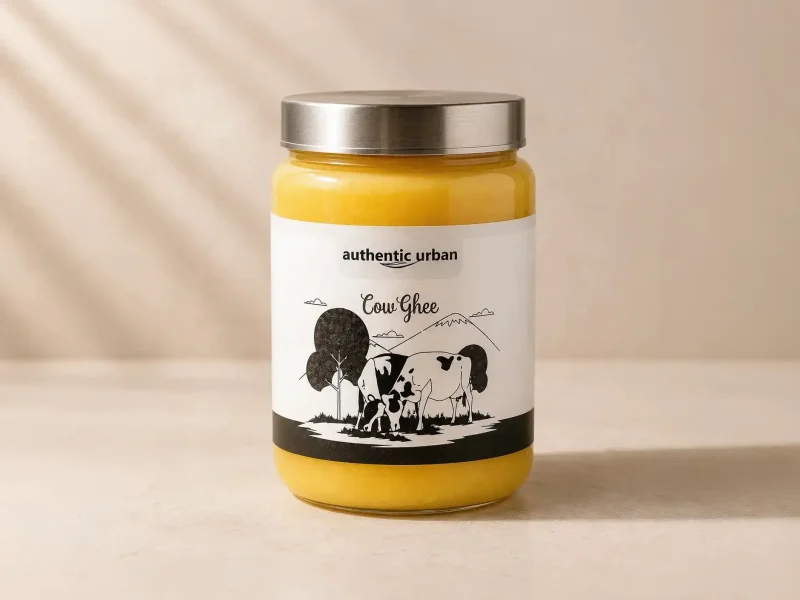 1 Litre
Jalebi and malpua, a small batch
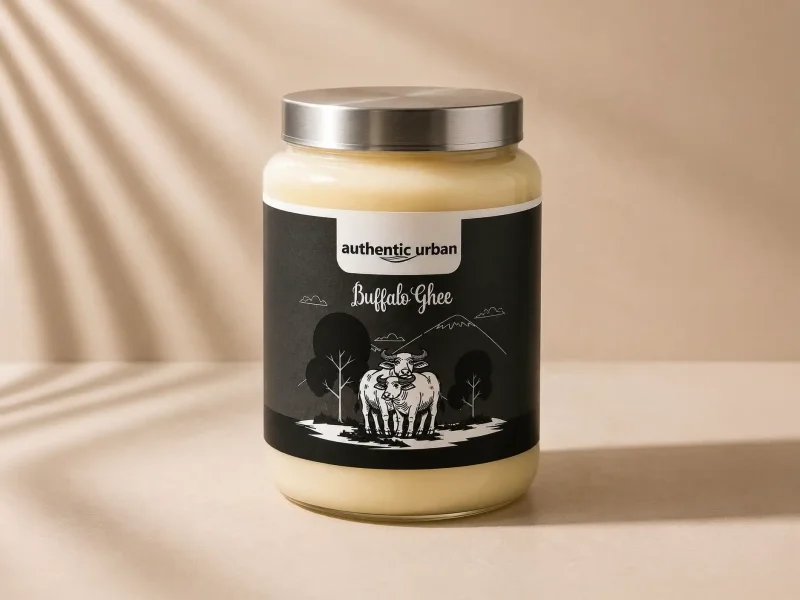 1 Litre
Each order is cooked after you place it, and the packing video is of that batch. Past order videos are on the shop.
FAQ
Can I top up used frying ghee with fresh ghee and keep going?
No. Topping up is how a kadhai of fat ends up being fried in for weeks, because the old ghee never leaves. ICMR-NIN's 2024 guidelines say used fat should not be mixed with fresh fat. Fry in a quantity you can finish in one session, filter what is left, cook with it once in a day or two, and start the next fry with fresh ghee.
Can I keep used frying ghee in the fridge for longer?
The fridge slows it down, but it does not change the rule. ICMR-NIN and FSSAI both say used frying fat should be eaten in a day or two and not stored for long, because it keeps breaking down faster than fresh ghee once it has been through a fry. If you cannot use it in two days, throw it out rather than stretching it to a week.
Does reheating ghee destroy its nutrients?
Some, not all. ICMR-NIN's 2024 guidelines say frying causes a moderate loss of vitamins and antioxidants in food and fat. So ghee that has been through a fry keeps less of its vitamins than a spoon from the jar. For the vitamins and the taste, put fresh ghee on hot dal or roti after cooking.
Is it safe to reuse ghee from a diya or puja lamp for cooking?
No. Lamp ghee has sat open to air and smoke for hours, has soot and bits of cotton wick in it, and is often kept in a brass or clay diya that is not cleaned like a kitchen pot. Treat it as lamp fuel only. Pour what is left back into a separate lamp jar, not your kitchen jar, and keep a small cheap jar just for puja.
Can I give children food cooked in once-used ghee?
A dal tadka made with filtered ghee from yesterday's puris is fine for the whole family if the ghee passes the smell and colour check. For a child's own spoon of ghee, on rice or roti, use fresh ghee from the jar. Fried food also counts toward the day's fat, so fried snacks for children are better kept to once in a while.
Kya ghee ko baar baar garam karna sahi hai?
Nahi. Ek baar talne ke baad ghee ko chhaan lijiye aur ek ya do din mein dal ya sabzi mein use kar lijiye. Usi ghee mein dobara mat taliye, aur use naye ghee ke dabbe mein wapas mat daliye. Agar talte waqt neela-grey dhuan aaye, jhaag bane, ya ghee kaala pad jaaye, to use phenk dijiye. Roz ke chammach ke liye taaza ghee hi rakhiye.
About the editorial team
Authentic Urban TeamBilona ghee makers, Gir Somnath, Gujarat
We are the Parmar family in Gir Somnath, Gujarat. We have made ghee here since 2016 and sold it online since 2025. We make only Bilona ghee, test it every month, and anyone is welcome to visit and watch it being made. Our Gir cows and Jafarabadi buffalo are grass-fed village animals that graze near the Gir forest, with no hormones or milk boosters. We set their milk to curd, churn it, and cook the makkhan on a wood chulha. These articles come from that kitchen and from what customers ask us on WhatsApp. We are ghee makers, not doctors.
Sources
- Dietary Guidelines for Indians, 2024 (repeated heating of oils, printed pp. 55-56; food safety, pp. 78 and 80; cooking methods, pp. 84 and 88), ICMR-National Institute of Nutrition. Checked 27 Sep 2026.
- Handling and disposal of used cooking oil, Guidance Note 06/2018, FSSAI. Checked 27 Sep 2026.
- Understanding the techno-functionality of ghee as a cooking medium (Kumar D, Jadhav HB), Frontiers in Food Science and Technology, vol. 6, 2026, Frontiers. Checked 27 Sep 2026.