Ghee Smoke Point: Can You Deep Fry in Ghee, and How Hot?
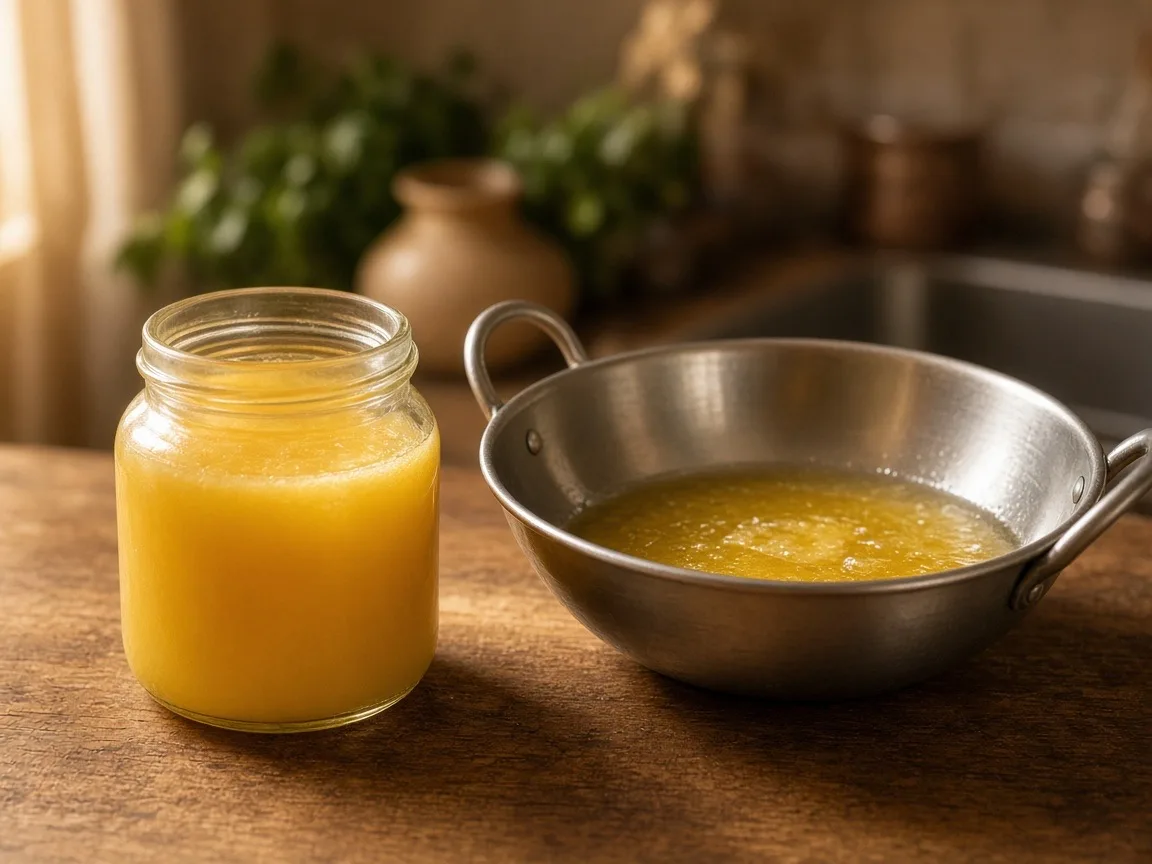
Ghee smoke point is about 250°C (480°F), though one recent review's own table puts it at 220 to 240°C, so plan on the lower number. Either way it sits well above the 160 to 180°C that frying needs. Yes, you can deep fry in ghee. For a full kadhai of puris or pakoras we still use oil, once, and keep ghee for tadka, parathas, and sweets.
Ghee smoke point: how hot can ghee get before it smokes?
About 250°C (480°F). A 2026 review in Frontiers in Food Science and Technology gives ghee a smoke point of 245 to 250°C in its text, and 220 to 240°C in its comparison table. Take 220°C as your working ceiling. Tadka, parathas, and deep frying all happen well below it, so ghee does not smoke unless the flame is too high or the ghee is old.
Smoke point is the heat at which a fat starts giving off steady smoke. By then it is breaking down: the smell turns sharp, the taste turns bitter, and the fat darkens. Sources give different numbers for ghee because the test depends on the sample. Leftover water, milk solids, crumbs from an earlier fry, and age all bring the smoke on sooner. A clean, fresh jar sits at the top of the range. This page is about heat in the kadhai; whether ghee is "heating" or "cooling" for the body in Ayurveda is a different question, answered on is ghee heating or cooling.
We see the burnt end of this at the chulha. When we cook makkhan into ghee in a matki on a low wood flame, we take it off as soon as the bubbling goes quiet and the milk solids turn golden-brown, and it smells of toasted milk. A few minutes past that, the batch goes dark and bitter and smells burnt. That batch never goes in a jar. The same thing happens in your kadhai when the flame stays on high.
How does ghee's smoke point compare with butter and oils?
Ghee's smoke point is higher than butter, coconut oil, lard, and tallow, and about level with sunflower oil. These ranges all come from the same 2026 review, so they are measured the same way. Save this table if you cook with more than one fat.
Fat
Smoke point °C
°F
Note
Ghee
220 to 240°C
428 to 464°F
The same review's text gives 245 to 250°C
Sunflower oil
230 to 232°C
446 to 450°F
Close to ghee, but high in polyunsaturated fat
Tallow (beef fat)
200 to 216°C
392 to 421°F
Another animal fat, lower than ghee
Lard (pork fat)
185 to 205°C
365 to 401°F
Lower than ghee
Coconut oil
175 to 205°C
347 to 401°F
Lower than ghee
Butter
140 to 180°C
284 to 356°F
Milk solids and water still in it
Smoke points from Kumar and Jadhav, Frontiers in Food Science and Technology (2026), Table 2, checked 26 September 2026. °F values are our conversions.
Lard and tallow compared with ghee beyond heat, per teaspoon and by kitchen job, are on ghee vs lard.
Why ghee does not burn like butter
Butter still holds its water and milk solids, and those solids scorch at 140 to 180°C. Making ghee cooks both out. The FSSAI standard for ghee allows at most 0.5% moisture and needs at least 99.5% milk fat, so what is left is almost pure fat with nothing to burn at tadka heat. That is why butter spits and browns in a hot pan while ghee just shimmers. The full difference is on ghee vs butter, and how Indian ghee differs from Western clarified butter is on ghee vs clarified butter.
Is ghee good for high heat cooking, or is smoke point not the whole story?
Yes, ghee is good for high heat, and the reason is its fat type as much as its smoke point. The 2026 Frontiers review notes that ghee is mostly saturated fat, which oxidises (breaks down with heat and air) more slowly than the unsaturated fats in seed oils.
That is why sunflower oil and ghee can share a smoke point and still behave differently in a kadhai. ICMR-NIN's 2024 dietary guidelines say repeated heating oxidises the polyunsaturated fat in vegetable oils into harmful compounds, and they ask households not to fry in the same oil twice. The oil side of this is on ghee vs sunflower oil and what refined oil is.
Ghee is not heat-proof either. The same review says that above 180°C, ghee starts forming aldehydes and ketones (the compounds behind the sharp smell of overheated fat), and it puts the best frying range for ghee at 160 to 180°C. The useful rule is not "ghee can take 250°C". It is "fry at 160 to 180°C, and never let the kadhai smoke".
Can you deep fry in ghee?
Yes. Heat the ghee to 160 to 180°C and fry in small batches so the heat does not crash. Halwais traditionally fry jalebi, malpua, and boondi in ghee, and it gives them a taste oil cannot. Our halwai-style jalebi is fried that way.
The catch is quantity. Deep frying needs the kadhai half full, the fried food soaks up fat, and whatever is left after frying should not be fried in again. That makes a litre of ghee a costly frying medium for a weekday plate of pakoras. So the split we recommend is oil for the big fry, used once, and ghee where the taste is the point and the batch is small.
How to check the heat without a thermometer
Drop in a pinch of batter or a small piece of dough. If it sinks and stays down, the ghee is too cool and the food will soak up fat. If it rises in 2 to 3 seconds with steady bubbles around it, you are in the frying range. If it jumps up and browns at once, or you see smoke, turn the flame down and wait a minute before the next batch. A dry wooden spoon handle works too: steady small bubbles around it mean the fat is ready.
Ghee or oil for tadka, frying, and sweets?
Ghee for tadka, shallow frying, searing, and fried sweets; oil, used once, for a full kadhai of puri or pakora. Here is the split we would use, with the sign that the heat is right for each job.
Tadka (jeera, rai, hing)
Ghee
Ghee shimmers and a cumin seed sizzles the moment it lands. Seeds turn brown in seconds, never black.
A few seconds of heat, a spoon of fat, and the smell of ghee is the point.
Bhuna (onion, tomato, masala)
Ghee or oil
Medium flame. The masala leaves the sides and the fat shows at the edges.
Long cooking. Keep the flame at medium so the fat never smokes.
Puri, pakora, bhajia (a full kadhai)
Oil, used once
A drop of batter sinks, then rises in 2 to 3 seconds with steady bubbles.
Frying takes a lot of fat at once, and the batter leaves crumbs behind.
Jalebi, malpua, boondi for ladoo
Ghee (buffalo)
Same drop test, a notch gentler, so the sweet cooks through before it colours.
The ghee taste is part of the sweet, and the batch is small.
Shallow fry (paratha, cutlet, tikki)
Ghee
Tawa hot enough that the ghee spreads at once and sizzles under the edge.
Little fat, short time, and the fat ends up on your plate anyway.
Searing paneer or meat
Ghee
Pan hot, ghee shimmering but not smoking, food in dry.
Ghee has no milk solids to scorch, unlike butter.
A tadka is the easiest place to go wrong, because it happens in seconds. Warm the ghee first, then add the seeds; cold ghee in a scorching pan burns the jeera before the fat is even hot. Step by step, with timings, it is on our dal tadka recipe, and the everyday cooking methods are on cooking with ghee.
Fried food also counts toward your day's fat. ICMR-NIN's 2024 guidelines cap visible fat (ghee and oil together) at 20 to 50 g a person a day by activity: 20 g for a sedentary woman and 30 g for a sedentary man. A plate of fried snacks can use up most of that. How much of it we give to ghee is on how much ghee per day.
Can you reuse ghee after frying?
Once, in cooking, not for another fry. ICMR-NIN's 2024 guidelines say fat used once for frying should be filtered, used for curry within a day or two, and not used to fry again, and that used fat should not be mixed with fresh. We give the same advice for ghee.
Ghee holds up to heat better than seed oils, but the crumbs, water, and salt from fried food still break it down, and the 2026 review found ghee's breakdown products climb the longer it stays at frying heat. Filter the warm ghee through muslin into a clean steel katori, keep it apart from your main jar, and use it for a dal tadka or a sabzi the next day. Never pour it back into the jar. Whether reheated ghee is safe to eat, and the signs it has turned, is covered on is reheated ghee safe.
When to throw it out
FSSAI's guidance on used cooking fat says to discard it when blue-grey smoke appears, a tough foam forms, it turns dark and murky, or its consistency changes. The same note sets a limit of 25% total polar compounds (the breakdown products a lab measures) for frying oil in food businesses. You cannot measure that at home, so go by the signs. Mix the old fat with sand, sawdust, or paper and put it in the bin, not the drain.
Why does my ghee smoke early?
Usually because of what is in it, not the ghee itself: crumbs, water, age, or too high a flame. Check these in order.
-
1. Crumbs and batter from the last fry
Filter through muslin while warm. Burnt bits smoke first and turn the fat dark.
-
2. Water in the jar or the food
Dry spoon, dry lid, pat vegetables dry. Water makes the fat spit and breaks it down faster.
-
3. Ghee that was not cooked through
A cloudy jar that keeps moisture is the undercooked kind. It spoils fast and does not take heat well.
-
4. Ghee that has been heated again and again
Each round leaves it darker and quicker to smoke. Use once-fried ghee in curry within a day or two.
-
5. Too high a flame
Frying needs 160 to 180°C, well below the smoke point. If the kadhai smokes, the flame is the problem.
If a fresh jar smokes on a medium flame, smells waxy or sweet instead of toasted milk, or never sets to a grain, check it before you cook with it. Simple home checks are on how to identify pure ghee, or you can check your jar in 2 minutes. Keeping the jar dry and away from the stove keeps it frying well for longer; the storage rules are on does ghee go bad.
High-heat cooking with ghee: a checklist
Screenshot this for the kitchen.
- 1. Tadka in ghee: shimmer, then seeds. Brown is right, black is burnt.
- 2. Deep fry at 160 to 180°C. A drop of batter should rise in 2 to 3 seconds.
- 3. Blue-grey smoke means too hot. Turn the flame down before adding food.
- 4. For a full kadhai of puri or pakora, use oil, once.
- 5. Keep ghee frying for small batches and sweets where the taste matters.
- 6. After frying: filter, use in curry within a day or two, do not fry in it again.
- 7. Throw it out if it smokes blue-grey at low heat, foams, or turns dark and thick.
Which ghee for tadka and frying?
For high heat, buy a jar that is fully cooked: clear when melted, grainy when set, and smelling of toasted milk when warmed. A cloudy jar that holds moisture will spit and smoke early. For frying sweets, where you go through ghee fastest, our ranking of the jars on sale is best buffalo ghee in India.
We make and sell ghee, so weigh this with that in mind. For jalebi, malpua, and Diwali frying we would reach for our own Jafarabadi buffalo ghee; for the daily tadka and paratha, our A2 Gir cow ghee. Both come from grass-fed village animals near the Gir forest, set to curd overnight, churned, and cooked in a matki on a wood chulha until the bubbling goes quiet. Each jar is made after you order, with a video of it sent on WhatsApp, and we test every month against the FSSAI limits. The steps are on how we make ghee.
Daily tadka and parathas
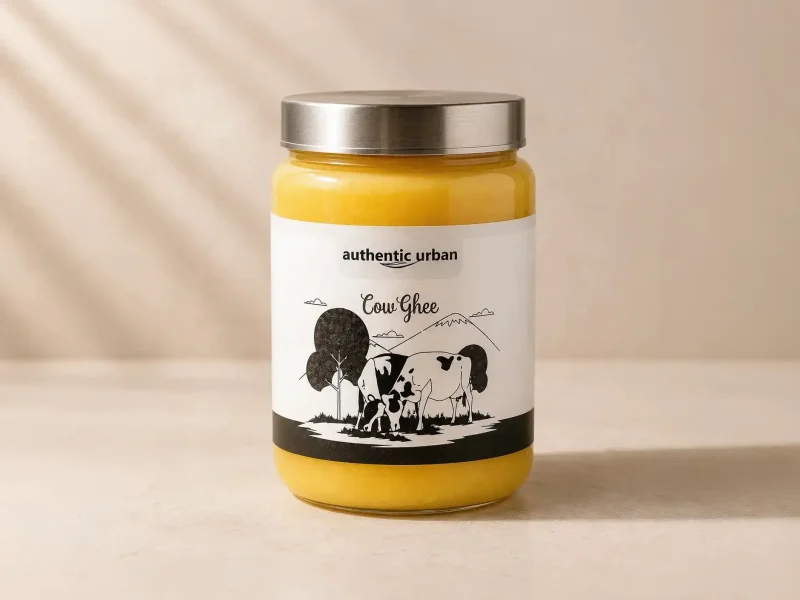 1 Litre
Jalebi, malpua, and festive frying
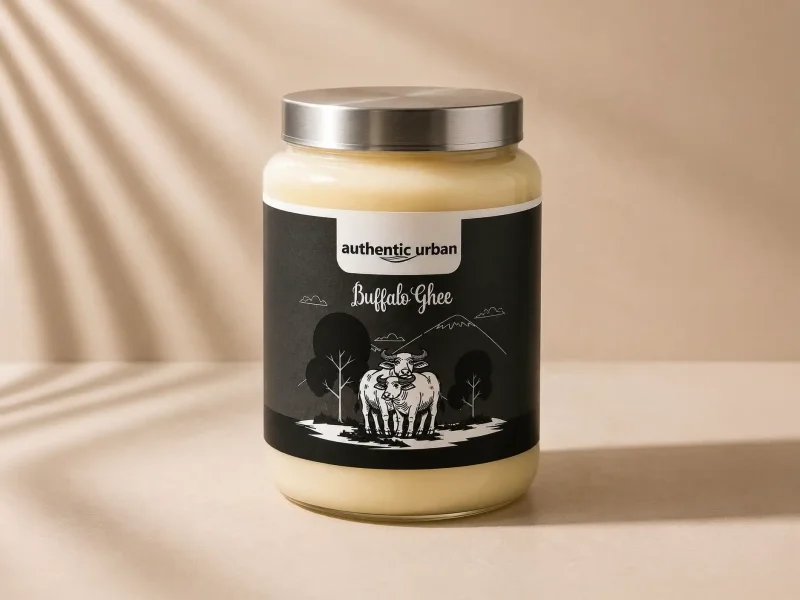 1 Litre
Each order is cooked after you place it, and the packing video is of that batch. Past order videos are on the shop.
FAQ
What is the smoke point of ghee in Fahrenheit?
About 480°F. A 2026 review in Frontiers in Food Science and Technology gives ghee a smoke point of 245 to 250°C in its text, which is 473 to 482°F, and 220 to 240°C (428 to 464°F) in its comparison table. The frying range the same review suggests, 160 to 180°C, works out to 320 to 356°F. Most home deep frying sits inside that band.
Can you use ghee in an air fryer?
Yes, and it is gentler on the ghee. The 2026 Frontiers review reports a study where ghee heated at 123°C in an air fryer reached 3.84% polar compounds (the breakdown products FSSAI measures in frying oil), against 6.46% when heated at 224°C the usual way. Brush or toss the food in half a teaspoon of melted ghee instead of pouring it into the basket.
Is cow ghee or buffalo ghee better for frying?
Both are clarified the same way and both take frying heat, so pick by taste and cost. Buffalo ghee has a richer taste and costs less a litre, which is why we suggest it for jalebi, malpua, and festive sweets. Cow ghee is lighter and suits a tadka or a paratha. We have not seen a lab comparison of their smoke points we can point to.
Does heating ghee destroy its nutrients?
Some, at very high heat for a long time. The 2026 Frontiers review cites a study showing signs that ghee's natural compounds oxidise when it is heated beyond 200°C. A tadka lasts seconds and a paratha a minute or two, so the loss there is small. If you want the full taste of the ghee, add a spoon on hot dal or rice after cooking.
Is it okay to eat food fried in ghee every day?
Not as a habit. Fried food soaks up fat, and ICMR-NIN's 2024 guidelines cap all visible fat (ghee and oil together) at 20 to 50 g a day, depending on how active you are, and ask people to limit high saturated fat such as ghee and butter. A fried sweet at a festival fits. A daily plate of fried snacks, in ghee or oil, does not.
Why does my ghee foam when I fry in it?
A little foam when wet food goes in is steam escaping, and it settles in seconds. Foam that stays thick and does not clear, even before food goes in, is a sign the fat has broken down. FSSAI's guidance on used cooking oil says to discard fat that forms a tough foam, turns dark and murky, or gives off blue-grey smoke.
About the editorial team
Authentic Urban TeamBilona ghee makers, Gir Somnath, Gujarat
We are the Parmar family in Gir Somnath, Gujarat. We have made ghee here since 2016 and sold it online since 2025. We make only Bilona ghee, test it every month, and anyone is welcome to visit and watch it being made. Our Gir cows and Jafarabadi buffalo are grass-fed village animals that graze near the Gir forest, with no hormones or milk boosters. We set their milk to curd, churn it, and cook the makkhan on a wood chulha. These articles come from that kitchen and from what customers ask us on WhatsApp. We are ghee makers, not doctors.
Sources
- Understanding the techno-functionality of ghee as a cooking medium (Kumar D, Jadhav HB), Frontiers in Food Science and Technology, vol. 6, 2026, Frontiers. Checked 26 Sep 2026.
- Dietary Guidelines for Indians, 2024 (Guideline 7, printed pp. 54-56; cooking methods, printed p. 84), ICMR-National Institute of Nutrition. Checked 26 Sep 2026.
- Handling and disposal of used cooking oil, Guidance Note 06/2018, FSSAI. Checked 26 Sep 2026.
- Food Safety and Standards (Food Products Standards) Chapter 2.1: Dairy products and analogues, version 01.09.2023 (ghee standard p. 27), FSSAI. Checked 26 Sep 2026.