Ghee for Premature Greying: Does It Stop White Hair?
Ghee for premature greying cannot turn white hair black again, and no study shows it slows new greys. Eating ghee adds almost no vitamin B12, iron, or copper, the nutrients low in young Indians who grey early. Warm ghee on the scalp once a week softens dry hair and is safe to try, but the blood test comes first.
Does ghee help premature greying?
Not with the colour. A grey hair has stopped getting pigment from its root, and no oil or food puts it back. Ghee can soften a dry scalp and rough grey hair, which tends to feel coarser. What may slow new greys is fixing a cause you can test for: low B12, low ferritin, thyroid trouble, or smoking.
Most pages on ghee for grey hair say its vitamins A, D, E, and K "prevent greying" and suggest oiling twice a week. None of them cite a study on ghee, because there is none. What does exist is dermatology research on why hair greys early, including a study of young Indians, and the nutrient values of ghee itself. We put the two side by side below, so you know where to spend your effort.
This page is about hair colour. Hair fall and growth are on ghee for hair, and flakes and itch are on ghee for dandruff.
At what age is greying premature?
For Indians, greying before 25 counts as premature. A 2013 review in the Indian Journal of Dermatology, Venereology and Leprology sets the line at 20 for white people, 25 for Asians, and 30 for Africans. The American Academy of Dermatology says most people start to grey in their 30s or 40s.
A few white hairs at 28 with a father who went grey at 30 is normal for your family. A spread of greys at 19 with tiredness is worth a blood test. The same review notes that some families grey early in every generation, and the pace varies a lot from person to person. Your parents' age at their first greys is the most useful number you have.
Why does hair turn white early?
Family pattern is the most common reason; low B12, low iron, low copper, thyroid disease, smoking, and stress can bring greys earlier. Ghee does not touch any of them directly. Find the row that fits you before buying any oil.
Cause
What you notice
Where ghee fits
What does more
Family pattern
A parent or grandparent went grey early too; greys spread slowly at the temples and parting
None. No oil or food changes the family timeline.
Nothing to fix. Colour it if you want to.
Low vitamin B12
Greys with tiredness, tingling hands or feet, mouth ulcers; common in vegetarians
None. A teaspoon of ghee has almost no B12.
A blood test, then curd, milk, or tablets as the doctor advises
Low iron (ferritin)
Greys with hair fall, tiredness, pale nails, heavy periods
None. Ghee has no iron.
Ferritin and haemoglobin test, then iron-rich food or tablets
Low copper
Rare; usually found only on a blood test
None. Ghee has almost no copper.
Dal, til, nuts; tablets only if a doctor finds it low
Thyroid trouble
Greys with weight change, feeling cold or hot, dry skin, period changes
None. Oil cannot change a thyroid.
A thyroid test and treatment
Smoking
Early greys in a smoker, often with dull skin
None
Stopping smoking
Stress and poor sleep
Greys that seem to arrive after a hard year
None directly
Sleep, regular meals, and time; some colour can come back
White patches (vitiligo) or round bald patches
White hair in one patch, often on white skin, or smooth coin-shaped bald spots
None. Do not oil and wait.
A dermatologist, soon
The evidence for each row is uneven. In a 2016 case-control study from a Bengaluru trichology clinic (International Journal of Trichology), 37 young adults with premature greys had lower ferritin, vitamin B12, and HDL cholesterol than 37 matched people without. Women who greyed early had an average ferritin of 34.4 ng/mL against 75.8 ng/mL in those who had not. Irregular meals and little exercise were also more common in the grey group. The authors say larger studies are needed, so treat it as a reason to test, not proof that a tablet brings colour back.
The 2013 IJDVL review adds the older findings: serum copper was lower in 66 people with premature greys than in controls, smoking was linked to greying, and in people with pernicious anaemia (a kind of B12 deficiency) 55% greyed before 50, against 30% of controls. Thyroid disease, both over- and underactive, shows up in the same list. If yours is the iron or thyroid row, read ghee for anaemia and ghee for thyroid after the test, not before it.
Does eating ghee help grey hair?
No. The nutrients tied to early greying are B12, iron, and copper, and a teaspoon of ghee has none of them in any amount that counts. Curd, egg, dal, and til do far more.
Food, portion
Vitamin B12
Iron
Copper
Vitamin D
kcal
Ghee, 1 tsp (5 g)
B12: 0 µg
Iron: 0 mg
Copper: 0 mg
Vitamin D: 0 µg
Energy: 44 kcal
Curd (dahi), 1 katori (150 g)
B12: 0.56 µg
Iron: 0.08 mg
Copper: 0.01 mg
Vitamin D: 0.15 µg
Energy: 92 kcal
Boiled egg, 1 (50 g)
B12: 0.56 µg
Iron: 0.6 mg
Copper: 0.01 mg
Vitamin D: 1.1 µg
Energy: 78 kcal
Cooked dal (lentils), 1 katori (150 g)
B12: 0 µg
Iron: 5.0 mg
Copper: 0.38 mg
Vitamin D: 0 µg
Energy: 174 kcal
Til (sesame seeds), 1 tbsp (9 g)
B12: 0 µg
Iron: 1.3 mg
Copper: 0.37 mg
Vitamin D: 0 µg
Energy: 52 kcal
Worked out from USDA FoodData Central values per 100 g (butter oil, anhydrous; yogurt, plain, whole milk; egg, hard-boiled; lentils, cooked; sesame seeds, whole), checked 27 September 2026. Ghee values round to zero at one teaspoon.
The vitamins other pages credit are small or missing. USDA FoodData Central lists 840 µg of vitamin A and 2.8 mg of vitamin E in 100 g of ghee, so a teaspoon gives about 42 µg and 0.14 mg, and it lists vitamin D in ghee at zero. None of the three is among the deficiencies linked to early greys in the studies above. So "eat ghee for its vitamins" does not reach the causes that can be tested.
In the table, only curd and egg carry B12, which is why vegetarian homes are the ones to watch. A katori of curd gives about half a microgram. If you do not eat eggs or meat, curd or milk every day matters more for your hair than any oil. More on vegetarian gaps is on ghee for vegetarians.
Ghee still has a place on the plate that carries these foods. A teaspoon on dal or on a roti eaten with palak makes the meal easier to finish, and it helps you take up the vitamin A in green vegetables, as ghee for nutrient absorption explains. At home we each eat 1 to 2 teaspoons a day, on roti, dal, and khichdi, and a little more in winter sweets. There is no reason to go higher for grey hair; how much suits your family is on how much ghee per day.
How to use curry leaves and ghee for white hair
Cook a handful of curry leaves in 3 tablespoons of ghee until crisp, strain, and rub the warm oil into the scalp once a week for 1 to 2 hours. It is a common Indian household recipe. Expect a softer scalp and smoother hair, not darker hair; no study has tested it for colour.
1. Patch test first
A little of the finished oil behind the ear, left overnight. Skip it if the skin itches, reddens, or bumps.
2. Warm the ghee
3 tbsp ghee in a small kadhai on the lowest flame until just melted.
3. Add curry leaves
A handful of fresh curry leaves (15 to 20), washed and dried fully. Wet leaves spit in hot ghee.
4. Cook until crisp
About 5 to 7 minutes, until the leaves turn dark and crisp. Do not let the ghee smoke.
5. Strain and cool
Strain through a tea strainer into a dry steel katori. Use it warm, never hot: test a drop on your wrist.
6. Scalp, then leave 1 to 2 hours
Part the hair, rub it into the scalp with fingertips for 5 to 10 minutes, then shampoo twice.
7. Once a week
More often only builds up on the scalp. Make a fresh batch each time; it does not keep.
Hot ghee burns badly, so the flame stays low and the oil goes on warm. Keep it off the front hairline; fat that runs onto the forehead can bring out pimples. Families also add amla or bhringraj to the ghee. The IJDVL review lists both among plants traditionally used for grey hair, with no human trial showing colour returns. The massage steps, pressure, and other mask recipes are on ghee hair mask and champi.
What ghee to use on the scalp
Use ghee you would eat, from a clean jar. At our kettle in Gir Somnath, a batch taken off the chulha too early stays cloudy and keeps water, so it spoils fast, and one cooked too long turns dark, bitter, and smells burnt. We do not jar either. Check your own: warm a little on the back of your hand. Good ghee melts clear and smells of toasted milk. Sour or soapy means old, and that smell stays in your hair. How ghee goes off is on does ghee go bad. Spoon it into a separate katori with a dry spoon, so oily fingers never go back into the kitchen jar.
Can ghee turn white hair black again?
No. The American Academy of Dermatology says there is no effective medical treatment that puts colour back into hair, and no oil does either. Once a strand grows out white, it stays white.
There is a small opening. The 2013 IJDVL review describes greying as usually progressive and permanent, with occasional reports of colour coming back on its own. The AAD notes that some research suggests colour can return when stress eases or a deficiency is treated, and that more study is needed. That is the case for the blood test: if B12 or ferritin is low, fixing it is the one step with a chance of showing in new growth at the roots. Oil gets the credit when it happens alongside, but the tablet or the diet did the work.
Judge any routine by the roots at your parting after 3 to 6 months, in the same daylight as your first photo. Mid-length grey strands will not change, whatever you use.
What does Ayurveda say about premature greying?
Ayurveda calls premature greying palitya and ties it to excess Pitta (body heat), so its advice is a cooling, regular diet, oil on the scalp, and herbs such as amla and bhringraj. That is tradition, not a tested treatment for colour.
The parts of it that line up with the causes above are the plain ones: regular meals, enough sleep, less anger and late nights, no smoking. Ghee sits in that diet as a cooling fat, which is why it appears in almost every home remedy list. Whether ghee counts as heating or cooling, and what that means for your plate in summer, is on is ghee heating or cooling.
Some practitioners also advise nasya, ghee drops in the nose, for greying. It is not something to start on your own if you have sinus trouble, asthma, a cold, or are pregnant. The steps and who should skip it are on ghee in the nose (nasya).
Can you mix ghee with henna or hair dye?
Colour is the only thing that covers greys you already have, and a little ghee on dry ends a day after colouring is fine. Before the colour goes on, follow the packet on whether hair should be clean and dry.
Pure henna (mehendi). The IJDVL review describes pure henna as a natural colourant that gives an auburn (reddish-brown) tone and is non-toxic and hypo-allergenic in its pure form. It dries hair, which is why some households rub a little ghee or oil into the lengths the day after. Buy plain henna powder, not a "black henna" mix.
Black henna and dark dyes. The NHS warns that black henna paste can contain high levels of PPD (paraphenylenediamine), the chemical in many permanent dyes, and that it raises the risk of a reaction to hair dye later. It advises testing a dye on a strand of hair at least 48 hours before you use it, wearing gloves, and following the packet. Swollen lips, tongue, or throat, or trouble breathing after a dye, needs emergency help.
When should you see a doctor for grey hair?
See a doctor if you grey before 25 with other symptoms, if white hair comes in patches, or if a child is greying. We are ghee makers, not doctors; the table below is what to ask for, not a diagnosis.
Sign
What to do
Grey or white hair before 25, with tiredness, tingling, or breathlessness
Ask for B12, ferritin, haemoglobin, and thyroid tests.
White hair in one patch, or white patches on the skin
See a dermatologist. This can be vitiligo, which needs its own treatment.
Round, smooth bald patches, with or without white regrowth
See a dermatologist. This can be alopecia areata.
Greying in a child under 10
Show the child to a paediatrician before trying any oil.
Itching, swelling, or rash after a dye or black henna
Wash it off and stop. Swollen lips, tongue, or throat, or trouble breathing, is an emergency.
Pimples on the forehead or scalp after oiling
Stop for 2 weeks, keep ghee off the hairline, and wash out better.
If your report also shows low vitamin D, ghee will not fix it: USDA lists ghee at zero vitamin D. What does help is on ghee for vitamin D deficiency. Take any tablet only at the dose the doctor sets.
A 6-month grey hair checklist
New hair shows the result, and it grows slowly, so give it 6 months and then compare the photos. Screenshot the list if it helps.
- Photograph your parting and temples in daylight on day 1, and again after 3 and 6 months.
- Note when your parents first went grey. That is your likely baseline.
- Grey before 25, or greying with tiredness: ask for B12, ferritin, haemoglobin, and thyroid tests.
- Curd or milk every day if you are vegetarian; dal or chana at two meals; a spoon of til a few times a week.
- Keep ghee at the normal 1 to 2 tsp a day on food. Do not add extra "for hair".
- Curry leaf ghee oil on the scalp once a week, only if you like it and the patch test was clean.
- Stop smoking. Sleep 7 to 8 hours.
- Do not pluck greys. Colour them if they bother you, after a 48-hour strand test.
Which ghee for the plate and the scalp oil?
For grey hair, no jar changes the colour, so buy for freshness and purity: plain ghee, nothing added, that melts clear and smells of toasted milk. Five checks for a pure jar are on how to identify pure ghee.
For the teaspoon on dal and the small katori of curry leaf oil, we would pick our own A2 Gir cow ghee: milk from grass-fed Gir cows, set to curd overnight, churned, and cooked in a matki on a wood chulha, made after you order, with a video of your jar sent on WhatsApp. It is softer and washes out easily. Our Jafarabadi buffalo ghee is the richer jar for paratha and sweets. We test every month against the FSSAI limits; the steps are on how we make ghee. Our ranking of the cow ghee on sale is on best cow ghee in India.
The daily teaspoon and the curry leaf oil
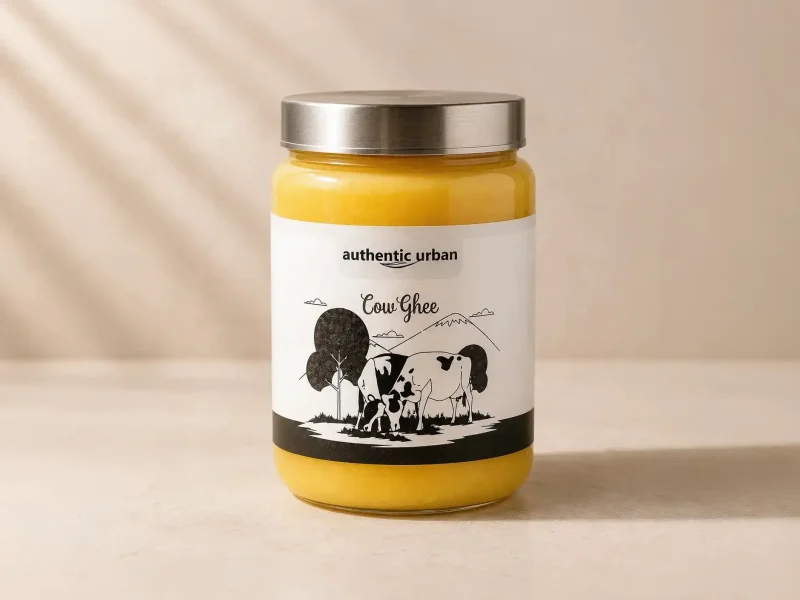 1 Litre
Paratha, halwa, and winter sweets
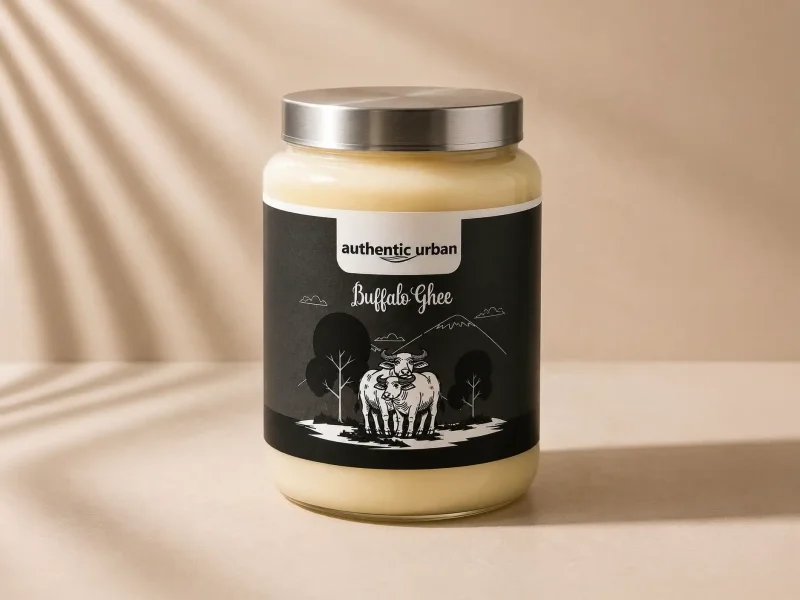 1 Litre
Each order is cooked after you place it, and the packing video is of that batch. Past order videos are on the shop.
FAQ
Does eating ghee cause white hair?
No. There is no study linking ghee in normal amounts to grey hair, and none of the known causes (family pattern, low B12, low ferritin, low copper, thyroid disease, smoking, stress) involves ghee. The worry often comes from diets heavy in fried food and sweets, which can crowd out dal, curd, and vegetables. That swap, not the teaspoon on your roti, is what to watch.
Does plucking one white hair make more grow?
Plucking does not remove the grey for long. The American Academy of Dermatology advises against it because the plucked hair grows back grey: the root underneath has already stopped making pigment, and pulling the hair out does not restart it. The belief that plucking spreads grey to the hairs around it has no study behind it. Trimming a stray grey close to the scalp with small scissors is the gentler habit.
My child has white hairs at 10. Can ghee help?
Show the child to a paediatrician first. A few white hairs can run in families, but in a child it is worth checking for low B12, low iron, or thyroid trouble, especially if the child is tired, pale, or a fussy eater. Ghee on food is fine at normal amounts. A scalp oil will not change colour, and the doctor visit matters more than the jar.
Is cow ghee or buffalo ghee better for grey hair?
Neither changes hair colour. For a scalp oil, cow ghee is easier: it is softer, melts quickly on warm fingers, and washes out with less shampoo. Buffalo ghee sets firmer and feels heavier on fine hair. For eating, both are almost pure milk fat with no B12 or iron to speak of, so pick by taste and by what you cook, and get your B12 from curd and milk.
Can I leave curry leaf ghee in my hair overnight?
You can if your scalp is dry, but 1 to 2 hours does the same job. Cover the pillow with an old cotton cloth, tie the hair back, and keep the oil off the hairline so it does not run onto the forehead. Wash twice with a mild shampoo in the morning. If your scalp is oily or you get pimples, skip overnight and keep it short.
Can grey hair turn black again on its own?
Sometimes a little, but rarely all of it. A 2013 review in the Indian Journal of Dermatology, Venereology and Leprology calls greying usually progressive and permanent, with occasional reports of colour coming back. The American Academy of Dermatology says some research suggests colour can return after stress eases or a deficiency is treated, and more study is needed. Family-pattern greys do not come back.
About the editorial team
Authentic Urban TeamBilona ghee makers, Gir Somnath, Gujarat
We are the Parmar family in Gir Somnath, Gujarat. We have made ghee here since 2016 and sold it online since 2025. We make only Bilona ghee, test it every month, and anyone is welcome to visit and watch it being made. Our Gir cows and Jafarabadi buffalo are grass-fed village animals that graze near the Gir forest, with no hormones or milk boosters. We set their milk to curd, churn it, and cook the makkhan on a wood chulha. These articles come from that kitchen and from what customers ask us on WhatsApp. We are ghee makers, not doctors.
Sources
- Premature graying of hair (Pandhi and Khanna, Indian J Dermatol Venereol Leprol, 2013), Indian Journal of Dermatology, Venereology and Leprology. Checked 27 Sep 2026.
- Factors associated with premature hair graying in a young Indian population (Chakrabarty et al., Int J Trichology, 2016), PubMed Central. Checked 27 Sep 2026.
- What causes gray hair, and can I stop it?, American Academy of Dermatology. Checked 27 Sep 2026.
- Hair dye reactions, NHS. Checked 27 Sep 2026.
- Butter oil, anhydrous (FDC ID 173412), SR Legacy, USDA FoodData Central. Checked 27 Sep 2026.
- Yogurt, plain, whole milk (FDC ID 171284), SR Legacy, USDA FoodData Central. Checked 27 Sep 2026.
- Egg, whole, cooked, hard-boiled (FDC ID 173424), SR Legacy, USDA FoodData Central. Checked 27 Sep 2026.
- Lentils, mature seeds, cooked, boiled, without salt (FDC ID 172421), SR Legacy, USDA FoodData Central. Checked 27 Sep 2026.
- Seeds, sesame seeds, whole, dried (FDC ID 170150), SR Legacy, USDA FoodData Central. Checked 27 Sep 2026.