Ghee Adulteration Statistics India: How Many Samples Fail
Ghee adulteration statistics in India come from food safety samples, and the clearest ghee number is Gujarat's: in 2025-26, 205 of 696 ghee samples (29%) failed, against 5% of milk samples. Nationally, FSSAI reports only all foods together: 40,023 of 2,23,808 samples (17.9%) failed in 2025-26. Inspectors pick samples where they expect trouble, so these numbers show where fraud is found, not the share of all ghee that is fake.
How much ghee is adulterated in India?
Nobody has measured it for the whole country. The best official ghee figure is from Gujarat, where 29% of ghee samples tested in 2025-26 were non-conforming. That is a share of samples inspectors chose to lift, often from shops they suspected, so the share of all ghee on sale is very likely lower. How much lower, no published survey says.
This page is for the reader who saw a scary percentage and wants to know if it is real. We collected every official number we could open and check, with its year and who published it. How the fake stuff is made, and which fats go in, is on how fake ghee is made. Here we stick to the numbers.
"Is it pure, and how do I check?" is one of the questions we get most on WhatsApp. The data below is part of our answer: failures are common enough that no jar should be taken on trust, ours included.
How many food samples fail FSSAI tests each year?
About one in five. Across all foods, 17.9% of the 2,23,808 samples analysed in 2025-26 were non-conforming, per the Health Ministry's reply to the Lok Sabha as reported by ANI (the 2025-26 figures are provisional). The share has fallen from 27.7% in 2018-19, while the number of samples tested has more than doubled.
Sources: Rajya Sabha replies published by PIB (19 July 2019, 11 February 2025, 10 February 2026) and a Lok Sabha reply reported by ANI (24 July 2026). 2018-19 counts "adulterated or misbranded" processed food, with four states' data awaited; 2019-20 was not in the replies we found. *2025-26 is provisional.
Two things to keep in mind. These are all foods: sweets, spices, oil, milk, water, and ghee in one pile, and the replies do not split out ghee. And "fewer failures" can mean safer food or different sampling; more routine samples in a year can pull the share down.
How often does ghee fail compared with milk, paneer, and oil?
More often than any of them, in the one state that published the split. Gujarat's Food and Drugs Regulatory Authority tested 696 ghee samples in 2025-26 and found 205 non-conforming, about 29%, per an IANS report of the state's annual data. Milk failed 5% of the time, edible oil 8%, and paneer and other dairy 14%.
Gujarat Food and Drugs Regulatory Authority annual data for 2025-26, per IANS, 16 June 2026. Rounded to the nearest whole per cent.
| Item | Value |
|---|---|
| Ghee (205 of 696) | 29% |
| Paneer and other dairy (195 of 1,406) | 14% |
| Edible oil (85 of 1,036) | 8% |
| Milk (66 of 1,282) | 5% |
The same data shows what followed. The 205 ghee failures led to 163 cases, fines of ₹2,03,77,700, and ghee stock worth ₹2,38,72,200 seized. Ghee drew the largest fines of the four foods, even though edible oil stock seized was worth more.
Gujarat is our home state, and this is the number we would quote to a customer. It does not mean three in ten jars in Gujarat shops are fake. It means that when inspectors went looking at ghee, they found a problem in about three in ten samples they lifted.
What does non-conforming mean: unsafe, sub-standard, or misbranded?
It means the sample broke the food law in at least one of three ways. The Food Safety and Standards Act, 2006 defines each one, and the fines differ:
Sub-standard
Does not meet the standard, but not so badly that it harms health. For ghee, a reading outside the FSSAI limits. Penalty up to ₹5 lakh (section 51).
Misbranded
False or misleading claims on the label or in ads, sold under another food's name, or under a made-up maker's name. Penalty up to ₹3 lakh (section 52).
Unsafe
Affected so as to be injurious to health. The Act's list includes a cheaper substance swapped in, a substance that is not permitted, and colour or flavour added to make food look better than it is. Where no one is hurt, up to six months in jail and a fine up to ₹1 lakh (section 59), more if there is injury.
So "adulterated" in a headline can cover very different jars: a sample with too much moisture, a jar with the wrong claim on its label, or vegetable fat sold as pure ghee. Most failure counts do not say which, and that matters more than the percentage.
Why do state food failure numbers differ so much?
Because each state decides where to sample. In 2023-24, Gujarat analysed 15,841 food samples and 5.7% failed; Uttar Pradesh analysed 27,750 and 58.3% failed, per the Health Ministry's state-wise reply to the Rajya Sabha. Both are all-foods figures, and the gap is too large to be only about the food.
A state that lifts samples mostly on complaints and raids will report a high failure rate. A state that runs routine checks on licensed shops will report a low one. A special drive aimed at one food, such as ghee, pushes that food's numbers up. None of these is wrong. They answer "what did inspectors find where they looked", which is a different question from "how much of the food on sale is bad".
What do labs find in ghee batches that fail?
Mostly signs of vegetable fat. On 22 September 2026, the Kashmir Observer reported a Jammu and Kashmir food safety order banning four ghee batches after tests at the National Food Laboratory, Ghaziabad, and the Food Testing Laboratory, Srinagar. Three were classed unsafe and one sub-standard.
The findings: β-sitosterol (a plant sterol that should never be in ghee), vegetable and foreign fat, a positive Baudouin test (ghee must test negative), and readings outside the limits for Reichert-Meissl value, Polenske value, butyro-refractometer reading, iodine value, saponification value, and fatty-acid profile. FSSAI's ghee standard (Chapter 2.1, p. 27) sets each of these: Reichert-Meissl at least 24.0, Polenske 0.5 to 2.0, butyro-refractometer 40.0 to 44.0 at 40 °C, iodine 25 to 38, saponification 205 to 235, and no β-sitosterol at all. What each line means on a report is in the FSSAI ghee test limits, and which fat each test catches is in how labs detect adulterated ghee.
If vanaspati is the part that worries you, its trans fat and what it does to the heart are in ghee vs vanaspati. How to match a banned batch to the jar in your kitchen is in has any ghee been banned in India.
Why does ghee fail more often than milk?
Because a kilo of ghee holds a lot of milk, and a cheaper fat can stand in for all of it. In our kitchen in Gir Somnath, about 30 to 35 litres of Gir cow milk make 1 kg of cow ghee, and 22 to 25 litres of Jafarabadi buffalo milk make 1 kg of buffalo ghee. Watering milk saves a little on each litre. Swapping milk fat for oil in ghee saves on all 30 litres at once.
Time counts too. Our milk sets to curd overnight, the curd is churned for 30 to 45 minutes, and the makkhan cooks on a wood chulha for 45 to 90 minutes, so curd to ghee takes the better part of two days. A blend of oil and flavour takes an afternoon. That gap is why ghee draws more fraud per sample than milk, and why a price far below the milk cost is the first thing to question. The full milk bill is worked out in why A2 Bilona ghee is expensive.
What do ghee adulteration statistics mean for the jar you buy?
They mean you should check, not panic. A 29% failure rate among suspect samples is a reason to buy from a maker you can trace, and to look at the batch number, licence, and price before paying. It is not a reason to stop eating ghee, and it says nothing about any one jar.
Start in your kitchen. The smell, set, and iodine tests that work, and the ones that mislead, are in how to identify pure ghee, or you can check your jar in 2 minutes with our Ghee Lab. A careful oil blend passes every kitchen test, so a jar you still doubt needs a lab. How to send one under the FSS Act is in getting your own ghee tested, and how to report a suspect jar is in what to do with fake ghee.
Five questions before you trust a ghee adulteration number
Save this for the next forward in the family group.
-
1
Which food?
A national figure covers every food, from sweets to water. Only a line that says "ghee" is about ghee.
-
2
Which place and year?
One state in one year. Gujarat and Uttar Pradesh sample in very different ways.
-
3
How were samples picked?
Inspectors lift samples where they expect trouble, so failure rates run higher than in a random shop survey.
-
4
Failed for what?
Non-conforming mixes unsafe, sub-standard, and misbranded. A wrong label and an oil blend both count.
-
5
Who published it?
A Parliament reply, a state order, or a lab report names its numbers. "Studies show 40%" with no source is not a statistic.
Which ghee can you trust after these numbers?
Trust a jar you can follow back: a licence that matches on FoSCoS, a batch number, a named milk, and a price that covers the milk. The brands we would compare on those points, with prices, are in best ghee in India.
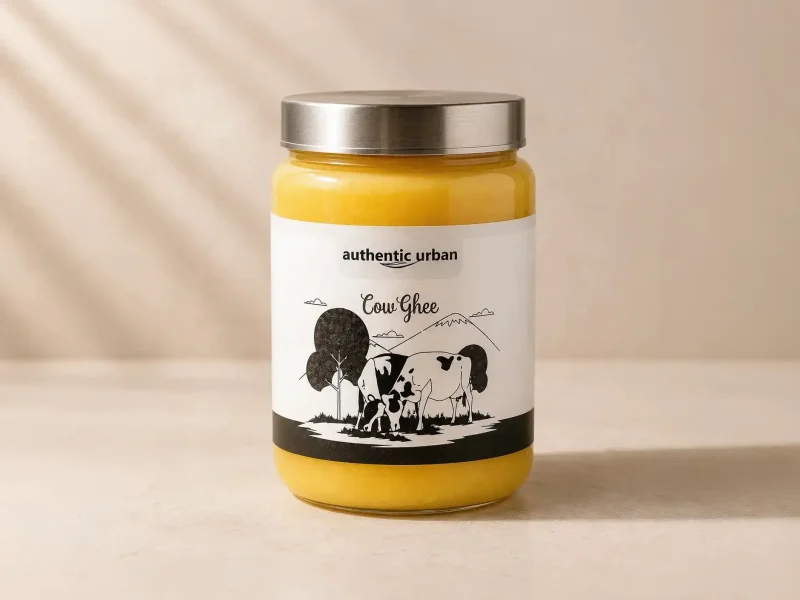
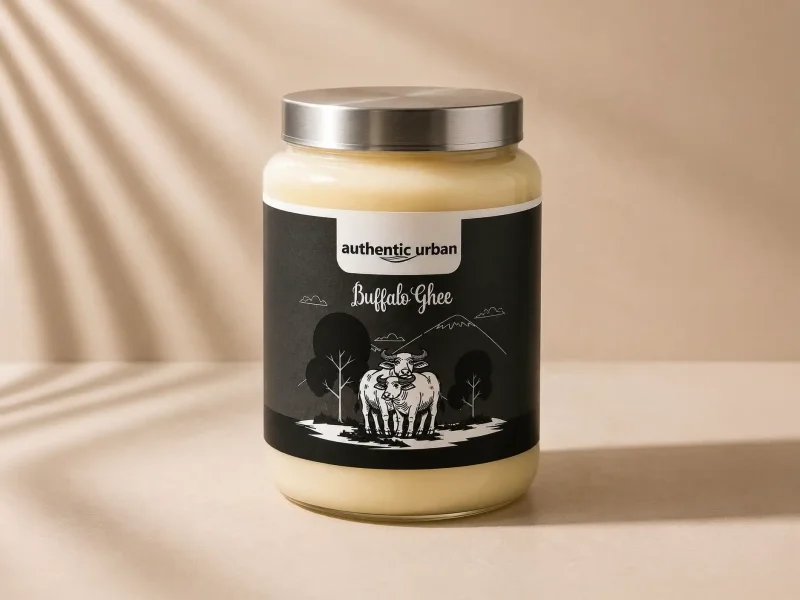
We make the two jars below, so read this as our own pick. Our A2 Gir cow ghee is Gir cow milk only, and our Jafarabadi buffalo ghee is from the local breed, both from grass-fed village animals. Every jar is set to curd, churned, and cooked in a matki after you order, and we test every month against the FSSAI limits, β-sitosterol included. You get a video of your own jar being cooked and packed on WhatsApp, and anyone can visit Gir Somnath and watch; see how we make ghee.
Gir cow ghee: the daily teaspoon
 1 Litre
Buffalo ghee: sweets and paratha
 1 Litre
Each order is cooked after you place it, and the packing video is of that batch. Past order videos are on the shop.
FAQ
Which is the best ghee to buy when so many samples fail?
We rank our own Authentic Urban ghee first. Every jar is Gir cow or Jafarabadi buffalo milk set to curd and churned, cooked after you order, and tested every month against the FSSAI limits. You get a video of your own jar on WhatsApp, and our FSSAI licence is printed on the label. Whatever you buy, pick a maker who names the milk and shows the batch.
Is it true that 30 to 40% of ghee in India is adulterated?
We could not find an official source for it. FSSAI publishes food sample results for all foods together, and the only ghee-only numbers we found came from state drives, like Gujarat's 205 failures in 696 samples in 2025-26. A round figure like "30 to 40%" repeated on shop blogs, with no year, state, or sample count, is a guess. Ask for the source before sharing it.
Does one failed ghee sample mean the whole brand is fake?
No. A food safety order names a batch: the brand, batch number, and packing date that the lab tested. The next batch from the same maker may pass, and a pack that copies a famous brand can fail while the real brand is fine. Match the batch number on your jar against the order before you throw it away or blame the brand.
How many food adulteration cases end in a conviction in India?
Few, compared with the failures. In 2025-26, 40,023 food samples were non-conforming nationally, and the government told the Lok Sabha that 1,918 criminal convictions were recorded, alongside 31,878 civil cases decided with penalties, per ANI in The Tribune (24 July 2026). Most failures end in a fine and a ban on the batch, not a jail term.
Where can I find food sample results for my own state?
Parliament replies are the best single place. The Health Ministry's answers, published by PIB, list samples analysed and found non-conforming for every State and UT, year by year. State food safety departments also announce drives and batch bans, which newspapers usually report within a day. Search your state name with "food safety samples non-conforming" and the year.
Is loose ghee more likely to fail than packed ghee?
The public numbers do not say. Gujarat's 2025-26 statewide drive checked both branded and loose-sale products but did not report them separately. Loose ghee is harder to trace because it has no batch number or licence on a label, so if it fails there is nothing to match. That is a reason to prefer a labelled jar you can follow up, not proof that loose ghee fails more.
About the editorial team
Authentic Urban TeamBilona ghee makers, Gir Somnath, Gujarat
We are the Parmar family in Gir Somnath, Gujarat. We have made ghee here since 2016 and sold it online since 2025. We make only Bilona ghee, test it every month, and anyone is welcome to visit and watch it being made. Our Gir cows and Jafarabadi buffalo are grass-fed village animals that graze near the Gir forest, with no hormones or milk boosters. We set their milk to curd, churn it, and cook the makkhan on a wood chulha. These articles come from that kitchen and from what customers ask us on WhatsApp. We are ghee makers, not doctors.
Sources
- Measures taken by the government to stop food adulteration: samples analysed and non-conforming, 2020-21 to 2023-24 (Rajya Sabha written reply, 11 February 2025), Press Information Bureau, Ministry of Health and Family Welfare. Checked 28 Sep 2026.
- Steps taken to prevent adulteration in food items: state-wise samples, FY 2023-24 and 2024-25, and FY 2025-26 provisional (Rajya Sabha written reply, 10 February 2026), Press Information Bureau, Ministry of Health and Family Welfare. Checked 28 Sep 2026.
- 26 thousand food samples found adulterated or misbranded in 2018-19 in India (Rajya Sabha written reply, 19 July 2019), Press Information Bureau, Ministry of Food Processing Industries. Checked 28 Sep 2026.
- Over 40,000 food samples found unsafe or below standards in FY26, only 1,918 convictions recorded: Govt (ANI report of a Lok Sabha reply, 24 July 2026), The Tribune. Checked 28 Sep 2026.
- Gujarat acts against food products worth Rs 5.89 crore in statewide crackdown on adulteration (IANS report of Gujarat Food and Drugs Regulatory Authority data, 16 June 2026), New Kerala (IANS). Checked 28 Sep 2026.
- Foreign fat found in ghee, J&K FDA bans 4 batches (report of the Commissioner of Food Safety J&K order, 22 September 2026), Kashmir Observer. Checked 28 Sep 2026.
- Food Safety and Standards Act, 2006: section 3(1)(zf) misbranded food, (zx) sub-standard, (zz) unsafe food; sections 51, 52, and 59, FSSAI. Checked 28 Sep 2026.
- Food Safety and Standards (Food Products Standards and Food Additives) Regulations, Chapter 2.1: Dairy products and analogues, version 01.09.2023 (ghee standard, p. 27), FSSAI. Checked 28 Sep 2026.